
AMD Stock in 2026: AI Megadeals, Helios Racks, and the Road to Multi‑Year Data Center Growth
AMD stock is jumping on fresh AI megadeals. Here’s what changed in 2025, what’s coming in 2026, and the key risks and milestones to watch.
Why AMD stock is surging now
AMD is back in the headlines after reports of a multiyear AI-chip agreement with Meta to deliver roughly 6 gigawatts of compute over several years, paired with performance-based stock warrants that could allow Meta to purchase up to 160 million AMD shares if deployment and price milestones are met. Coverage from major outlets framed the pact as a $100B‑plus commitment over time and a validation of AMD’s AI roadmap as it squares off against Nvidia. Shares jumped on the news. (wsj.com)
As of the latest available print on Tuesday, February 24, 2026 (21:15 UTC), AMD traded at $213.84, implying a market capitalization of about $259B and a trailing P/E near 78. Figures will move with the market; always check a live quote.
The business reset: AI first, at scale
AMD exited 2025 with record results and clear AI momentum. In Q4 2025, revenue reached $10.3B with non‑GAAP EPS of $1.53; full‑year revenue hit $34.6B. Data Center revenue set quarterly and annual records, powered by EPYC server CPUs and Instinct accelerators. Management also disclosed the impact of U.S. export controls on certain MI308 accelerators (about $440M in full‑year inventory and related charges) and noted ~$390M of Q4 Instinct revenue to China. (amd.com)
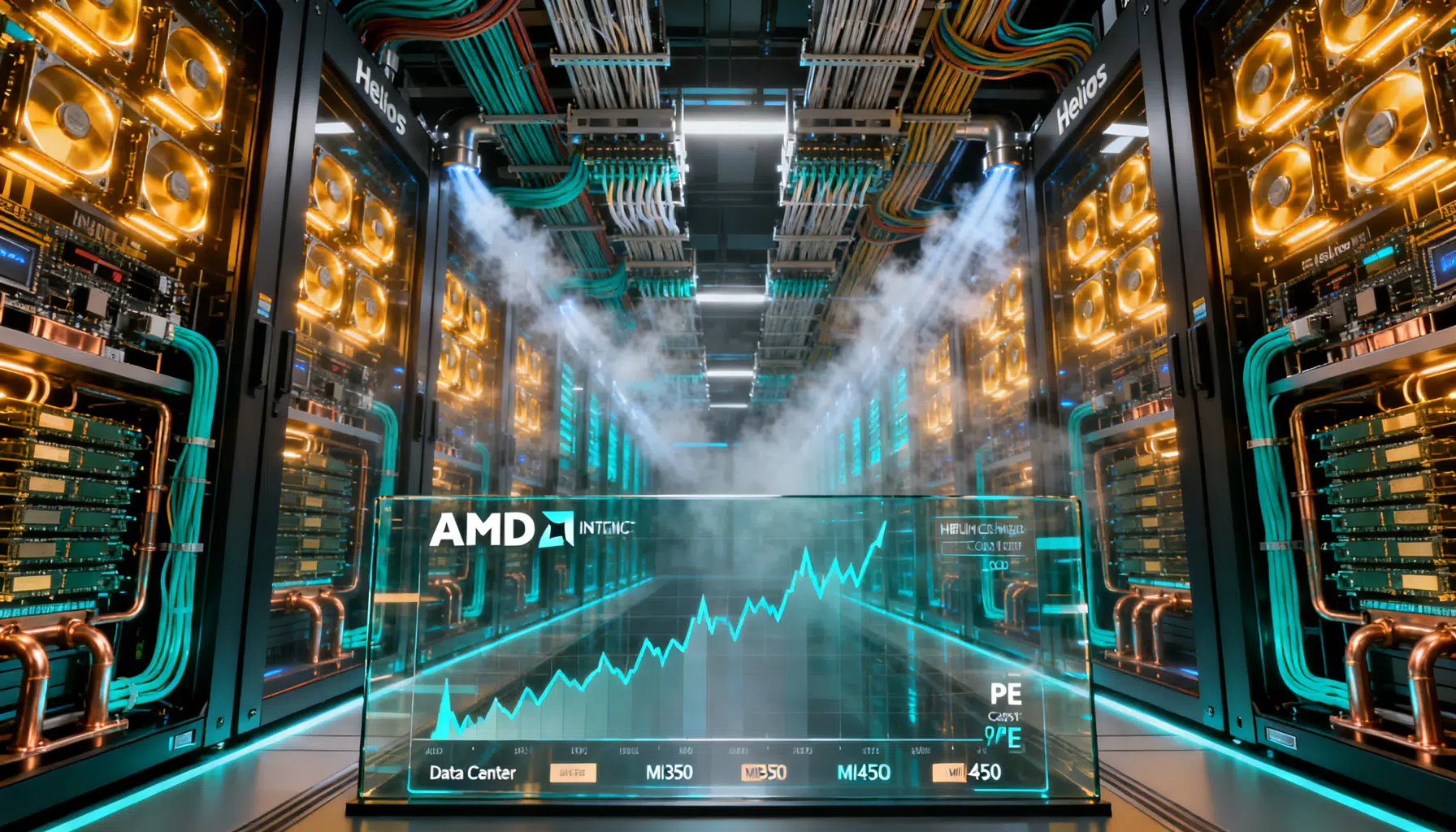
Earlier in 2025, AMD introduced the MI350 series and laid out a multi‑year accelerator cadence, while also expanding its rack‑scale ambitions with “Helios,” an open, OCP‑aligned AI system architecture designed for easier serviceability and Ethernet‑based scale. (amd.com)
Product roadmap: From MI350 to MI450 and Helios
- Annual accelerator cadence: At Computex 2024, AMD detailed MI325X (Q4 2024 availability), CDNA 4‑based MI350 in 2025 (with large inference gains vs. MI300), and a follow‑on MI400 line in 2026. The strategy is an explicit answer to the AI market’s rapid iteration cycle. (ir.amd.com)
- MI350 launch and positioning: AMD formally unveiled the MI350 family in 2025, highlighting multi‑x generational compute and inferencing improvements to broaden AI training and inference coverage. (amd.com)
- MI450 and rack‑scale systems: AMD’s MI450 generation underpins the Helios rack, which targets trillion‑parameter training with 72 GPUs per rack, massive HBM capacity, and Ethernet‑based scale‑up/scale‑out fabrics. AMD’s blog and OEM materials outline 2026 availability through partners. (amd.com)
Demand signals: Hyperscaler traction (and new financing models)
- OpenAI partnership: In October 2025, AMD and OpenAI announced a 6‑gigawatt, multi‑generation deal that begins with MI450 deployments in 2H 2026, also structured with performance‑based warrants. (amd.com)
- Oracle cloud deployment: AMD’s Q3 2025 update flagged Oracle Cloud Infrastructure as an early public AI supercluster partner, with an initial ~50,000‑GPU deployment starting in Q3 2026 using Helios/MI450. (amd.com)
- Meta pact (reported): Today’s Meta coverage mirrors that OpenAI construct—multi‑gigawatt supply plus vesting stock warrants—signaling an emerging template for “circular” AI capacity financing and long‑horizon commitments. (wsj.com)
- Ecosystem and OEMs: HPE publicly adopted Helios as a 2026 rack‑scale platform, pairing AMD compute with Broadcom Ethernet fabrics via an HPE Juniper scale‑up switch to keep the design open and serviceable. (hpe.com)
Financial snapshot and valuation context
- Price, market cap, P/E: $213.84; ~$259B; ~78x trailing EPS, respectively, as of February 24, 2026 (21:15 UTC).
- Growth drivers: Data Center (EPYC + Instinct) is the engine; 2025 Data Center revenue reached $16.6B, with a record $5.4B in Q4 alone. Client and Gaming also grew in Q4, aided by Ryzen strength and higher semi‑custom and Radeon demand. (amd.com)
- Profitability levers: Mix shift toward EPYC/Instinct, ramping volumes, and software‑plus‑systems attachment (ROCm, Helios) support margin resilience, though export‑control volatility and early‑generation ramp costs can introduce noise. (amd.com)
Competitive position: What matters for investors in 2026
- Performance and memory: AMD’s emphasis on HBM capacity and open interconnects targets fast‑growing inference and retraining use cases—an area where memory footprint and bandwidth are strategic differentiators. Helios’ open, Ethernet‑centric fabric aims to reduce vendor lock‑in versus proprietary approaches. (amd.com)
- Roadmap credibility: Computex 2024 set an annual cadence that investors can now track: MI350 ramp in 2025, MI400 in 2026, and MI450‑based rack‑scale deployments starting 2H 2026 with named hyperscalers and OEMs. Execution against those milestones will be a key stock driver. (ir.amd.com)
- Commercial validation: The OpenAI agreement and today’s Meta reports suggest rising willingness among top AI buyers to diversify away from a single‑supplier model, even using warrants and structured financing to secure multi‑year capacity. (amd.com)
Risks to the bull case
- Supply chain and HBM constraints: Any shortfall in advanced packaging or HBM supply could cap upside during peak demand windows.
- Export controls and geography: U.S. restrictions have already created charges and revenue timing shifts for MI308; policy changes remain a swing factor. (amd.com)
- Competitive response: Incumbents can reset product cycles quickly; pricing, software ecosystems, and interconnect lock‑in remain formidable barriers.
- Dilution optics: Performance‑based warrants issued to strategic partners could be seen as costly customer acquisition if not matched by durable cash flows; reports around Meta’s potential 10% stake highlight that tension. (barrons.com)
What to watch next (2026 milestones)
- Q1 and Q2 2026 prints: Look for Data Center mix, MI350 shipments, and any updated AI revenue disclosures or capacity commentary. (amd.com)
- Helios OEM rollouts: HPE’s 2026 availability and any new OEMs adopting Helios; watch for early scale‑up Ethernet proof points and serviceability metrics. (hpe.com)
- Hyperscaler deployments: Concrete timelines for OpenAI’s initial 1‑gigawatt (2H 2026) and any Meta deployment milestones or binding purchase schedules. (amd.com)
- Software ecosystem: ROCm momentum—including Windows and Linux developer adoption—matters for inference and TCO. (amd.com)
Bottom line
AMD’s AI thesis is increasingly about systems, not just silicon: annual GPU cadence, EPYC CPUs, ROCm software, and an open, Ethernet‑centric rack architecture in Helios. With reported mega‑deals at hyperscalers and OEM traction, the company has clearer visibility into multi‑year AI demand. The setup is compelling—but still execution‑heavy—given supply dynamics, policy risk, and intense competition. For investors, 2026 is about proof: MI350/MI450 ramps, Helios deliveries, and hyperscaler deployments that translate into sustained, high‑margin Data Center growth. (ir.amd.com)
Note: This article is for information only and is not investment advice.
Related Posts
Sony PlayStation 6 Rumors Hint at 2027 Launch, AMD Partnership, and 8K Gaming
Leaked reports and industry speculation suggest the PlayStation 6 will arrive in holiday 2027 with a custom AMD APU, backward compatibility focus, and 8K/4K performance modes.