
RAG vs. Fine‑Tuning: How to Choose the Right Approach
A practical guide to choosing RAG vs fine-tuning, with a clear decision framework, patterns, code sketches, and pitfalls.
ASOasis
6 min read
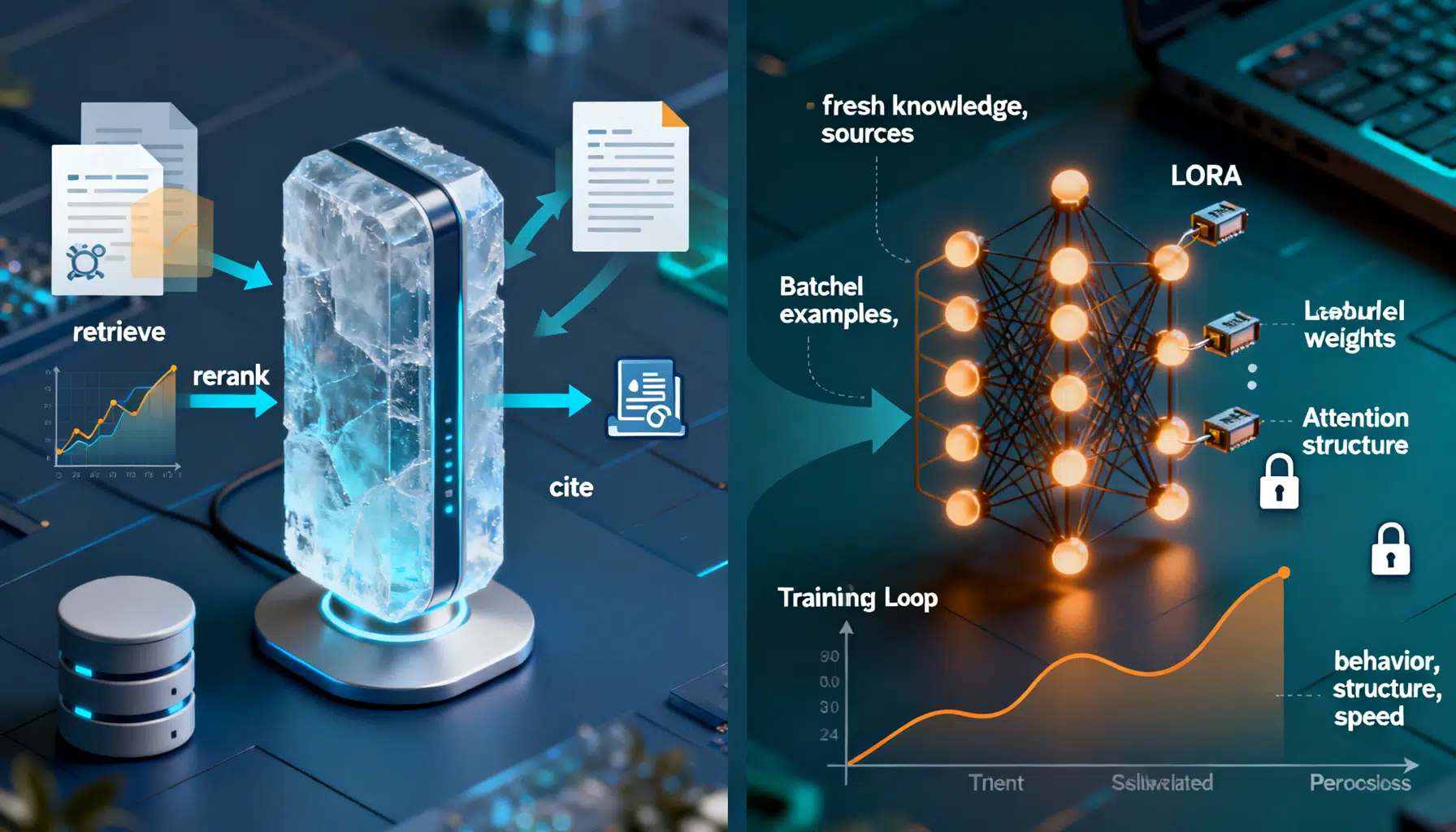
Image used for representation purposes only.
TL;DR
- Use RAG when your knowledge changes frequently, must be source‑grounded, or needs tenant isolation without retraining.
- Use fine‑tuning when you need behavior changes (style, tone, step‑by‑step formats, tool use), consistent structured outputs, or very low latency with smaller models.
- Most production systems benefit from a hybrid: fine‑tune for formatting and reasoning patterns; RAG for fresh, attributable facts.
Definitions at a glance
- Retrieval‑Augmented Generation (RAG): The model stays frozen. You retrieve relevant context (documents, tables, APIs) at query time and feed it to the model via the prompt. Quality hinges on retrieval and prompt engineering.
- Fine‑tuning: You update model weights (full or parameter‑efficient like LoRA/QLoRA) using curated examples so the model internalizes behaviors or domain patterns. Quality hinges on data quality and training regimen.
What problem does each solve?
- RAG solves knowledge freshness and attribution.
- Injects external facts at inference time.
- Enables citations and auditability.
- Supports per‑tenant knowledge without retraining or risk of data leakage (with isolated indexes).
- Fine‑tuning solves behavior and formatting.
- Teaches the model to follow domain‑specific instructions, schemas, and voice.
- Reduces prompt complexity and tokens used to “steer” outputs.
- Improves reliability of function/tool calling and JSON compliance.
Decision framework (use this mental checklist)
Ask these questions and pick the dominant pattern:
- How volatile is the knowledge?
- High volatility (hours–weeks): Prefer RAG.
- Low volatility (months–years): Fine‑tuning viable.
- Do you need citations or audit trails?
- Yes: RAG (with retrieved sources) or hybrid.
- Is tenant isolation a must?
- Yes: RAG with per‑tenant indexes; fine‑tuning per tenant is costly and risky.
- Is the main gap “facts” or “behavior”?
- Facts: RAG. Behavior/format: Fine‑tuning.
- Latency and cost targets?
- Ultra‑low latency or edge deployment: Fine‑tune a smaller model; optionally distill. RAG adds retrieval hops.
- Context length constraints?
- Very long documents or multi‑file analysis: RAG with chunking/rerankers; consider long‑context models. Fine‑tuning does not expand context.
- Output structure strictness?
- Strict JSON or schema: Fine‑tuning (plus constrained decoding) shines.
- Data privacy/regulatory needs?
- Keep raw docs out of prompts? Prefer fine‑tuning (but trade off freshness). Need traceability? Prefer RAG.
Architecture patterns
- RAG pipeline
- Ingest: chunking, embeddings, metadata, access‑control tags.
- Index: vector store; optional BM25 for hybrid search; reranker (cross‑encoder) for precision.
- Orchestration: retrieve → construct prompt with sources → generate → cite.
- Enhancements: query rewriting (HyDE), multi‑vector indexes, caching, retrieval‑guardrails.
- Fine‑tuning pipeline
- Data: pairs of (instruction, response), tool‑use traces, or preference data.
- Training: SFT → (optional) preference optimization (DPO) → evaluation → safety review.
- Deployment: versioned checkpoints, A/B, rollback; monitor drift and format adherence.
Cost, latency, and scale
- RAG
- Cost drivers: embedding generation (one‑time per document), storage, retrieval tokens, larger prompts.
- Latency: extra hops for retrieval/rerank; cache hot paths to mitigate.
- Scaling: shard indexes by tenant/domain; precompute embeddings offline.
- Fine‑tuning
- Cost drivers: curation and model training; cheaper inference if a smaller, specialized model is used.
- Latency: can be fastest at runtime, especially with small models and no retrieval.
- Scaling: more models/checkpoints to manage; re‑train for new knowledge or behaviors.
Evaluation and quality signals
- RAG‑specific
- Retrieval hit rate@k, MRR, reranker precision.
- Groundedness/factuality: proportion of claims supported by retrieved sources.
- Context utilization: how often cited context appears in output.
- Fine‑tuning‑specific
- Instruction following accuracy; schema/JSON validity rate.
- Tool‑use success and function‑calling accuracy.
- Consistency: variance across seeds and prompts.
- Shared
- Task metrics (Exact Match, F1, ROUGE for summarization, BLEU for translation‑like tasks).
- Human ratings for helpfulness, harmlessness, honesty.
- Latency p50/p95; cost per successful task.
Security and governance considerations
- RAG
- Pros: source attribution, easier redaction/updates, tenant isolation by index and ACLs.
- Cons: prompt may contain sensitive snippets; apply PII scrubbing, encryption at rest/in transit, and access policies.
- Fine‑tuning
- Pros: no document snippets at inference; smaller payloads.
- Cons: risk of memorization if trained on sensitive data; strict data minimization, differential privacy, and red‑teaming advised.
Real‑world scenarios (recommendations)
- Customer support on ever‑changing policies and product catalogs: RAG first; optionally fine‑tune for agent style and reply templates.
- Contract clause extraction with strict JSON schema: Fine‑tune for structured output; add RAG if you must cite the source clause.
- Internal knowledge assistant across teams with different permissions: RAG with per‑tenant/per‑team indexes; optional lightweight fine‑tune for tone.
- Code‑aware assistant for a living codebase: RAG over repos + reranker; small fine‑tune for chain‑of‑thought style or tool calling.
- On‑device assistant with tight latency and no network: Fine‑tune or distill a small model; periodically refresh via OTA updates.
Implementation quick‑start
- Minimal RAG sketch (Python‑like pseudocode)
# 1) Ingest and index
chunks = chunk_docs(load_docs("/docs"), tokens=800, overlap=120)
emb = EmbeddingModel("mini-embed")
vecs = [emb.encode(c.text) for c in chunks]
index = VectorStore.from_embeddings(vecs, metadatas=[c.meta for c in chunks])

# 2) Query → retrieve → rerank → prompt
q = user_input()
q_vec = emb.encode(q)
candidates = index.search(q_vec, top_k=40)
reranked = CrossEncoder("rerank-large").rank(q, candidates)[:8]

context = "\n\n".join([f"[Doc {i}] {c.text}" for i, c in enumerate(reranked, 1)])
prompt = f"""
You are a helpful assistant. Answer using only the provided sources.
Question: {q}
Sources:\n{context}
Cite sources as [Doc N].
"""

answer = LLM("gpt-like").generate(prompt)
return answer
- Minimal fine‑tuning sketch (parameter‑efficient LoRA)
from transformers import AutoModelForCausalLM, AutoTokenizer, Trainer, TrainingArguments
from peft import LoraConfig, get_peft_model

base = AutoModelForCausalLM.from_pretrained("base-llm")
base.gradient_checkpointing_enable()

peft_cfg = LoraConfig(r=16, lora_alpha=32, lora_dropout=0.05, target_modules=["q_proj","v_proj"])
model = get_peft_model(base, peft_cfg)

train_data = load_sft_dataset("train.jsonl")  # {instruction, input, output}
tok = AutoTokenizer.from_pretrained("base-llm")

args = TrainingArguments(per_device_train_batch_size=4, num_train_epochs=3, lr_scheduler_type="cosine",
                         learning_rate=2e-4, fp16=True, logging_steps=20, save_total_limit=2)

trainer = Trainer(model=model, args=args, train_dataset=tokenize(train_data, tok))
trainer.train()
model.save_pretrained("ft-checkpoint-lora")
Hybrid strategies that work
- Fine‑tune for formatting and tool use; RAG for facts and citations.
- Use small fine‑tunes to compress prompts (teach style), then keep prompts short to control token costs in RAG.
- Add a reranker to reduce context size and improve groundedness.
- Apply constrained decoding (JSON schema) even with fine‑tuning for extra reliability.
- Cache retrieval results and final completions for frequent queries.
Common pitfalls
- Treating fine‑tuning as a fix for missing knowledge. It will go stale; prefer RAG for updates.
- Over‑chunking documents leading to loss of context; under‑chunking bloats prompts. Start with ~600–1,000 tokens and tune.
- Ignoring retrieval quality: embeddings, hybrid search, and reranking often matter more than the base LLM choice.
- Using noisy SFT data: garbage in → brittle behaviors and hallucinations. Enforce data contracts and review guidelines.
- No evaluation loop: ship‑and‑forget leads to regressions. Automate offline and online evals with clear SLAs.
Migration path (pragmatic)
- Start with RAG MVP to unblock knowledge freshness and citations.
- Instrument: log retrieval hit rate, groundedness, latency, and user feedback.
- Identify recurring formatting/behavioral gaps from logs.
- Curate high‑quality SFT data from best interactions and add tool‑use traces.
- Fine‑tune parameter‑efficient adapters; layer into the RAG system.
- Continuously evaluate; only consider full model fine‑tunes or distillation when latency/cost or on‑device constraints demand it.
Quick checklist
- If you need up‑to‑date, attributable facts → choose RAG.
- If you need consistent format, tool use, or domain style → fine‑tune.
- For strict compliance/traceability → RAG (with citations) or hybrid.
- For ultra‑low latency/edge → fine‑tune a compact model.
- When in doubt, start with RAG, measure, then fine‑tune for the gaps.
Related Posts

AI Image Generation API Integration: Architecture, Code Examples, and Best Practices
A practical guide to integrating AI image generation APIs with production-ready code, architecture patterns, safety, and cost optimization.
ASOasis
Read More
7 min

Designing a Robust AI Text Summarization API: Architecture to Production
How to build and use an AI text summarization API: models, request design, chunking, evaluation, security, and production best practices.
ASOasis
Read More
7 min
LangChain API Tutorial: From Hello World to Production RAG with FastAPI and LangServe
Build a production-ready LangChain API: LCEL chains, LangServe, FastAPI streaming, RAG, structured outputs, testing, and deployment tips.
ASOasis
Read More
7 min