
API Gateway Design Patterns: A Practical, High‑Performance Guide
A practical guide to API gateway design patterns: when to use them, trade-offs, and reference configs for secure, scalable microservices and edge APIs.
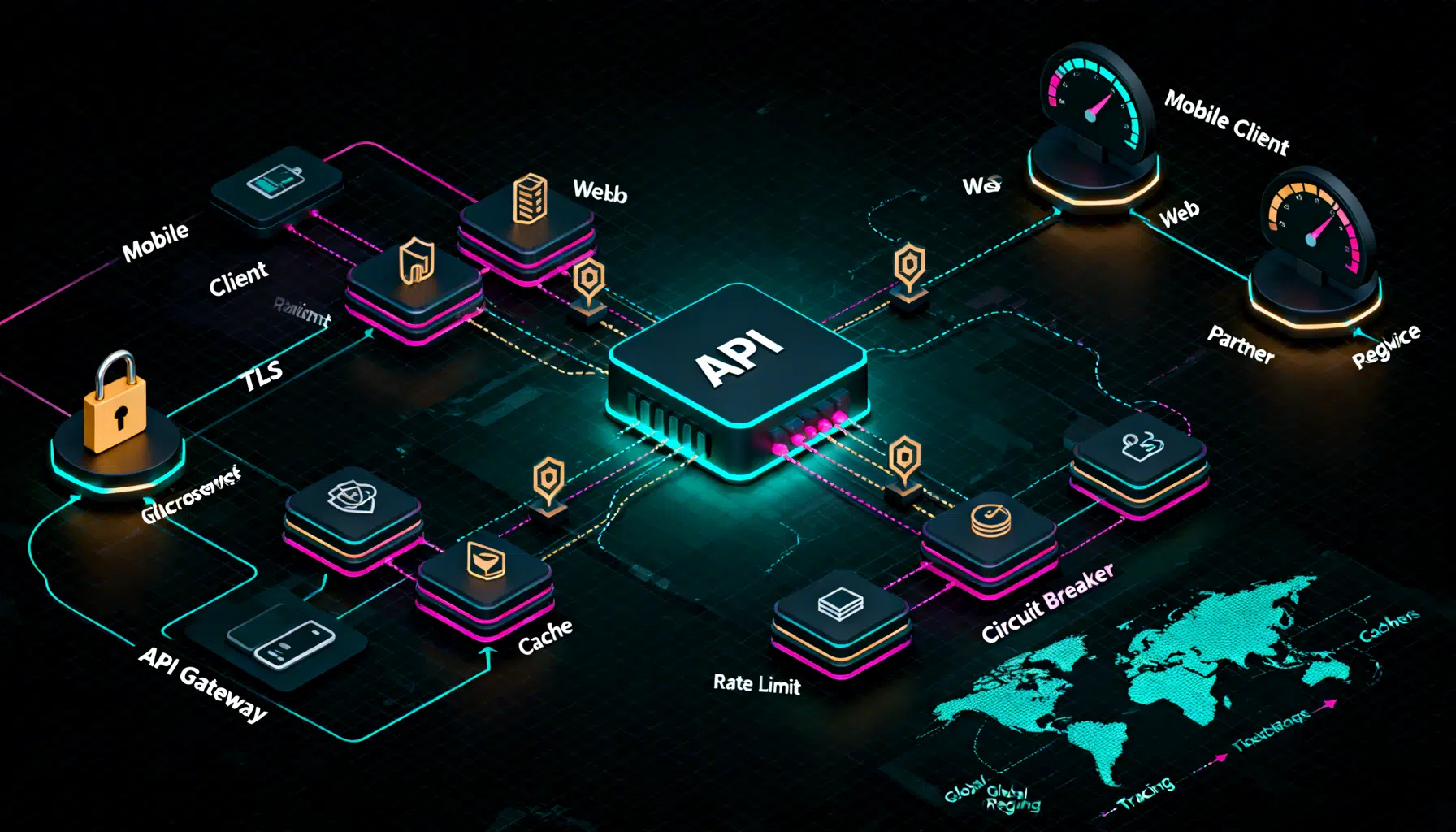
Image used for representation purposes only.
Overview
API gateways sit between clients and services, mediating traffic, enforcing policies, and shaping the developer experience. Done well, a gateway reduces cognitive load on service teams, concentrates cross‑cutting concerns (auth, rate limits, observability), and enables controlled evolution of your APIs. Done poorly, it becomes a bottleneck and a single point of failure.
This guide explains core API gateway capabilities, then dives into common design patterns, trade‑offs, and practical implementation tips. Whether you run Kubernetes with Envoy/Kong/NGINX, managed gateways in the cloud, or a hybrid edge, these patterns will help you select the right approach for your context.
Core responsibilities of an API gateway
- Traffic management: routing, load balancing, retries, timeouts, circuit breaking.
- Security: TLS termination, OAuth2/OIDC, mTLS, API keys, WAF, bot mitigation.
- Governance: rate limiting, quotas, tenant isolation, schema/version enforcement.
- Mediation: request/response transformation, protocol bridging (HTTP/1.1, HTTP/2, gRPC, WebSocket), content negotiation, compression.
- Observability: access logs, distributed tracing headers, metrics, audit trails.
- Developer experience: documentation, self‑service onboarding, sandboxing, mocking.
Choosing a pattern: key questions
- Who are the clients (mobile/web/partner/internal/batch)?
- How often do payloads change and who controls them (client vs server teams)?
- Do you need to aggregate many services or expose them one‑for‑one?
- What are your compliance and isolation requirements (tenant, region, data boundary)?
- How will you scale globally and roll out changes safely?
Keep these in mind as you read each pattern.
Pattern 1: Edge Gateway
A single, internet‑facing gateway at the network edge terminates TLS, authenticates requests, and routes to internal services.
When to use:
- You need a unified entry point for external clients.
- Security policies and observability must be consistent.
Trade‑offs:
- Can become a choke point; plan for horizontal scale and HA.
- Overloading it with heavy transformations can increase latency.
Reference snippet (Envoy route):
static_resources:
  listeners:
  - name: edge
    address: { socket_address: { address: 0.0.0.0, port_value: 443 } }
    filter_chains:
    - filters:
      - name: envoy.filters.network.http_connection_manager
        typed_config:
          "@type": type.googleapis.com/envoy.extensions.filters.network.http_connection_manager.v3.HttpConnectionManager
          route_config:
            name: edge-routes
            virtual_hosts:
            - name: public
              domains: ["api.example.com"]
              routes:
              - match: { prefix: "/catalog" }
                route: { cluster: svc-catalog }
              - match: { prefix: "/orders" }
                route: { cluster: svc-orders }
Pattern 2: Backend for Frontend (BFF)
Create tailored gateway surfaces per client type—e.g., WebBFF, MobileBFF—so each client gets optimized endpoints and payloads.
When to use:
- Mobile apps need coarse‑grained endpoints and less chatty protocols.
- Web SPA needs different caching or pagination.
Trade‑offs:
- More deployables to manage; versioning complexity.
- Risk of duplicating logic—mandate shared libraries and policy templates.
Tips:
- Keep BFFs thin: orchestration and mapping only; business rules live in services.
- Version per client to decouple release cadences.
Pattern 3: Aggregator/Facade
Expose a single endpoint that stitches data from multiple backing services, reducing client round trips and coupling.
When to use:
- Dashboards or product pages that compose data from many domains.
Trade‑offs:
- Aggregation latency is bounded by the slowest call; use parallel fan‑out and timeouts.
- Risk of becoming a “mega‑service”; keep boundaries strict.
Example orchestration (pseudo‑code):
// /api/product/:id facade
const [p, inv, rec] = await Promise.all([
  fetch(`/products/${id}`, { timeout: 200ms }),
  fetch(`/inventory/${id}`, { timeout: 80ms }),
  fetch(`/recommendations?seed=${id}`, { timeout: 120ms })
]);
return { ...p, inventory: inv.qty ?? 0, recommended: rec.items?.slice(0,5) };
Pattern 4: Pass‑Through Reverse Proxy
Expose services directly with minimal mediation; the gateway mainly standardizes authn/z, limits, and observability.
When to use:
- Teams own their APIs and only need consistent edge controls.
Trade‑offs:
- Clients may need to handle service evolution more directly.
- Useful in early phases; reassess as the surface grows.
Pattern 5: Strangler‑Fig Migration via Gateway
Use the gateway to route a subset of traffic to a new service while the legacy system serves the rest. Gradually expand until legacy is retired.
Techniques:
- Route by resource path, header, or percentage (canary).
- Transform legacy payloads to the new schema at the edge while services evolve.
Example route‑based cutover:
routes:
- match: { prefix: "/v1/payments" }
  route: { cluster: legacy-payments }
- match: { prefix: "/v2/payments" }
  route: { cluster: new-payments }
Pattern 6: CQRS at the Edge (Read/Write Segregation)
Split read and write paths through the gateway to direct traffic to optimized backends—e.g., reads to cached replicas, writes to primaries.
When to use:
- High read/write asymmetry, strict SLA on reads, or geographic locality needs.
Trade‑offs:
- Consistency expectations must be explicit; serve staleness headers or ETags.
Policy example:
- match: { prefix: "/orders", headers: [{ name: ":method", exact_match: "GET" }] }
  route: { cluster: ro-orders, hash_policy: [{ header: { header_name: "X-User" } }] }
- match: { prefix: "/orders", headers: [{ name: ":method", exact_match: "POST" }] }
  route: { cluster: rw-orders }
Pattern 7: Service Mesh Ingress Gateway
In Kubernetes or mesh environments, the API gateway acts as the north‑south ingress, handing off to the mesh for east‑west policies.
When to use:
- You need a clear demarcation: internet edge security vs. internal zero‑trust with mTLS, policy, and telemetry.
Trade‑offs:
- Two control planes can add operational complexity; standardize on one policy model where possible.
Pattern 8: Global/Regional Traffic Steering
Place gateways per region and a global traffic layer in front (DNS/GSLB/Anycast). Steer by geography, latency, compliance, or tenant.
When to use:
- Data residency constraints or multi‑region HA.
Trade‑offs:
- Requires state awareness (idempotency keys, sticky sessions avoided) and global config management.
Tips:
- Keep JWT signing keys and rate limit counters region‑local, but replicate metadata asynchronously.
Pattern 9: Security Offload and Zero‑Trust Edge
Centralize TLS, mTLS to services, OIDC validation, WAF, and fine‑grained authorization checks in the gateway or a policy engine it calls.
When to use:
- Regulated environments, partner integrations, or high bot/abuse risk.
Trade‑offs:
- Latency from policy checks; co‑locate the policy engine or use sidecar caches.
Example OIDC verification (pseudo‑policy):
package http.authz

# Allow if token is valid and scope includes required resource
allow {
  io.jwt.verify_rs256(input.headers["authorization"], data.jwks)
  required := sprintf("%s:%s", [input.method, input.path])
  required == "GET:/orders"; contains(input.jwt.claims["scope"], "orders.read")
}
Pattern 10: Webhook Relay / Outbound Gateway
Treat outbound calls (webhooks, callbacks, third‑party APIs) as first‑class traffic through an egress gateway: sign requests, retry with backoff, and quarantine failing destinations.
When to use:
- You need reliability, observability, and security for callbacks.
Trade‑offs:
- More moving parts; use queues and dead‑letter lanes.
Cross‑cutting concerns and best practices
- Performance budgets: set SLOs for p50/p95 latency added by the gateway (e.g., <5 ms local, <15 ms with auth and WAF). Continuously benchmark.
- Timeouts > retries: default to conservative timeouts with jittered retries; never retry non‑idempotent methods without safeguards.
- Backpressure and rate limits: prefer sliding‑window or token‑bucket per principal (user, key, IP) with headers to communicate limits.
- Caching: cache only safe, cacheable responses (GET, 2xx) with clear TTLs. Use content‑aware cache keys (Accept, tenant, version).
- Transformations: keep them declarative and minimal. Push complex mapping to dedicated facade services.
- Versioning: prefer additive changes; deprecate with dates. Use Accept headers or /vN paths consistently.
- Observability: emit structured logs, trace context (W3C Trace‑Context), and RED metrics (rate, errors, duration). Sample intelligently at the edge.
- Policy as code: store routes, limits, and auth policies in Git; validate with CI; promote through environments.
Anti‑patterns to avoid
- God‑Gateway: embedding business rules that belong in services.
- Hidden coupling: letting client‑specific transformations leak into shared routes.
- Silent failure: swallowing upstream errors or masking status codes.
- Unbounded fan‑out: aggregations across many services without concurrency or time budgets.
- Per‑request discovery: doing service discovery on the hot path without caching.
Tenant isolation and metering patterns
- Keyed limits: shard rate limits by tenant and endpoint.
- Routing partitions: route premium tenants to dedicated clusters or regions.
- Request tagging: propagate tenant IDs and plan tiers via headers for downstream metering.
Example rate‑limit policy:
rate_limits:
- actions:
  - request_headers: { header_name: "X-Tenant-ID", descriptor_key: "tenant" }
  limit: { unit: minute, requests_per_unit: 600 }
Safe rollout strategies at the gateway
- Canary by header or percentage; observe error budgets before ramping.
- Blue/green routes behind a feature flag; swap atomically.
- Shadow traffic: mirror reads to a new service; compare responses offline.
- Sticky canaries: bind a cohort by cookie or user ID to avoid cross‑request drift.
Canary example:
- match: { prefix: "/search" }
  route:
    weighted_clusters:
      clusters:
      - name: search-v1
        weight: 95
      - name: search-v2
        weight: 5
Cloud and platform reference options
- Managed gateways: offload scaling and DDoS controls; integrate with cloud IAM and WAF. Great for edge APIs, less flexible for bespoke L7 logic.
- Open‑source gateways (Envoy, Kong, NGINX, Traefik): maximal control, rich plugin ecosystems; you own scaling and upgrades.
- Hybrid: managed edge for public ingress, OSS gateway inside clusters for internal traffic and BFFs.
Terraform sketch (managed gateway):
resource "aws_api_gateway_rest_api" "public" {
  name = "public-api"
}
resource "aws_api_gateway_usage_plan" "standard" {
  name = "standard"
  throttle { rate_limit = 1000, burst_limit = 200 }
}
Operational checklist
- High availability: multi‑AZ instances, health checks, fast failover, config rollbacks.
- Configuration hygiene: lint routes, prevent overlaps, test negative paths.
- Secrets: rotate TLS keys and client secrets; pin JWKS providers and cache keys with expiry.
- Compliance: audit logs immutable; PII redaction at the edge.
- Incident drills: chaos tests for upstream outages and retry storms.
Decision guide: mapping needs to patterns
- Mobile/web with divergent needs → BFF + Aggregator.
- External partner API with strict policies → Edge Gateway + Security Offload + Tenant Isolation.
- Legacy to microservices → Strangler‑Fig + Aggregator + Canary.
- Global SaaS footprint → Regional Gateways + Global Steering + CQRS Reads.
- Mesh‑heavy platform → Ingress Gateway + Pass‑Through, keep business logic in services.
Conclusion
API gateways are not just traffic routers; they’re policy and evolution platforms. Start with a lean edge gateway, add BFFs or facades where the client experience demands it, and use the gateway’s position in the request path to roll out changes safely. Keep transformations declarative, policies versioned, and latency budgets sacred. With the right patterns and discipline, your gateway becomes an accelerant—enabling secure, observable, and adaptable APIs without stealing focus from the services that power them.
Related Posts
gRPC Microservices Tutorial: Build, Secure, and Observe a Production-Ready API in Go
Step-by-step gRPC microservices tutorial: Protobuf design, Go services, TLS/mTLS, deadlines, retries, streaming, observability, Docker, and Kubernetes.

Flutter Firebase Authentication: A Complete, Modern Guide
A complete, pragmatic guide to Firebase Authentication in Flutter: setup, email, Google, Apple, phone, linking, security, and testing.

iOS 26.3.1 is out: What’s new, who should update, and what to expect
Apple releases iOS 26.3.1 with bug fixes and Studio Display support—no new CVEs. Here’s what’s in the update, who should install it, and how to get it.