
T‑Mobile in 2026: AI‑Powered Calls, Satellite Messaging, and Rural Expansion Drive the Next Leg of Growth
T‑Mobile enters 2026 with live call translation, UScellular integration, Starlink messaging, and a five‑year plan guarantee—plus strong guidance.
T‑Mobile’s 2026 story at a glance
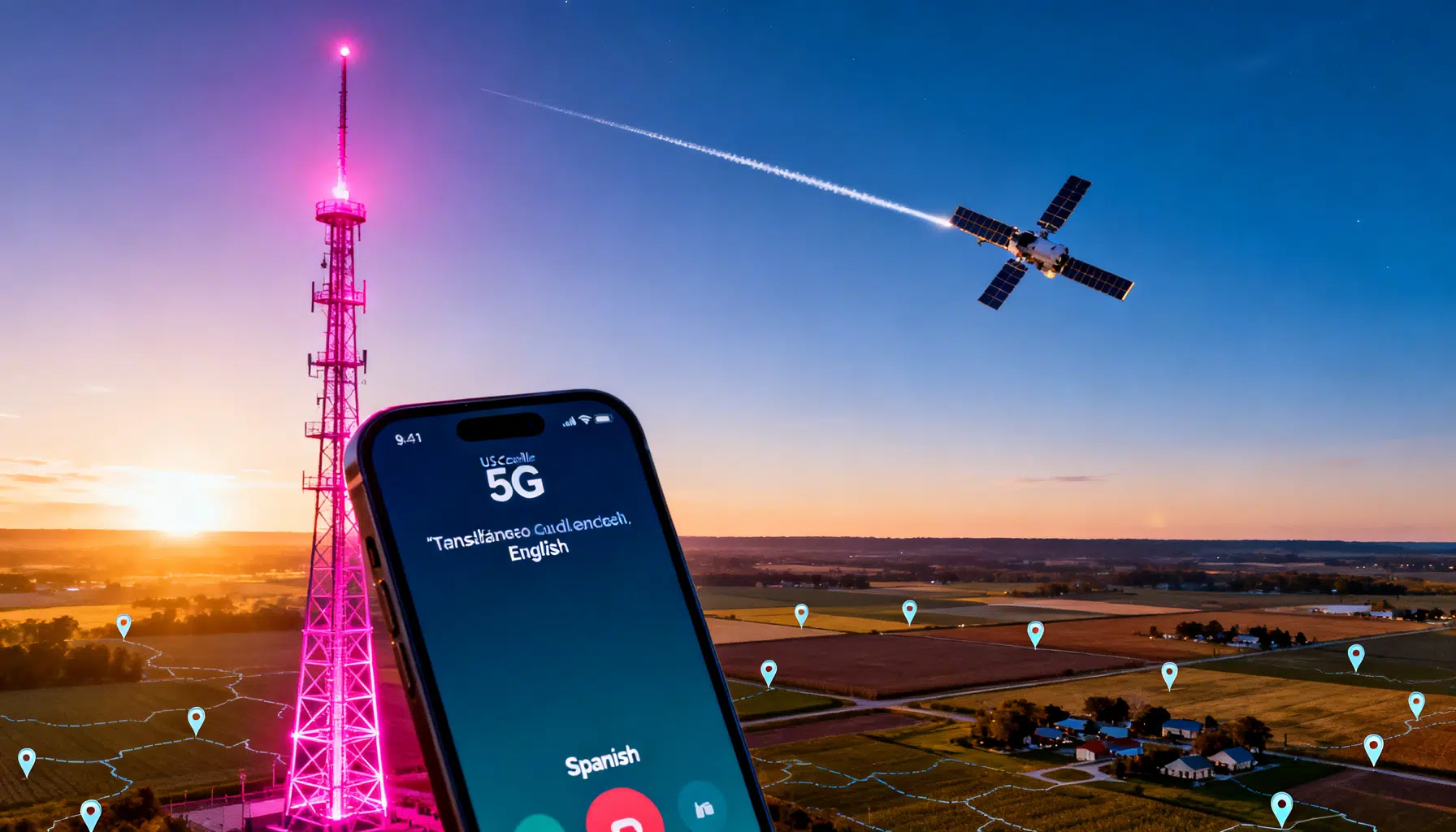
T‑Mobile enters 2026 with fresh momentum: record 2025 subscriber growth and a stronger 2026 outlook, a just‑announced AI service that live‑translates phone calls at the network level, continued integration of UScellular’s wireless business to deepen rural reach, a Starlink‑powered satellite messaging service moving from beta to broader availability, and a simplified plan lineup with a five‑year price guarantee. (t-mobile.com)
Earnings, scale and 2026 guidance
On February 11, 2026, T‑Mobile reported Q4 and full‑year 2025 results: 7.8 million total postpaid net adds in 2025 (962,000 postpaid phone net adds in Q4), service revenue of $71.3 billion for the year, and 142.4 million total customers exiting 2025. For 2026, management guided to $77.0 billion in service revenue, Core Adjusted EBITDA of $37.0–$37.5 billion, and 900,000–1.0 million postpaid net account additions. (t-mobile.com)
Wall Street’s read: despite an EPS miss tied partly to severance and transformation costs, shares edged higher as investors focused on 2026/2027 targets and the company’s expanding lead in account growth. (barrons.com)
A strategic reporting shift also arrived with this cycle: beginning in Q1 2026, T‑Mobile will emphasize postpaid accounts and ARPA (average revenue per account), discontinuing disclosures like postpaid phone ARPU and phone line adds as headline metrics—reflecting how value is increasingly created at the account level. (aol.com)
A network that now speaks your language
T‑Mobile unveiled “Live Translation,” an AI service built directly into its network that can translate calls in real time in 50+ languages—no app, special device, or subscription required during the beta. Eligible postpaid members can register now; once enrolled, they start or stop translation mid‑call by dialing 87. Only one party on the call needs to be a T‑Mobile customer. The beta begins in spring 2026. (t-mobile.com)
Early coverage notes the feature works over VoLTE/5G voice and is positioned as a privacy‑minded, network‑level capability; T‑Mobile hasn’t announced pricing post‑beta. (theverge.com)
Rural reach and retail: UScellular is in the fold
T‑Mobile closed its purchase of UScellular’s wireless operations on August 1, 2025, in a transaction valued at about $4.3 billion (cash plus assumed debt). The deal transferred millions of customers, stores, and roughly 30% of UScellular’s spectrum to T‑Mobile, while the seller (now Array Digital Infrastructure) retained its towers and remaining spectrum. A 15‑year master license agreement makes T‑Mobile a long‑term tenant on at least 2,015 additional towers. (investors.uscellular.com)
Following close, T‑Mobile raised and accelerated synergy targets and began rolling UScellular customers onto its nationwide network—promising better coverage in underserved rural markets while allowing customers to keep their existing plans during the transition. (t-mobile.com)
Plans and pricing: the ‘Experience’ lineup and a five‑year price guarantee
In April 2025, T‑Mobile simplified consumer plans and introduced a built‑in five‑year price guarantee on talk, text and data. Two flagship tiers—Experience More and Experience Beyond—layer richer hotspot allotments, expanded roaming, and premium perks on top of the Go5G benefits. Experience Beyond also includes T‑Satellite (Starlink) messaging at no extra cost during designated promotional windows. (t-mobile.com)
From towers to satellites: Starlink messaging goes mainstream
T‑Mobile’s direct‑to‑cell partnership with SpaceX’s Starlink moved from early beta into paid service in 2025 with “T‑Satellite” messaging. After testing, T‑Mobile set launch pricing at $10/month, with the add‑on free for top‑tier plans like Experience Beyond and Go5G Next; the company also opened access to non‑T‑Mobile users via eSIM. Initial service focuses on text messaging in dead zones, with a roadmap to richer data as the satellite constellation and approvals mature. (satellitetoday.com)
Regulators continue to clear technical milestones: in March 2025 the FCC allowed higher power levels for Starlink’s supplemental‑coverage‑from‑space (SCS) operations adjacent to T‑Mobile spectrum, a move expected to improve link budgets and pave the way toward voice and video. (spacenews.com)
Meanwhile, competitive dynamics are shifting. EchoStar struck a multibillion‑dollar spectrum and commercial pact with SpaceX that positions Boost Mobile to tap Starlink’s next‑gen direct‑to‑cell service—an indicator that satellite‑to‑phone connectivity will broaden beyond T‑Mobile over time. (ir.echostar.com)
Network scorecard: speed, coverage and consistency
Independent testing throughout 2025 continued to show T‑Mobile leading U.S. mobile performance on many measures. Opensignal’s June 2025 report credited T‑Mobile with the lion’s share of national awards, including overall Download Speed Experience, 5G Download Speed, and multiple consistency and experiential categories, while noting Verizon’s continued strength in certain 5G subsets and overall coverage. (opensignal.com)
Ookla’s H2 2025 Speedtest Connectivity Report similarly ranked T‑Mobile fastest nationwide across all technologies and on 5G, with median speeds above 250 Mbps, reinforcing its speed leadership into late 2025. (telecompaper.com)
T‑Mobile’s own year‑end summary highlighted a sweep of overall experience categories from third‑party testers as of January 2026, underscoring sustained gains from mid‑band 5G deployments and ongoing 5G Advanced upgrades. (t-mobile.com)
Integration, broadband and where growth comes next
Beyond mobile phones, T‑Mobile now counts 8.5 million 5G home broadband customers and is scaling its fiber initiative (“T‑Fiber”), targeting 15 million fixed wireless and 3–4 million fiber customers by 2030. The company frames broadband—alongside business accounts, advertising, and AI‑enabled experiences—as engines for multi‑year service‑revenue and cash‑flow expansion. (t-mobile.com)
Executives are also leaning into digitization. Management expects billions in incremental EBITDA by 2027 from AI and digital transformation—evident in Live Translation and deeper T‑Life app adoption—and continues to return capital via buybacks under a multi‑year authorization. (t-mobile.com)
What this means for customers right now
- Coverage: UScellular markets are being folded into T‑Mobile’s footprint, with rural customers set to see improved service as integration progresses. No plan changes are required for legacy UScellular users during the transition. (t-mobile.com)
- Plans: Experience More/Experience Beyond concentrate perks and include a five‑year price guarantee on core services—useful insulation amid industry price churn. (t-mobile.com)
- Satellite: If you hike, boat, or commute through dead zones, T‑Satellite offers $10/month peace of mind for texts, with richer features expected as spectrum, satellite density and power levels scale. (satellitetoday.com)
- New AI: Live Translation is free in beta; enrollment has opened and activation is a simple in‑call code. (t-mobile.com)
The bottom line
As of February 28, 2026, T‑Mobile is pressing a multi‑pronged advantage: network performance validated by third‑party testers, rural expansion via UScellular, differentiated coverage with satellite messaging, and a headline‑grabbing AI feature built into the network itself. The company’s 2026 guidance suggests that account growth, ARPA gains, and broadband will remain the pillars to watch—alongside how quickly satellite‑to‑phone evolves from emergency‑ready texts to mainstream voice and data. (opensignal.com)
Related Posts
Surface goes all‑in on 5G: Firmware fix and Microsoft–Ericsson tie‑up put always‑connected PCs front and center
Microsoft Surface targets “always connected” PCs: new 5G partnership with Ericsson and a timely Surface Pro firmware fix land ahead of MWC 2026.

Huawei’s 2026 Playbook: Phones, Chips, Cars—and a New Tech Fault Line
Huawei’s 2026 surge: back on top in China phones, pushing HarmonyOS, mapping bold AI chips, powering hot EVs—while U.S. and Europe tighten the screws.

CRM Stock: Salesforce’s Record FY26 Can’t Offset Cautious FY27 Outlook
Salesforce’s CRM slips after a record FY26 beat as FY27 guidance and AI pricing questions outweigh a bigger buyback and dividend boost.