
5G in 2026: 5G‑Advanced arrives as fixed wireless booms and satellites go direct-to-cell
5G in 2026: 5G‑Advanced lands, fixed‑wireless surges, direct‑to‑cell matures, and U.S. spectrum auctions reboot—here’s what changed and what’s next.
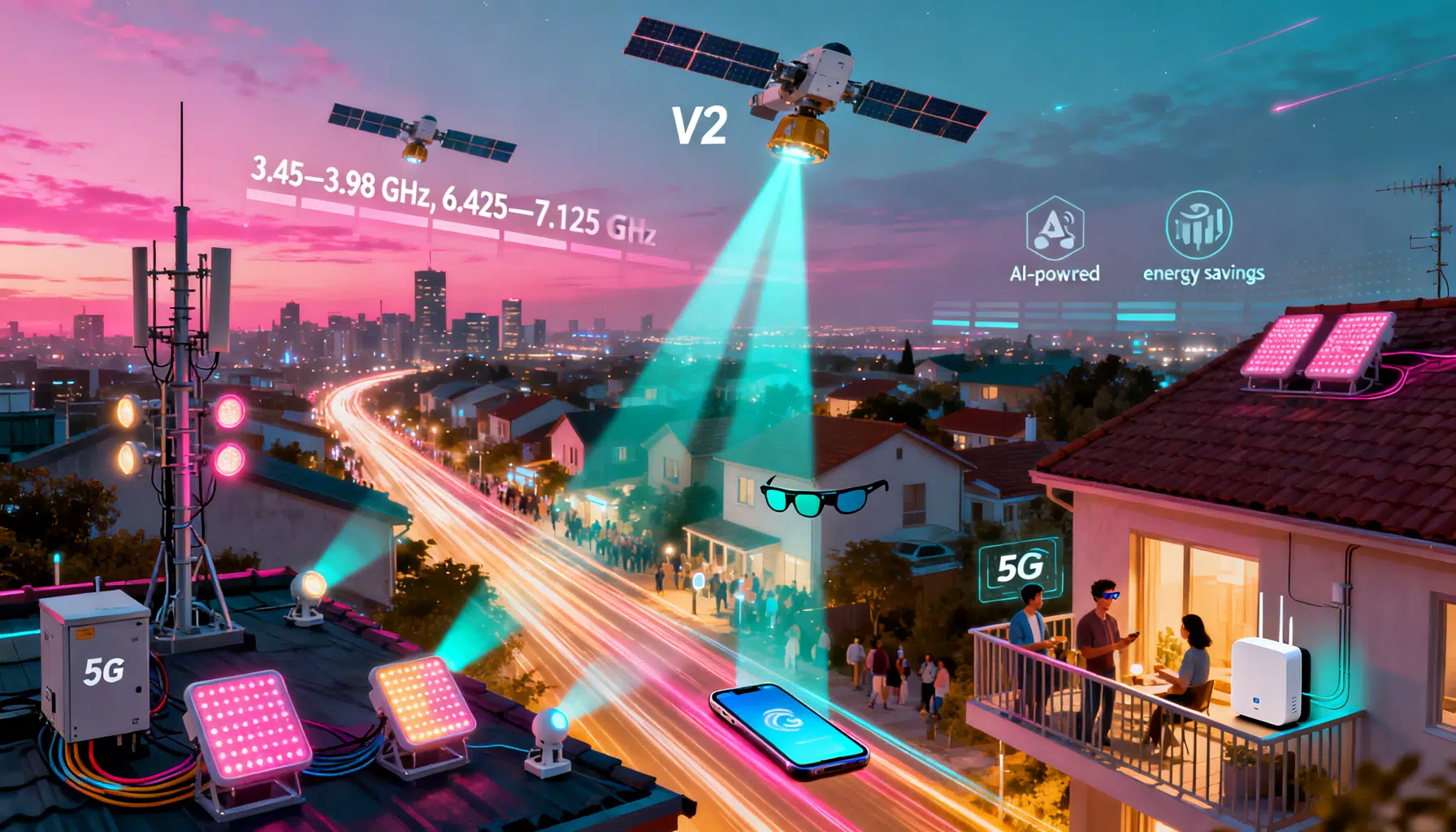
Image used for representation purposes only.
5G in 2026: 5G‑Advanced goes mainstream, satellites join the party, and spectrum policy heats up
Fifth‑generation mobile is entering a new phase in 2026. Standards for 5G‑Advanced (3GPP Release 18) are now frozen, operators are scaling standalone cores and fixed‑wireless broadband, direct‑to‑cell satellites are shifting from promises to pilots, and regulators are busy refilling the spectrum pipeline. Here’s what’s new—and what it means next.
The standards: Release 18 is done, Release 19 underway
- 5G‑Advanced (Release 18) reached stability (“frozen”) in mid‑2024, opening the door for commercial devices and networks that implement features like AI‑assisted RAN optimization, enhanced positioning, RedCap/eRedCap for IoT, XR improvements, and energy‑saving mechanisms. (nokia.com )
- Vendors and operators are already aligning product roadmaps to R18: Nokia and Ericsson highlight standardized energy‑saving modes, AI/ML control loops, L4S for interactive apps, and time‑sensitive networking enhancements. (nokia.com )
- Work on Release 19 (the second wave of 5G‑Advanced) is in progress, extending AI/ML and power‑saving capabilities and laying groundwork for 6G studies. (ericsson.com )
The market: Fixed wireless keeps surging in the U.S.
- T‑Mobile ended 2025 with about 8.45 million 5G broadband (FWA) customers, up from 6.43 million a year earlier. Verizon closed 2025 with “over 5.7 million” FWA subscribers after adding 319,000 in Q4. Both carriers say momentum is intact into 2026. (s29.q4cdn.com )
- The consumer shift to wireless home internet is increasingly structural, pressuring cable and accelerating mid‑band 5G investment and in‑home CPE innovation. Ericsson’s outlook projects 5G subscriptions reaching around 2.9 billion by end‑2025, with continued growth this decade. (ericsson.com )
Network performance: SA scales, and 5G experience gaps narrow
- AT&T says its 5G Standalone (SA) core is now deployed nationwide, with customers being migrated and RedCap coverage lit for IoT classes of devices. T‑Mobile continues to position its nationwide SA as the foundation for “5G‑Advanced” features. (about.att.com )
- Independent testing: Early‑January 2026 reporting on Opensignal’s latest U.S. Mobile Network Experience shows T‑Mobile leading many categories (download/upload, 5G availability/coverage), while Verizon retains strengths in overall coverage and certain 5G experience metrics—differences that reflect spectrum holdings and SA maturity. (androidauthority.com )
Devices and silicon: ‘5G‑Advanced‑ready’ modems hit the market
- Qualcomm’s X85 5G Modem‑RF—announced at MWC 2025—pushes peak downlink to 12.5 Gbps, adds AI‑assisted link adaptation and power control, and targets phones, PCs and fixed wireless CPE. R18‑aligned platforms are now appearing in modules and devices. (thurrott.com )
- On the IoT side, RedCap is real: Semtech’s EM8695 module (based on Snapdragon X35) achieved FCC/PTCRB certifications after testing on AT&T’s RedCap network, illustrating a migration path from LTE Cat‑1 to 5G RedCap/eRedCap as LTE sunsets near the end of the decade. (semtech.com )
Energy efficiency: Standards meet operations
- Release 18 codifies multiple network energy‑saving features (e.g., reduced broadcast, gNB DTX/DRX, dynamic downlink power, antenna‑port adaptation) and expands AI/ML hooks for energy optimization. Operators piloting AI‑guided “deep sleep” modes report large off‑peak savings. (ericsson.com )
- Expect broader commercial rollout of these features through 2026–2027 as R18 software baselines hit live networks and R19 refines power‑saving wake‑up signaling and control. (arxiv.org )
Spectrum: WRC‑23 reshaped 6 GHz; the U.S. restores auctions and targets Upper C‑band
- World Radiocommunication Conference 2023 identified parts of the upper 6 GHz band for IMT (mobile) via footnotes: 6.425–7.125 GHz in ITU Region 1 (EMEA) and 7.025–7.125 GHz in Region 3 (APAC); Brazil and Mexico added 6.425–7.125 GHz nationally in Region 2. This cements a sizable, though regionally varied, mid‑band runway for 5G‑Advanced. (cept.org )
- In the U.S., Congress restored the FCC’s auction authority on July 4, 2025 and directed a new spectrum pipeline. The FCC has now opened an NPRM to clear at least 100 MHz in the Upper C‑band (3.98–4.2 GHz) for auction by July 2027. Expect contentious debates with satellite incumbents and broadcasters. (everycrsreport.com )
- Aviation update: With radio‑altimeter retrofits completed for the mainline fleet, the FAA’s requirements effective February 1, 2024 allow regular C‑band 5G operations near airports, closing a high‑visibility coexistence chapter. (faa.gov )
NTN/direct‑to‑cell: From texting to “5G‑from‑space” claims
- The direct‑to‑cell beta that began with text messaging is expanding. Starlink has rebranded its program as “Starlink Mobile” and is touting next‑gen V2 satellites that promise “5G speeds from space” with 100× the data density of V1, with heavier‑duty service trials expected around 2027. For now, real‑world service is still in early stages and primarily text‑based. (tomshardware.com )
Enterprise and IoT: RedCap/eRedCap broaden 5G’s addressable market
- RedCap (Release 17) and enhanced RedCap (Release 18) target wearables, sensors, video cameras, industrial gateways, and point‑of‑sale with lower cost/complexity than full 5G. The ecosystem—modules, routers, wearables—is scaling in 2025–2026, with eRedCap devices anticipated to land through 2026 as networks adopt R18 baselines. (3gpp.org )
Security and supply chain: ‘Rip‑and‑replace’ funding catch‑up
- After multi‑year shortfalls, Congress authorized an additional $3.08 billion in 2025 for the FCC’s Secure and Trusted Communications Networks Reimbursement Program, helping rural carriers finish removing Huawei/ZTE gear. The FCC reports continuing oversight as recipients execute replacements. (ruralspectrumscanner.com )
What to watch next
- Release 19 commercialization: Expect AI‑native control loops, broader multi‑carrier aggregation, uplink boosts, and further energy savings to move from lab to field as operators deploy 2026–2027 software. (ericsson.com )
- Spectrum politics: U.S. Upper C‑band reallocation, more mid‑band identification globally post‑WRC‑23, and national decisions in upper 6 GHz will shape 5G‑Advanced capacity footprints through the decade. (tvtechnology.com )
- Satellite integration: Direct‑to‑cell shifts from texting to data as constellations scale; watch payload densities and handset interoperability claims—plus standards alignment under 3GPP NTN profiles. (techradar.com )
- Early 6G road‑mapping: Vendors are sketching commercialization paths later this decade, but 5G‑Advanced will carry the load in the interim. (itpro.com )
Bottom line
The 5G story in 2026 is less about raw peak speeds and more about breadth—coverage, capacity, energy efficiency, and new device classes. Release 18 made 5G‑Advanced real; U.S. fixed‑wireless broadband is mainstream; satellite‑to‑cell is edging from hype to pilots; and spectrum policy is finally rebuilding a pipeline. The next 18 months will be defined by how quickly operators operationalize R18/R19 features at scale—and how regulators and device makers keep pace.
Related Posts
T‑Mobile in 2026: AI‑Powered Calls, Satellite Messaging, and Rural Expansion Drive the Next Leg of Growth
T‑Mobile enters 2026 with live call translation, UScellular integration, Starlink messaging, and a five‑year plan guarantee—plus strong guidance.
Surface goes all‑in on 5G: Firmware fix and Microsoft–Ericsson tie‑up put always‑connected PCs front and center
Microsoft Surface targets “always connected” PCs: new 5G partnership with Ericsson and a timely Surface Pro firmware fix land ahead of MWC 2026.
Huawei’s 2026 Playbook: Phones, Chips, Cars—and a New Tech Fault Line
Huawei’s 2026 surge: back on top in China phones, pushing HarmonyOS, mapping bold AI chips, powering hot EVs—while U.S. and Europe tighten the screws.