
NVIDIA GTC 2026: DLSS 5, an Inference OS, and the Blueprint for AI Factories as $1T Chip Era Dawns
At GTC 2026, NVIDIA unveils DLSS 5, Dynamo inference OS, and a Physical AI Data Factory as Jensen Huang touts $1T in AI chip sales through 2027.
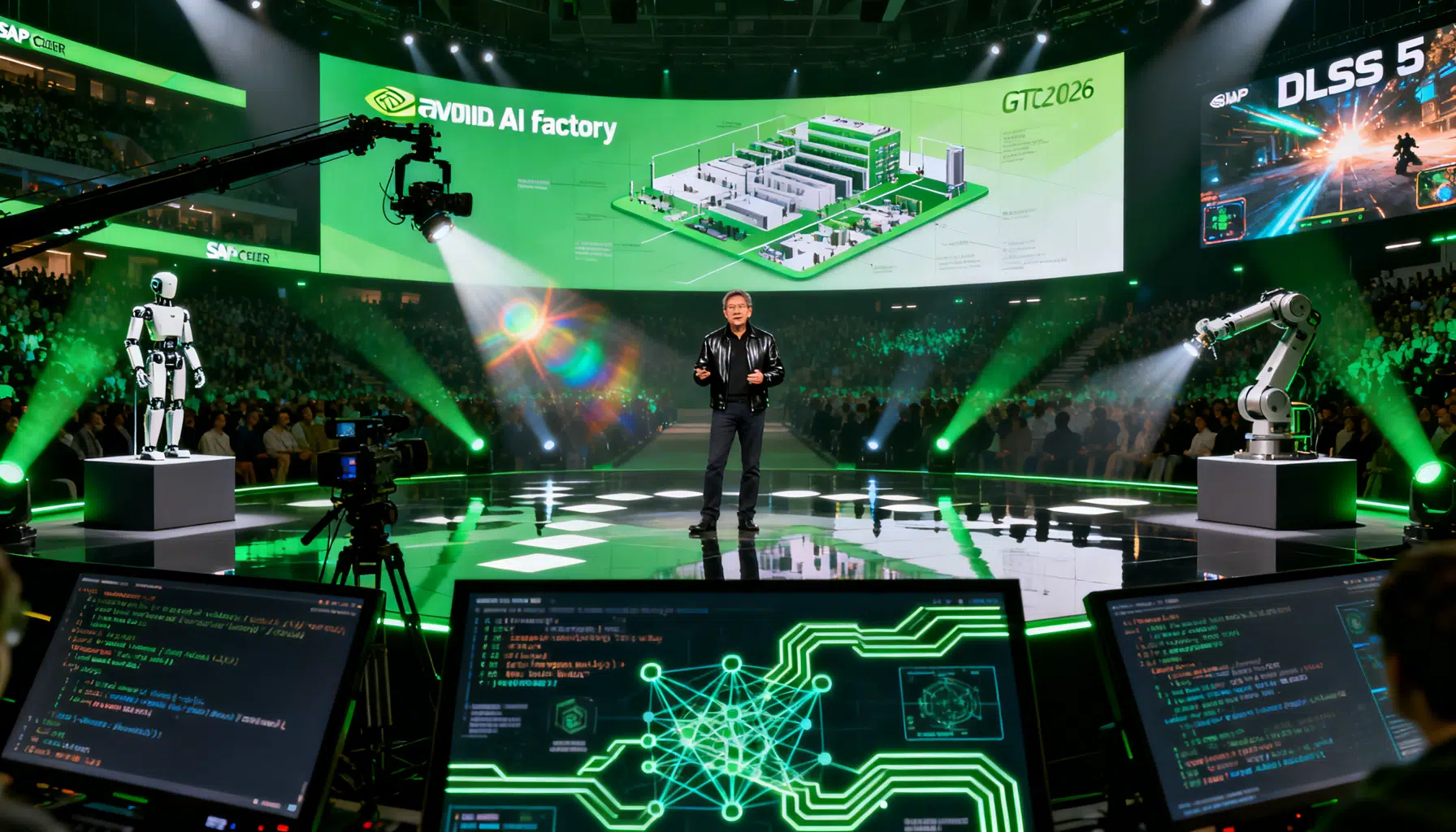
Image used for representation purposes only.
NVIDIA GTC 2026 opens with sweeping bets on agents, robotics and real‑time graphics
SAN JOSE — NVIDIA’s flagship AI conference, GTC, returned to downtown San Jose on March 16–19, 2026, with CEO Jensen Huang using his SAP Center keynote to frame AI as a once‑in‑a‑generation infrastructure buildout and to roll out new software and platform announcements across gaming, inference, robotics and “AI factories.” A capacity crowd heard Huang forecast at least $1 trillion in cumulative revenue from NVIDIA’s current Blackwell chips and next‑gen Vera Rubin systems through 2027, underscoring how quickly demand for AI compute is shifting from training to large‑scale inference. (axios.com )
Key announcements at a glance
- DLSS 5 unveiled for PC gaming, introducing a real‑time neural rendering model that enhances lighting and materials; availability set for fall 2026. (nvidianews.nvidia.com )
- Dynamo 1.0, an open‑source inference operating system for AI factories, enters production, integrating with popular agentic/inference frameworks and promising up to 7x inference gains on Blackwell GPUs. (nvidianews.nvidia.com )
- An open Physical AI Data Factory blueprint debuts to industrialize the generation and curation of robotics and vision‑AI training data across cloud platforms. (nvidianews.nvidia.com )
- Robotics “physical AI” push expands with new world models (Cosmos), Isaac simulation upgrades and GR00T N models; partners span ABB, Agility, FANUC, KUKA, Universal Robots and more. (nvidianews.nvidia.com )
- NVIDIA’s agent strategy steps into the spotlight as Huang champions open agents and introduces “NemoClaw,” positioning it alongside the viral open‑source agent OpenClaw. (axios.com )
Gaming: DLSS 5 is NVIDIA’s next big swing at real‑time photorealism
NVIDIA announced DLSS 5, calling it its most significant graphics breakthrough since real‑time ray tracing in 2018. Rather than only upscaling or generating frames, DLSS 5’s neural rendering model takes color and motion vectors each frame and infuses the scene with photoreal lighting and material cues while preserving a game’s intended art style. NVIDIA says it runs up to 4K in real time, with major publishers on board and general availability slated for fall 2026. (nvidianews.nvidia.com )
The reveal follows January’s DLSS 4.5 updates and March’s GDC briefings on Dynamic Multi‑Frame Generation; together they sketch an aggressive cadence from performance‑oriented upscaling to fidelity‑oriented neural rendering. (blogs.nvidia.com )
Inference at scale: Dynamo 1.0 and the AI factory stack
Huang’s keynote theme — that the “inflection point of inference has arrived” — was backed by the production release of Dynamo 1.0, which NVIDIA describes as an open‑source, production‑grade inference OS. It plugs into widely used frameworks (LangChain, SGLang, vLLM and others) and, in NVIDIA’s tests, can lift Blackwell inference throughput up to sevenfold — a direct play to lower token costs across the installed base of GPUs. Major clouds and AI‑native companies are listed as early adopters. (axios.com )
To feed those inference pipelines, NVIDIA introduced its open Physical AI Data Factory blueprint — a reference architecture to automate data generation/curation, synthetic data creation and reinforcement learning loops for robotics, vision agents and AV stacks. Microsoft Azure and Nebius are integrating the blueprint to turn vast compute footprints into “agent‑driven data production engines.” (nvidianews.nvidia.com )
Robotics and “physical AI”: from world models to factory floors
NVIDIA used GTC to expand its physical‑world push: new Cosmos world models, refreshed Isaac simulation frameworks and GR00T N models aim to shorten the path from simulation to deployment. Industrial partners — including ABB, Agility, FANUC, KUKA, Universal Robots and YASKAWA — are integrating Omniverse, Isaac and Jetson/IGX Thor compute to validate lines via high‑fidelity digital twins and to run real‑time AI at the edge. (nvidianews.nvidia.com )
A notable on‑stage demo brought Disney’s Olaf onto the keynote set, illustrating how Omniverse‑powered simulation and NVIDIA’s physics stack underpin embodied AI — with Olaf slated for a Disneyland Paris debut later this month. (nvidianews.nvidia.com )
IGX Thor — the industrial sibling to NVIDIA’s Jetson/Thor roadmap — is now in customers’ hands and seeing uptake across transportation and surgical robotics, building on previews from late 2025 and CES 2026 that emphasized functional safety and real‑time sensor fusion at the edge. (investor.nvidia.com )
Agents take center stage: NemoClaw, OpenClaw and the “AaaS” pivot
If 2025 was about model scale, 2026 is shaping up to be about agents. Onstage, Huang praised OpenClaw — the fast‑rising open agent that has catalyzed a wave of local‑first automation — and unveiled NVIDIA “NemoClaw,” pitched as an enterprise‑ready, open‑source agent platform designed to interoperate with OpenClaw while adding security and control layers. He predicted SaaS will morph into “AaaS” — agentic AI as a service. (axios.com )
Reports ahead of GTC signaled NVIDIA’s intent to compete directly in the agent platform space; Huang’s keynote draws a line from chips to software to agents, casting agents as the workload that will keep AI factories busy. (techradar.com )
Blackwell now, Rubin next: the hardware runway
GTC 2026 didn’t introduce a brand‑new data center GPU, but the roadmap message was clear: Blackwell remains the training/inference workhorse, with Rubin ramping in the second half of 2026. At CES, NVIDIA previewed the Rubin NVL72 rack‑scale system, claiming up to 5x greater inference performance and 10x lower cost per token than Blackwell, setting expectations for the next wave of AI factory upgrades later this year. (tomshardware.com )
Context from recent GTCs helps explain the cadence. In 2024, NVIDIA unveiled Blackwell/GB200 and the NVL72 rack — a tightly coupled, liquid‑cooled “giant GPU” domain designed for trillion‑parameter models — anchoring today’s AI factory builds. (blogs.nvidia.com )
Scale and spectacle: GTC by the numbers
NVIDIA’s live blog tallied more than 30,000 attendees across 10 venues in downtown San Jose, with over 1,000 sessions, 2,000 speakers and 450+ sponsors. The keynote was preceded by an analyst/founder preshow and will be followed by panels on open models, industry keynotes and hands‑on labs through Thursday, March 19. (blogs.nvidia.com )
Why it matters: the “five‑layer cake” and the power‑constrained buildout
Huang has been describing AI’s buildout as a “five‑layer cake” — from energy and chips, through cloud and models, up to applications — and GTC 2026 put meat on that framework: DLSS 5 at the application layer, Dynamo and agents at the inference/software layers, and data/robotics blueprints tying cloud and edge together. It comes amid a broader message that the biggest buildout is still ahead and that power and inference efficiency will set winners and losers. (blogs.nvidia.com )
The trillion‑dollar sales target through 2027, spanning Blackwell and Rubin, signals NVIDIA’s confidence that “AI factories” — data centers optimized for continuous agentic inference and simulation — are moving from concept to standardized production patterns across public clouds, sovereign compute, and on‑prem industrial deployments. (axios.com )
What to watch next
- DLSS 5 developer integrations and first‑wave game support as fall approaches. (nvidianews.nvidia.com )
- Dynamo 1.0 adoption curves across hyperscalers and AI‑native platforms; whether the promised 7x uplift appears in independent benchmarks. (nvidianews.nvidia.com )
- Physical AI deployments: partner rollouts of Cosmos/Isaac/GR00T stacks, plus early IGX Thor production wins in industrial and medical settings. (nvidianews.nvidia.com )
- Rubin NVL72 production timing in 2H 2026, and whether NVIDIA’s cost‑per‑token and perf‑per‑watt claims hold in production AI factories. (tomshardware.com )
As GTC sessions continue through Thursday, expect more detail on agentic AI guardrails, multi‑modal inference pipelines and end‑to‑end robotics workflows — the connective tissue NVIDIA believes will keep its AI factory vision humming long after the keynote lights dim. (blogs.nvidia.com )
Related Posts
DLSS 5: Hype vs. Reality — What NVIDIA Has Actually Announced and What Comes Next
DLSS 5 is trending, but NVIDIA’s latest official release is DLSS 4.5. Here’s what’s real now, what’s coming March 31, and what a true next leap could include.
NemoClaw Debuts at GTC: Nvidia’s Open‑Source Stack for Safer, Always‑On AI Agents
Nvidia launches NemoClaw at GTC 2026: an open‑source stack to run safer, always‑on OpenClaw agents with policy, privacy, and one‑command install.
NBIS Alert: Nebius Snags $2B From NVIDIA and Wins Approval for a 1.2 GW AI Factory in Missouri
NVIDIA invests $2B in Nebius (NBIS) as Independence, Missouri approves a 1.2 GW “AI factory,” signaling a rapid buildout of hyperscale AI compute.