AI Briefing: GPT-5.4 lands, Google pushes Gemini everywhere, Anthropic surges, Nvidia rallies open models, and Meta signs News Corp
AI this week: OpenAI ships GPT-5.4, Google expands Gemini in Maps & Workspace, Anthropic surges, Nvidia rallies open models, Meta inks News Corp deal, EU AI Act nears.
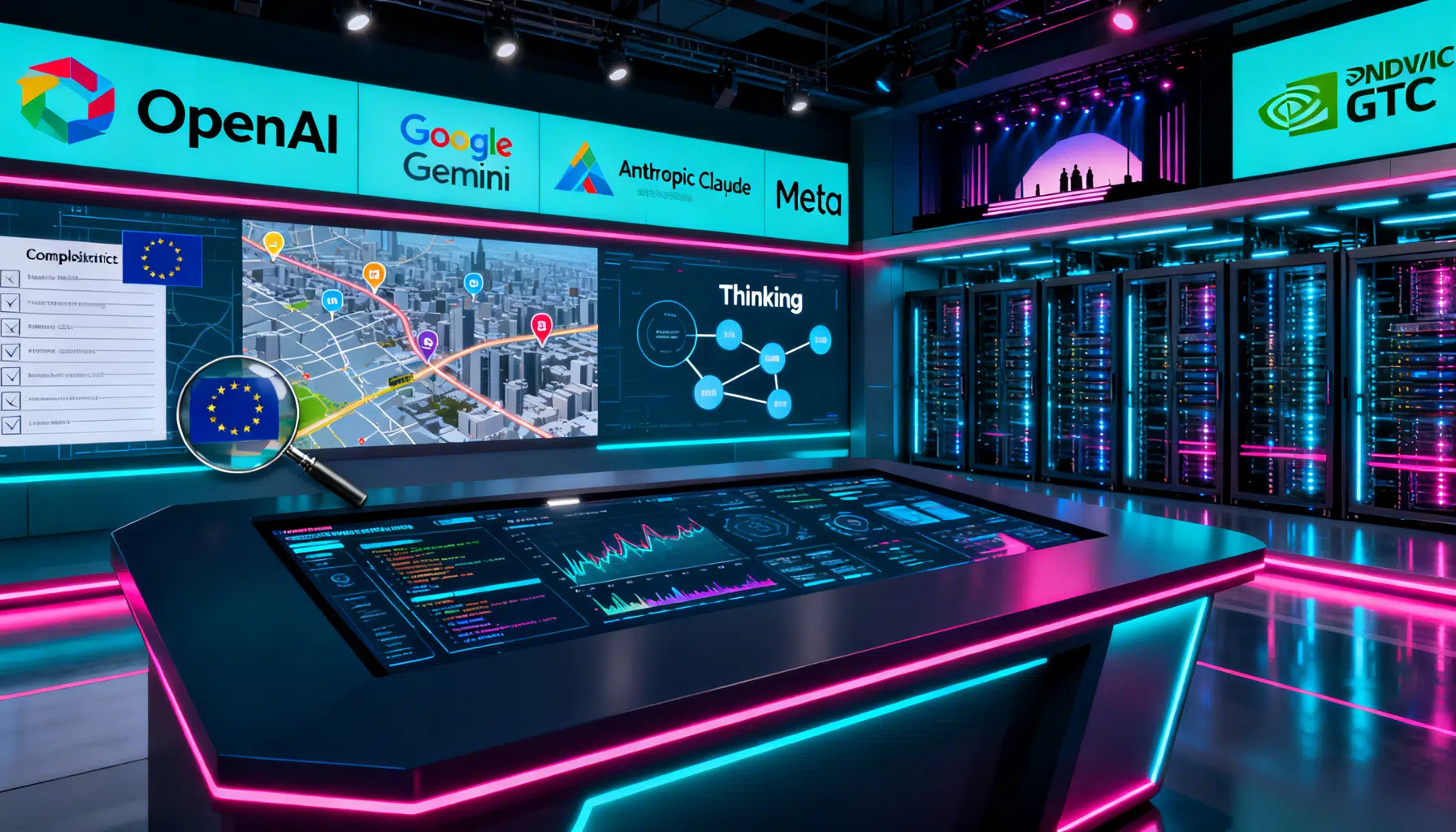
Image used for representation purposes only.
This week in AI: models race ahead, maps get smarter, and regulators circle
A flurry of announcements across labs, platforms, chips, and policy shaped the artificial intelligence landscape in the run‑up to March 19, 2026. Here’s what mattered, why it matters, and what to watch next.
OpenAI ships GPT-5.4 and doubles down on “Thinking”
On March 5, 2026, OpenAI introduced GPT‑5.4 in two tiers—Pro and a reasoning‑optimized “Thinking” variant—positioning it as a higher‑reliability, workplace‑oriented upgrade. Early coverage emphasized reductions in reasoning errors and improvements in spreadsheet, document and code tasks, with the “Thinking” tier exposing structured intermediate reasoning to help users steer the model mid‑response. OpenAI published a dedicated system card detailing safety, evaluation and cyber safeguards for the “Thinking” model. (techcrunch.com )
OpenAI also continued a multi‑month cleanup of its model lineup. In March release notes, the company confirmed retirements of older GPT‑4 family models and earlier o‑series variants from ChatGPT, marking a full pivot to the GPT‑5 generation. (help.openai.com )
Why it matters: Enterprises are signaling they’ll pay for fewer, more dependable models that can reason, cite, and integrate more cleanly with office workflows—precisely where GPT‑5.4 is aimed. Expect accelerated competition on “agent‑readiness” features (computer use, tool invocation, interruptible chain‑of‑thought) through Q2.
Google rolls Gemini deeper into everyday life
Google expanded Gemini‑powered features across consumer and productivity surfaces the week of March 12. Google Maps rolled out new AI navigation and trip‑planning upgrades, reflecting the company’s confidence in the Gemini 3 family. On the enterprise side, Google Workspace added broader Gemini assistance in Docs, Slides, Sheets and Drive. A companion patch cut voice‑assistant latency for Gemini‑for‑Home. (apnews.com )
Why it matters: Google is executing a “pervasive Gemini” strategy—embedding the model where users already are. As Maps and Workspace harden Gemini’s utility story, expect pressure on rivals to ship more visible, day‑to‑day wins beyond chat interfaces.
Anthropic’s Claude surge and a sharpening safety debate
Anthropic’s February model refresh continued to ripple: the company rolled out Claude Sonnet 4.6 (mid‑tier) and Opus 4.6 (flagship) with upgrades across coding, computer use and long‑context reasoning. (macrumors.com )
Then, policy drama spilled into product momentum. After weeks of tension with the U.S. Department of Defense over permissible military use, reporting on March 6 indicated Claude downloads and paid subscriptions jumped, with business subscriptions up sharply since January. Third‑party web and app metrics corroborated a step‑change in daily active users around early March. (washingtonpost.com )
Simultaneously, Anthropic warned of elevated misuse risks in certain agentic computer‑use settings and argued for stricter guardrails—underscoring an industry‑wide pattern: as tools get better at taking actions, risk surfaces expand. (axios.com )
Why it matters: The “agentic turn” is colliding with national‑security and safety obligations. Vendors winning enterprise share will be those that can demonstrate fine‑grained use controls, auditable trails, and conditional capability gating by default.
Meta inks a high-profile licensing deal—and keeps stockpiling compute
On March 3–4, 2026, multiple outlets reported Meta struck a three‑year AI content licensing deal with News Corp worth up to $50 million annually, granting access to U.S. and U.K. journalism for training and for improved responses in Meta’s AI assistant. The move follows a string of Meta data‑licensing pacts with major publishers in late 2025. (theguardian.com )
Under the hood, Meta continued its compute spree. In mid‑February, Axios reported Meta would buy “millions” of Nvidia chips—spanning Grace CPUs to forthcoming Blackwell GPUs—for its 2026–2027 data‑center buildout. Related coverage highlighted a separate, multi‑gigawatt AMD infrastructure pact slated to begin deployments in H2 2026. (axios.com )
Why it matters: The generative‑AI content race is shifting from “scrape and litigate” to “license and differentiate,” while the compute race keeps compounding. Expect licensing to spread from news into specialized scientific, financial and educational corpora—and to be a key input to safer, more grounded assistants.
Nvidia uses GTC to rally an open-model coalition
At GTC on March 16, Nvidia unveiled the “Nemotron Coalition,” recruiting eight labs and platforms—including Mistral AI, Perplexity and LangChain—to co‑develop open frontier models on DGX Cloud, feeding into forthcoming Nemotron families. The effort is pitched as a way to accelerate agent‑ready, open models that run across Nvidia’s CUDA‑optimized stack. (tomshardware.com )
Why it matters: Open‑weight models are re‑accelerating. Nvidia’s bet is that standardized toolchains (NIM microservices, NeMo Agent Toolkit) plus coalition‑curated data and evals will compress time‑to‑production for enterprises that prefer open or sovereign options.
xAI’s Grok faces intensifying scrutiny in Europe
Regulators kept the pressure on image‑editing abuse. In January and February, European authorities escalated investigations into Grok’s role in sexualized deepfakes, prompting xAI to limit or block certain image‑manipulation features and restrict access to paid users in an effort to enforce accountability. (apnews.com )
Why it matters: As more chatbots gain rich image and video tools, liability is moving from purely user behavior to platform design. Expect a policy drumbeat on provenance, traceability and default safety rails across the industry.
Policy and compliance: EU AI Act countdown enters the home stretch
The EU’s AI Act entered into force on August 1, 2024 and becomes broadly applicable on August 2, 2026, with staggered timelines for specific obligations (for example, embedded high‑risk systems in Annex II apply August 2, 2027). The Commission’s AI Office has been publishing guidance and timelines to help providers and deployers prepare. (digital-strategy.ec.europa.eu )
Why it matters: With fewer than five months until the core applicability date, global vendors are localizing governance: labeling and disclosure updates, post‑market monitoring plans, and transparency tooling—especially around general‑purpose models. U.S. standards work via NIST’s AI Safety Institute provides complementary—but voluntary—anchors for risk management programs. (nist.gov )
Compute wars: multi‑gigawatt buildouts lock in 2026–2027 capacity
Two 2025 announcements that will begin landing in the second half of 2026 remained central to this week’s enterprise conversations: OpenAI’s partnerships with AMD and Nvidia. Both deals point to multi‑gigawatt deployments of next‑gen accelerators and end‑to‑end systems, with warrants and investment structures underscoring how tightly model roadmaps now couple to silicon supply. (apnews.com )
Why it matters: Capacity is strategy. As models grow more agentic and multimodal, inference costs—not just training—dominate TCO. Expect vendors to pitch not only accuracy and safety, but also watts‑per‑token, latency‑under‑load and predictable scaling curves.
The big picture: the “agentic turn” becomes real product surface area
Across OpenAI’s GPT‑5.4 “Thinking,” Google’s Gemini‑infused Maps and Workspace, Anthropic’s 4.6 series, and Nvidia’s coalition, one pattern is unmistakable: assistants are becoming doers. The winners will combine strong guardrails with usable autonomy—while proving it with transparent evals, red‑teaming and logs enterprises can actually audit.
What to watch next (March–April 2026):
- Enterprise agents graduate pilots: Expect more vendors to ship interruptible, tool‑using assistants into IT‑approved environments, plus clearer billing for “actions,” not just tokens.
- Licensing momentum: Additional newsroom and data‑provider deals are likely as training ramps before the EU AI Act’s August 2 applicability.
- GTC aftershocks: Track which coalition models and NIM services actually land in public registries and clouds—and whether Mistral co‑dev models appear on open hubs on schedule. (tomshardware.com )
Bottom line
This week’s news confirms that 2026 is not just about bigger models; it’s about deployable, governable capability. The firms that harmonize reliability, rights‑respecting data, and efficient compute will set the next 12 months of the AI agenda.
Related Posts

AMD Stock after Meta’s 6GW AI Deal: Growth, Dilution, and the 2026 Playbook
AMD stock jumps as Meta inks a 6GW AI chip deal featuring performance-based warrants. Here’s what it means for growth, dilution, and 2026 execution.

GPT in March 2026: OpenAI retires older models as reasoning and real‑time multimodality take over
As of March 18, 2026, GPT enters a consolidation phase: older models are retired while reasoning, multimodality, and enterprise use take center stage.

Instagram messages outage: DMs fail globally on March 11, 2026 — what we know now
Instagram’s DMs failed globally on March 11, 2026, disrupting messages and some posts. Here’s the latest on timing, impact, and what to do next.