
The Metaverse in 2026: Consumer VR Resets, Gaming Scales, Industry Accelerates
In 2026 the metaverse resets: consumer VR cools, Roblox/Fortnite scale, industrial twins accelerate, and OpenUSD-led standards—and governance—solidify.
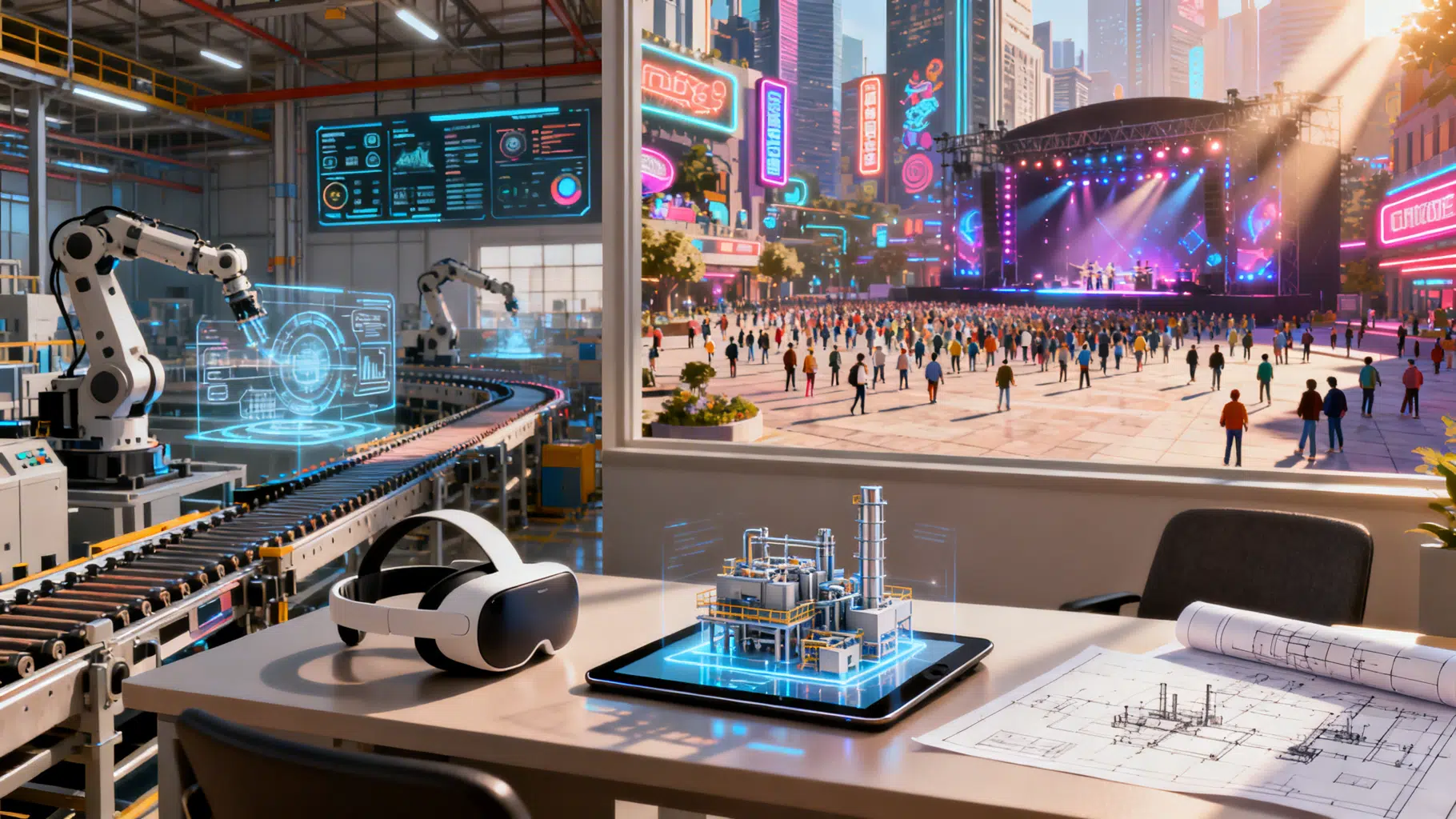
Image used for representation purposes only.
The metaverse in 2026: resets, realignment, and quiet momentum
Two years after the 2024 hype cycle around “spatial computing,” the metaverse is reshaping itself. Consumer VR is recalibrating, gaming-born platforms are becoming de facto social 3D hubs, and industrial digital twins are turning into board‑level initiatives. Meanwhile, standards bodies and regulators are laying connective tissue for interoperability and safety. Here’s where things stand as of March 2026.
Consumer VR cools as strategies shift
- Meta trimmed its metaverse ambitions in January 2026, laying off roughly 10% of Reality Labs and closing three first‑party VR studios (including Sanzaru and Armature), as leadership redirected attention and budget toward AI‑infused wearables and smart glasses. Meta says it isn’t leaving VR, but the restructuring underscores a pivot. (techcrunch.com )
- Hardware demand is mixed. IDC expects combined AR/VR and smart‑glasses shipments to rebound by about 39% in 2025 to 14.3 million units, yet the rebound skews toward lighter “smart glasses,” not high‑end headsets. (idc.com )
- Apple’s Vision Pro remains a premium niche one year on. Analyst tallies cited by MacRumors and others point to hundreds of thousands of units in 2024 and soft 2025 holiday‑quarter volumes, highlighting price‑sensitive demand relative to lower‑cost Quest devices. (macrumors.com )
- Microsoft folded its standalone Mesh effort into Teams. Mesh hit general availability in January 2024, then the Mesh apps and “Immersive space (3D)” view were retired on December 1, 2025, with “immersive events in Teams” now GA and accessible from Quest and desktop. (microsoft.com )
The platforms that scale: Roblox and Fortnite
If you want the mass‑market metaverse in 2026, look first to platforms that people already use daily.
- Roblox reported 111.8 million average daily active users (DAU) in Q2 2025, up 41% year over year—evidence that user‑generated 3D worlds and virtual economies keep compounding at scale. (ir.roblox.com )
- Epic’s Fortnite continues evolving into a creator ecosystem and branded entertainment venue. Disney’s $1.5 billion investment (February 7, 2024) set up a “games and entertainment universe” connected to Fortnite; by late 2025, the first Disneyland‑themed Creative island went live. Epic also signaled broader creator reach by announcing plans to let Unity‑engine games publish into Fortnite. (thewaltdisneycompany.com )
Industrial metaverse: from pilot to platform
While consumer VR resets, industrial use cases are accelerating with measurable ROI—simulation, training, factory layout, energy optimization and more.
- NVIDIA’s Omniverse is becoming a common substrate for “physical AI” and digital‑twin workflows, integrated by major engineering and automation vendors (Siemens, Schneider Electric with ETAP, Cadence, Ansys and others). NVIDIA detailed expanded blueprints for AI‑factory and data‑center twins through 2025. (investor.nvidia.com )
- Siemens says 62% of companies increased investment in industrial‑metaverse technologies in 2024, with North America leading in depth of adoption. The Siemens–NVIDIA partnership deepened through 2025 and into early 2026 around an “Industrial AI Operating System.” (press.siemens.com )
- The market outlook mirrors that momentum: multiple industry trackers project strong growth for industrial metaverse spending through the early 2030s, driven by digital twins and AI‑assisted engineering. (prnewswire.com )
Interoperability gets real: OpenUSD, OpenXR and forum coordination
Standards work has quietly become one of 2025–2026’s most consequential metaverse stories.
- The Alliance for OpenUSD (AOUSD) reported that 2025 was a “landmark” year, including ratification of the OpenUSD Core Specification 1.0 and expansion of working groups; in early 2026, the Academy Software Foundation formalized a liaison with AOUSD to accelerate adoption. (aousd.org )
- The Metaverse Standards Forum (hosted by Khronos) spent 2025 advancing pragmatic, pre‑standardization work—from 3D web interoperability to town halls on standardizing Gaussian Splatting content—alongside its 2024 annual report and Forum Labs initiatives. (metaverse-standards.org )
- Broader SDOs are engaged: IEEE’s P2048 taxonomy and related digital‑content committees, plus ITU‑T’s new Joint Coordination Activity on Metaverse Standardization (2025–2028), aim to align terminology and interoperability at a global level. (standards.ieee.org )
Governance and safety: policy scaffolding takes shape
- The European Union has moved virtual‑world policy under its “Web 4.0 and Virtual Worlds” strategy, convening a global governance conference on March 31–April 1, 2025, and prioritizing standards, identity and user rights in its 2025 rolling plan for ICT standardization. (digital-strategy.ec.europa.eu )
- Regulators continue to police monetization and youth safety inside virtual platforms. In June 2025, the U.S. Federal Trade Commission began sending $126 million in refunds to Fortnite players for unwanted charges, a reminder that consumer‑protection rules extend into virtual economies. (ftc.gov )
By the numbers (latest milestones)
- 111.8 million: Roblox average DAU, Q2 2025 (+41% YoY). (ir.roblox.com )
- 14.3 million: projected 2025 global AR/VR and smart‑glasses shipments (+39.2% YoY). (idc.com )
- 62%: organizations increasing industrial‑metaverse investment (2024 study). (press.siemens.com )
- $1.5 billion: Disney’s 2024 equity stake in Epic to build a Fortnite‑connected universe. (thewaltdisneycompany.com )
- Core Specification 1.0: OpenUSD’s 2025 ratification milestone. (aousd.org )
What this means for 2026–2027
- Consumer experiences migrate to where users already are. Expect more brand activations, live events and shoppable 3D inside Roblox and Fortnite, while premium headsets focus on prosumers and enterprise. (ir.roblox.com )
- Industrial digital twins professionalize. With Omniverse‑based stacks and Siemens/NVIDIA frameworks maturing, more factories, power systems and logistics networks will be simulated end‑to‑end before build‑out, tightening the loop between design and operations. (investor.nvidia.com )
- Interop becomes the differentiator. AOUSD’s Core Spec and liaisons, OpenXR runtime reach, and Forum‑coordinated work on formats like glTF and emerging Gaussian‑splatting pipelines will reduce friction across tools, devices and the web. (aousd.org )
- Policy gets more prescriptive. Expect Web 4.0/virtual‑world governance discussions in the EU to ripple into standards and procurement, while U.S. regulators continue to enforce consumer‑protection norms in virtual transactions. (digital-strategy.ec.europa.eu )
Bottom line
The metaverse didn’t vanish—it diversified. Consumer VR is regrouping after a reality check, but the “metaverse” lives on through gaming‑scale platforms and, increasingly, through industrial digital twins that tie AI and simulation directly to business outcomes. The connective tissue—open standards, web‑centric interoperability and pragmatic regulation—is hardening. In 2026, that may be the most important story of all.
Related Posts
IEEE in 2026: Wi‑Fi 8 peeks out, 1.6T Ethernet nears, and AI standards accelerate
Why IEEE is trending in 2026: early Wi‑Fi 8 demos, 1.6T Ethernet progress, new AI and open‑access standards, and highlights from IEEE Spectrum.