
The API Versioning Playbook: Best Practices, Patterns, and Pitfalls
A practical playbook for API versioning: strategies, SemVer, backward compatibility, deprecation, testing, and rollout patterns for stable, evolving APIs.
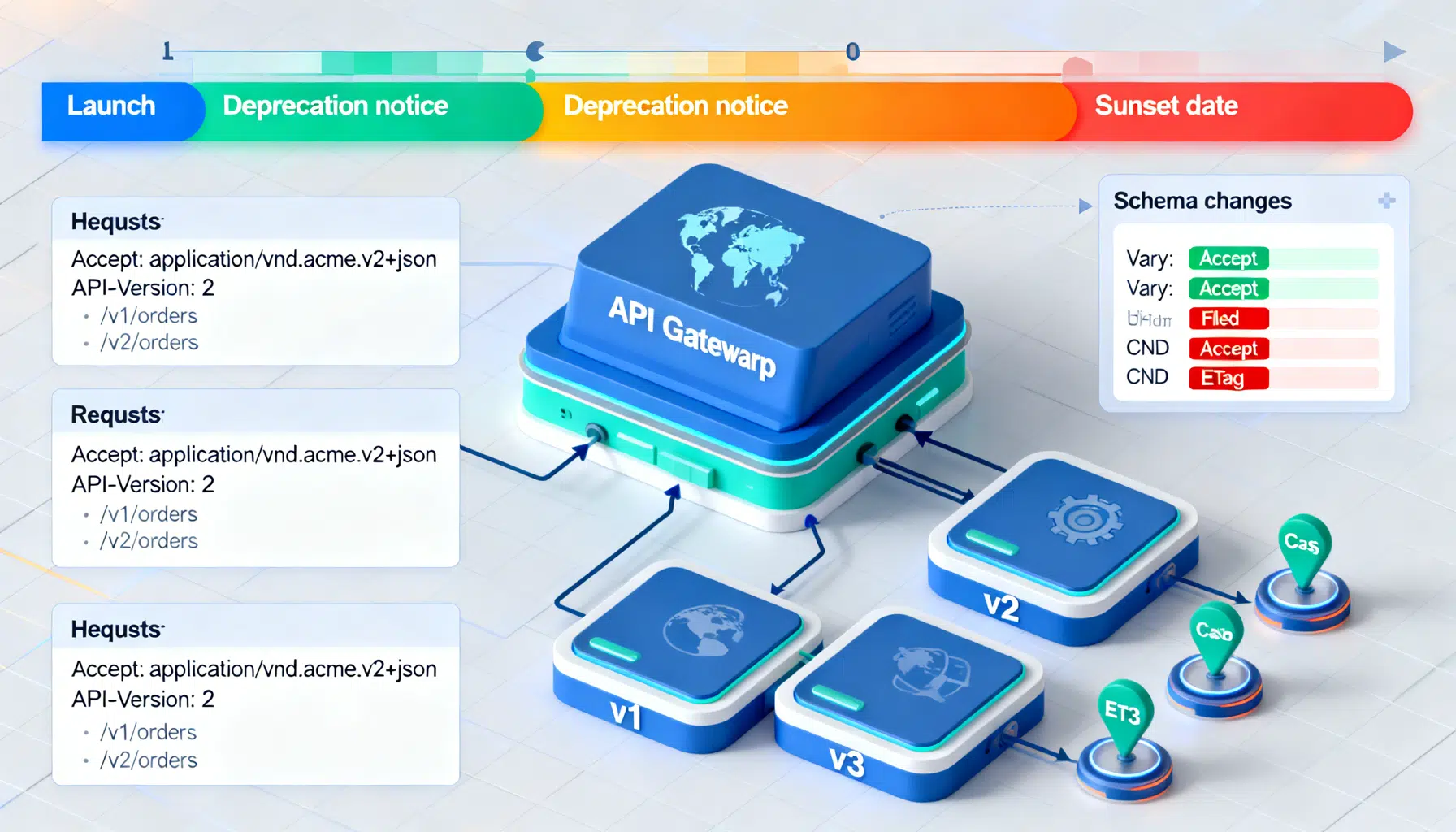
Image used for representation purposes only.
Overview
APIs live longer than the code that creates them. Versioning is how you evolve an interface without breaking clients, earn trust, and move faster over time. This guide distills practical strategies, patterns, and guardrails you can apply to REST, GraphQL, gRPC, and event-driven APIs.
Breaking vs. non‑breaking changes
- Non‑breaking (backward compatible): Additive fields, new endpoints, new enum values tolerated by clients, performance improvements.
- Breaking: Removing or renaming fields, changing types or formats, tightening validation, altering semantics, changing pagination shapes, or modifying default behaviors.
Adopt a “compatibility first” mindset: prefer additive changes; remove only with a clear deprecation plan and overlap period.
Common versioning strategies
- Path-based
- Example: /v1/orders, /v2/orders
- Pros: Extremely explicit; CDN- and cache-friendly; simple routing and monitoring.
- Cons: URL churn; encourages copy-paste duplication if not managed.
- Media type (content negotiation)
- Example request:
curl -H "Accept: application/vnd.acme.orders.v2+json" \
     https://api.acme.com/orders/123
- Pros: Clean URLs; version lives in representation; aligns with HTTP caching via Vary: Accept.
- Cons: More complex debugging; requires disciplined client libraries and CDNs.
- Header-based (custom header)
- Example: X-API-Version: 2025-11-15 or API-Version: 2
- Pros: Leaves URLs stable; easy to roll out.
- Cons: Non-standard; must configure caches to include the header in cache keys; more hidden for users.
- Query parameter
- Example: /orders/123?version=2
- Pros: Easy to A/B test; quick adoption.
- Cons: Weak caching defaults; easy to strip or forget; often discouraged for long-term strategy.
- Subdomain or host
- Example: v2.api.acme.com
- Pros: Strong isolation; supports different infrastructure stacks.
- Cons: Operational overhead; cross-origin and certificate complexity.
Recommendation: Prefer path-based or media-type versioning for public REST APIs. Use header- or host-based versions when you need infrastructure isolation or internal control.
Choosing a strategy (quick guide)
- Public APIs with broad client diversity: path-based (/v1) for clarity and caching.
- Enterprise APIs where URL stability matters: media-type versioning with Vary: Accept.
- Internal microservices: minimize explicit versions; use backward-compatible evolution and traffic management; reserve versions for true breaks.
- GraphQL: typically versionless schema; use field deprecations and additive evolution.
- gRPC/Protobuf: evolve messages with new fields; reserve and never reuse removed field numbers; version service only for extreme breaks.
Semantic versioning for APIs
- Major (X): Breaking changes. Introduce /vX or a new media type (…vX+json). Keep old major live through a supported window.
- Minor (Y): Backward-compatible additions (fields, endpoints, optional behaviors). No client breakage expected.
- Patch (Z): Bug fixes and non-behavioral changes.
Expose “info.version” in your OpenAPI and keep it aligned with release notes. For path-based versions, the URL major is the source of truth; info.version can still reflect full SemVer.
openapi: 3.1.0
info:
  title: Acme Orders API
  version: 2.4.1
servers:
  - url: https://api.acme.com/v2
Designing for compatibility
- Additive first: add optional fields; default them server-side.
- Tolerant readers: clients should ignore unknown fields; servers should ignore unknown query params where safe.
- Never change meaning: avoid repurposing fields.
- Enumerations: expect new values; use safe defaults.
- Nullability: document clearly; avoid “null vs missing” ambiguity.
- Pagination: pick a stable shape early (cursor-based recommended). Changing pagination schemas is breaking.
- Error contracts: use consistent Problem Details-like structures with stable machine-readable codes.
- IDs and formats: avoid changing identifier format or length. If you must, version the resource or introduce new fields.
Deprecation and sunsetting
- Announce: changelog, email/webhooks to app owners, and docs banners.
- Overlap: run old and new majors in parallel for a defined period (e.g., 12–24 months for public APIs; 3–6 months internal).
- Signal via headers:
- Sunset:
to indicate planned retirement. - Link: rel=“sunset” to documentation about the change.
- Sunset:
- Telemetry: measure active callers by version; target outreach to laggards.
- Enforce: staged rollouts—warn, throttle non-critical, then block after EOL.
Example response headers near EOL:
Sunset: Tue, 30 Jun 2026 23:59:59 GMT
Link: <https://developer.acme.com/migrate/v1-to-v2>; rel="sunset"
Documentation and discoverability
- Pin docs per version and default to the latest stable.
- Maintain a machine-readable changelog and migration guides.
- Host separate OpenAPI documents per major. Keep examples for both old and new versions until EOL.
- Provide a version discovery endpoint (“GET /” or “/versions”) returning supported and deprecated versions with dates.
Testing and governance
- Contract tests: verify responses against versioned schemas.
- Consumer-driven contracts (CDCs): capture expectations from key clients; block breaking server changes.
- API diffing: integrate spec-diff tools in CI to detect breaking changes before merge.
- Backward-compat gates: require explicit approval for major changes and a mitigation plan.
Deployment and rollout patterns
- Dual-stack routing: run v1 and v2 behind the same gateway; route by path or Accept header.
- Shadow traffic: mirror a slice of v1 requests to v2 to validate behavior safely.
- Canary and phased percentage rollouts by API key, tenant, or region.
- Compatibility shims: temporary adapters that translate v2 responses into v1 for holdout clients.
Example NGINX snippet for media-type routing:
map $http_accept $api_upstream {
  default            api_v1;
  ~*vnd\.acme\..*v2  api_v2;
}
upstream api_v1 { server v1.internal:8080; }
upstream api_v2 { server v2.internal:8080; }
server {
  location / { proxy_pass http://$api_upstream; }
}
Caching and performance
- Include version in cache keys:
- Path-based: automatic.
- Media-type/header-based: configure Vary: Accept (or your version header) and CDN cache rules.
- ETags and Last-Modified remain valid across versions but must change if representation changes.
- Avoid cache poisoning by ensuring intermediaries respect the Vary header.
Security and compliance
- Least privilege: scope tokens by API version or resource set when practical.
- Avoid information leaks: don’t echo internal version identifiers in errors; expose public API version only.
- Audit trail: log version, API key/app id, and endpoint; retain beyond your longest overlap.
- Compliance windows: choose overlap periods that respect contractual/SLA commitments.
Special cases
-
GraphQL
- Prefer a single evolving schema.
- Deprecate fields with @deprecated; keep them until after a published date.
- Add fields instead of mutating shapes; avoid removing commonly used fields without a long overlap.
-
gRPC / Protobuf
- Use new optional fields with unique field numbers; never reuse removed numbers (mark as reserved).
- Keep wire compatibility; version the package/service only for protocol-breaking changes.
-
Event-driven APIs
- Version event types (e.g., order.created.v2).
- Keep envelopes stable; add fields; ensure consumers ignore unknown attributes.
Example patterns
- Path-based REST example:
GET /v2/orders/123
Accept: application/json
- Media-type versioning example:
GET /orders/123
Accept: application/vnd.acme.orders.v2+json
- Express.js routing by major version:
const v1 = require('./routes/v1');
const v2 = require('./routes/v2');
app.use('/v1', v1);
app.use('/v2', v2);
- Minimal version negotiation middleware (header-based):
app.use((req, res, next) => {
  const v = req.get('API-Version') || '1';
  req.apiVersion = ['1','2'].includes(v) ? v : '1';
  next();
});
Operational playbook (checklist)
- Decide strategy: path or media-type for public REST; versionless with deprecations for GraphQL; Protobuf evolution for gRPC.
- Define SemVer policy and what constitutes “breaking” in your context.
- Establish deprecation lifecycle with explicit dates and the Sunset header.
- Provide version discovery and pinned documentation.
- Enforce backward-compatibility in CI with spec diffs and CDCs.
- Instrument usage by version and set alerting on deprecated calls.
- Plan rollouts: canary, shadow, and shims.
- Communicate early and often with clear migration guides.
Common pitfalls
- Sneaking in breaking changes under “minor” updates.
- Not measuring which clients use which versions; flying blind during sunsetting.
- Letting docs drift from actual behavior.
- Overusing versions for non-breaking changes (churn without value).
- Fragmenting SDKs such that SDK and API versions diverge confusingly.
Conclusion
Versioning is guardrails plus communication. Choose a clear strategy, design for compatibility, automate detection of breakages, and publish explicit timelines. Done well, versioning becomes an accelerator—not a brake—on your product roadmap.
Related Posts
gRPC Microservices Tutorial: Build, Secure, and Observe a Production-Ready API in Go
Step-by-step gRPC microservices tutorial: Protobuf design, Go services, TLS/mTLS, deadlines, retries, streaming, observability, Docker, and Kubernetes.

Build a GraphQL API and React Client: An End‑to‑End Tutorial
Learn GraphQL with React and Apollo Client by building a full stack app with queries, mutations, caching, and pagination—step by step.