
Ethical Guardrails for AI Voice Cloning APIs: A Practical Guide
A practical guide to ethical AI voice cloning APIs: consent, safety-by-design, legal context, safeguards, and developer checklists.
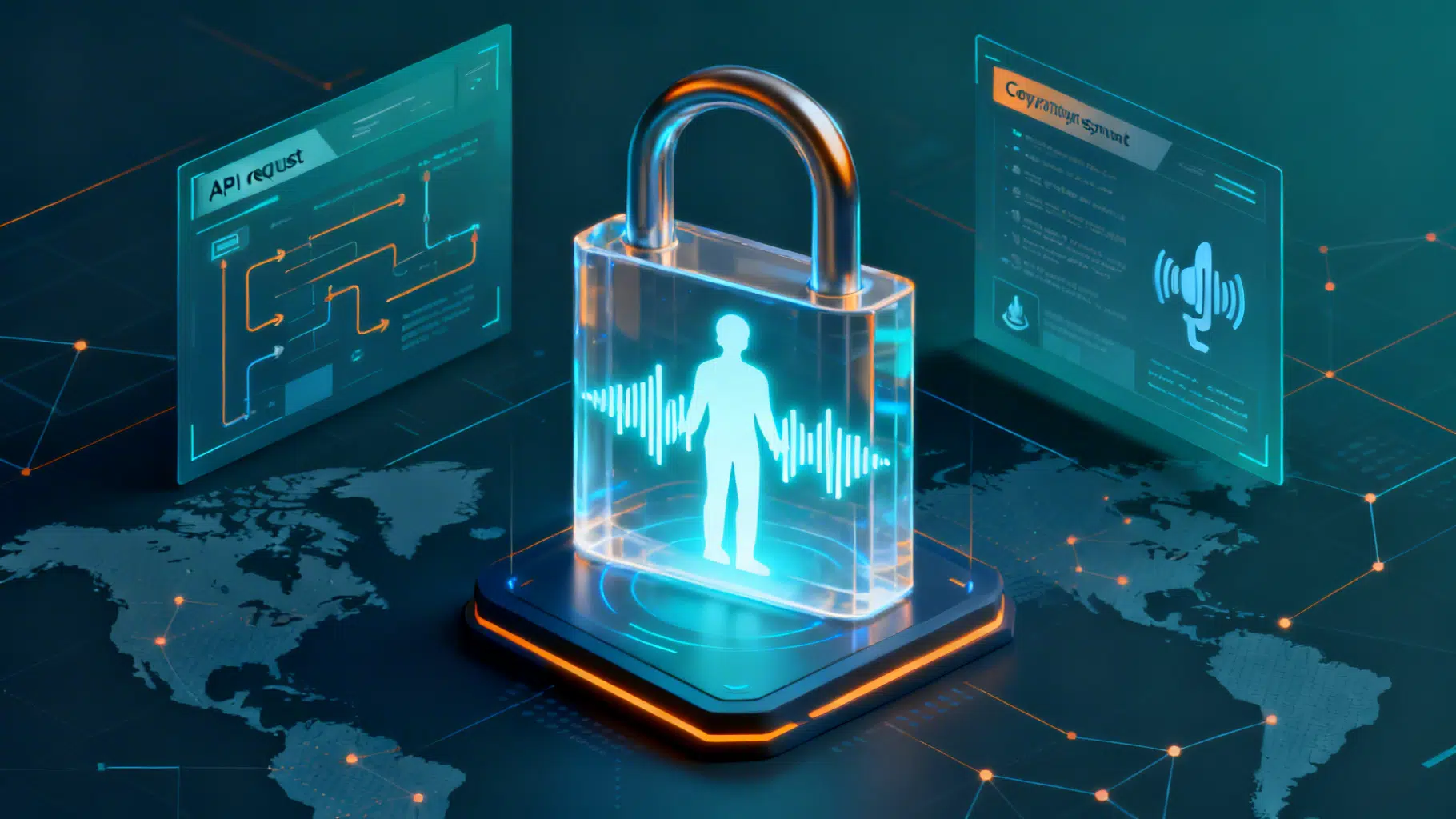
Image used for representation purposes only.
Why Voice Cloning APIs Demand Higher Ethical Standards
Synthetic voice has crossed a threshold: a few seconds of audio can seed a convincing clone. When packaged as an API—scalable, composable, and easily integrated—voice cloning becomes a powerful capability with asymmetric risk. The same tool that restores speech for a laryngectomy patient can also enable financial fraud, defamation, and political manipulation. This article presents a practical, ethics-first blueprint for building and consuming AI voice cloning APIs responsibly.
What Makes Voice Different
- Identity: A voice functions as a biometric and a social signature; it conveys identity, emotion, and intent.
- Permanence: People cannot realistically “rotate” their voice like a password; compromise has long-tail consequences.
- Social trust: Humans rely on vocal cues for authenticity. High-fidelity clones exploit this bias.
- Low-friction scaling: APIs abstract away complexity, enabling rapid integration and mass distribution.
These traits elevate the ethical bar beyond generic text synthesis.
Core Ethical Principles
- Informed, verifiable consent from the voice owner, specific to purpose and duration.
- Purpose limitation and data minimization across collection, training, and generation.
- Transparency to end users and listeners that a voice is synthetic.
- Safety-by-design: proactive, layered controls that prevent foreseeable harm.
- Accountability: auditability, red-teaming, and clear incident response.
- Fairness and accessibility: maximize beneficial uses while mitigating disparate harms.
Legitimate and High-Risk Use Cases
Beneficial scenarios:
- Assistive communication (ALS, aphasia), voice banking, and rehabilitation.
- Dubbing with consent for education, accessibility, and localization.
- Creative projects where the performer opts in and retains control.
High-risk or typically prohibited scenarios:
- Impersonation of any individual without proof of authorization.
- Political persuasion, fundraising, or news-like content without explicit disclosure and consent.
- Financial fraud vectors (customer support spoofing, account recovery calls).
- Cloning of minors’ voices except under stringent parental/guardian consent and safeguards.
Legal Context (Non-Legal Advice)
Regulatory landscapes vary and evolve. Key themes include:
- Privacy and data protection: requirements for lawful basis, purpose limitation, and data subject rights (e.g., access, deletion).
- Biometric/voiceprint rules: storage, security, retention limits, and breach duties in some jurisdictions.
- Publicity and personality rights: control over commercial use of one’s voice and likeness.
- Consumer protection and advertising law: deception and disclosures.
Build for compliance by design, not as an afterthought.
Safety-by-Design for API Providers
- Consent and Identity Verification
- Mandatory consent capture with traceable artifacts: signed text, video consent, or interactive spoken consent tied to a verification flow.
- Voice owner enrollment: gather reference samples plus a government-ID or identity-proofing step commensurate with risk.
- Purpose-scoped grants: consent tokens that enumerate allowed uses (e.g., audiobook, accessibility), expiration, and revocation URLs.
- Revocation-first UX: simple mechanisms to pause or permanently withdraw consent across all downstream consumers.
- Anti-Impersonation Controls
- Default denial for attempts to clone a voice that matches known public figures or enrolled “protected voices.”
- Speaker-similarity thresholds and active liveness checks to prevent replay enrollment.
- Enterprise gating for sensitive features (zero-shot cloning, high-fidelity timbre transfer).
- Transparency and Disclosure
- Built-in watermarking of synthetic audio and cryptographic provenance metadata.
- SDK components that inject audible cues or short disclosures at call start in telephony contexts.
- Required on-screen labels and transcript markers in UIs.
- Guardrails in the Generation Pipeline
- Content classification before and after synthesis (e.g., hate, threats, scams) with policy-aware blocks.
- Real-time risk scoring: rate-limit or halt sessions exhibiting fraud patterns (e.g., bank IVR prompt mimicry).
- Geo and time-based controls (elections, emergencies) where applicable.
- Security and Data Governance
- Encrypt at rest/in transit; isolate voiceprints and consent artifacts with strict access controls.
- Data minimization: store only what’s necessary; configurable retention windows; irreversible deletion on revocation.
- Secrets hygiene for API keys; support OAuth2/OIDC and per-user scoping to map voice actions to actors.
- Accountability
- Comprehensive logging of enrollment, generation, and moderation decisions.
- Periodic independent audits; red-teaming and bounty programs targeting voice abuse.
- Public transparency reports on blocked attempts and law-enforcement requests.
Technical Safeguards That Actually Work
- Robust audio watermarking: embed a resilient, imperceptible signal that survives common transformations (compression, trimming). Pair with open verification tools.
- Provenance metadata: attach signed manifests (e.g., C2PA-like) stating model, provider, time, and policy claims; verify at distribution and playback.
- Speaker verification and similarity limits: prevent clones of protected voices; require stronger consent for high-similarity outputs.
- Liveness and challenge-response: randomized phrases during enrollment to defeat replay.
- Abuse heuristics: detect scripts targeting high-value phrases (“wire transfer,” “reset my password”).
- Canary outputs: optional audible chimes at intervals for real-time contexts like phone trees.
Example: Policy as Code
Below is a simplified policy artifact that providers can enforce at the edge and expose to developers.
{
  "version": "2026-03-01",
  "voice_enrollment": {
    "required": true,
    "identity_proof": "level_2",
    "min_samples_sec": 15,
    "liveness_check": true
  },
  "consent": {
    "token_required": true,
    "scopes": ["accessibility", "education", "creative"],
    "revocation_url": "https://provider.example/revoke/{token_id}",
    "expires_max_days": 365
  },
  "safety": {
    "protected_voices": "block",
    "similarity_threshold": 0.82,
    "content_moderation": ["fraud", "hate", "violence"],
    "election_blackout_days": 5
  },
  "provenance": {
    "audio_watermark": "enabled_strong",
    "manifest": {
      "issuer": "provider.example",
      "sign": true,
      "fields": ["model_id", "timestamp", "policy_hash", "requester_id"]
    }
  },
  "security": {
    "store_voiceprints": "encrypted_separate",
    "retention_days": 90,
    "min_auth": "oauth2_user_scope",
    "ip_rate_limit_per_min": 60
  },
  "observability": {
    "generation_logs": "immutable_1y",
    "anomaly_detection": true,
    "alert_on_protected_match": true
  },
  "blocked_use_cases": [
    "non-consensual impersonation",
    "political_persuasion_without_disclosure",
    "financial_fraud_vectors"
  ]
}
Consent Tokens: A Practical Pattern
Use tamper-evident tokens to bind a voice owner’s grant to specific purposes and time windows.
{
  "iss": "voice-provider.example",
  "sub": "voice_owner_9fa1",
  "aud": "voice-api",
  "grant_purposes": ["audiobook_en-US"],
  "voiceprint_hash": "vph_sha256_...",
  "representative": { "name": "Agent LLC", "role": "talent_manager" },
  "constraints": { "region": ["US", "CA"], "max_output_hours": 10 },
  "iat": 1742600000,
  "exp": 1774136000,
  "revocation": "https://provider.example/revoke/abc123",
  "sig": "ed25519:..."
}
Implementation notes:
- The token refers to a registered voiceprint; the provider enforces purpose and region.
- Revocation lists are checked at generation time, not just enrollment.
- For minors or incapacitated individuals, require guardian authorization with higher assurance.
Developer Responsibilities When Integrating the API
- Collect and verify consent before enrollment or generation; store the consent artifact ID, not raw PII where possible.
- Communicate clearly to end users and audiences. Use visible labels, audible notices, and documentation.
- Respect revocations immediately. Build admin tooling to trace and delete dependent assets.
- Disable or gate real-time cloning features in high-risk contexts (customer service, account recovery).
- Keep humans in the loop for edge cases and appeals.
- Log with purpose: record who requested what voice, why, and the outcome; avoid logging raw audio unless required.
Data Sourcing and Model Training
- Datasets: source from licensed, consented, or public-domain material with use aligned to creators’ expectations.
- Diversity: include accents, ages, and languages in a way that avoids stereotyping and accommodates accessibility.
- Exclusion: honor do-not-train and takedown requests; remove minors’ data unless verifiably consented.
- Retention: document how training data and embeddings can be removed or deprecated after revocation.
UX and Disclosure Patterns
- Synthetic voice badge and tooltip explaining the technology.
- First-utterance disclosure in telephony (“This call uses a synthetic voice for accessibility”).
- Watermarked downloads by default; unwatermarked exports require elevated review and additional justification.
Auditing, Red-Teaming, and Transparency
- Pre-deployment: simulate fraud calls, political propaganda, and celebrity impersonations to test guardrails.
- Post-deployment: monitor false positives/negatives; publish aggregate stats on blocked attempts and appeals.
- Incident response: documented playbooks, customer notification timelines, and remediation steps.
Measuring Success Ethically
Track not just latency and cost but also:
- Percentage of generations with validated consent.
- Rate of blocked high-risk attempts and time to mitigation.
- Revocation SLA compliance and deletion verification.
- Watermark verification pass rate in the wild.
Quick Checklist
- Do we have verifiable, purpose-bound consent for this voice?
- Are anti-impersonation and similarity thresholds active and tested?
- Is every output watermarked and provenance-signed by default?
- Can the voice owner revoke, and can we propagate that across all assets?
- Have we documented retention, deletion, and incident response?
- Are disclosures clear to both users and listeners?
- Have we conducted red-team scenarios relevant to our domain?
Conclusion
Voice cloning APIs can amplify human capability—or erode trust. The difference lies in design choices: consent as a first-class citizen, layered safeguards, and transparent governance. Treat voice as the sensitive biometric it is, prove your stewardship with policy and code, and make the ethical path the easiest path.
Related Posts

iOS 26.4 Beta: What to Expect, How to Test, and Best Practices
A comprehensive guide to iOS 26.4 beta: features, testing steps, and safety tips for developers and enthusiasts.

The Engineer’s Guide to Multi-Modal AI API Integration
A practical, production-ready guide to integrating multi-modal AI APIs—covering architecture, streaming, function calling, safety, cost, and reliability.

LLM Prompt Engineering Techniques in 2026: A Practical Playbook
A 2026 field guide to modern LLM prompt engineering: patterns, multimodal tips, structured outputs, RAG, agents, security, and evaluation.