
React Context vs Redux in 2026: a practical, up-to-date comparison
React Context vs Redux in 2026: when to pick each, how React 19 changes things, performance trade-offs, and code you can ship today.
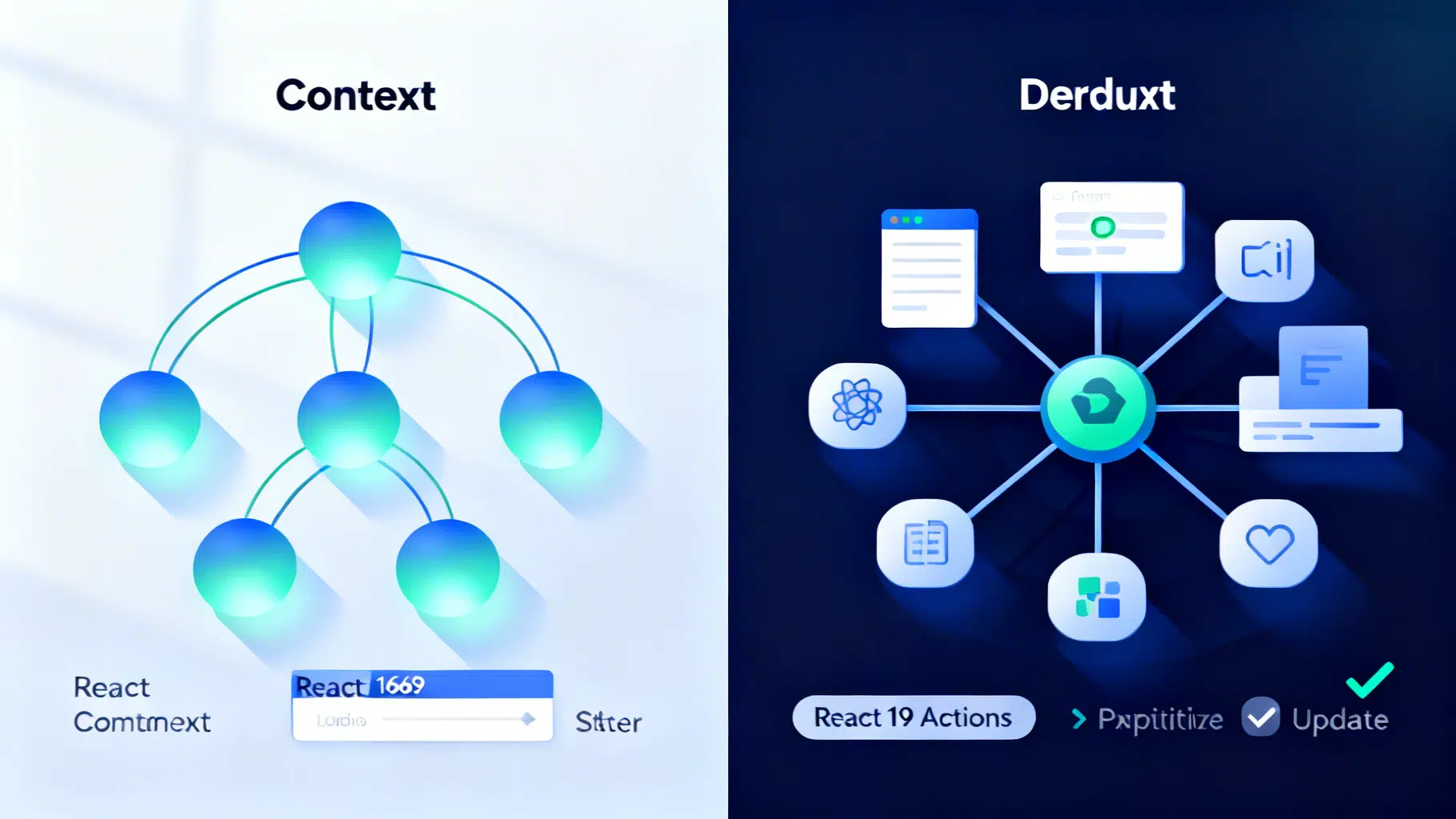
Image used for representation purposes only.
React Context vs Redux in 2026: how to choose with React 19
React’s state story evolved rapidly between 2024 and 2026. React 19 shipped new form “Actions,” useActionState, useFormStatus, and useOptimistic, while React 19.2 added features like <Activity /> and Partial Pre-rendering. In February 2026, stewardship moved from Meta to the React Foundation under the Linux Foundation, signaling long-term neutrality and stability. These shifts don’t deprecate Context or Redux—but they do change when each makes sense. (react.dev
)
This guide compares React Context and Redux (via Redux Toolkit) as they stand in early 2026, and offers clear decision rules, performance notes, and code snippets you can drop into real projects.
First principles: classify your state before you pick a tool
Not all state is the same. Classify it first:
- Local UI state: ephemeral values tied to one component (input text, open/closed toggles). Use React state.
- Global client state: user/session objects, feature flags, cross-page carts, wizard progress. Consider Context (low-churn) or Redux (complex/high-churn).
- Server state: data fetched from APIs that must cache, refetch, and stay fresh. Prefer a server-state library such as TanStack Query or RTK Query. TanStack Query explicitly positions itself as server-state, not a client-state replacement. (tanstack.com )
React 19’s Actions-based forms reduce a chunk of “temporary client state” you previously held just to manage submissions, pending states, optimistic updates, and errors. That can simplify both Context- and Redux-heavy apps. (react.dev )
React Context in 2026: strengths and limits
What it is: a way to pass data through the tree without prop drilling. Any component calling useContext(SomeContext) will re-render when the provider’s value changes (compared with Object.is). This is ideal for low-frequency, ambient values such as theme, i18n, or a stable user/session reference. (react.dev
)
Practical patterns and caveats:
- Re-render boundaries: changing the
valueforces all consumers to update; wrap functions inuseCallbackand memoizevalueobjects withuseMemoto avoid unnecessary re-renders. (react.dev ) - Many contexts > one mega-context: split unrelated concerns (theme, locale, feature flags) into separate providers to minimize invalidations. (react.dev )
- High-churn data: frequent updates (e.g., typing-driven filters) can cause broad re-renders; prefer an external store pattern for selective subscriptions.
When Context shines
- Ambient config (theme, locale, permissions gates)
- Stable service dependencies (analytics client, logger)
- Small apps where global updates are rare
Redux Toolkit in 2026: the default Redux experience
Redux in 2026 is “Redux Toolkit + React-Redux,” not hand-rolled reducers and createStore. RTK 2.0 and Redux 5.0 modernized packaging and added quality-of-life APIs like combineSlices for code-split reducers; React-Redux 9 aligns with these releases. (redux-toolkit.js.org
)
Key advantages today
- Predictable updates with time-travel DevTools, middleware, and strong TypeScript ergonomics (
createSlice, Immer). (redux-toolkit.js.org ) - Selective re-renders: React-Redux provides the store via context but subscribes components with
useSelector, avoiding tree-wide invalidations. Internally it uses subscription wrappers anduseSyncExternalStore, so components re-render only when their selected slice changes. (react-redux.js.org ) - Server-state integration: RTK Query coexists with client-state slices, caching API data in the Redux store and reducing boilerplate for fetching, invalidation, and background refetch. (redux-toolkit.js.org )
- Modern frameworks: Official guidance for Next.js App Router and React Server Components is current as of February 8, 2026. (redux-toolkit.js.org )
What changed recently
- RTK 2.0 / Redux 5.0: modern ES2020 targets, breaking-change cleanup, and a new
combineSlicesAPI that simplifies lazy-loaded reducers in large apps. (redux-toolkit.js.org )
Concurrency note
- External-store subscriptions (
useSyncExternalStore) can interact with concurrent features like transitions; React Labs has discussed trade-offs. In most line-of-business apps the ergonomics and DevTools outweigh this, but it’s good to be aware when heavy transitions are central to UX. (react.dev )
Performance: Context vs Redux
- Context: provider updates propagate to all consumers; optimization requires splitting contexts and memoizing values. Great for low-churn state; less ideal for high-frequency updates that touch many components. (react.dev )
- Redux Toolkit: components subscribe to selected slices; only consumers of changed data re-render. This pattern scales better for high-churn global state in complex apps. (react-redux.js.org )
Decision guide for 2026
Choose Context if:
- The data is ambient and rarely changes (theme, locale, feature flags).
- You want minimal dependencies and a tiny mental model.
Choose Redux Toolkit if:
- You manage complex, frequently updated, cross-cutting state (carts, permissions, multi-step wizards, cross-tab sync, offline queues).
- You need time-travel debugging, middleware, or standardized patterns for teams.
- You’re already using RTK Query and want one consolidated state layer.
For server state:
- Prefer TanStack Query or RTK Query; both solve caching, deduping, background refresh, and mutations better than ad hoc Context or reducers. (tanstack.com )
Code: one app, three layers (Context + RTK + RTK Query)
Ambient theme via Context (low-churn):
// theme-context.tsx
import { createContext, useMemo, useState, useContext } from 'react'

type Theme = 'light' | 'dark'
const ThemeContext = createContext<{ theme: Theme; setTheme: (t: Theme) => void } | null>(null)

export function ThemeProvider({ children }: { children: React.ReactNode }) {
  const [theme, setTheme] = useState<Theme>('light')
  const value = useMemo(() => ({ theme, setTheme }), [theme])
  return <ThemeContext.Provider value={value}>{children}</ThemeContext.Provider>
}

export const useTheme = () => {
  const ctx = useContext(ThemeContext)
  if (!ctx) throw new Error('useTheme must be used within ThemeProvider')
  return ctx
}
High-churn client state via Redux Toolkit:
// store.ts
import { configureStore, createSlice, PayloadAction } from '@reduxjs/toolkit'

interface CartItem { id: string; qty: number }
const cartSlice = createSlice({
  name: 'cart',
  initialState: [] as CartItem[],
  reducers: {
    add(state, action: PayloadAction<{ id: string }>) {
      const found = state.find(i => i.id === action.payload.id)
      found ? (found.qty += 1) : state.push({ id: action.payload.id, qty: 1 })
    },
    remove(state, action: PayloadAction<{ id: string }>) {
      return state.filter(i => i.id !== action.payload.id)
    },
  },
})

export const { add, remove } = cartSlice.actions
export const store = configureStore({ reducer: { cart: cartSlice.reducer } })
export type RootState = ReturnType<typeof store.getState>
Server state via RTK Query:
// api.ts
import { createApi, fetchBaseQuery } from '@reduxjs/toolkit/query/react'

export const api = createApi({
  baseQuery: fetchBaseQuery({ baseUrl: '/api' }),
  endpoints: builder => ({
    getProducts: builder.query<{ id: string; name: string }[], void>({
      query: () => '/products',
    }),
  }),
})
export const { useGetProductsQuery } = api
// integrate RTK Query + store
import { configureStore } from '@reduxjs/toolkit'
import { api } from './api'
import cartReducer from './cartSlice'

export const store = configureStore({
  reducer: { [api.reducerPath]: api.reducer, cart: cartReducer },
  middleware: getDefault => getDefault().concat(api.middleware),
})
With this split, theme changes don’t invalidate cart subscribers, and product queries are cached and refreshed automatically.
React 19 effects: implications for state choice
- Forms and mutations: Client/Server Actions and
useActionStatereduce the boilerplate for pending/error/optimistic flows. You’ll often remove “helper” client state you previously managed with Context or Redux. (react.dev ) - Concurrency: React-Redux relies on
useSyncExternalStoreunder the hood, which has known trade-offs with transitions. For apps leaning heavily on transitions-as-UX, measure before you commit. (react-redux.js.org )
Security note: If you use React Server Components, ensure you’ve patched December 2025 vulnerabilities; React lists safe versions 19.0.4, 19.1.5, and 19.2.4. (react.dev )
Migration tips (2026-ready)
- Start small: keep local state local; add Context for ambient values only.
- Add a server-state library early: TanStack Query or RTK Query will save you from ad hoc caching logic. (tanstack.com )
- Escalate to Redux Toolkit when:
- Updates are frequent and cross-cutting.
- You need DevTools, middleware, undo/redo, or time-travel debugging.
- Multiple teams need a shared, explicit dataflow contract.
- Large apps: adopt RTK 2.0 features like
combineSlicesto lazy-load reducers and keep bundles lean. (redux-toolkit.js.org )
Bottom line
- Use Context for low-churn, ambient state and dependencies.
- Use Redux Toolkit for complex, high-churn global client state, especially in multi-team or enterprise codebases.
- Use TanStack Query or RTK Query for server state.
- Factor in React 19 Actions to delete unneeded “form plumbing” state.
With React now governed by the React Foundation and React 19.x features stabilizing, both Context and Redux remain first-class choices in 2026—so long as you apply them to the right kind of state. (react.dev )
Related Posts
React Hydration Mismatch: A Practical Debugging Guide
Learn how to diagnose and fix React hydration mismatches with step-by-step checks, common causes, and production-safe patterns for SSR and Next.js.

React Streaming SSR with Next.js: A Practical Tutorial
Build a fast, progressive UI with React streaming SSR in Next.js. Learn Suspense, loading UIs, error boundaries, and streaming APIs with clear examples.

React Optimistic UI Updates: A Practical, Fail‑Safe Tutorial
Build fast, resilient optimistic UI updates in React. Learn patterns, rollback, and examples using plain hooks and TanStack Query.