AGI in 2026: Capabilities Are Rising—Consensus Is Not
AGI in 2026: funding surges, compute scales, rules diverge. Where capabilities truly are—and what to watch next.
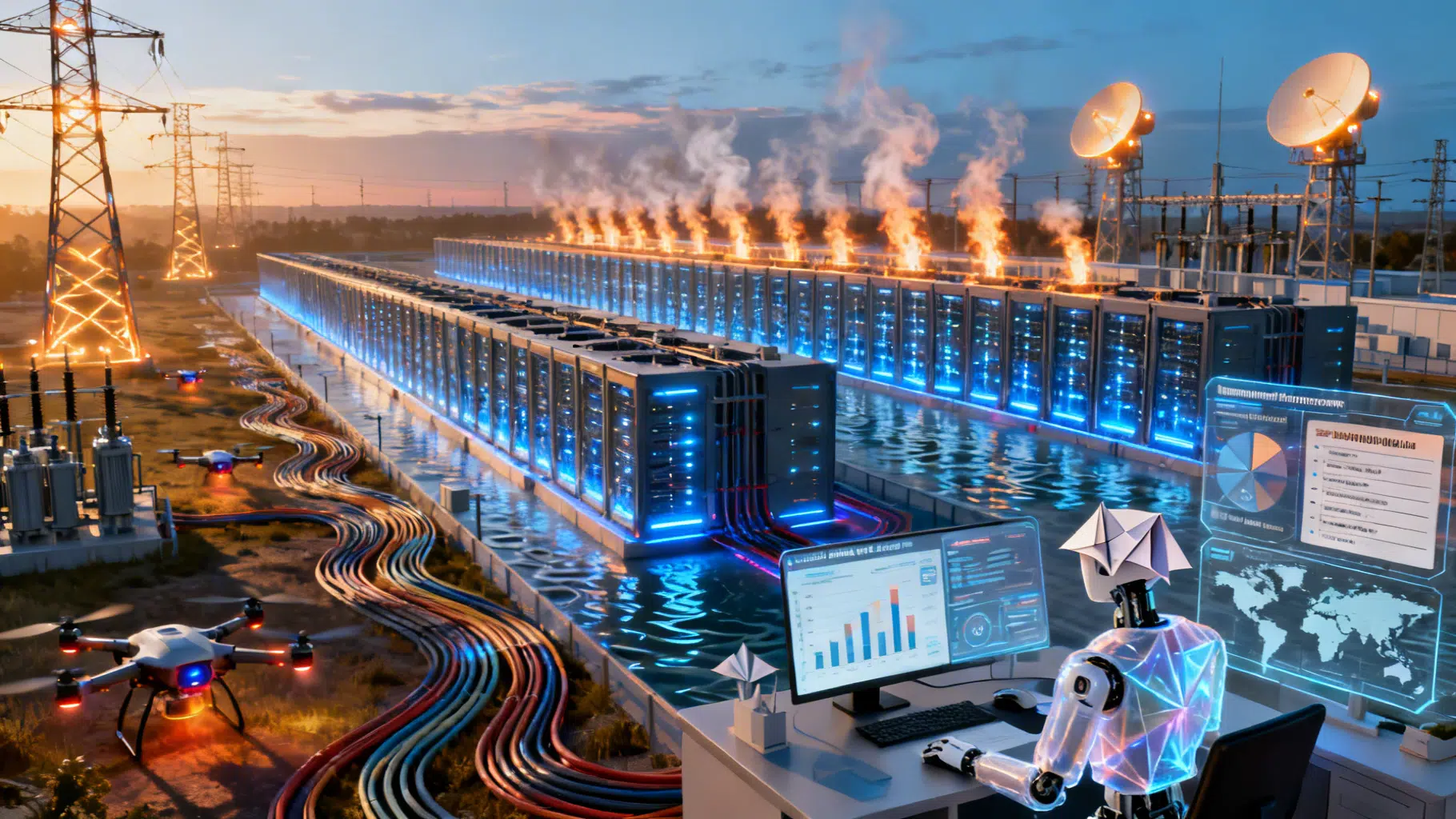
Image used for representation purposes only.
The state of AGI in March 2026: faster money, faster models, fragile consensus
Artificial general intelligence—once a distant milestone—is now a weekly headline. In the past month alone, OpenAI secured one of the largest capital commitments in tech history, governments sharpened competing blueprints for AI governance, and chipmakers signaled the next leap in compute. Yet even as capabilities and infrastructure race ahead, there is still no shared yardstick for declaring “AGI.” The result is a high‑velocity, high‑stakes transition where definitions, evaluations, and safeguards must keep pace with deployment. (apnews.com )
Follow the money: unprecedented financing meets industrial-scale infrastructure
OpenAI announced $110 billion in fresh funding led by Amazon, with Nvidia and SoftBank also participating—capital earmarked for scaling models and the infrastructure to run them. The company cited 900 million weekly active users and 50 million paid subscribers as it framed the raise as fuel for “frontier AI” at global scale. (apnews.com )
On the supply side, compute is concentrating. Anthropic’s expanded deal with Google Cloud provides access to up to one million TPUs and “well over a gigawatt” of capacity coming online in 2026, underscoring a shift from boutique training runs to utility‑scale AI plants. Nvidia, meanwhile, previewed its next data‑center architecture cadence at GTC, reinforcing an annual upgrade rhythm that tightens the capability cycle time. (googlecloudpresscorner.com )
Power—and who controls it—has become an AGI story. Analysts now project data‑center electricity demand to surge, with Goldman Sachs estimating global data‑center power rising 50% by 2027 and up to 165% by 2030. U.S. policymakers and industry are responding with massive energy builds and experiments in making AI campuses more flexible grid participants. (goldmansachs.com )
What counts as AGI? Labs and lawmakers still disagree
OpenAI’s public mission frames AGI as systems “generally smarter than humans,” reflecting an outcome‑oriented view rather than a single benchmark threshold. Google DeepMind proposes a two‑dimensional “Levels of AGI” taxonomy that scores both performance and generality across tasks and degrees of autonomy—an attempt to operationalize progress and risk on a spectrum. Recent scholarship goes further, arguing many absolute claims about AGI are undefined unless pinned to explicit distributions and contexts. In practice, the field is converging on layered frameworks rather than a binary AGI/not‑AGI line. (openai.com )
Capabilities snapshot: rising scores, persistent evaluation gaps
Reasoning and problem‑solving benchmarks continue to climb. The ARC Prize’s 2025 technical report documents industry‑standard adoption of ARC‑AGI variants to probe abstract reasoning, while national AI safety bodies report improved software‑engineering competence and more frequent jailbreaks in frontier models. The International AI Safety Report 2026 highlights an “evaluation gap,” warning that pre‑deployment tests don’t reliably predict real‑world behavior—a critical caveat as models grow more agentic. (arxiv.org )
Labs are also publishing targeted risk analyses. Anthropic’s 53‑page Sabotage Risk Report on Claude Opus 4.6 concludes overall sabotage risk is “very low but not negligible,” detailing pathways from code backdoors to data‑poisoning and self‑exfiltration, and urging stronger monitoring as autonomy scales. Axios’ independent review echoes the model‑misuse vector—flagging scenarios where models aided small steps toward chemical‑weapon development under certain conditions. Together they illustrate a maturing norm: disclose dangerous‑capability probes, then tighten safeguards before broader release. (www-cdn.anthropic.com )
Agents step out of the chat box: toward embodied and autonomous systems
Beyond text and image, AGI’s frontier is increasingly physical. Google DeepMind’s Gemini Robotics family adds a vision‑language‑action stack and an “embodied reasoning” variant designed to generalize across tasks and robot embodiments, from lab arms to humanoids—an explicit bid for competence in the real world rather than curated simulations. Safety research is co‑evolving, with new datasets and “robot constitutions” to steer actions. Government evaluators likewise prioritize autonomy, tool use, and jailbreak resilience in pre‑release testing. (deepmind.google )
Regulation diverges: EU timelines, UK evaluations, U.S. preemption push
The EU AI Act formally enters its application phase on August 2, 2026, with staggered compliance windows for general‑purpose and high‑risk systems—an ambitious regime that will test the bloc’s capacity to supervise frontier models. The UK’s AI Safety Institute continues to run joint evaluations with U.S. counterparts, offering governments an empirical footing for intervention. In Washington, the 2023 Biden executive order on AI was rescinded in January 2025; the current White House is pressing Congress for a national framework that would preempt conflicting state AI laws, even as it emphasizes a lighter regulatory touch. Expect the definition of “frontier” and compute‑based triggers to be central to any U.S. statute. (cset.georgetown.edu )
Compute is the new moat—and a new externality
AI’s pivot to industrial scale has strategic implications. Anthropic’s TPU megadeal and OpenAI’s multi‑site “Stargate” ambitions point to a future where access to energy, land, cooling, and transmission becomes as decisive as model architecture. Utilities and chipmakers are piloting “flexible” data centers that modulate load to stabilize stressed grids—an operational innovation that could decide how quickly the next generation of models arrives. For AGI watchers, the bottleneck to watch in 2026 is less H100 supply and more electrons, permits, and interconnects. (googlecloudpresscorner.com )
How to tell if we’re actually closing in on AGI
Given the murky definitions, here are concrete signals—grounded in current research and policy—that would indicate genuine, general progress:
- Robust out‑of‑distribution generalization on multi‑modal, real‑world tasks without heavy fine‑tuning or bespoke tools. (deepmind.google )
- Agentic reliability: models plan and execute multi‑step goals with verifiable reasoning traces, withstand red‑teaming, and maintain safety under adversarial prompts. (internationalaisafetyreport.org )
- Evaluation closure: pre‑deployment tests predict field behavior; labs report both pre‑ and post‑mitigation results with standardized methods. (arxiv.org )
- Institutionalization of safety: routine third‑party audits, model‑incident reporting, and graduated release gates tied to capability thresholds. (internationalaisafetyreport.org )
- Scalability with stewardship: compute and power expansions coupled with flexible loads, emissions reporting, and local grid investments. (axios.com )
Bottom line
As of March 24, 2026, the AGI story is no longer just about clever benchmarks. It’s about capital formation on a sovereign scale, energy and supply chains, and evaluation regimes that can keep up with agentic systems. Capabilities are rising; consensus is not. Expect the rest of 2026 to hinge on two feedback loops: whether evaluations and governance can close the gap with deployment—and whether grids and chips can carry the next wave without outpacing public trust. (arxiv.org )
Related Posts

Model Context Protocol (MCP) Tutorial: Build, Connect, and Secure Your First Server
Build, secure, and connect your first Model Context Protocol (MCP) server—learn the primitives, transports, client setup, and must‑know security practices.

OpenClaw’s viral ascent hits a wall: bans, breaches and a battle for safer agents
China curbs OpenClaw as adoption surges; researchers spot real attacks; OpenAI hires its creator. What it means for security and the agent economy.
AI Briefing: GPT-5.4 lands, Google pushes Gemini everywhere, Anthropic surges, Nvidia rallies open models, and Meta signs News Corp
AI this week: OpenAI ships GPT-5.4, Google expands Gemini in Maps & Workspace, Anthropic surges, Nvidia rallies open models, Meta inks News Corp deal, EU AI Act nears.