
Flutter vs React Native in 2026: The Pragmatic Buyer’s Guide
Flutter vs React Native in 2026: architecture, performance, tooling, and when to choose each—concise, current, and practical.
ASOasis
6 min read
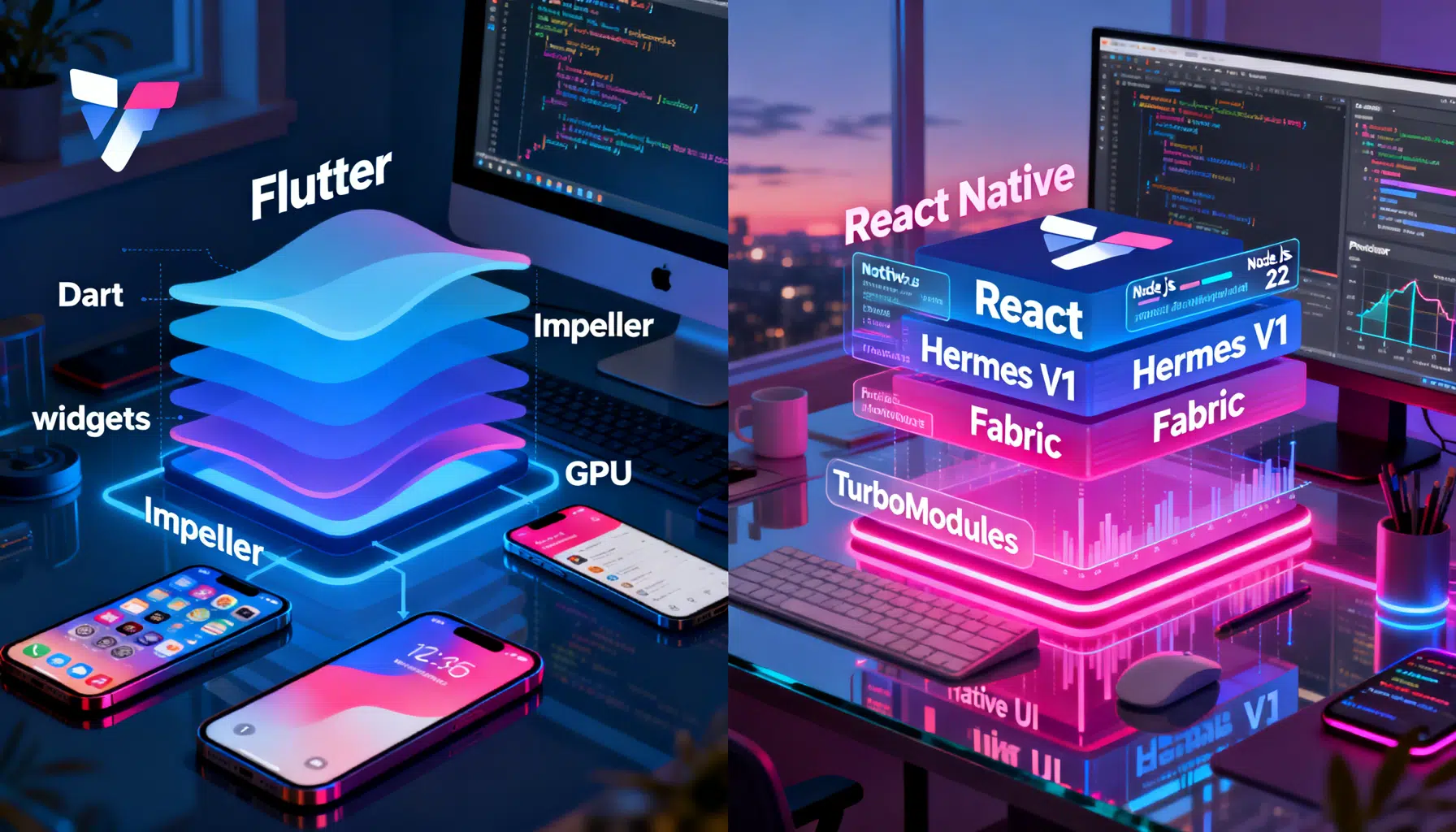
Image used for representation purposes only.
TL;DR
- Flutter delivers uniform, highly-performant UIs with its Impeller renderer now default on iOS and modern Android (API 29+). It shines for pixel‑perfect design systems and ambitious desktop targets alongside mobile. (docs.flutter.dev )
- React Native’s New Architecture is the default, and Hermes V1 is now the default JS engine (as of React Native 0.84), tightening performance and modernizing tooling. If you live in the React/TypeScript ecosystem or need deep native parity, RN is compelling in 2026. (reactnative.dev )
What changed since 2024–2025
- React Native 0.76 made the New Architecture (Fabric renderer, TurboModules, JSI) the default, plus shipped React Native DevTools. 0.77 added major styling features and Android 16KB page support. In February 2026, 0.84 set Hermes V1 as the default and raised the Node.js minimum. (reactnative.dev )
- Flutter’s Impeller renderer is now the default on iOS and on Android 10+ devices, with fallbacks for older Android; official docs also outline flags to temporarily disable it during debugging if needed. (docs.flutter.dev )
- Dart reached 3.11 on February 11, 2026, continuing steady improvements to tooling and language features. (dart.dev )
Architectural differences that matter in 2026
-
Rendering and UI layer
- Flutter renders its own widgets via Skia/Impeller, giving consistent visuals across platforms and tight control over animation and layout. This reduces platform-specific UI drift and makes design-system implementation straightforward. (docs.flutter.dev )
- React Native renders to native UI components. With the New Architecture’s Fabric renderer and JSI, it minimizes serialization overhead and improves synchronization between JS and native, while preserving platform-native look and feel. (reactnative.dev )
-
Language/runtime
- Flutter compiles Dart ahead-of-time (AOT) for release, and hot-reloads in development. Dart 3.x maturity in 2025–2026 improved tooling and language clarity for large codebases. (dart.dev )
- React Native runs JavaScript with Hermes. As of 0.84, Hermes V1 is default, bringing notable runtime/VM improvements without app-level migration work. (reactnative.dev )
Performance and stability
- Flutter
- Impeller eliminates shader-jank by precompiling a smaller set of shaders and leaning on modern GPU APIs (Metal/Vulkan). On Android API 29+, it’s enabled by default; older or incompatible devices fall back automatically. For edge cases, you can disable Impeller during debugging or at deploy time. (docs.flutter.dev )
- React Native
- The New Architecture removes the legacy bridge bottleneck, enabling more direct, synchronous interactions between JS and native via JSI/TurboModules and a modern renderer (Fabric). 0.77’s Android 16KB page support preempted Play requirements on newer devices; Hermes V1 in 0.84 further reduces execution and memory overhead. (reactnative.dev )
Developer experience (DX) and tooling
- Flutter
- A cohesive SDK, first‑party tooling (flutter CLI, DevTools), and a single widget model across mobile, web, and desktop. The uniformity shortens feedback loops for design-heavy teams and simplifies multi-target builds. Official docs cover desktop builds for Windows, macOS, and Linux. (docs.flutter.dev )
- React Native
- First‑party React Native DevTools (0.76) replaced a patchwork of debugging paths, aligning with Chrome DevTools Protocol. The ecosystem around Metro, Expo, and platform templates has modernized; 0.77 introduced a Swift iOS template and expanded CSS-like styling. Hermes V1 (0.84) is on by default, and iOS prebuilt binaries reduce clean-build times. (reactnative.dev )
Ecosystem and libraries
- Flutter
- Pub.dev offers a broad package catalog covering UI kits, charts, storage, and platform integrations. Where platform features diverge, method channels and federated plugins bridge gaps. Desktop coverage has matured, but you should still audit plugins for each desktop OS you target. Official guidance details platform support tiers. (docs.flutter.dev )
- React Native
- The web-scale React ecosystem (state, networking, testing) ports cleanly. Many popular RN libraries now target the New Architecture; still, verify Fabric and TurboModules support during upgrades. The React Native Windows/macOS teams have also moved the desktop ports forward with the New Architecture enabled by default in current Windows releases. (devblogs.microsoft.com )
Web and desktop reach
- Flutter
- Strong first-party story for desktop (Windows, macOS, Linux) and web (CanvasKit/SKWASM), sharing a single UI layer and build system. This is attractive for design-system consistency across screens. (docs.flutter.dev )
- React Native
- RN Web is a separate community effort focused on web parity for many primitives; React Native Windows and macOS are maintained by Microsoft, with active 2025–2026 releases aligned with upstream. Evaluate your surface area (native modules, accessibility, input devices) early. (devblogs.microsoft.com )
Team skills, hiring, and ramp-up
- Choose Flutter if your org values a consistent UI model across platforms and can invest in Dart. Designers and prototypers often appreciate Flutter’s rapid iteration and fine-grained control.
- Choose React Native if your org is already deep in React/TypeScript, uses shared UI/state logic with the web app, or depends on best-in-class native components and platform behaviors.
Maintenance and upgrade reality in 2026
- Flutter
- Upgrades are generally smooth within the same major line; when renderer or platform changes land, read the release notes and test on a device matrix. The Impeller doc details how to opt out on Android when diagnosing issues. (docs.flutter.dev )
- React Native
- The pace is brisk. Since 0.76, changes to minimum iOS/Android SDKs, library merging on Android, and Hermes evolution require careful reading of release notes and using the RN Upgrade Helper. Expect a short stabilization window after each major bump. (reactnative.dev )
Cost, performance, and product fit: a quick decision guide
- Pick Flutter when:
- You must guarantee identical visuals across iOS/Android/desktop, including advanced custom graphics and motion.
- You want one rendering stack and predictable performance characteristics.
- You plan to ship desktop clients with a shared codebase.
- Pick React Native when:
- Your team lives in React/TypeScript and shares domain/UI logic with the web.
- Your product needs native platform look-and-feel, newest platform APIs, or niche native SDKs.
- You value incremental adoption (embedding screens into existing native apps) and broad hiring pools.
Practical recommendations for new projects in 2026
- Mobile + desktop parity with a tight design system: Default to Flutter; validate critical plugins per desktop OS and confirm web rendering trade-offs early. (docs.flutter.dev )
- Mobile-first with a web-heavy roadmap and React expertise: Default to React Native; standardize on the New Architecture, Hermes V1, and React Native DevTools from day one. (reactnative.dev )
- Regulated or device-integrated apps (payments, biometrics, OEM SDKs): Prefer React Native if best-in-class native components or vendor SDKs are decisive; otherwise, prototype in Flutter to assess rendering and plugin maturity.
Migration and upgrade checklist
- Flutter
- Audit target Android API levels and iOS/macOS minimums; test with Impeller on a representative device matrix. Keep a fallback plan (disable for Android) during triage. (docs.flutter.dev )
- React Native
- Read the 0.76+ and 0.84 release notes carefully; note minimum Node.js and platform SDKs. Plan a library-compatibility sweep for Fabric/TurboModules and Hermes V1. Use the RN Upgrade Helper. (reactnative.dev )
Bottom line
- In 2026, both Flutter and React Native are production‑ready across large swaths of the app spectrum. Flutter prioritizes consistent, high‑fidelity UI and multiplatform reach with a single rendering stack. React Native prioritizes native parity, React/TS developer velocity, and now benefits from a modern, bridgeless architecture and an upgraded engine by default. Your winner depends on platform mix, design demands, team skills, and the third‑party SDKs you must support.
Sources and further reading
- Flutter Impeller overview and platform defaults (updated late‑2025). (docs.flutter.dev )
- Flutter desktop support docs. (docs.flutter.dev )
- Dart 3.11 (released February 11, 2026) overview. (dart.dev )
- React Native 0.76: New Architecture by default and DevTools. (reactnative.dev )
- React Native 0.77: styling upgrades, Android 16KB page support, Swift template. (reactnative.dev )
- React Native 0.84 (February 11, 2026): Hermes V1 default, Node 22 minimum, prebuilt iOS binaries. (reactnative.dev )
Related Posts

Flutter REST API Integration: A Practical, Production-Ready Guide
End-to-end Flutter REST API integration: http vs Dio, auth, error handling, caching, pagination, testing, security, and best practices.
ASOasis
Read More
8 min

Pros and Cons of Flutter
A comprehensive exploration of Flutter’s key advantages and trade-offs for cross-platform development.
ASOasis Tech Private Limited
Read More
4 min
Flutter vs React Native: In-Depth Performance & Ecosystem Comparison
An extensive analysis of Flutter and React Native across performance benchmarks, ecosystem maturity, and developer experience.
ASOasis Tech Private Limited
Read More
4 min