
Consumer-Driven Contract Testing: A Practical Guide to Safer, Faster API Delivery
A practical guide to consumer-driven contract testing: how it works, why it matters, and how to implement it with CI/CD to ship APIs faster without breaks.
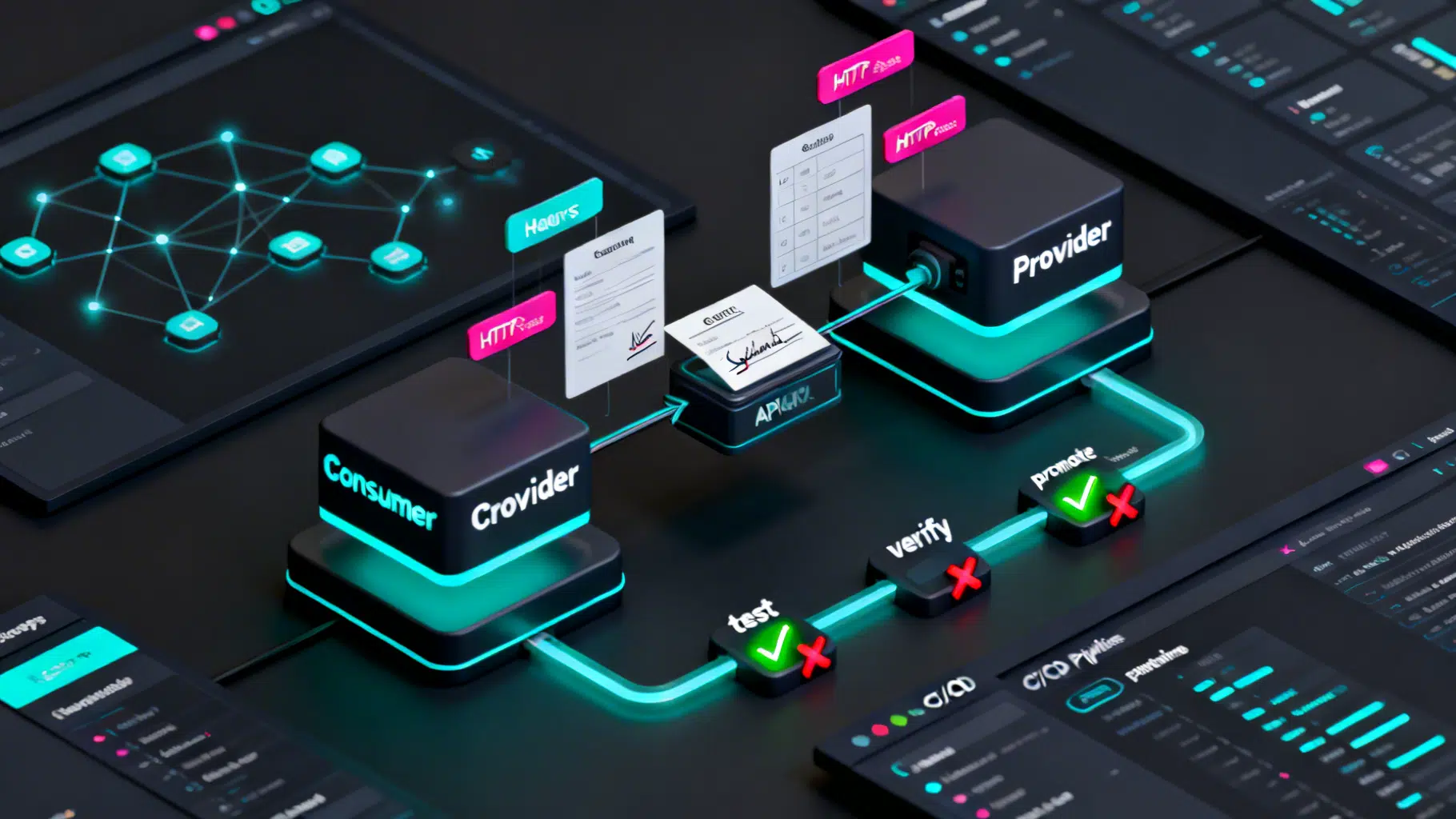
Image used for representation purposes only.
Overview
Consumer-driven contract testing (CDCT) flips the usual integration-testing model on its head. Instead of the provider dictating an API and every consumer rushing to keep up, consumers encode their expectations as executable contracts. Providers verify against those contracts in CI before shipping. The result is faster feedback, fewer surprise breaks, and a safer path to independently deployable services.
This article explains how CDCT works, when to use it, how to implement it, and where teams commonly go wrong. You’ll also find example snippets, pipeline patterns, and a pragmatic rollout checklist.
What is Consumer-Driven Contract Testing?
At its core, a “contract” is an executable artifact describing the interactions a consumer expects from a provider (e.g., requests, responses, headers, status codes, and body shapes). In a consumer-driven model:
- Consumers write tests that exercise their HTTP/gRPC/AMQP client against a local mock that records expectations.
- The tests produce a contract file (often called a “pact”).
- Contracts are published to a broker (a central registry) and tagged (e.g., main, prod, dev).
- Providers pull relevant contracts and run provider verification against a real service (or a service booted in test mode) to confirm they meet all consumer expectations.
- Deployment gates use verification results to prevent breaking changes from reaching shared environments.
CDCT can be used for HTTP/JSON, messaging (Kafka, SNS/SQS), and even GraphQL. The mechanism is the same: consumers drive, providers verify.
Why Not Just End-to-End Tests?
- Speed and determinism: End-to-end suites are slow and brittle. CDCT gives feedback in seconds or minutes inside each service’s CI pipeline.
- Change isolation: A provider can safely evolve as long as it continues to satisfy published consumer contracts. You don’t need to coordinate multi-team release trains.
- Reduced test surface: Model the interactions you actually use—not everything the provider could do.
End-to-end tests remain valuable for cross-cutting concerns (authentication, routing, SSO, real data flows). But most behavioral compatibility belongs in contracts.
Contracts vs. Schemas vs. Mocks
- OpenAPI/AsyncAPI schemas define the surface area but are not usage-specific. Contracts capture the exact paths, fields, and variations a consumer depends on.
- Pure mocks often diverge from reality. In CDCT, the same contract that powers the consumer’s mock is verified against the provider, eliminating drift.
- Contracts are executable: verification passes or fails in CI, turning “documentation” into an enforceable safety net.
The Core Workflow
- Write a consumer test that exercises calls to a mock provider.
- Generate a contract file that encodes the expectations.
- Publish the contract to a broker with a tag (branch, env, or version).
- In the provider pipeline, pull all relevant contracts and verify them against the provider (booted locally or in test mode) using provider states to seed data.
- Gate deployments on verification results; optionally use canary or blue/green to roll out safely.
- Iterate: consumers evolve expectations; providers evolve implementations; the broker records compatibility over time.
Minimal Consumer Example (HTTP/JSON with Pact JS)
// consumer/orders-ui/pact/orders.pact.test.js
const { PactV3, MatchersV3 } = require('@pact-foundation/pact');
const fetch = require('node-fetch');

const provider = new PactV3({
  consumer: 'orders-ui',
  provider: 'orders-service',
});

describe('GET /orders/:id', () => {
  it('returns an order the UI can render', async () => {
    const { like, eachLike, regex, decimal } = MatchersV3;

    provider.addInteraction({
      states: [{ description: 'order 123 exists' }],
      uponReceiving: 'a request for order 123',
      withRequest: {
        method: 'GET',
        path: regex({ generate: '/orders/123', matcher: '/orders/\\d+' }),
        headers: { Accept: 'application/json' },
      },
      willRespondWith: {
        status: 200,
        headers: { 'Content-Type': 'application/json; charset=utf-8' },
        body: like({
          id: '123',
          status: regex({ generate: 'SHIPPED', matcher: 'NEW|PAID|SHIPPED|CANCELLED' }),
          total: decimal(42.50),
          items: eachLike({ sku: like('ABC-123'), qty: like(1), price: decimal(42.50) }),
        }),
      },
    });

    await provider.executeTest(async (mock) => {
      const res = await fetch(`${mock.url}/orders/123`, { headers: { Accept: 'application/json' } });
      const json = await res.json();
      expect(res.status).toBe(200);
      expect(json.id).toBe('123');
      expect(json.items.length).toBeGreaterThan(0);
    });
  });
});
This test creates a mock based on expectations and, when it passes, emits a pact file your pipeline can publish to a broker.
Provider Verification (CLI in CI)
# In the provider repo pipeline
export PACT_BROKER_BASE_URL=$PACT_BROKER_URL
export PACT_BROKER_TOKEN=$PACT_BROKER_TOKEN

pact-provider-verifier \
  --provider-base-url=http://localhost:8080 \
  --provider "orders-service" \
  --provider-app-version "$GIT_COMMIT" \
  --publish-verification-results \
  --broker-base-url "$PACT_BROKER_BASE_URL" \
  --enable-pending \
  --include-wip-pacts-since "2024-01-01" \
  --provider-version-tag main
Provider states let the verifier prepare data:
# Example state handler contract (conceptual)
State: "order 123 exists" -> seed an order with ID=123 and status=SHIPPED
Designing Durable Contracts
- Capture behavior, not implementation details. Don’t assert exact timestamps or UUID formats unless required.
- Use matchers (e.g., “string matching this regex”, “number like 123.45”) rather than exact literals.
- Prefer additive changes: new fields should be optional. Consumers should ignore unknown fields (tolerant reader pattern).
- Keep payloads minimal: only include fields your consumer truly needs.
- Name interactions by intent (“returns an order the UI can render”) to maintain readability.
- Document provider states clearly; each should describe a business scenario, not database internals.
Versioning and Backward Compatibility
Breaking changes still happen; plan for them:
- Parallel endpoints or versions: /v1 and /v2, or content negotiation with custom media types.
- Deprecation windows: communicate timelines and tag contracts (e.g., “v1-deprecated”) to track remaining consumers.
- Provider-first safe changes: additive fields, relaxed validation, stable error shapes.
- Consumer migrations: add new expectations under a new tag; once all consumers verify against the new contract, retire the old one.
A broker view of “who uses what” is indispensable for scheduling removals responsibly.
CI/CD Integration Patterns
- Contract publication: On each consumer build of main, publish pacts tagged main; on PRs, tag with the branch name.
- Provider gate: Before merging or releasing, verify against:
- main-tagged contracts (current baseline), and
- any PR/feature tags you agree to support.
- Pending pacts: Enable pending mode so new consumer expectations don’t immediately fail your provider build until you’ve had a chance to implement them.
- Environments: Promote verification results by tag (e.g., “staging”, “prod”) rather than rebuilding artifacts per environment.
- Deployment checks: Block deploys if there’s an unverified contract for the target environment/tag.
Monorepo vs. Polyrepo
- Monorepo: Simple discovery and shared tooling; easy local end-to-end smoke tests. Risk: tighter coupling and noisier CI.
- Polyrepo: Stronger service autonomy; use a broker to decouple pipelines and coordinate compatibility across repos.
In both models, treat contracts as first-class artifacts with versioning and retention policies.
Messaging Contracts (Kafka/SNS/SQS)
For event-driven systems, apply the same principles:
- Consumers define expected event shapes (key, headers, payload schema) and subscription semantics.
- Providers (producers) verify they publish events matching those expectations using contract verifiers or schema registries plus contract wrappers.
- Use provider states to seed upstream conditions that produce the event under test.
Key tip: encode idempotency and replay behavior in contracts where relevant.
Common Anti-Patterns
- Over-specifying: Asserting exact arrays, field orders, or timestamps; this creates fragility without business value.
- Contract drift via copy-paste mocks: Always generate mocks from contracts or libraries that can verify against providers.
- Treating the broker as optional: Without a source of truth, you lose visibility and orchestration.
- One giant “does everything” contract: Split by use case; smaller, focused interactions are easier to evolve.
- Using CDCT to test provider internals: Contracts validate interfaces, not database queries or business rules.
- Ignoring error paths: Include at least one negative interaction (e.g., 404, 422) per critical flow.
Measuring Success
Track outcomes, not just test counts:
- Lead time for changes to consumer or provider APIs
- Rate of production integration incidents and rollbacks
- Mean time to detect (MTTD) compatibility issues (should be minutes in CI)
- Percentage of additive vs. breaking API changes
- Contract verification pass rate across environments/tags
When Not to Use CDCT
- A single consumer and provider both owned by one team with stable release cadence and ample end-to-end coverage.
- Third-party SaaS APIs you don’t control (use schema validation, sandbox tests, and robust fallback strategies instead).
- Binary protocols without good tooling support where building verifiers would cost more than the benefit.
Rollout Playbook
- Pick one critical integration and implement CDCT end-to-end.
- Stand up a contract broker; agree on tagging conventions (main, staging, prod, feature/*).
- Add provider verification as a mandatory CI gate.
- Educate teams on additive change strategy and tolerant readers.
- Expand to high-churn or incident-prone integrations.
- Retire flaky end-to-end tests that are now covered by contracts; keep a thin smoke layer.
- Track metrics and publicize wins (faster merges, fewer breakages).
Practical Tips
- Keep contracts small and intent-focused; prefer 1–3 interactions per user journey, not per endpoint.
- Use provider state handlers to create realistic scenarios without coupling to underlying storage.
- Store contract files as build artifacts; don’t commit generated pacts to source control.
- Make verification fast: run against an in-memory or containerized provider with seeded data.
- For GraphQL, use operation-level contracts with example variables and responses; validate error extensions too.
Conclusion
Consumer-driven contract testing gives teams a precise, automatable way to guarantee compatibility while moving quickly. By letting consumers define what they truly need—and making providers prove it in CI—you replace fragile integration suites with fast, trustworthy checks. Start small, enforce gates, favor additive changes, and let the broker become your compatibility ledger. The payoff is real: fewer surprises, safer deploys, and APIs that can evolve without drama.
Related Posts

API‑First Development: An End‑to‑End Workflow Guide
A practical, end-to-end API-first workflow: design, mock, test, secure, observe, and release with contracts as the single source of truth.
From Zero to Published: Building and Releasing a Flutter Package on pub.dev
Step-by-step guide to build, test, document, and publish Flutter packages and plugins to pub.dev with CI, versioning, and scoring tips.

Flutter Flavors Done Right: Production and Staging Configuration
A practical, end-to-end guide to configuring Flutter flavors for production and staging across Android, iOS, CI/CD, Firebase, and more.