
AI Chatbot Emotion Detection: Techniques, Ethics, and a Production Playbook
How to design, build, and safely deploy emotion-aware chatbots: models, data, metrics, real-time architecture, and ethical guardrails.
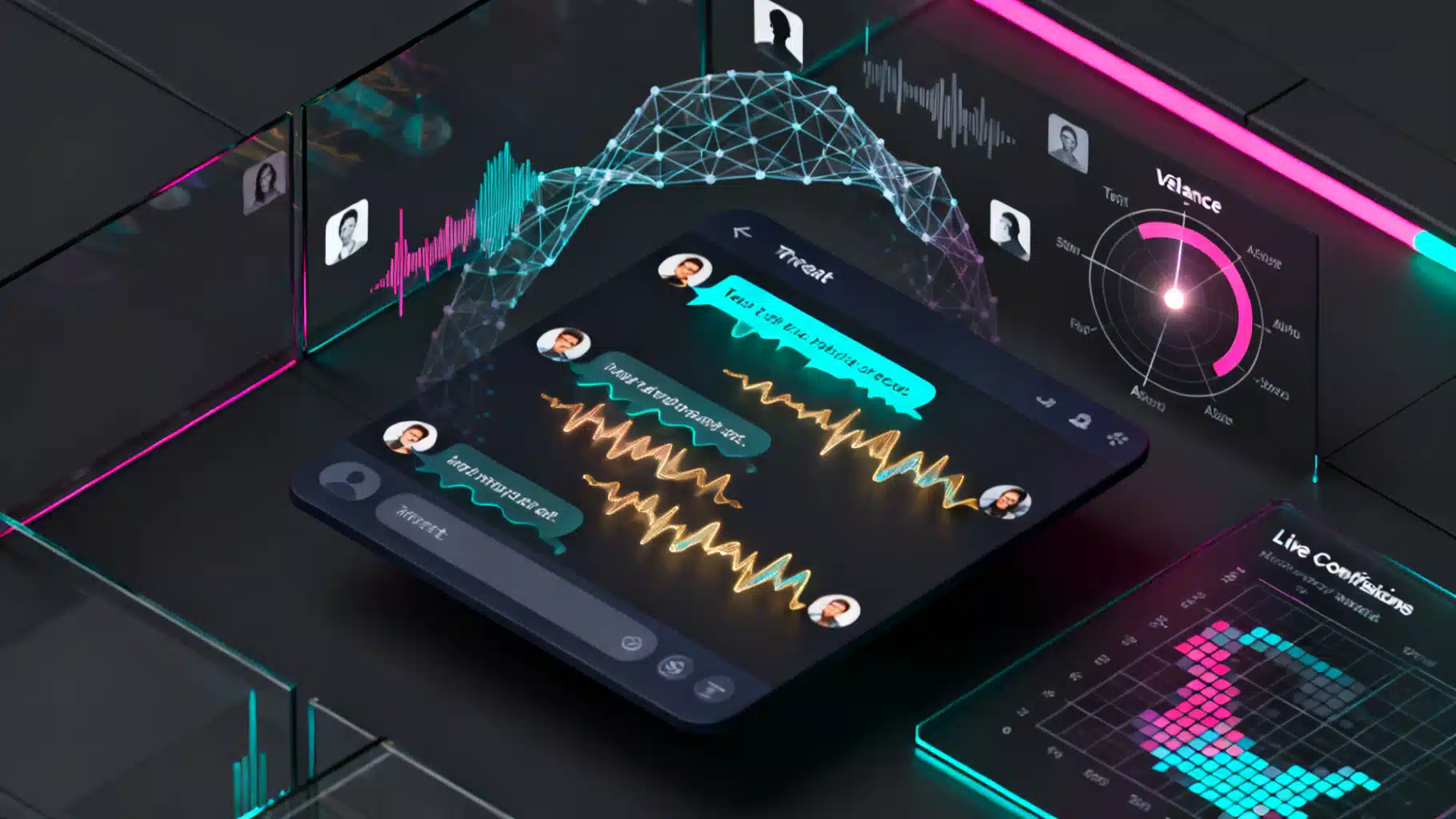
Image used for representation purposes only.
Why Emotion Detection Matters in Chatbots
Emotion-aware chatbots promise more human conversations. They can de‑escalate frustration, show empathy, and route sensitive issues to people. Done right, they lift CSAT, reduce escalations, and build trust. Done poorly, they stereotype users, misread sarcasm, and overstep privacy boundaries.
This article is a practical guide to building, evaluating, and safely deploying emotion detection in conversational AI.
What Do We Mean by “Emotion”?
Two common representations dominate production systems:
- Discrete labels: anger, sadness, joy, fear, disgust, surprise, neutral; expanded sets may include frustration, confusion, embarrassment, pride, etc.
- Dimensional models: continuous valence (negative↔positive) and arousal (calm↔excited), sometimes dominance/control. These support smoother policy decisions and aggregation over time.
Pick a representation based on your use case:
- Compliance and routing prefer a small, auditable label set (e.g., angry, at‑risk, neutral).
- Empathic phrasing benefits from valence/arousal to modulate tone (“warmer” vs “cooler”) without hard category jumps.
Techniques: From Text to Multimodal
Text‑Only (most common in chat)
- Lexicon baselines: fast, interpretable, and weak on sarcasm or domain jargon.
- Supervised classifiers: fine‑tuned transformers (e.g., domain‑adapted encoder models) with task‑specific heads for multi‑label classification or regression to valence/arousal.
- Zero/low‑shot with large language models: prompt LLMs to rate emotion with a fixed rubric; add self‑consistency (multiple samples) and calibration.
- Enrichment features: emojis, punctuation, elongated words, capitalization, user metadata (only with consent), and conversation position (turn index).
Speech Prosody (voice bots and voice-enabled chat)
- Features: pitch (F0), energy, speaking rate, jitter/shimmer, spectral features (e.g., MFCCs), disfluencies, sighs/laughter.
- Model options: CNN/RNN or transformer encoders over log‑mel spectrograms; self‑supervised audio representations; on‑device tiny models for privacy and latency.
Visual Signals (video chat/avatars)
- Facial affect (action units, micro‑expressions) and head pose. High risk for bias and privacy intrusion; require explicit opt‑in and strong safeguards.
Multimodal Fusion
- Early fusion: concatenate learned embeddings (text+audio) before classification.
- Late fusion: independent modality classifiers with a combiner (weighted voting, learned gating).
- Hybrid/cross‑attention: modalities attend to each other; best performance but heavier compute.
For most chat support scenarios, text‑first with optional prosody yields the best accuracy‑to‑complexity ratio.
Data: Labels, Culture, and Drift
- Label design: keep it small and meaningful to downstream actions. Map synonyms (irritated→anger) and define “neutral” precisely.
- Annotation guidelines: provide conversation context windows (3–5 turns), cultural notes, and sarcasm examples. Measure inter‑annotator agreement (e.g., Krippendorff’s α).
- Class imbalance: anger and joy may dominate; use focal loss, class weights, or re‑sampling. Validate with macro‑averaged metrics.
- Domain shift: retrain or adapt for new products, seasons, or crises. Monitor distribution drift (e.g., embedding distance, population stability index) and refresh data.
- Synthetic data: carefully generate counterfactuals (style/emoji/sarcasm variants) to fill gaps, but always human‑review a sample.
Evaluation and Calibration
- Classification metrics: macro‑F1, per‑class F1, Matthews correlation; confusion matrices are essential for spotting harmful swaps (e.g., anger↔joy).
- Regression metrics (valence/arousal): concordance correlation, RMSE.
- Calibration: expected calibration error (ECE) and reliability curves. Apply temperature scaling or isotonic regression.
- Realism tests: sarcasm sets, code‑switching, noisy ASR transcripts, domain jargon, and multilingual input.
- Fairness checks: stratify performance by language, dialect, and identified user groups where applicable and permitted. Avoid proxy attributes and over‑inference.
Real‑Time Architecture That Doesn’t Flake Out
Design for stability, not twitchiness. A practical streaming stack:
- Ingestion: text turns (and optionally audio frames) arrive on an event bus.
- Per‑modality inference: fast text classifier; optional prosody model on voice.
- Temporal smoothing: exponential moving average (EMA) on probabilities or valence; add hysteresis to prevent rapid flips.
- State machine: maintain a session‑level affect state with cooldowns and escalation thresholds.
- Policy interface: emit a compact emotion event that the dialogue manager can consume.
Example: Streaming Smoothing and State
# Pseudocode: text-only EMA with hysteresis and cooldown
class EmotionTracker:
    def __init__(self, labels, alpha=0.4, rise=0.15, fall=0.10, cooldown_s=20):
        self.labels = labels
        self.ema = {l: 1.0/len(labels) for l in labels}
        self.last_change_ts = 0
        self.active_label = 'neutral'
        self.alpha = alpha
        self.rise, self.fall = rise, fall
        self.cooldown_s = cooldown_s

    def update(self, probs, now_s):
        # EMA smoothing
        for l in self.labels:
            self.ema[l] = self.alpha*probs[l] + (1-self.alpha)*self.ema[l]
        # Hysteresis thresholds
        new_label = max(self.ema, key=self.ema.get)
        delta = self.ema[new_label] - self.ema.get(self.active_label, 0)
        threshold = self.rise if new_label != self.active_label else -self.fall
        if (delta > threshold) and (now_s - self.last_change_ts > self.cooldown_s):
            self.active_label = new_label
            self.last_change_ts = now_s
        return {
            'label': self.active_label,
            'probs': dict(self.ema),
            'confidence': self.ema[self.active_label]
        }
Suggested Emotion Event Schema
{
  "timestamp": "2026-08-25T15:04:05Z",
  "message_id": "abc123",
  "modalities": ["text"],
  "emotion": {
    "label": "frustration",
    "probs": {"frustration": 0.62, "sadness": 0.21, "neutral": 0.12, "joy": 0.05},
    "valence": -0.45,
    "arousal": 0.70,
    "confidence": 0.62
  },
  "context": {"window_ids": ["m119","m120","m121"], "language": "en", "sarcasm": 0.14},
  "policy_hint": "deescalate_and_offer_handoff"
}
Turning Signals into Better Conversations
Emotion detection only matters if it changes behavior:
- Empathic style control: prepend brief acknowledgments (“I’m sorry this happened”) and adjust verbosity to arousal (shorter under high arousal).
- Safety routing: trigger live‑agent handoff on sustained anger or crisis cues. Log rationale.
- Personalization: with consent, remember stable preferences (tone, reading level). Keep emotion itself ephemeral—don’t build long‑term affect profiles.
- Guardrails: never claim medical or psychological diagnoses; avoid manipulative tactics.
A/B test policy changes and track:
- CSAT or post‑chat sentiment delta.
- First‑contact resolution and handle time.
- Escalation and abandonment rates.
- Negative side effects (e.g., over‑apologizing lengthens chats).
Privacy, Security, and Ethical Boundaries
- Consent and transparency: clearly state when and how affect is inferred; provide opt‑out and non‑voice fallback.
- Data minimization: redact PII before storage; keep raw audio transient if you only need prosody features.
- On‑device where possible: especially for prosody to avoid streaming sensitive voice data.
- Access control and encryption: protect features, embeddings, and labels at rest and in transit.
- Retention: store derived labels briefly; avoid building sensitive user profiles.
- Bias and cultural sensitivity: evaluate across dialects, languages, and demographics where appropriate and permitted. Document known limitations.
- Crisis handling: maintain a curated list of high‑risk cues; escalate to trained humans. Provide resource links rather than advice.
Common Failure Modes (and Fixes)
- Sarcasm/irony: augment with sarcastic corpora; use conversation context and user history (with consent); add a sarcasm detector feeding a “low‑confidence” path.
- Code‑switching/multilingual: multilingual encoders and language ID; fallback to valence/arousal when categorical labels are uncertain.
- ASR noise: confidence‑weighted fusion of text and prosody; re‑request confirmation instead of guessing.
- Domain jargon: domain‑adaptive pretraining and in‑domain fine‑tuning; curate jargon lexicons.
- Emoji/ASCII art spam: normalize and cap repetition effects; adversarial training.
- Over‑triggering apologies: add cooldowns and vary templates; measure user irritation at repetition.
- Model drift: monitor input distributions and per‑class F1 weekly; schedule refreshes.
Build/Deploy Playbook (Condensed)
- Define outcomes and label set tied to actions.
- Collect/annotate contextual conversation snippets; measure agreement.
- Start with a strong text model; add prosody if voice is critical.
- Calibrate, smooth, and add hysteresis; document thresholds.
- Integrate with policy as a small, auditable event.
- Red‑team for sarcasm, dialects, and adversarial inputs.
- Ship with consent flows, PII redaction, and retention limits.
- A/B test, monitor, iterate.
Looking Ahead
- Unified conversational affect models that jointly track user and assistant states.
- Continual learning with privacy‑preserving techniques (federated updates, differential privacy noise on gradients).
- Richer prosody from synthesized voices to respond more naturally—while preserving transparency that it’s synthetic.
Emotion detection can make chatbots more considerate and effective. The goal isn’t to “read minds,” but to sense enough affect to choose safer, kinder actions—reliably, fairly, and with the user’s permission.
Related Posts

Implementing AI Chatbots for Customer Service: An End-to-End Guide
End-to-end guide to planning, building, and launching AI chatbots for customer service: architecture, KPIs, workflows, security, and ROI.

Building Social Media Insights with AI Sentiment Analysis APIs: Architecture, Metrics, and Code
How to integrate AI sentiment analysis APIs into social media stacks—architecture, metrics, sample code, and best practices for reliable, real-time insights.

AI Summarization APIs for News: Architecture, Quality, and Compliance
Design a reliable AI summarization API for news: architecture, schema, grounding, evaluation, safety, compliance, and cost strategies.