
AMD Stock after Meta’s 6GW AI Deal: Growth, Dilution, and the 2026 Playbook
AMD stock jumps as Meta inks a 6GW AI chip deal featuring performance-based warrants. Here’s what it means for growth, dilution, and 2026 execution.
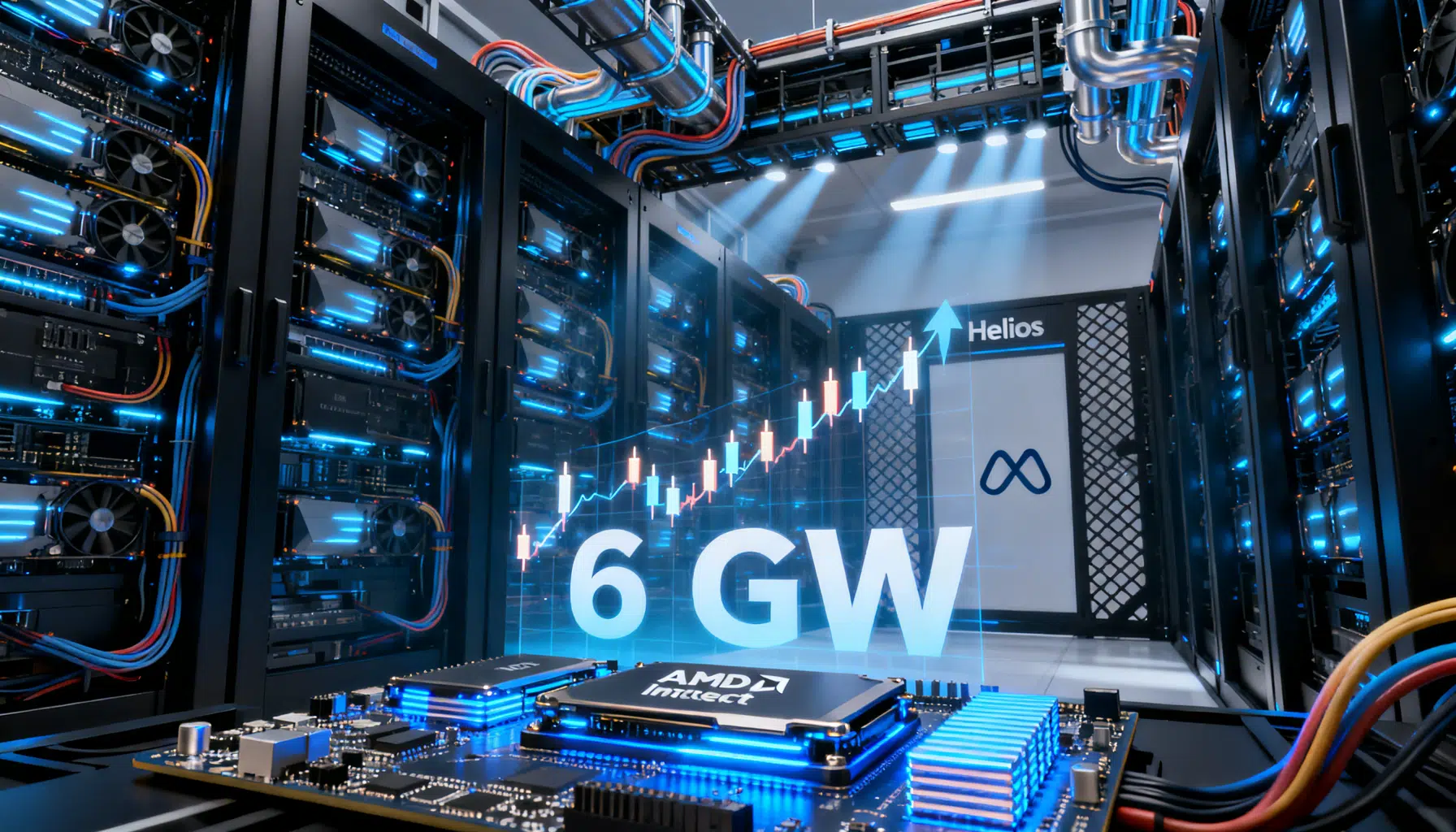
Image used for representation purposes only.
AMD stock jumps on Meta’s 6GW AI bet — and a novel equity sweetener
Advanced Micro Devices surged after unveiling a multi‑year pact with Meta to deploy up to 6 gigawatts of Instinct GPUs starting in the second half of 2026, aligned to AMD’s Helios rack‑scale architecture and next‑gen MI450 accelerators. The agreement includes performance‑based warrants granting Meta the right to acquire up to 160 million AMD shares if deployment and share‑price milestones are met, a structure AMD also used in a similar 6GW agreement with OpenAI in October 2025. (amd.com )
Where the stock stands now
- Last price: $213.84 (as of Tuesday, February 24, 2026, 21:15 UTC). Trailing P/E roughly 78.3. Note that prices move intraday; check real‑time quotes if you’re trading.
- Shares rallied about 9% on February 24 following the Meta announcement, with multiple outlets reporting the move. (barrons.com )
What Meta’s deal actually includes
- Scale and timing: Up to 6GW of AMD compute across multiple silicon generations; shipments supporting the first gigawatt begin in 2H 2026. (amd.com )
- Silicon and systems: A custom Instinct GPU based on MI450, 6th‑gen EPYC “Venice” CPUs, and deployment on AMD’s Helios rack‑scale platform co‑developed through the Open Compute Project. (amd.com )
- The equity component: Meta receives performance‑based warrants for up to 160M AMD shares (potentially ~10% of AMD if fully vested), with vesting tied to delivery milestones and stock‑price thresholds that extend as high as $600. Analysts and financial press describe the total contract value as “tens of billions per gigawatt” and over $100B across the term. (ft.com )
Why it matters: The structure secures hyperscale demand during a capacity‑constrained AI cycle and publicly validates AMD’s roadmap, but it also introduces possible dilution if milestones are achieved. Investors should weigh the growth visibility against the warrant overhang. (barrons.com )
Financial backdrop: record results, clear AI mix shift
AMD posted record Q4 and FY2025 results on February 3, 2026, with Q4 revenue at $10.3B (+34% y/y), non‑GAAP gross margin at 57%, and data center segment revenue at a record $5.4B on EPYC and Instinct strength. Q1 2026 guidance called for ~$9.8B revenue (±$300M) and ~55% non‑GAAP gross margin. Management also noted ~$390M of Q4 Instinct MI308 revenue to China and a ~$360M release of prior inventory charges related to export‑controlled parts. (amd.com )
Takeaway: Data center AI is becoming AMD’s primary growth engine, with MI300/MI350 ramps now complemented by MI450‑class programs at multiple hyperscalers. The China disclosure highlights how export policies can swing near‑term mix and margins. (amd.com )
Strategy and product roadmap: Helios, MI4xx today, MI5xx tomorrow
At CES 2026, AMD expanded its AI portfolio and previewed its rack‑scale Helios platform, designed for “yotta‑scale” compute. The company introduced the Instinct MI440X for enterprise AI, provided an early look at MI455X within Helios, and previewed the MI500 series for later in the decade. On the client side, AMD rolled out new Ryzen AI platforms to push on‑device inference. (ir.amd.com )
Why it matters: Hyperscalers are increasingly buying not just chips but full systems, networking, and software stacks. Rack‑scale designs like Helios aim to compress time‑to‑deploy and power efficiency—key decision factors for multi‑gigawatt AI builds. (ir.amd.com )
The competitive landscape: Nvidia still dominates — for now
Industry estimates continue to place Nvidia’s share of AI accelerators in the 70%–95% range, underscoring its ecosystem and supply chain lead. But 2025–2026 forecasts from Omdia and Dell’Oro show rapid overall market expansion and growing traction for alternatives, including custom ASICs and AMD’s Instinct line—especially as hyperscalers diversify suppliers. (cnbc.com )
What the Meta pact signals: AMD is winning flagship, multi‑generation footprints that bundle silicon with systems. Even if Nvidia remains the volume and margin leader, these wins can materially lift AMD’s data center revenue and smooth multi‑year visibility. (amd.com )
Supply chain watch: packaging and memory are the swing factors
- Advanced packaging and HBM memory have been the binding constraints for AI accelerators. Recent market work shows HBM capacity expansions are pulling wafer and capex away from legacy DRAM, tightening older‑node memory while AI‑grade memory remains prioritized. Expect component pricing and availability to influence AMD’s shipment cadence and margins through 2026. (spglobal.com )
Valuation snapshot
- Price and multiple: AMD traded around $213.84 on February 24, implying a trailing P/E near 78 on the latest print. Momentum investors will focus on AI revenue run‑rate acceleration from MI300/MI350 to MI450, while fundamental investors will track conversion of large announcements into recognized revenue and free cash flow.
Key risks to the bull case
- Dilution overhang: If Meta’s (and OpenAI’s) performance‑based warrants vest, dilution could approach ~10% per deal; the payoff is multi‑year revenue visibility at hyperscale. (ft.com )
- Execution and software: Delivering custom MI450‑class parts on schedule, at target perf/watt, with ROCm software maturity is essential to win repeat orders beyond initial tranches. (amd.com )
- Supply constraints: Tight HBM and advanced packaging capacity can limit upside or pressure margins if mix skews to lower‑availability configurations. (spglobal.com )
- Policy risk: U.S. export controls affected Q4 mix and could do so again; visibility in China remains fluid. (amd.com )
- Competitive response: Nvidia’s cadence and CUDA ecosystem moat remain formidable; any step‑function uplift from rivals can compress AMD’s share gains. (cnbc.com )
What to watch next (2026–2027)
- Final contract mechanics: Look for additional Meta and OpenAI filings or disclosures clarifying tranche triggers, pricing frameworks, and software deliverables—including ROCm and model‑specific optimizations. (amd.com )
- MI450 ramp milestones: Tape‑out, sampling, and system‑level perf/watt disclosures tied to Helios. Early customer benchmarks will be a tell on inference economics versus Nvidia’s contemporaries. (amd.com )
- Component supply: HBM output ramps and any updates from memory vendors on 2026 capacity, along with hyperscaler optical/networking orders that often precede GPU deliveries. (spglobal.com )
- Quarterly prints: Watch the data center segment run‑rate, gross margin trajectory, and commentary on China demand and export compliance as AMD executes 2026 guidance. (amd.com )
Bottom line
AMD just converted roadmap credibility into marquee, multi‑gigawatt wins at two of AI’s most visible buyers. The Meta and OpenAI structures trade potential dilution for multi‑year scale and validation. With record fundamentals exiting 2025 and a clear product path to MI450 and Helios in 2026, the setup for data center AI growth looks stronger—so long as execution, supply, and software keep pace. For investors, AMD is increasingly a call option on AI infrastructure share gains, not a traditional PC‑cycle play. (amd.com )
Disclaimer: This article is for informational purposes only and is not investment advice. Always do your own research and consider consulting a licensed financial professional before making investment decisions.
Related Posts
Sony PlayStation 6 Rumors Hint at 2027 Launch, AMD Partnership, and 8K Gaming
Leaked reports and industry speculation suggest the PlayStation 6 will arrive in holiday 2027 with a custom AMD APU, backward compatibility focus, and 8K/4K performance modes.