
Samsung’s big week: Galaxy S26 goes live as HBM4 race heats up
Samsung launches Galaxy S26 and doubles down on AI as HBM4 validation nears, capping record chip-driven profits. Key dates, features, and outlook.
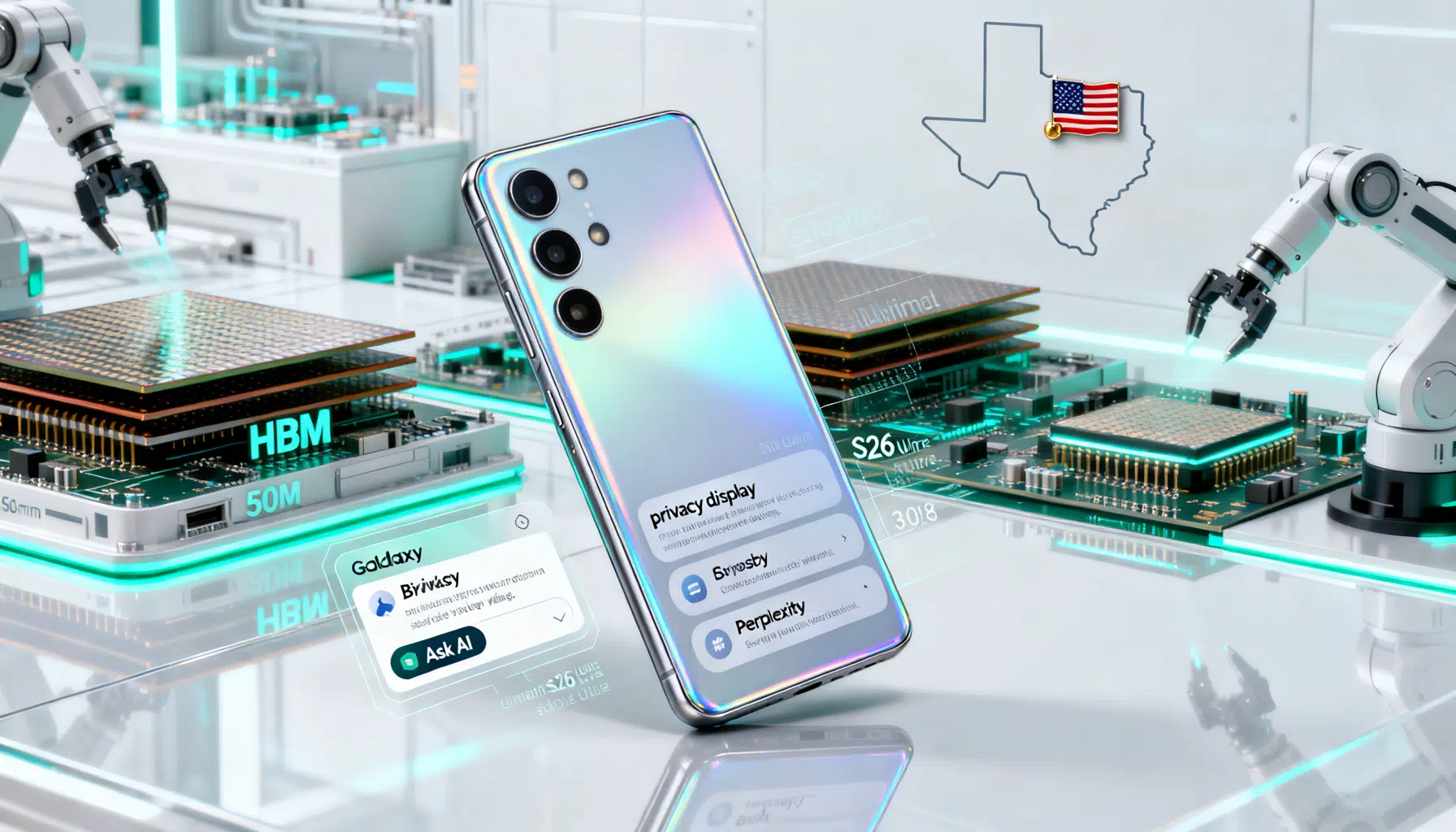
Image used for representation purposes only.
Samsung’s pivotal week: S26 phones, smarter Bixby, and an HBM4 memory sprint
Samsung capped a consequential 48 hours for its mobile and chip businesses, unveiling the Galaxy S26 lineup at Galaxy Unpacked in San Francisco on February 25, 2026, and sharpening its AI and semiconductor narratives for the year ahead. The company billed the event as a new phase for “personal, adaptive” AI, with a live stream at 10 a.m. PT. (news.samsung.com )
On the financial front, Samsung closed January by reporting record quarterly revenue of KRW 93.8 trillion and record operating profit of KRW 20.1 trillion for Q4 2025—driven by a powerful rebound in its memory business. Management highlighted HBM and other high‑value memory as primary tailwinds. (news.samsungsemiconductor.com )
What Samsung announced at Unpacked
- Galaxy S26 series: Samsung emphasized refined hardware and a push toward embedded, unobtrusive AI. A standout headline was a “privacy display” that narrows viewing angles on S26 Ultra, alongside a common design language across the trio and March 11 availability. Pricing spans roughly $900 for S26 up to about $1,300 for S26 Ultra, positioning the family squarely in the premium bracket. (wired.com )
- Galaxy Buds4 and Buds4 Pro: New earbuds debuted with upgraded audio and gesture controls, launching alongside the phones in March. (wired.com )
Key dates and details:
- Unpacked: February 25, 2026 (San Francisco)
- Availability: March 11, 2026 (select markets)
- Theme: AI features that work “in the background,” including new on‑device tools and deeper partner integrations. (insights.samsung.com )
Galaxy AI broadens—and Bixby grows up
Samsung formalized a multi‑agent strategy for Galaxy AI, introducing Perplexity as an additional, integrated agent accessible by voice and system shortcuts. The company says the approach reduces steps by letting users move through tasks with context that spans apps, an architecture set to reach upcoming flagships. (news.samsung.com )
In parallel, Bixby is being re‑cast as a conversational device agent with One UI 8.5, allowing natural‑language controls (“keep my screen awake while I’m reading”) and embedded web results without switching to a browser. A public beta is rolling out in select regions including the US. (engadget.com )
Chips: Samsung races toward HBM4
Behind the scenes, Samsung’s memory unit is steering into the AI compute boom. TrendForce reports the industry’s three HBM suppliers—Samsung, SK hynix, and Micron—are in final HBM4 validation with completion anticipated by Q2 2026, as Nvidia’s Rubin platform accelerates demand. The firm projects Samsung could secure certification first, citing product stability. (trendforce.com )
Samsung’s chip chief Jun Young‑hyun underscored momentum in a New Year address, telling employees that customers have praised the “differentiated competitiveness” of Samsung’s HBM4 and that the company is in close discussion to supply Nvidia—an important signal after a choppy HBM3E qualification journey. (investing.com )
That journey included a milestone last fall, when Samsung’s 12‑high HBM3E reportedly passed Nvidia’s qualification—positioning the company to play a larger role in the AI memory stack as shipments scale in 2026. (tomshardware.com )
US manufacturing and policy context
Samsung’s expanding US footprint remains a strategic pillar. The Commerce Department agreed in April 2024 to provide up to $6.4 billion in CHIPS Act funding to help build a leading‑edge logic, advanced packaging, and R&D cluster centered on Taylor, Texas—part of more than $40 billion in planned private investment. (commerce.gov )
Texas separately awarded a record $250 million Semiconductor Innovation Fund grant in September 2025 to support the Taylor fab build‑out, further anchoring Samsung’s US capacity. (gov.texas.gov )
Regulatory clarity also advanced this year: the US granted Samsung 2026 export licenses for shipping chipmaking tools to its China facilities—annual approvals that replace an expiring waiver system and help maintain vital memory production while adhering to controls. (tomshardware.com )
Why it matters now
- For consumers: The S26 family leans into privacy‑minded hardware and practical AI that hides complexity. Samsung says availability begins March 11, 2026, with a focus on features that automate tasks across apps and services rather than splashy, one‑off demos. (insights.samsung.com )
- For developers and partners: The multi‑agent model (with Perplexity support) signals a more open Galaxy AI fabric, where third‑party services can plug into system‑level workflows—a notable shift from siloed “assistant” experiences. (news.samsung.com )
- For investors: Memory remains the earnings engine. Record Q4 2025 results reflect tight supply and surging AI infrastructure demand; whether Samsung wins early HBM4 certifications—and converts them into volume shipments—will shape margins through 2026. (news.samsungsemiconductor.com )
The near‑term scoreboard
- February 25, 2026: Galaxy Unpacked (S26 series and Buds4) — done. (news.samsung.com )
- Late February–early March: Preorders and retail ramp; phones and buds set for March 11 availability. (insights.samsung.com )
- By Q2 2026: Industry HBM4 validation window—watch for certification order, supplier shares, and whether Samsung secures early Nvidia allocations for Rubin. (trendforce.com )
Bottom line
Samsung is threading two narratives: on phones, a push for AI that is useful, quiet, and privacy‑aware; on chips, an aggressive sprint to HBM4 and US‑based capacity. If the company converts its validation lead into sustained HBM4 shipments while S26 lands cleanly in March, its 2025 records may be a prelude—not a peak. (trendforce.com )