
Huawei’s 2026 Playbook: Phones, Chips, Cars—and a New Tech Fault Line
Huawei’s 2026 surge: back on top in China phones, pushing HarmonyOS, mapping bold AI chips, powering hot EVs—while U.S. and Europe tighten the screws.
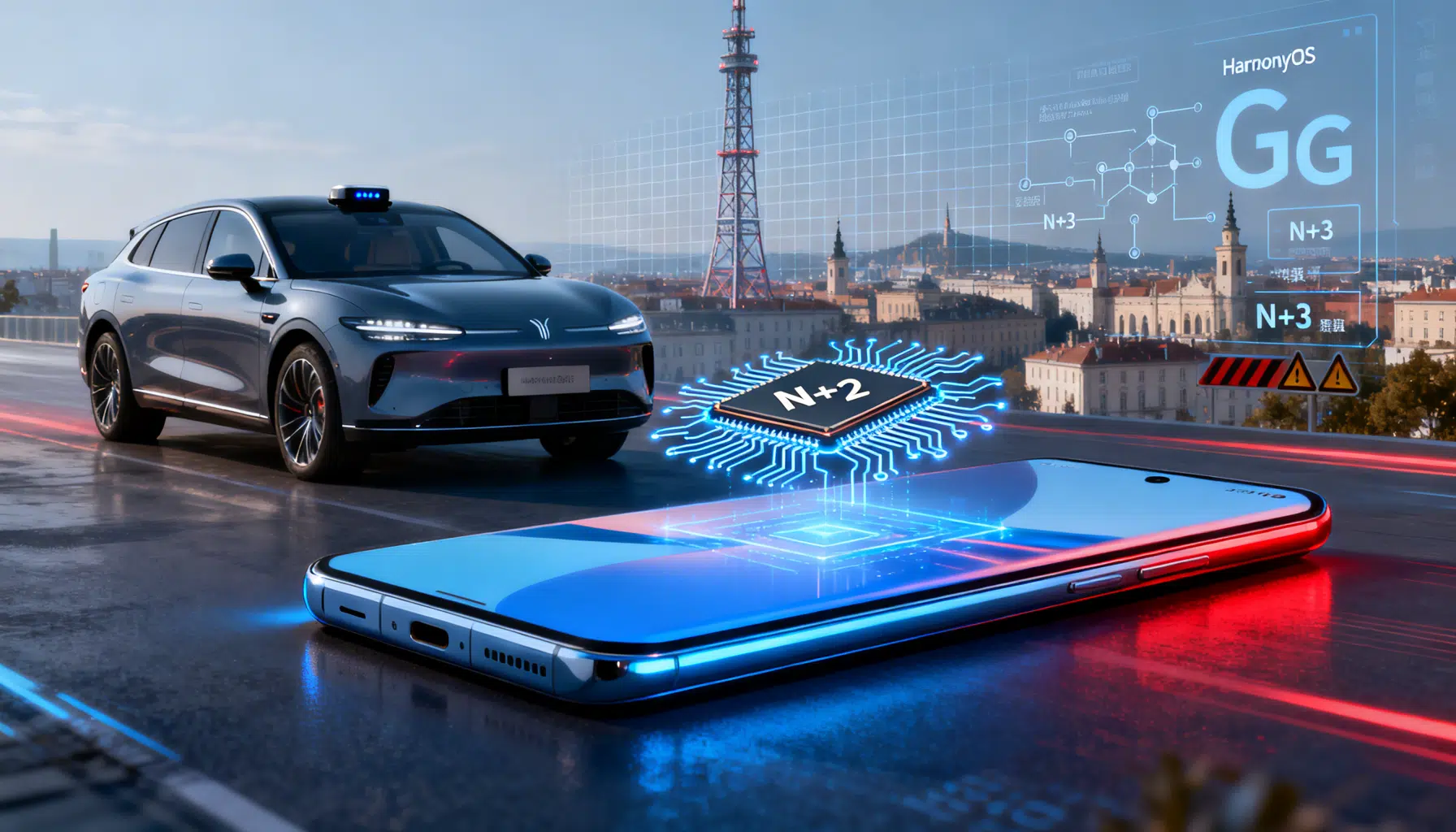
Image used for representation purposes only.
Huawei in 2026: A sanctioned giant surges back across phones, chips, cars, and 5G
Huawei is trending again—and for good reason. In the past 12–18 months it has reclaimed smartphone leadership in China, accelerated its Android-free operating system, mapped out an ambitious AI-chip roadmap, and helped power one of the country’s hottest luxury EV brands. All of this is unfolding against tightening restrictions in the U.S. and Europe, making Huawei a bellwether for the tech decoupling era. (canalys.com )
Smartphones: back on top at home, pressing ahead with homegrown silicon
- Market share whiplash favored Huawei through 2025. In Q2 2025, Huawei shipped 12.2 million smartphones to lead China with an 18% share, according to Canalys. Q3 saw jostling (vivo briefly retook No. 1), underscoring a tight race at the top, but Huawei’s resurgence is unmistakable. (canalys.com )
- The rebound is rooted in domestic silicon and patriotic demand. TechInsights confirmed the Mate 60 Pro’s Kirin 9000S was fabricated on SMIC’s 7nm-class “N+2” process—China’s most advanced commercial logic node without EUV—marking a watershed for Huawei’s supply autonomy. (www-prod.techinsights.com )
- Huawei pushed further with the Mate 80 series (late 2025), powered by the Kirin 9030 built on SMIC’s “N+3,” an incremental evolution of its 7nm-class node. Analysts say N+3 brings density gains but still trails true 5nm-class tech from TSMC and Samsung. Hardware highlights include a Pro Max model touting an ultra-bright dual‑layer OLED display. (scmp.com )
- Beijing’s 2025 national consumption program also juiced demand: a 15% subsidy (capped at 500 yuan) for devices under 6,000 yuan lifted first‑quarter sales, with Huawei among the biggest beneficiaries. (scmp.com )
HarmonyOS breaks with Android—and scales up
Huawei’s operating system has pivoted from “Android‑compatible” to fully independent.
- HarmonyOS Next (rolled out with Mate 70 in late 2024) dropped Android app compatibility and now requires native development, signaling the emergence of a third ecosystem distinct from iOS and Android. Early momentum included thousands of native apps from major Chinese platforms like WeChat. (theverge.com )
- In October 2025, Huawei launched HarmonyOS 6 for mainstream devices, emphasizing performance, cross‑device workflows, and security hardening. Monthly security bulletins continue into February 2026 with fixes spanning media and camera modules. (gizmochina.com )
- Beyond phones, Huawei is seeding HarmonyOS into commercial hardware—such as a smart cash register co‑developed with Alipay and deployed across tens of thousands of stores—aimed at building an end‑to‑end ecosystem that stretches from retail to smart vehicles. (techradar.com )
AI chips and cloud: a bolder silicon roadmap
At Huawei Connect 2025, the company sketched a three‑year Ascend roadmap, with new accelerators due in 2026 and beyond and claims of in‑house HBM. If delivered, the Atlas “supernode” configs could scale to tens of thousands of chips per cluster—Huawei’s bid to challenge Nvidia‑class builds with fully domestic stacks. Execution and software maturity remain the big questions under export controls. (tomshardware.com )
Auto: AITO M9 becomes China’s boardroom favorite
Huawei’s automotive bet—partnering with Seres under the AITO brand—paid off. The AITO M9, loaded with Huawei’s ADS intelligent‑driving and HarmonyOS cockpit, crossed 260,000 cumulative deliveries by late December 2025 and surpassed 270,000 by January 2026, consistently topping China’s >¥500,000 luxury SUV segment. Media tallies in 2024 already showed AITO outpacing BMW and Mercedes in China’s premium market. (chinaevhome.com )
The policy vise tightens: U.S., EU, Taiwan, Germany
- Washington tightened the screws in 2024 by revoking chip export licenses, curbing Intel and Qualcomm sales to Huawei’s PC and phone lines. (cnbc.com )
- Taiwan added Huawei and SMIC to its export‑control list in mid‑2025, requiring permits for shipments—a move aligned with U.S. policy. (cnbc.com )
- In January 2026, the U.S. allowed TSMC, Samsung, and SK Hynix to continue bringing U.S.‑made tools into their China fabs, but only under annually renewed licenses—keeping pressure on advanced capacity while maintaining legacy operations. (tomshardware.com )
- Europe is moving toward mandatory “high‑risk vendor” phase‑outs for critical networks, widely read as targeting Huawei and ZTE. Separately, Germany has set explicit deadlines: remove Chinese components from 5G cores by end‑2026 and phase out critical management systems in RAN/transport by end‑2029. (apnews.com )
Networks and infrastructure: from rip‑and‑replace to fresh wins
While restrictions mount in Western markets, Huawei continues to score wins elsewhere. In Africa, for example, MTN Nigeria and Huawei announced the first commercial FDD tri‑band Massive MIMO site in February 2025, citing large traffic and speed gains versus prior deployments. Such projects illustrate Huawei’s ongoing relevance in global RAN, even as some countries mandate phase‑outs. (blog.huawei.com )
Financials: revenue up, profits leaner, R&D splurge
Huawei’s 2024 revenue rose to 862.1 billion yuan as smartphones rebounded and auto tech scaled, though net profit fell to 62.6 billion yuan amid heavy reinvestment. The company poured 179.7 billion yuan—over 20% of revenue—into R&D in 2024, underscoring a strategy of self‑reliance across chips, software, cloud, and vehicles. (huawei.com )
What to watch next (February–December 2026)
- AI silicon landfall: Early‑2026 availability for new Ascend 950‑series parts will be closely scrutinized for real‑world performance, power efficiency, and software stack maturity. (tomshardware.com )
- Phone supply vs. demand: Tight Kirin 9030 supply constrained some Mate 80 variants into early 2026; watch whether capacity ramps keep pace with demand and how this shapes Q1–Q2 share. (huaweicentral.com )
- HarmonyOS ecosystem depth: App coverage beyond China and enterprise‑grade tools will determine whether HarmonyOS Next gains traction outside its home market. (ft.com )
- Europe’s phase‑out clock: EU legislation and Germany’s 2026/2029 deadlines will test operator timelines, costs, and supplier diversification. (apnews.com )
Bottom line
Despite the most far‑reaching tech sanctions of any major vendor, Huawei has rebuilt momentum across its core businesses. The company’s China‑first strategy—homegrown chips, an independent OS, deep ties to domestic partners, and premium EV collaborations—has restored growth while highlighting the contours of a split tech universe. Whether Huawei’s AI chips, mobile silicon, and HarmonyOS can compete sustainably at scale without Western tools remains the defining question for 2026. (www-prod.techinsights.com )
Related Posts
Samsung’s big week: Galaxy S26 goes live as HBM4 race heats up
Samsung launches Galaxy S26 and doubles down on AI as HBM4 validation nears, capping record chip-driven profits. Key dates, features, and outlook.