
IEEE in 2026: Wi‑Fi 8 peeks out, 1.6T Ethernet nears, and AI standards accelerate
Why IEEE is trending in 2026: early Wi‑Fi 8 demos, 1.6T Ethernet progress, new AI and open‑access standards, and highlights from IEEE Spectrum.
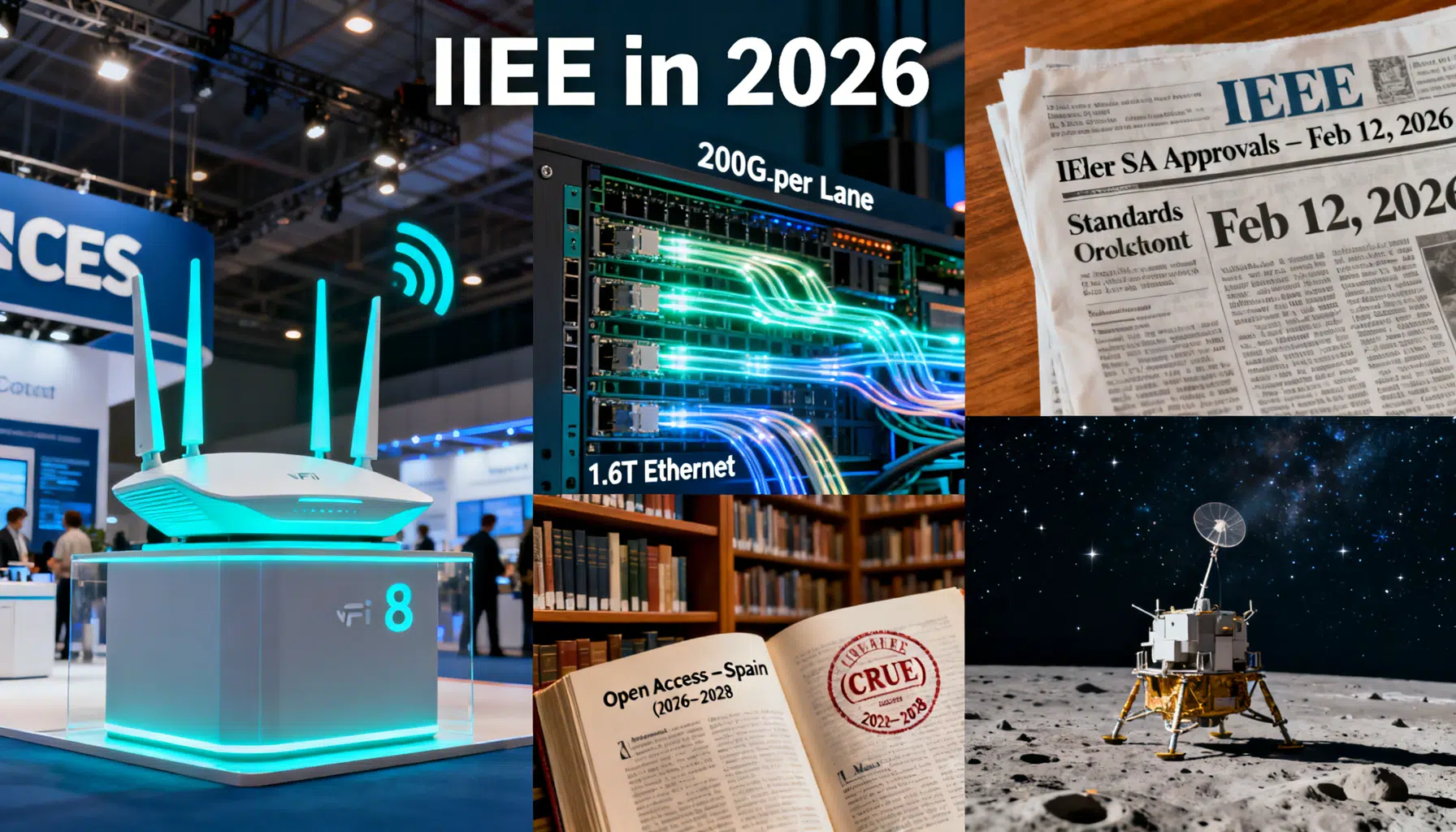
Image used for representation purposes only.
Why IEEE is trending now
Early Wi‑Fi 8 demos at CES 2026, new Ethernet milestones on the road to 1.6‑terabit networking, a fresh wave of AI and robotics standards, and a significant open‑access expansion are putting the Institute of Electrical and Electronics Engineers (IEEE) squarely in the tech headlines this month. At CES, silicon vendors previewed Wi‑Fi 8 (IEEE 802.11bn) chipsets and reference designs years ahead of final ratification, while Wi‑Fi 7 (802.11be) has now been formally published—available free via IEEE’s GET program—marking a major generational hand‑off in wireless LANs. (techspot.com )
Wi‑Fi 7 is official; Wi‑Fi 8 is already peeking out
IEEE 802.11be (Wi‑Fi 7) cleared board approval on 26 September 2024 and was published on 22 July 2025. The amendment promises at least one mode with 30 Gbit/s at the MAC SAP, operating across 2.4/5/6 GHz and improving worst‑case latency—now available through the IEEE GET program. (standards.ieee.org )
Even as Wi‑Fi 7 rolls out, vendors are laying groundwork for Wi‑Fi 8 (802.11bn). Broadcom and MediaTek showcased early Wi‑Fi 8 platform silicon at CES 2026, signaling that draft‑based products could appear in limited channels before the standard is final. Analysts caution that full conformance and Wi‑Fi Alliance certification targets cluster around 2028, mirroring historical timelines. (techspot.com )
What’s different this time is emphasis: Wi‑Fi 8 prioritizes reliability, roaming, and consistency under congestion over raw peak speed. Industry roadmaps highlight coordination features—like multi‑AP scheduling, coordinated beamforming, and spatial reuse—to trim worst‑case latency and packet loss in dense environments. (tomshardware.com )
Meanwhile, the 802.11 Working Group notes ongoing next‑gen activity beyond throughput, from integrated millimeter‑wave efforts (TGbq) to post‑quantum cryptography (TGbt). It also confirms recent publications including WLAN sensing (802.11bf‑2025) and that 802.11be‑2024 is now available, underscoring the brisk cadence of Wi‑Fi evolution. (grouper.ieee.org )
Ethernet’s sprint toward 1.6T
On the wired side, IEEE’s Ethernet work is accelerating. The 802.3df amendment enabling 400 and 800 Gb/s was approved in February 2024 and published in March 2024, laying crucial groundwork for hyperscale and AI fabrics. (ieee802.org )
The successor project, P802.3dj, advances 200G‑per‑lane signaling to support 200G/400G/800G and 1.6T rates and remains on track for late‑2026 completion, with early 200G/lane products entering market validation. Interop events like the Ethernet Alliance HSN Plugfest in December 2025 focused specifically on 200G/lane technology—evidence the supply chain is converging on the draft. (networkworld.com )
Industry trackers report the community is already preparing for a subsequent 400G‑per‑lane era to meet AI networking demands, even as dj nears the finish line—an unusually tight leapfrog that reflects data‑center growth. (networkworld.com )
Fresh standards approvals: from metadata in Ethernet to AI agents in industry
IEEE Standards Association (IEEE SA) posted a new tranche of approvals on 12 February 2026 that span IoT security assessment (P2994), energy‑and‑mobility use cases, industrial embodied intelligence (P3927 series), and a new Ethernet amendment project (P802.3dt) for Ethernet Metadata Services. The list also includes work items touching autonomous driving data interfaces and even audio large‑language models—revealing how quickly generative‑AI‑adjacent standards are materializing across domains. (standards.ieee.org )
Beyond these PARs, IEEE’s AI governance portfolio keeps broadening. In July 2025, IEEE highlighted contributions to an International AI Standards Exchange and noted more than 100 AI‑related IEEE standards in play—part of a multi‑stakeholder effort to align technical norms with emerging policy frameworks. (standards.ieee.org )
IEEE’s publication of the Spatial Web standard in 2025 (IEEE 2874) is another notable step: it specifies HSML and HSTP to let devices, robots, and AI agents interoperate with shared context—a potential backbone for autonomous systems at city scale. IEEE Spectrum profiled the standard’s intent and implications last July. (spectrum.ieee.org )
Open access: Spain signs on, momentum builds globally
On 1 January 2026, IEEE announced a three‑year transformative open‑access agreement with CRUE, the consortium of Spanish universities. Authors at participating institutions can publish OA in roughly 180 IEEE hybrid journals with APCs covered and receive discounts for fully OA titles—broadening immediate public access to Spanish research outputs. (open.ieee.org )
This follows other national‑scale arrangements, such as Brazil’s 2025 agreement with CAPES, which opened OA publication options across more than 200 IEEE journals for researchers at 160+ institutions. Together, these deals signal a steady shift in how IEEE content is funded, accessed, and disseminated. (ieeephotonics.org )
Leadership updates and governance
IEEE’s leadership pipeline also sets the stage for 2026–2027 priorities. Jill I. Gostin was elected 2026 IEEE President‑Elect and will serve as president beginning 1 January 2027, following a membership vote announced in October 2025. A year earlier, Mary Ellen Randall was elected 2025 President‑Elect and became 2026 president on 1 January 2026. (spectrum.ieee.org )
In IEEE Spectrum: moon‑based radio telescopes and the “Spatial Web”
February’s IEEE Spectrum issue underscores the breadth of IEEE’s editorial lens. Feature coverage includes the quest to build a radio telescope on the Moon’s far side to probe the “cosmic dark ages,” an explainer on Spatial Web standards, and a look at cheap grid‑congestion fixes in Britain—threads that connect standards work to frontier science and real‑world systems. (spectrum.ieee.org )
The lunar radio‑astronomy feature, for example, details LuSEE‑Night’s 2027 target and the larger vision of future interferometric arrays—science that may hinge on careful electromagnetic stewardship of the lunar far side. (spectrum.ieee.org )
What to watch next (2026)
- Wi‑Fi 8 timeline discipline: Expect more “draft‑based” demos through 2026, but certification and final ratification remain several years out. For enterprises, the near‑term ROI still leans Wi‑Fi 7, while pilot Wi‑Fi 8 trials will target high‑density and latency‑sensitive venues. (networkworld.com )
- 802.11 working‑group milestones: Post‑quantum security work (TGbt) and integrated mmWave (TGbq) continue to mature, while internal schedules point to draft milestones later in 2026—signaling where Wi‑Fi 8 features may harden. (grouper.ieee.org )
- Ethernet to 1.6T: Watch P802.3dj enter final balloting and feed more 200G/lane prototypes and interop events; hyperscalers will eye power, optics, and cabling trade‑offs as 1.6T links move from slides to labs. (networkworld.com )
- AI and autonomy standards: Expect rapid expansion of IEEE SA projects around embodied intelligence, automotive interfaces, and model‑centric requirements (e.g., for audio LLMs). These will shape compliance checklists for vendors long before regulations fully crystallize. (standards.ieee.org )
- Open access expansion: CRUE’s three‑year deal sets a template for additional regional agreements. Watch for more library consortia to seek OA offsets that bundle reading and publishing at scale. (open.ieee.org )
Bottom line
IEEE’s fingerprints are on the year’s most consequential connectivity and AI stories. Wi‑Fi 8 is surfacing early with a reliability‑first ethos, Ethernet is closing on 1.6T to feed AI clusters, and the standards pipeline now reaches from lunar science to the Spatial Web—all while access to the literature broadens via new OA compacts. For engineers, product teams, and researchers, 2026 is shaping up as a year to build on finalized Wi‑Fi 7 and 800G Ethernet while prototyping the coordinated, AI‑aware networks that IEEE’s next wave of standards is starting to define. (standards.ieee.org )