
Arm Stock Soars as Company Enters Silicon With First In‑House ‘AGI CPU’
Arm stock jumps after Arm unveils its first in‑house AGI CPU, entering silicon with Meta as lead partner and targeting agentic AI data centers.
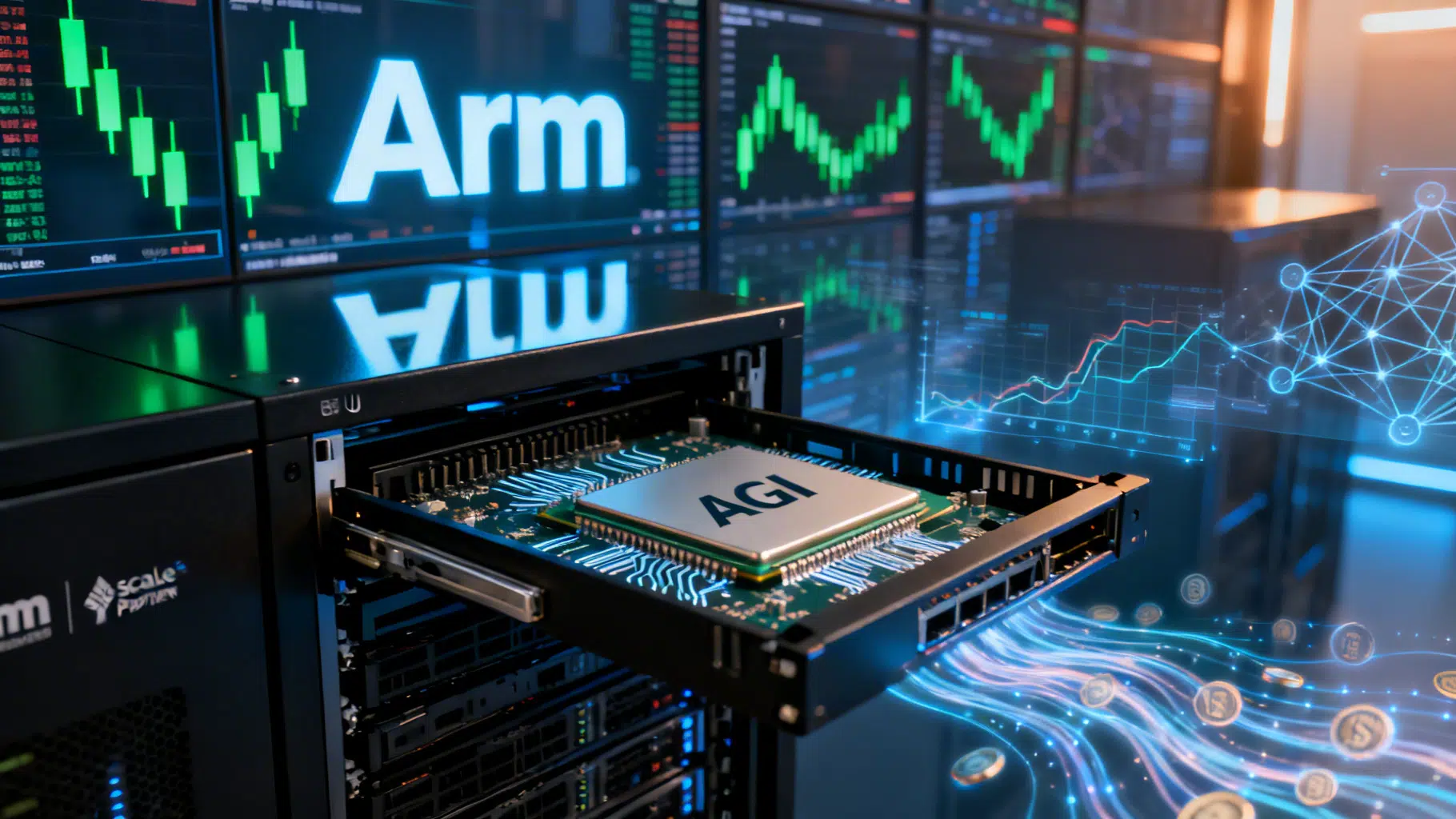
Image used for representation purposes only.
Arm stock spikes after Arm enters the chip business with its first in‑house “AGI CPU”
Arm Holdings jolted markets this week after formally expanding beyond IP licensing into production silicon. On March 24, 2026, the company unveiled the Arm AGI CPU, a data‑center processor designed for “agentic AI” workloads—and said it will now offer finished chips alongside its core intellectual property and compute subsystems. Arm named Meta as lead partner and said additional customers and ODMs are already lined up for production. Early systems are available now, with broader availability expected in the second half of 2026. (newsroom.arm.com )
What Arm announced—and why it matters
Arm framed the move as a “historic” expansion of its compute platform. Key launch details:
- Product: Arm AGI CPU for AI data centers.
- Architecture: Up to 136 Arm Neoverse V3 cores per CPU, 6 GB/s memory bandwidth per core at sub‑100 ns latency, and a 300‑watt TDP tuned for sustained, deterministic throughput. (newsroom.arm.com )
- Performance claim: More than 2× performance per rack versus x86 CPUs, potentially yielding up to $10 billion in capex savings per gigawatt of AI data‑center capacity (Arm’s estimates). (newsroom.arm.com )
- Partners and manufacturing: Meta is the lead partner; Arm also cited commitments from OpenAI, Cloudflare, SAP, and SK Telecom, with systems from ASRock Rack, Lenovo, Quanta, and Supermicro. TSMC said it will manufacture the chip on its 3 nm process. (newsroom.arm.com )
Strategically, this is a break from Arm’s 30‑plus‑year model of licensing CPU designs and collecting royalties. It also positions Arm directly in the path of swelling CPU demand as AI shifts from model training to always‑on, multi‑agent inference that is CPU‑heavy for orchestration and data movement. Arm has been publicly seeding this argument—CPUs “scale with AI”—for months. (newsroom.arm.com )
Market reaction: ARM shares rip higher
Arm’s shares surged following the news. As of 00:15 UTC on March 26, 2026 (Wednesday evening U.S. time), ARM traded at $157.07, up 16.37% on heavy volume, after swinging between an intraday low of $147.00 and a high of $163.71.
Context: Arm’s rising data‑center footprint—and an ecosystem tailwind
Arm’s data‑center story has accelerated over the past year as hyperscalers adopted higher‑core‑count Arm CPUs. In its Q3 FYE26 shareholder letter (results released February 4, 2026), Arm highlighted: AWS Graviton5 at 192 cores; Microsoft’s Arm‑based Cobalt 200 at 132 cores; and Nvidia’s next‑gen Vera CPU at 88 Arm cores—signposts of a core‑count race driven by AI inference. Arm said Neoverse CPU deployments have surpassed one billion cores and that its share among top hyperscalers is expected to approach 50%. (investors.arm.com )
Separately, Arm recently joined Nvidia’s NVLink Fusion ecosystem, aiming to make Arm‑based CPUs even more attractive for GPU‑accelerated AI systems by enabling tighter CPU‑GPU coupling—another potential catalyst for Arm’s data‑center royalty and silicon businesses. (tomshardware.com )
The numbers behind the narrative
- Latest quarter (Q3 FYE26): Revenue $1.24 billion, up 26% year over year; record royalty revenue of $737 million (up 27%). Non‑GAAP EPS was $0.43. (investors.arm.com )
- Guidance (as of Feb. 4, 2026): Q4 FYE26 revenue guidance of $1.47 billion ± $50 million and non‑GAAP EPS of $0.58 ± $0.04. (investors.arm.com )
These figures reflect Arm’s thesis that higher‑value IP (Armv9 and Compute Subsystems) and rising data‑center exposure can lift royalty rates and sustain growth. The pivot to shipping silicon could, if executed well, add an incremental revenue stream atop that foundation. (investors.arm.com )
What could go right—and what could go wrong
Upside catalysts
- Demand fit: Arm’s AGI CPU is tuned for “agentic AI,” where large fleets of AI agents run persistently and are CPU‑bound for coordination. If that workload mix scales as Arm anticipates, CPU sockets—and Arm’s addressable market—expand meaningfully. (newsroom.arm.com )
- Ecosystem momentum: Public support spans hyperscalers, chipmakers, memory vendors, and ODMs; manufacturing on TSMC 3 nm reduces execution risk on process. (newsroom.arm.com )
Key risks
- Channel conflict: Selling Arm‑designed chips could strain relationships with customers that also license Arm IP. Analysts and trade press flagged this risk when reports of an Arm chip push first surfaced in 2025; now the strategy is official. (computerworld.com )
- Execution and competition: Entering the server‑CPU market pits Arm against incumbents and partners simultaneously. Platform‑level tie‑ups (e.g., NVLink Fusion) help, but competitive dynamics will be intense. (tomshardware.com )
- Valuation sensitivity: Independent analysis has, at times, flagged ARM as richly valued relative to fundamentals; any stumble on silicon rollout, licensing, or royalties could amplify volatility. (global.morningstar.com )
Investor takeaway
Arm just crossed a Rubicon. By adding production silicon to its platform, it aims to capture more economics from the same AI build‑out that has already turbocharged its licensing and royalties. The launch gives investors a new growth vector to model—one with bigger potential upside, but also higher execution and relationship risks than Arm’s traditional Switzerland‑style stance.
For now, the market is voting with its feet: ARM shares are rallying on the prospect that Arm can parlay its architecture ubiquity into a CPU business built for the AI‑at‑scale era. The next milestones to watch are customer system launches through mid‑2026, any quantified revenue targets management discloses for AGI CPU, and the company’s Q4 FYE26 print and outlook update in early May. (newsroom.arm.com )
Related Posts
INTC in 2026: Price Action, Nvidia Tie‑Up, Altera Sale, and the 18A Foundry Reboot
Intel (INTC) in 2026: price, Nvidia stake, Altera sale, Q1 outlook, and 18A foundry ramp—key catalysts, risks, and what to watch next.
AMD Stock after Meta’s 6GW AI Deal: Growth, Dilution, and the 2026 Playbook
AMD stock jumps as Meta inks a 6GW AI chip deal featuring performance-based warrants. Here’s what it means for growth, dilution, and 2026 execution.
AI Briefing: GPT-5.4 lands, Google pushes Gemini everywhere, Anthropic surges, Nvidia rallies open models, and Meta signs News Corp
AI this week: OpenAI ships GPT-5.4, Google expands Gemini in Maps & Workspace, Anthropic surges, Nvidia rallies open models, Meta inks News Corp deal, EU AI Act nears.