
Apple kills the Mac Pro after 20 years: what pros need to know now
Apple ends Mac Pro after 20 years. What Apple confirmed on March 26, 2026 means for pro users, PCIe workflows, and the Mac Studio future.
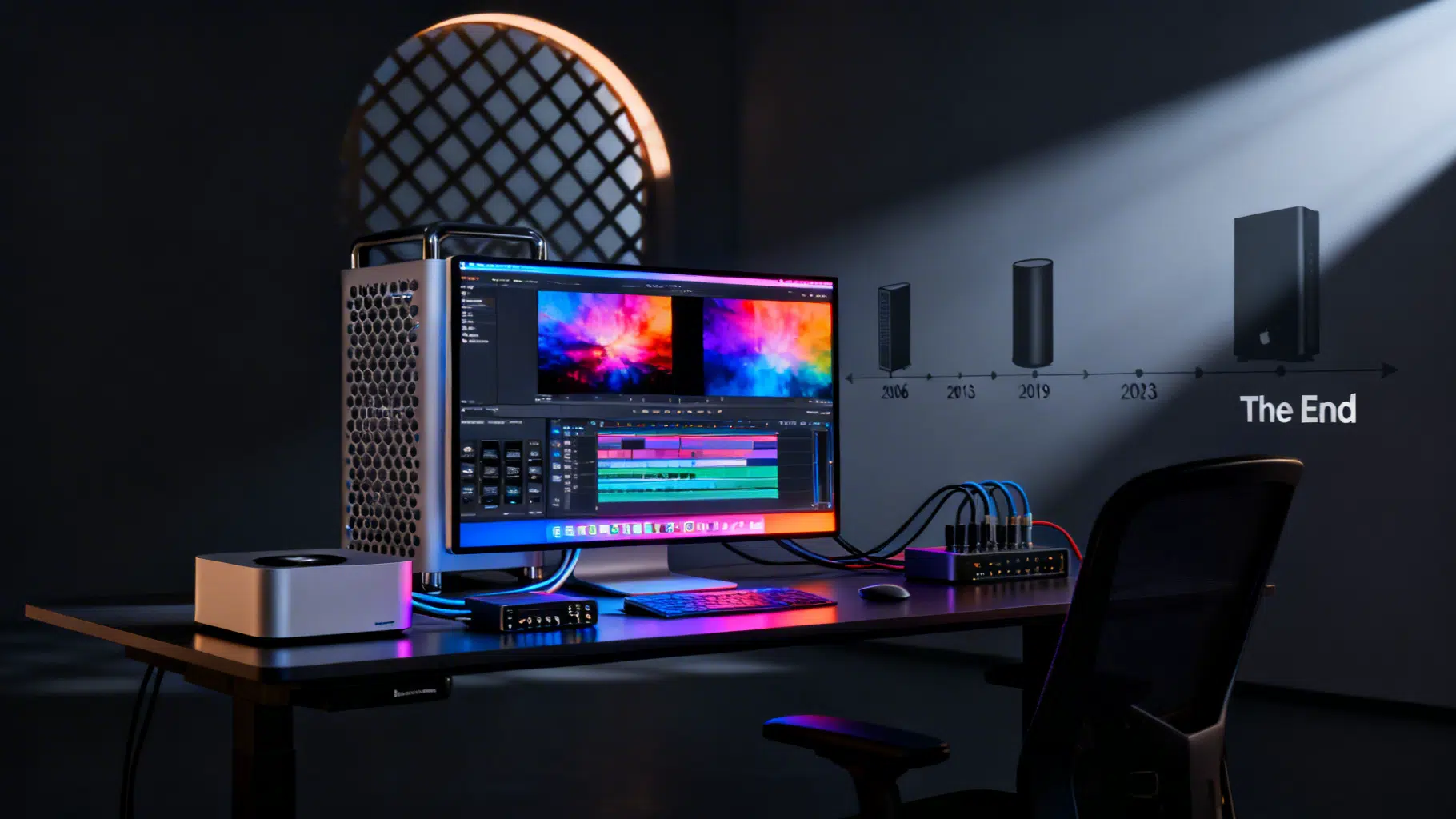
Image used for representation purposes only.
Apple ends the Mac Pro era
Apple has discontinued the Mac Pro, confirming to 9to5Mac on March 26, 2026 that the workstation tower is no longer in production and that there are no plans for future Mac Pro hardware. The “Buy” link for Mac Pro on Apple’s site now redirects to the general Mac page, effectively removing the product from the lineup. (9to5mac.com )
Tom’s Hardware, citing Apple’s confirmation to 9to5Mac, reported that Apple is positioning Mac Studio as the company’s pro desktop going forward, closing the book on a 20‑year run that began in 2006. (tomshardware.com )
Why now: a tower stuck in the Apple Silicon transition
The Mac Pro’s final major update arrived at WWDC on June 5, 2023, when Apple moved the machine to its M2 Ultra chip and kept the $6,999 starting price. While the Apple Silicon redesign preserved six PCIe slots for specialized I/O, the architecture’s unified memory design meant users could not upgrade RAM or install discrete GPUs—anathema to the expandability that once defined the Mac Pro. Apple’s own support documentation also makes clear that external GPUs (eGPUs) are only supported on Intel‑based Macs, not Apple Silicon, further constraining GPU options for the 2023 Mac Pro. (apple.com )
The Mac Studio meanwhile advanced briskly: in March 2025 Apple introduced configurations with M4 Max and M3 Ultra, delivering outsized performance in a far smaller chassis and at much lower starting prices. That cadence—paired with the inability to materially expand graphics or memory on Mac Pro—left Apple’s tower overshadowed by a desktop that was cheaper, quieter, and nearly as fast in many workflows. (apple.com )
The heir apparent: Mac Studio
With the Mac Pro now out, Apple’s pro‑desktop story consolidates around Mac Studio. The 2025 refresh brought Thunderbolt 5 connectivity and options that span from M4 Max to M3 Ultra, with Apple and press reviews touting large gains over the prior generation and even over 2019’s top‑end Intel workstations in GPU‑bound tasks. Industry reporting also points to an M5 Ultra update for Mac Studio later in 2026, underscoring Apple’s commitment to the compact form factor as its flagship workstation. (apple.com )
For studios that previously relied on the Mac Pro’s PCIe slots, Apple and third‑party vendors have increasingly demonstrated Thunderbolt‑attached expansion and network‑centric scaling as the new path. 9to5Mac noted that recent macOS releases added low‑latency interconnect features that let multiple Macs coordinate workloads over Thunderbolt 5—one more signpost toward modularity without an internal backplane. (9to5mac.com )
A 20‑year timeline of a workstation
- 2006: First‑generation Mac Pro debuts, replacing the Power Mac G5 and inaugurating the Intel Xeon era in Apple’s professional desktops. (en.wikipedia.org )
- 2013: Apple ships the cylindrical “trash can” Mac Pro—innovative but thermally and expansion‑limited, with no internal PCIe slots. (en.wikipedia.org )
- 2019: Apple returns to a modular tower with eight PCIe slots, up to a 28‑core Intel Xeon W, and launches the Pro Display XDR alongside it. (en.wikipedia.org )
- 2023: The Apple Silicon transition reaches Mac Pro with M2 Ultra and six PCIe 4.0 slots; no discrete GPU or RAM upgrades. Base price remains $6,999. (apple.com )
- March 26, 2026: Apple discontinues Mac Pro; Mac Studio becomes the pro desktop focus. (9to5mac.com )
What this means for pro workflows
- PCIe workflows: If your projects depend on SDI capture, pro audio DSP, high‑speed storage HBAs, or timecode/sync cards, you can continue using them in the 2019 Intel Mac Pro or the 2023 M2 Ultra model. Looking forward, Apple and accessory makers increasingly steer those needs to Thunderbolt expansion chassis and network appliances paired with Mac Studio. Apple Silicon’s lack of discrete/eGPU support isn’t changing, so plan around external PCIe and compute rather than internal GPU cards. (support.apple.com )
- GPU compute: On Apple Silicon, GPU scale comes from buying the right SoC bin (Max/Ultra) up front. For teams that previously upgraded GPUs every 12–24 months, procurement shifts to earlier capacity planning and, where appropriate, distributing workloads across multiple Macs. (apple.com )
- Displays: Apple also ended the Pro Display XDR’s six‑year run on March 3, 2026, replacing it with a new Studio Display XDR, further aligning the pro desktop ecosystem around “Studio” branding. (apple.com )
The market context: from rumors to reality
Throughout late 2025, reporting by Bloomberg (via multiple outlets) and others suggested Apple had “largely written off” the Mac Pro internally, with no significant 2026 update planned. That sentiment is now borne out by Apple’s confirmation and the removal of Mac Pro from apple.com. The rumors also indicated that an M4 Ultra Mac Pro had been considered and then shelved, while the “Ultra” tier would continue on Mac Studio. (9to5mac.com )
If you own a Mac Pro today
- 2019 Intel Mac Pro: macOS 26 “Tahoe” supports the 2019 tower, and Apple typically provides security and service coverage windows based on published “vintage” and “obsolete” policy timelines (five and seven years, respectively, after last sale). Expect future macOS feature releases to prioritize Apple Silicon, but the 2019 tower remains viable for PCIe‑centric workflows and legacy macOS/software stacks. (macrumors.com )
- 2023 M2 Ultra Mac Pro: Apple has not announced an end‑of‑software‑support date. Given it is the newest and last Mac Pro, it remains eligible for current macOS releases and Apple service. The caveat remains the same: no discrete GPU or RAM upgrades, so performance headroom depends entirely on your purchased configuration. (support.apple.com )
If you’re mid‑project on a Mac Pro, there’s no cause for immediate alarm—Apple tends to support recently sold Macs for multiple years. But procurement teams should begin standardizing around Mac Studio (and, where mobility is essential, MacBook Pro) with Thunderbolt expansion and network storage as the new baseline. (apple.com )
The bottom line
As of March 26, 2026, Apple has formally ended the Mac Pro line, capping two decades of workstation history. The decision reflects both the success of Mac Studio and the practical limits of bringing traditional, slot‑driven modularity to Apple Silicon’s unified architecture. For most creative and technical shops, the path forward is clear: spec the right SoC at purchase, lean on Thunderbolt 5 and fast networks for modularity, and plan workflows around the Studio. The tower era at Apple is over; the Studio era is here. (9to5mac.com )
Related Posts
MacBook Air M5: Faster Silicon, Wi‑Fi 7, and 512GB Base Storage Mark Apple’s 2026 Refresh
Apple’s 2026 MacBook Air adds M5 speed, Wi‑Fi 7/Bluetooth 6, and 512GB base storage. Prices start at $1,099 on March 11 availability.