
RTX 60 ‘Rubin’ specs leak: credible clues, shaky numbers, and a long wait ahead
Fresh RTX 60 “Rubin” leaks hint at GR20x dies, 3nm, GDDR7, and a 2027+ launch. Here’s what’s credible—and what isn’t, as of March 28, 2026.
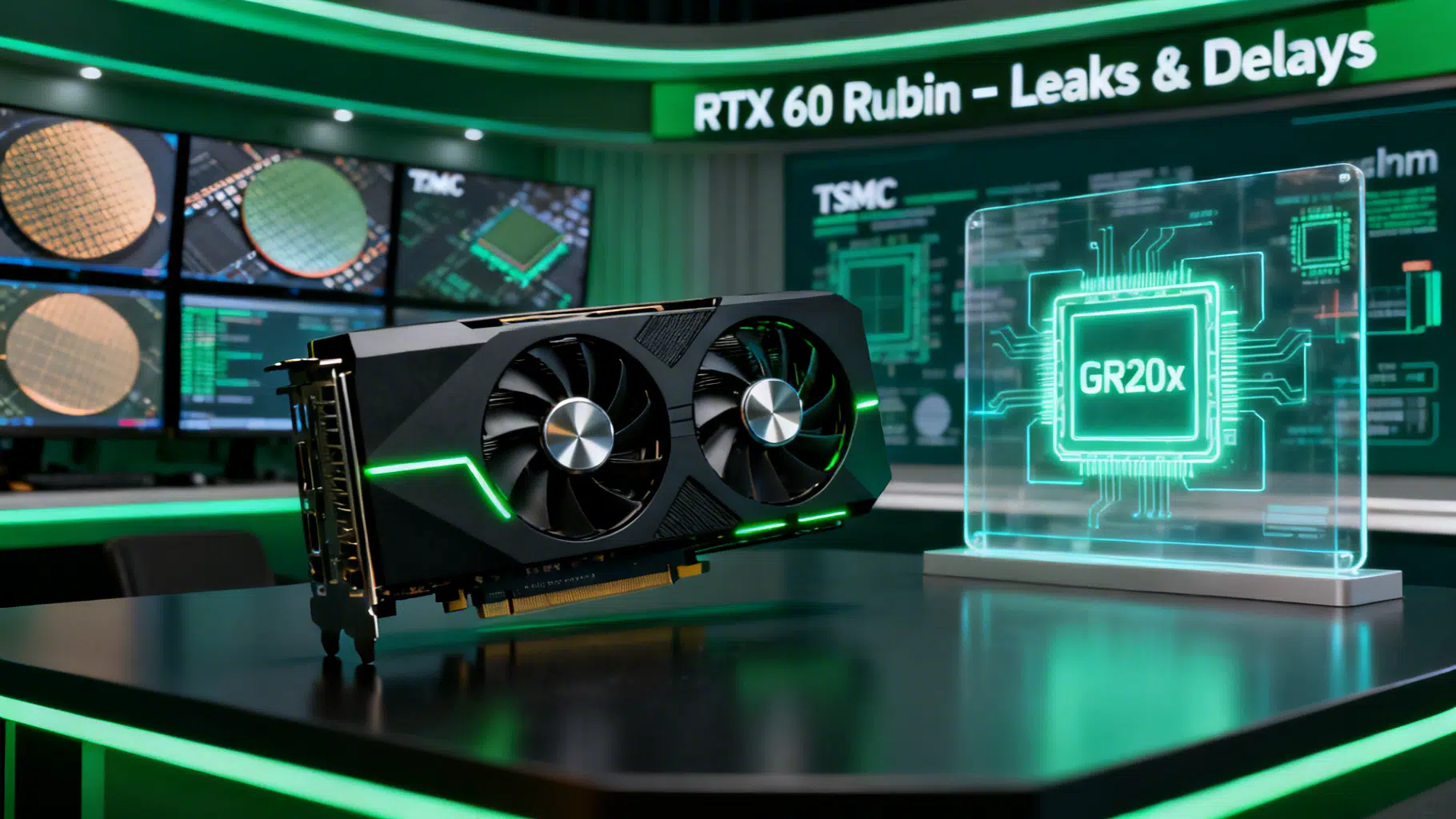
Image used for representation purposes only.
NVIDIA RTX 60 “specs leak”: what’s real, what’s rumor, and why the timeline is slippery
As of March 28, 2026, a fresh round of leaks has reignited chatter about Nvidia’s next GeForce generation—commonly dubbed the RTX 60 series. Core claims center on a move to the Rubin architecture and GR20x GPU dies, with the flagship rumored as “GR202,” but with launch timing sliding toward late 2027 or beyond. Here’s the state of play, sifted for signal over noise. (tomshardware.com )
The headline claims in the latest leak cycle
Multiple reports—largely sourced to well-known leaker kopite7kimi and summarized by tech outlets—paint the following picture. Treat every bullet as rumor unless otherwise stated.
- Architecture and dies: GeForce “RTX 60” is said to pivot to Nvidia’s Rubin architecture for gaming, using GR20x silicon (e.g., GR202 for the halo card). This is consistent across several write‑ups that track kopite7kimi’s posts. (tomshardware.com )
- Process node: Analysts and reporters covering Rubin indicate a shift to TSMC’s 3nm-class manufacturing (N3/N3P). For gaming SKUs this remains inference, but it is a reasonable extension of the AI roadmap. (techspot.com )
- Compute configuration (very speculative): Die imagery and labeling discussions around Rubin CPX (an AI part) have prompted guesses of as many as 192 SMs on a large consumer die—roughly mirroring the top Blackwell configurations by count—but this is extrapolation, not a confirmed gaming spec. (tomshardware.com )
- Memory: GDDR7 is a given for any next-gen GeForce cadence, and suppliers have publicly discussed higher-capacity GDDR7 parts—context that supports, but does not confirm, future GeForce configs. (tomshardware.com )
- Performance target: Some coverage of January leaks floated a halo-card uplift “at least 30% faster” than the RTX 5090—again, strictly rumor at this stage. (tomshardware.com )
The timing: 2027 or even 2028 remains the safe bet
The most consistent thread in credible reporting is delay. After a quiet CES 2026 for gaming GPUs, multiple outlets now expect no new GeForce launches in 2026, with RTX 60 mass production slipping to late 2027—or potentially 2028—amid memory supply constraints. Nvidia hasn’t announced RTX 60 and has instead acknowledged industry‑wide memory headwinds impacting gaming GPUs. (tomshardware.com )
Why the dates (and specs) are so fluid
- Memory economics: GDDR7 pricing and availability are shaping GPU roadmaps. Industry commentary suggests vendors prioritize products that deliver the most revenue per gigabyte of scarce VRAM, which tilts allocation decisions and can reshuffle consumer timelines. (tomshardware.com )
- AI first: Rubin’s AI accelerators on 3nm are widely reported to be on an aggressive schedule at TSMC. If those parts consume node capacity and packaging, gaming SKUs can be pushed back even if design work progresses. (notebookcheck.net )
- CES 2026 context: Nvidia skipped new gaming GPU announcements at the show, reinforcing the notion that any “RTX 60” reveal is a mid‑to‑late‑2027 story at the earliest. Some coverage even cites internal targets slipping to 2028. (tomshardware.com )
Sorting the leak: what seems credible vs. questionable
-
Credible trajectory
- Rubin architecture + GR20x family for GeForce. This aligns with multiple independent write‑ups tracking the same primary leaker. (tomshardware.com )
- 3nm‑class TSMC node. Numerous reports tie Rubin to N3/N3P; applying this to gaming is a reasonable inference but still unconfirmed. (techspot.com )
- Continued GDDR7 with evolving capacities. Supplier disclosures make this likely, though exact VRAM sizes per SKU are unknown. (tomshardware.com )
-
Questionable or unverified
- SM counts and exact die layouts for consumer cards (e.g., “192 SM” on GR202). Current numbers derive from AI‑chip die labeling and are not confirmed gaming specs. (tomshardware.com )
- Big VRAM/TGP one‑offs circulating on social media. Treat outsized figures skeptically until corroborated by multiple reputable outlets or official materials. (General guidance; no single reliable source backs extreme values.)
How it could stack up against today’s flagships
If the node shrink and memory improvements materialize, expect generational uplifts from efficiency and bandwidth alone, with neural‑rendering features doing more of the heavy lifting—continuing Nvidia’s shift toward AI‑assisted performance rather than raw rasterization gains. Some reports cite internal targets suggesting a 30% uplift for the top card versus RTX 5090, but that figure is best read as an early ambition, not a shipping promise. (tomshardware.com )
What’s officially confirmed?
Nothing about RTX 60 specifications is official as of today. Nvidia has not announced the lineup, chips, clocks, VRAM sizes, or power. The company did, however, address supply context this year, acknowledging constrained memory availability while declining to comment on unannounced products. (tomshardware.com )
What to watch next
- Foundry signals: Any credible confirmation of 3nm gaming tape‑outs beyond AI parts will strengthen the 2027 window case. (notebookcheck.net )
- Memory roadmaps: Supplier updates on higher‑density GDDR7 (e.g., 3GB chips moving to volume) could unlock more attractive SKU configurations—and firmer launch planning. (tomshardware.com )
- Major events: If Nvidia follows past patterns, a first tease could land in late 2026 or at CES 2027—but current reporting cautions patience. (pcworld.com )
Bottom line
Today’s “RTX 60 specs leak” should be read as a directional preview, not a spec sheet. The most defensible takeaways are architectural (Rubin/GR20x), process (3nm‑class), memory (GDDR7), and an elongated cadence shaped by VRAM supply and AI demand. Concrete numbers—cores, clocks, VRAM per SKU, power—remain unconfirmed and, based on industry signals, may not solidify until well into 2027. (tomshardware.com )
Related Posts

Arm Stock Soars as Company Enters Silicon With First In‑House ‘AGI CPU’
Arm stock jumps after Arm unveils its first in‑house AGI CPU, entering silicon with Meta as lead partner and targeting agentic AI data centers.

AGI in 2026: Capabilities Are Rising—Consensus Is Not
AGI in 2026: funding surges, compute scales, rules diverge. Where capabilities truly are—and what to watch next.

NVIDIA DLSS 5: What’s Real, What’s Rumor, and What Ships Now
DLSS 5 is trending, but NVIDIA hasn’t announced it. Here’s what DLSS 4.5 adds now—and what a future DLSS 5 might deliver.