China’s Supercomputers in 2026: Exascale Power, Off the Record
China’s supercomputing push is accelerating—but off the books. Where exascale progress stands in April 2026, and why it matters.
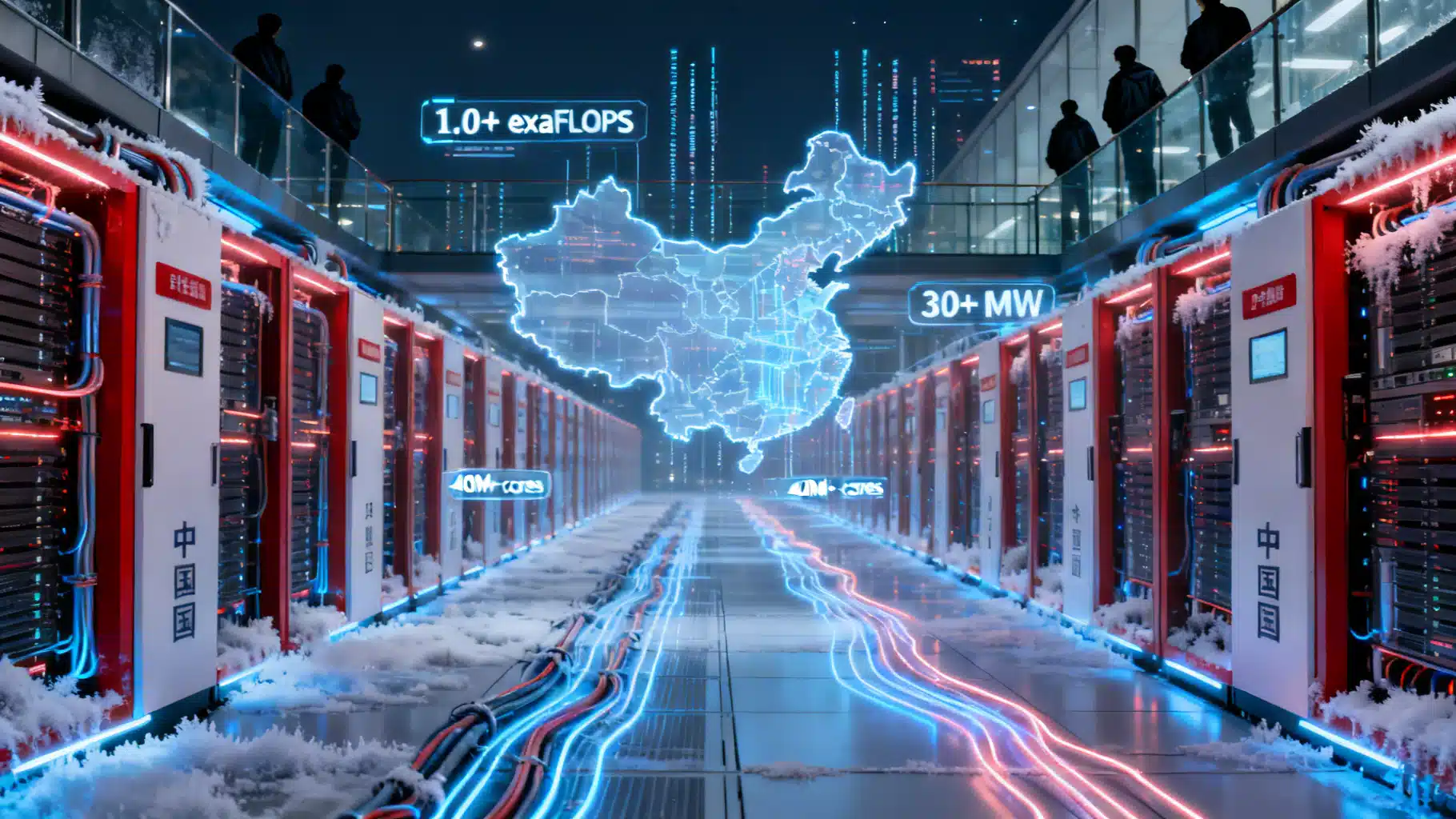
Image used for representation purposes only.
China’s hidden exascale era: where things stand in April 2026
China’s supercomputing story has entered a paradoxical phase: the country continues to scale massive, homegrown high‑performance computing (HPC) systems for science and AI, yet its most potent machines remain largely absent from international rankings. In 2024 Beijing’s tech authorities disclosed aggressive growth in aggregate “computing power,” while researchers published results that could only be achieved on exascale‑class hardware. But China still withholds flagship submissions to the TOP500, leaving analysts to piece together progress from conference papers, government statements, and industry reporting. (govt.chinadaily.com.cn )
Hard numbers China has published
- China’s Computer Society released a domestic Top 100 list for 2024. Its leading entry posted 487.94 petaflops (Linpack) with 10,649,600 CPU cores—performance that would have placed it around fifth worldwide at the time—but the list included no exascale systems. (datacenterdynamics.com )
- In parallel, the Ministry of Industry and Information Technology (MIIT) said the nation’s total compute capacity reached about 280 EFLOPS by end‑2024 and targeted 300 EFLOPS by 2025—a metric that aggregates data‑center and AI compute, not just traditional HPC. (govt.chinadaily.com.cn )
- On the global TOP500, China has not introduced new headline systems and its representation fell compared with prior years, even as the exascale era expanded elsewhere. (top500.org )
Taken together, the data describe a country that is adding enormous compute but disclosing little about its fastest HPC installations.
The exascale machines we don’t see (but can increasingly infer)
Multiple lines of evidence point to at least two Chinese exascale‑class systems operating since the early‑to‑mid 2020s:
- Sunway “OceanLight” (also called “New Sunway”), a successor to Sunway TaihuLight, appears to have crossed the exascale threshold using upgraded ShenWei processors. Research teams report production science at 37–40 million cores and near‑real‑time simulations at unprecedented scale—results consistent with an exascale‑class platform. (arxiv.org )
- Tianhe‑3, the follow‑on to Tianhe‑2A, is widely reported to use domestically designed heterogeneous processors; estimates in open reporting have placed its sustained Linpack above 1 EFLOPS, though official figures remain undisclosed. (tomshardware.com )
At SC24, a Gordon Bell Prize finalist explicitly cited performance scaling on “the new Sunway system” alongside a major Beijing AI cluster, further corroborating large‑scale availability. And in late 2025, a Sunway team detailed AI‑driven quantum chemistry at molecular scale across 37 million cores on OceanLight. Neither effort provided a formal TOP500 submission, but both offered technical breadcrumbs that align with exascale operation. (sc24.supercomputing.org )
Chips and architecture: made in China
- Sunway line: Analyses by HPC specialists suggest OceanLight relies on an enhanced ShenWei CPU generation (“SW26010‑Pro”/“SW26010P”), scaling classic Sunway many‑core design across more than 100,000 nodes. Earlier community deep‑dives argued China achieved exascale here despite using comparatively mature process technology—underscoring architectural and system‑level efficiency. (old.chipsandcheese.com )
- Tianhe line: The publicly listed Tianhe‑2A already runs NUDT’s Matrix‑2000 accelerators; reports indicate Tianhe‑3 advances this heterogeneous approach with newer domestic chips, though specifics are not formally published. (top500.org )
The through‑line is self‑reliance: China’s flagship HPC is built around indigenous CPUs/accelerators and interconnects, shaped by years of export controls.
Sanctions, procurement shifts, and strategic opacity
Washington’s 2021 decision to add key Chinese supercomputing entities to the U.S. Commerce Department Entity List—and subsequent rule tightenings—constrained access to advanced semiconductors and manufacturing tools. China’s response has been twofold: push deeper into domestic silicon and refrain from submitting crown‑jewel systems to foreign‑run rankings that could spotlight sanctioned supply chains. In early 2026, reporting also surfaced of tightened Chinese procurement lists prioritizing local AI/HPC hardware for government buyers. (commerce.gov )
This policy mix helps explain why China’s most powerful supercomputers remain “off‑list” even as domestic compute capacity soars.
The science on Sunway: what recent papers show
- Kilometer‑scale Earth system modeling: Researchers ported CESM 2.2 to a 40‑million‑core Sunway system, achieving hundreds of simulated days per day at 5‑km atmosphere and 3‑km ocean resolutions—feats that demand exascale‑class resources. (arxiv.org )
- Electronic structure at extreme scale: A 2024 study pushed plane‑wave DFT to systems with 16,384 atoms on “New Sunway,” reporting 64.8× speedups versus earlier baselines—again implying access to a massive, tightly coupled machine. (arxiv.org )
- Quantum chemistry via AI: In 2025, the Sunway team described neural‑network quantum states at molecular scale across 37 million cores, blending AI with HPC to tackle classically intractable problems. (tomshardware.com )
These peer‑reviewed and preprint results don’t replace official benchmarks, but they chart the capabilities of China’s hidden exascale class.
Meanwhile, the public rankings tell a different story
On the November 2024 TOP500, exascale leadership was centered in U.S. labs and clouds, and China neither introduced new flagships nor reversed a slide in participation. By 2025, the list continued to expand its exascale entries without high‑profile Chinese submissions. The gap between what’s measured internationally and what appears to be running inside China keeps widening. (top500.org )
Why this matters
- AI‑HPC convergence: China’s push is increasingly about AI supercomputing as much as physics‑based simulation. MIIT’s EFLOPS disclosures include “intelligent computing,” reflecting national priorities around large‑model training, inference, and industry AI. (govt.chinadaily.com.cn )
- Scientific competitiveness: From climate to quantum chemistry, the Sunway corpus shows Chinese teams executing work that competes at the frontier of exascale science. (arxiv.org )
- Geopolitics and supply chains: Export controls and domestic procurement mandates are reshaping who builds—and who can buy—the most powerful computers on Earth. Expect continued divergence between on‑the‑ground capability and what appears in Western‑maintained leaderboards. (commerce.gov )
What to watch through 2026
- TOP500 (June/November 2026): Will China re‑enter with any of its rumored exascale machines, or continue to opt out? Recent lists suggest continued non‑participation, but policy or messaging shifts could change that calculus. (top500.org )
- Sunway and Tianhe publications: Conference papers and arXiv preprints remain the best window into performance. Watch for scaling studies that disclose node counts, interconnect behavior, and energy efficiency on “New Sunway” and Tianhe‑class systems. (arxiv.org )
- China’s compute policy: MIIT’s national computing‑network initiatives and procurement guidance favoring domestic chips will influence where and how the next wave of AI/HPC clusters are built. (govt.chinadaily.com.cn )
- Sanctions trajectory: Any updates from the U.S. Commerce Department could affect availability of accelerators, memory, and EDA tools—variables that shape China’s system designs and disclosure strategy. (apnews.com )
Bottom line
As of April 9, 2026, the weight of technical evidence indicates China has operated multiple exascale‑class supercomputers for several years, led by Sunway OceanLight and likely Tianhe‑3. Yet absent formal benchmarking, the world sees these systems primarily through scientific results and policy tea leaves. If Beijing continues to prize strategic ambiguity—and if export controls persist—China’s most powerful supercomputers may stay “off‑list” even as they push frontier science at home. (arxiv.org )
Related Posts

AAPL Briefing: Record Quarter, Gemini‑Powered Siri, and the WWDC 2026 Countdown
AAPL’s 2026 story: record Q1, a Google Gemini–backed Siri, WWDC 2026 AI previews, and an active DOJ case keep Apple’s stock in the headlines.
INTC in 2026: Price Action, Nvidia Tie‑Up, Altera Sale, and the 18A Foundry Reboot
Intel (INTC) in 2026: price, Nvidia stake, Altera sale, Q1 outlook, and 18A foundry ramp—key catalysts, risks, and what to watch next.

Taiwan’s March Crunch: Defense Deadlines, PLA Drills, and an AI-Powered Economy
As March deadlines loom for U.S. arms deals, Taiwan weighs defense budgets and PLA pressure against an AI-driven economic surge and a new U.S. trade pact.