Google’s April 2026: Gemini alliances, tougher rules, a search reset, and I/O on deck
Google’s April 2026: Apple’s Gemini deal, U.S. antitrust remedies, EU DMA pressure, a fresh core update, Android 17 betas, Chrome DBSC, and a $20B bond tap.
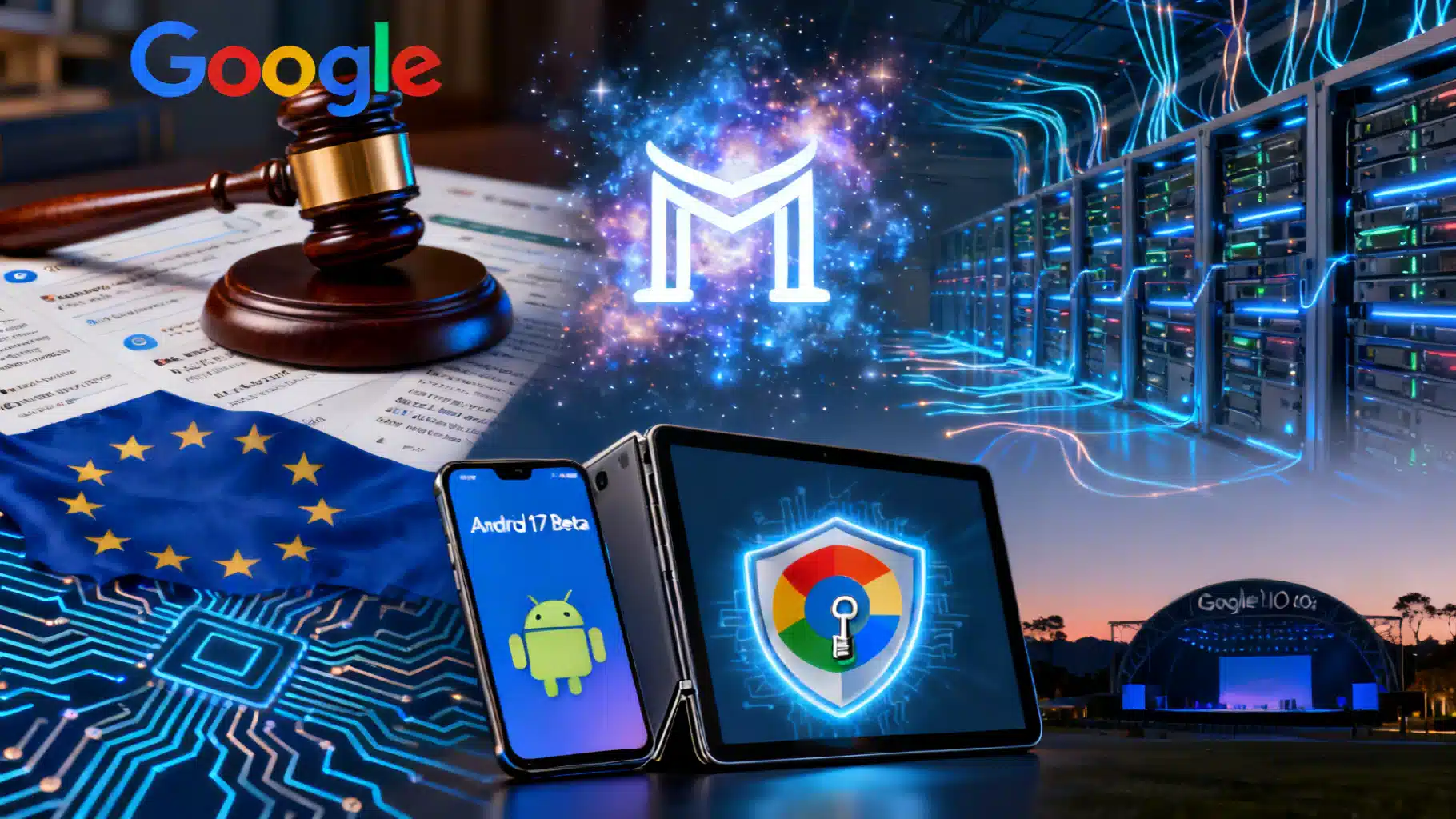
Image used for representation purposes only.
Google in April 2026: AI deals, regulation, and a search shake-up
Google enters mid‑April 2026 with momentum and scrutiny in equal measure. The company sealed a headline AI partnership with Apple, faces new regulatory guardrails in the U.S. and EU, completed a significant Google Search core update, and is gearing up for its annual developer conference next month. Together, these moves underscore how central Gemini, search, Android, and cloud infrastructure have become to Google’s strategy. (androidauthority.com )
Gemini everywhere — including inside Apple’s next Siri
On January 12, Apple and Google jointly confirmed a multiyear deal to use Google’s Gemini models for an overhauled Siri and broader “Apple Intelligence” features. The announcement ended months of speculation and marks a rare, public alliance between the iPhone maker and Google on core AI technology. Reporting at the time described Gemini as the external model Apple selected after evaluations, with Bloomberg and others characterizing it as a foundational piece of the Siri revamp slated for 2026. (androidauthority.com )
Google, for its part, has been pushing Gemini deeper into its own products. In January, it introduced a “Personal Intelligence” experience that ties Gemini to user data across Gmail, Photos, Search, and YouTube, rolling out initially to U.S. personal accounts. Google also began upgrading AI Overviews in Search with newer Gemini models and follow‑up chats in the results, signaling a tighter fusion of answer generation and web search. (techradar.com )
Beyond Search, Gmail is getting a Gemini‑powered “AI Inbox” capable of answering natural‑language questions about your mail, another sign that Google is laying down AI rails across Workspace. (androidcentral.com )
Search in flux: the March 2026 core update lands
Google confirmed that its March 2026 broad core update has finished rolling out in early April, with industry trackers noting noticeable ranking volatility through the period. Core updates recalibrate multiple systems, so site operators are now poring over analytics to understand traffic shifts. (searchenginejournal.com )
While Google rarely details the precise levers, SEOs widely observed greater sensitivity to content originality and reductions of scaled, low‑value pages, consistent with Google’s longer‑term guidance. If your site was affected, Google’s documentation (and past recovery patterns) suggest focusing on expertise, clear sourcing, and demonstrable usefulness rather than technical quick fixes. (searchenginejournal.com )
Antitrust: remedies in the U.S., access mandates in the EU, and an Epic settlement
In the United States, the Department of Justice celebrated a major remedies win against Google on September 2, 2025, after the court found Google illegally maintained monopolies in search and search advertising. The remedies bar exclusivity for distribution of Google Search, Chrome, Assistant, and the Gemini app; require providing certain search index and user‑interaction data to rivals; and mandate search and search‑text‑ads syndication access — explicitly extending to guard against leveraging the same tactics in GenAI markets. The case continues to shape Google’s obligations as appeals and implementation unfold. (justice.gov )
In Europe, regulators have shifted from principle to playbook under the Digital Markets Act. On January 27, 2026, the European Commission opened “specification proceedings” to define how Google must provide rival AI services equivalent access to Android features used by Gemini and share search data on FRAND terms — with non‑compliance ultimately risking steep fines. (apnews.com )
Meanwhile, Google moved to end a five‑year app‑store battle with Epic Games. On March 4, 2026, the companies announced a settlement that lowers standard Google Play commissions to around 20% (with lower rates for some transactions) and paves the way for Fortnite’s return and broader alternative‑store distribution on Android — a material shift in Google’s mobile ecosystem economics subject to court processes. (apnews.com )
Android 17: a faster beta track — and new rules for large screens and NPUs
Google accelerated Android’s release cadence this year by skipping classic Developer Previews and moving straight into public betas. Android 17 Beta 1 arrived in mid‑February, with Beta 3 landing on March 26 as APIs locked for final compatibility testing. Google highlights several notable changes: removing the developer opt‑out for orientation and resizability on large screens (developers should test for tablets/folds now), vendor‑defined camera extensions (think ‘Super Resolution’ or other AI‑driven modes), and manifest‑declared access for neural processing units (NPUs). A stable release is targeted for Q2 2026. (android-developers.googleblog.com )
Chrome security: device‑bound sessions arrive
Google’s browser team rolled out Device Bound Session Credentials (DBSC) in Chrome 146 on Windows, cryptographically tying session cookies to the hardware so that exfiltrated cookies quickly expire and become useless to infostealers. macOS support is following. The move builds on 2025 pilots and continues Chrome’s incremental hardening of web authentication. (techradar.com )
Money and machines: Alphabet taps bond markets as AI capex swells
Alphabet raised roughly $20 billion in a seven‑part U.S. dollar bond sale in early February — part of a broader Big Tech borrowing wave to fund massive AI infrastructure buildouts. Bloomberg and Reuters reported maturities stretching into the 2060s, with strong investor demand. Alphabet’s own commentary around Q4 2025 stresses that depreciation and capex will step up in 2026 as Google scales GPUs, TPUs, and data center capacity for Gemini and Cloud. (bloomberg.com )
Operationally, Alphabet’s Q4 2025 and full‑year 2025 results showed healthy fundamentals: management highlighted rapidly rising revenue from gen‑AI products and a sharp improvement in Google Cloud’s operating margin, reflecting scale in AI infrastructure and services. (blog.google )
What to watch at Google I/O 2026 (May 19–20)
Google I/O returns to Shoreline Amphitheatre on May 19–20. Expect Gemini to dominate the keynote — spanning Search, Workspace, Android, and developer tooling — alongside Android 17 updates and likely new “personal intelligence” experiences. The company’s AI posture with regulators in Brussels and Washington will be the subtext as Google details how third‑party access and web links show up inside AI results. (blog.google )
The takeaway
Google’s 2026 playbook is clear: push Gemini into every surface, secure sessions in Chrome, refactor Android for the next wave of AI‑first devices, and feed it all with colossal compute. That strategy is now bounded by firmer remedies and access rules — in the U.S. via court‑ordered constraints on exclusivity and data, and in the EU via DMA‑driven interoperability for AI and search. How deftly Google executes within those lines — while preserving the open web’s link economy as AI answers expand — will define the company’s next era. (justice.gov )
Related Posts
Sundar Pichai’s AI Bet: Apple’s Siri Tie‑Up, Record 2026 CapEx, and Gemini Everywhere
Sundar Pichai’s AI era: Apple’s Siri deal, record 2026 CapEx, and Gemini’s rapid expansion—plus the regulatory tests that could shape Google’s future.
Google class action lawsuits: Where the big cases stand now and who could get paid
As of April 9, 2026: The latest on Google class actions—Play Store $700M nearing court approval, Android data $135M, Assistant $68M, and a $425.7M verdict.

iPhone in 2026: iPhone 17 momentum, messaging shifts, and the foldable wildcard
As of March 23, 2026, iPhone 17 sales stay strong while RCS, DMA rules, and a possible foldable iPhone redefine Apple’s smartphone story.