
Hotels 2026: Flat RevPAR, AI rollouts, and the junk‑fee crackdown meet a volatile World Cup
Hotels in 2026 face flat RevPAR, a federal junk-fee crackdown, rapid AI rollouts, and volatile World Cup demand patterns across host cities.
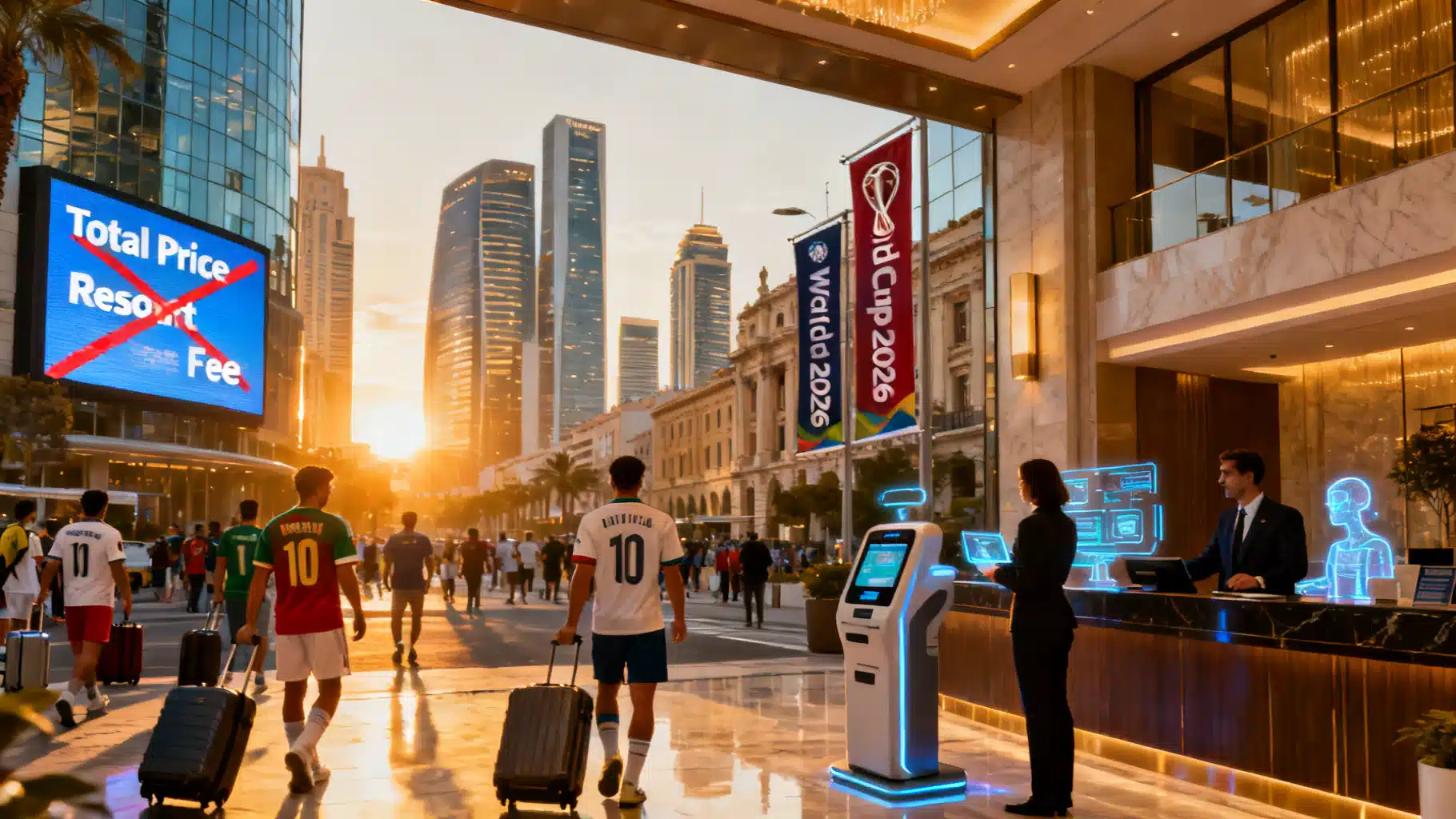
Image used for representation purposes only.
Hotels in 2026: Softening fundamentals, AI acceleration, and a new transparency era collide
The global hotel sector enters May 2026 with a split-screen outlook: U.S. performance indicators remain subdued after a choppy 2025, while brand tech investments and a landmark pricing-transparency rule are reshaping how rooms are sold. And from June 11 to July 19, the FIFA World Cup will create intense, uneven demand spikes across North American host cities. (costar.com )
The numbers: a tepid U.S. forecast after a rare dip
Industry forecaster STR (part of CoStar) and Tourism Economics project that U.S. hotels will eke out about 0.6% RevPAR growth for full-year 2026—essentially flat performance following 2025’s 0.3% RevPAR decline, the first non‑recessionary dip on record. Executives caution there’s no clear catalyst for a sharp inflection this year. (costar.com )
Outside the U.S., patterns diverge. STR’s February 2026 global assumptions point to modest RevPAR gains led by Asia Pacific, with ADR remaining the primary driver in many markets. Europe is expected to see ADR growth reassert itself relative to occupancy after a mixed 2025. (costar.com )
Price transparency takes effect: the “junk fees” crackdown reaches hotels
A major structural change is already live for travelers and operators. The Federal Trade Commission finalized its Unfair or Deceptive Fees (“junk fees”) rule in December 2024, with the short‑term lodging provisions taking effect on May 12, 2025. Hotels and vacation rentals must present the full, upfront price inclusive of mandatory charges in offers and ads—reducing “gotcha” resort or destination fees at checkout. (ftc.gov )
Enforcement momentum has followed. On December 30, 2025, the Texas Attorney General announced a $1.25 million settlement with Hyatt over alleged hidden-fee practices, requiring clearer disclosures—one of several state actions reinforcing the federal push. Legal analyses have flagged the rule’s narrower scope (focused on ticketing and short‑term lodging) and ongoing local and state transparency initiatives. (oag.state.tx.us )
What this means in practice: brand and OTA listings are being redesigned to show total stay price earlier in the booking flow; revenue teams are rethinking how to package amenities now that mandatory add‑ons must be baked into headline pricing.
World Cup 2026: surges, splits, and late pivots
With matches spread across 16 cities in the U.S., Canada, and Mexico from June 11 to July 19, 2026, host markets are seeing sharp spikes in both bookings and ADR—though the pattern isn’t uniform. Data shared with Hotel Dive show year‑over‑year jumps in booking volume and rates across U.S. host cities. In Houston, officials say hotel supply is well‑positioned even as bookings surge. (hoteldive.com )
But not every signal points up. Reporting in The Week has highlighted concerns that ticket demand in some markets may lag expectations, which could ripple into last‑minute hotel performance. Meanwhile, Mexico City’s hotel sector disclosed that FIFA revoked around 800 of the 2,000 rooms it had blocked there, forcing a rebalancing in that market. Expect volatility as allocations and fan travel patterns crystallize in the final weeks. (theweek.com )
Short‑term rentals will also be part of the picture. AirDNA data cited by Axios show Kansas City emerging as one of the most in‑demand STR markets among U.S. hosts, with occupancy and listings climbing after the match schedule announcements. Hotels will compete aggressively on last‑minute value adds as STRs absorb peak spillover. (axios.com )
Short‑term rental rules are reshaping urban hotel dynamics
Local clampdowns on STRs continue to alter city‑center lodging economics. In New York City, enforcement of Local Law 18 (fully in force since September 2023) slashed short‑term rental supply and has been associated with higher hotel ADR. A 2025 peer‑reviewed study estimates NYC hotel prices rose roughly $14–$19 per night as STR supply contracted. Broader reporting underscores that hotels have been key beneficiaries even as housing outcomes remain contested. (sciencedirect.com )
Guides published for 2026 still describe NYC’s STR regime as among the strictest in the U.S., and commercial real estate research attributes a portion of New York’s recent hotel rate strength to the policy shift. Watch for similar dynamics in cities tightening registration, host‑presence, or unit‑cap rules. (awning.com )
AI moves from pilots to payoffs
After years of experimentation, 2026 is the year hotel AI adoption shifts from pilots to scaled deployment. Hilton introduced a generative AI trip‑planning assistant in March, joining a wave of tools aimed at discovery, itinerary building, and on‑property service. Marriott, for its part, is investing heavily this year in cloud‑native platforms and AI layers to standardize data and automation across brands. A recent industry study reports more than 80% of hotels plan to expand AI use in 2026, while J.P. Morgan analysis suggests those investments will begin to show up in earnings. (hospitality.today )
Where the impact lands first:
- Commercial: smarter pricing and demand forecasts; automated bid rules for business travel and groups; personalized offers in brand direct channels.
- Operations: AI‑assisted housekeeping routing, maintenance triage, and energy optimization against occupancy curves.
- Guest experience: proactive service recovery, real‑time itinerary tweaks, and multilingual digital concierges embedded in apps and messaging.
What travelers should expect now
- Clearer upfront pricing. Because of the federal rule effective May 12, 2025, the “total price” (including mandatory fees) should appear in the first advertised price you see. If it doesn’t, take screenshots and consider reporting it. (ftc.gov )
- Event‑driven price spikes. In World Cup host cities, late‑stage compression will push ADR higher on key match days, though softness could appear in non‑match submarkets. Flexible dates and neighborhood‑level searches can yield savings. (hoteldive.com )
- Smarter service. Expect more proactive, app‑based help—from room‑ready alerts to conversational planning tools—especially across major brands rolling out new AI capabilities. (hospitality.today )
What owners and operators should watch
- Mix management under flat RevPAR. With 2026 growth forecasts near zero in the U.S., owners will need to defend profitability through labor productivity, energy control, and direct‑booking conversion—rather than rate alone. (costar.com )
- Transparency compliance as a revenue‑design problem. Folding former “resort fees” into base rates changes comp‑set optics and OTA sort order; test package architectures and loyalty‑member inclusions to retain value perception within the new rulescape. (ftc.gov )
- Event strategy beyond block allocations. World Cup demand is real but uneven; monitor pace at the ZIP‑code level, hold inventory for high‑yield windows, and prepare contingency offers where ticket sales lag. (hoteldive.com )
- STR policy spillovers. Markets tightening STR rules can deliver durable pricing power to hotels; benchmark ADR and compression curves against policy timelines and enforcement intensity. (sciencedirect.com )
- AI ROI discipline. Prioritize deployments with measurable service‑level or margin gains (e.g., call‑deflection, cross‑sell lift, housekeeping hours per occupied room) as Wall Street increasingly expects payoffs in 2026. (skift.com )
Bottom line
As of May 1, 2026, U.S. hotels face a pragmatic year: muted RevPAR growth, meaningful regulatory change, and a marquee mega‑event that will reward granular revenue strategy rather than blanket optimism. The brands investing in trustworthy price disclosure, data plumbing, and targeted AI use are best positioned to win share—before, during, and after the World Cup. (costar.com )
Related Posts

AI Translation API Comparison (2026): Google vs Azure vs AWS vs DeepL vs OpenAI
The 2026 guide to AI translation APIs: capabilities, customization, privacy, costs, and when to pick Google, Azure, AWS, DeepL, OpenAI, or open‑source.

React Native vs Flutter Performance Benchmark (2026): Startup, FPS, Memory, and Power
A 2026, real-world benchmark of React Native vs Flutter: startup, FPS, memory, power, and size—plus what changed, how we tested, and when to pick each.