
Ceuta’s 24-Hour Shock: Border Surge Tests Spain—and Schengen—in Real Time
Ceuta’s border sees a dramatic 24-hour surge, testing Spain’s response and Europe’s resolve on Schengen, security, and humanitarian management.
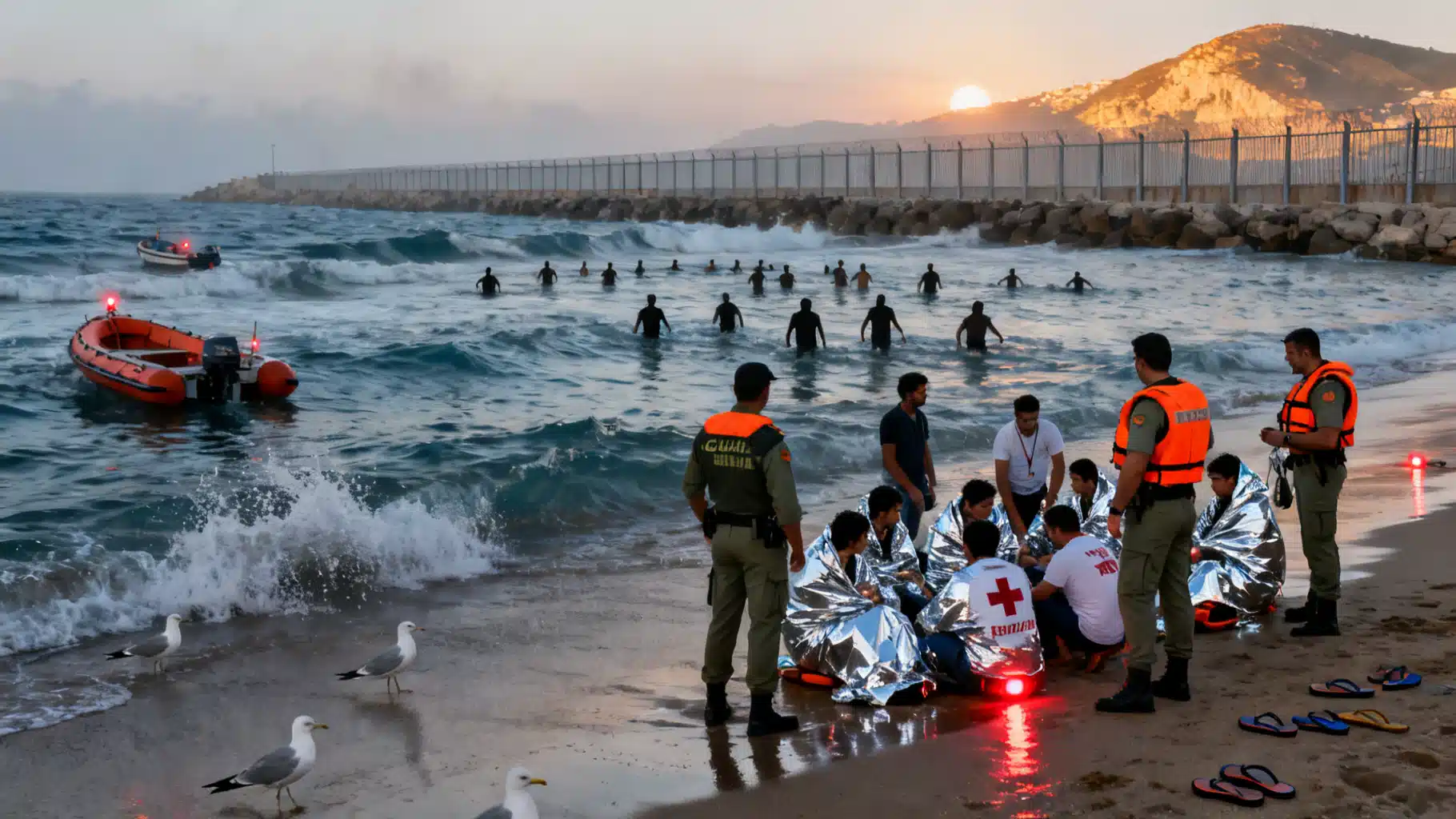
Image used for representation purposes only.
CEUTA, Spain — July 31, 2026
Spain’s North African enclave of Ceuta was thrust back into the global spotlight after an extraordinary 24 hours in which local authorities said around 60,000 people crossed from neighboring Morocco—an influx equivalent to roughly 70% of the city’s population. By Friday evening, many had already returned to Morocco, yet the scale and speed of the crossings strained reception capacity, triggered a security deployment, and rippled across European politics. (apnews.com )
What happened and when
The surge accelerated between Thursday and Friday, July 30–31, with Spain moving to reinforce order at the border and in the city. At least nine people died attempting to reach the enclave, according to officials, underscoring the human cost of the latest crisis. Authorities cited overwhelmed shelters and makeshift sleeping arrangements as the city struggled to process arrivals. (apnews.com )
Why Ceuta, why now
Irregular movements through Ceuta have been climbing through early 2026 as routes shifted toward Spain’s Western Mediterranean frontier. Multiple monitoring groups noted Ceuta’s emergence as a principal entry point to Spain this year, mirroring a broader reconfiguration of North African migration corridors. (mixedmigration.org )
In recent months, local and regional outlets tracked steady daily arrivals to Ceuta, a trend that—while significant—did not foreshadow the dramatic spike seen this week. Observers also reported sharp percentage increases in crossings in 2026 compared with previous periods, reflecting changing dynamics along the Morocco–Spain corridor. (elpueblodeceuta.es )
Data compiled earlier in the year by European and Spanish civil-society sources recorded notable year-on-year rises via land routes into Ceuta during 2025, indicating mounting pressure well before this week’s events. (euaa.europa.eu )
The legal geography that makes Ceuta different
Ceuta is part of Spain and of the European Union, but it sits outside the EU customs territory and operates under a special fiscal regime. The enclave’s trade with the EU follows specific duty exemptions established under Protocol 2 to Spain’s Act of Accession, a technical arrangement that shapes economic life at the border. (sede.agenciatributaria.gob.es )
On the people-movement side, Ceuta and its sister city Melilla have a bespoke status vis-à-vis the Schengen Area. EU documents clarify that while Spain is in Schengen, the two enclaves are subject to special rules: identity and document checks are performed for travelers departing Ceuta to mainland Spain or other Schengen members. This exceptional regime matters during surges, as movements from Ceuta to the European mainland do not automatically confer free onward travel. (europarl.europa.eu )
Political shockwaves across Europe
The scale of the crossings quickly fed a broader political argument over Schengen and migration management. Some European leaders demanded hardline steps, with Italy’s government publicly pressing Spain over control of its external border and even floating suspension from Schengen—a move for which there is no formal mechanism—drawing sharp debate about what EU law actually permits. (theatlantic.com )
Brussels, for its part, has recently emphasized Schengen’s resilience amid successive stress tests and adopted fresh priorities for 2026–2027, even as national capitals skirmish over operational responses. The Commission’s State of Schengen work and a parallel push to modernize customs oversight sketch out a rules-first approach in a volatile environment. (home-affairs.ec.europa.eu )
Security response and the human toll on the ground
Madrid ordered military units to support police at the border and within Ceuta, citing the need to stabilize the situation after mass entries and fatalities. These steps recall similar emergency deployments during the May 2021 crisis, though the current influx—by local estimates—dwarfs that episode. (apnews.com )
Inside the enclave, reception centers and temporary shelters faced acute overcrowding. Spain has for months worked to redistribute unaccompanied minors from front-line territories—Ceuta, Melilla, and the Canary Islands—to other autonomous communities, an effort officials say is designed to prevent chronic saturation and to safeguard child welfare. (mptmd.gob.es )
Reporters on the ground and humanitarian agencies describe a familiar, harrowing calculus: some cross by sea under cover of darkness, others attempt the fence, and many hope for transfer to mainland Spain—only to encounter legal bottlenecks, identity checks, and prolonged uncertainty. (youtube.com )
Fact-check: Claims and counterclaims
The information vacuum around fast-moving events drew a wave of misleading narratives online. A review by independent fact-checkers and wire services found no evidence that Spain’s domestic regularization policies directly triggered the rush into Ceuta, despite high-profile political assertions to the contrary from abroad. EU officials likewise stressed that individuals in Ceuta do not automatically gain entry to the Schengen mainland. (apnews.com )
How this intersects with EU border tech and policy in 2026
The EU’s new Entry/Exit System (EES), fully rolled out in April 2026, was designed to tighten external-border controls by registering non‑EU nationals as they enter and exit the Schengen Area. While Ceuta sits under a special legal regime, the broader modernization of Europe’s border‑management architecture—EES included—forms the backdrop to policy debates ignited by Friday’s events. (eulisa.europa.eu )
Beyond border checks, EU institutions have advanced reforms to improve customs coordination and risk management, aiming to buttress external controls without undermining the single market—an agenda that will continue to test the line between national sovereignty and shared European responsibility when crises flare at nodes like Ceuta. (consilium.europa.eu )
Spain–Morocco ties under scrutiny
Ceuta’s stability is closely bound to bilateral cooperation with Morocco. After a 2025 reset that produced a slate of cooperation agreements, Madrid and Rabat sought to institutionalize coordination across fisheries, migration, and security. The latest surge will stress-test these mechanisms and could shape the next phase of diplomacy across the Strait. (lamoncloa.gob.es )
What to watch next
- Operational control: How long will enhanced security deployments remain, and will Spain request or receive additional EU operational support? (apnews.com )
- Intra‑EU politics: Whether calls to curtail Spain’s Schengen privileges gain traction—or meet legal reality—will be a barometer for the union’s cohesion under pressure. (theatlantic.com )
- Humanitarian management: Capacity for dignified reception, rapid screening, and child protection will determine whether the city’s facilities can stabilize after an unprecedented week. (mptmd.gob.es )
- Disinformation: Expect further claims about causes and consequences; verified data and EU legal context remain essential to understanding what movement from Ceuta does—and does not—permit. (apnews.com )
The bottom line
Ceuta is a small place with outsized geopolitical weight. Friday’s mass crossings were a local emergency with continental implications, fusing human tragedy, legal complexity, and political theater. As the situation evolves, Spain’s response—and Europe’s ability to balance solidarity, legality, and control—will be measured not only at a fence on the Strait’s edge, but in decisions taken in Madrid, Rabat, and Brussels in the days ahead. (apnews.com )
Related Posts

Europe Travel 2026: New Border Tech, City Fees—and a Bigger Bet on Trains
Europe travel in 2026: EES goes fully live April 10, UK ETA is enforced, ETIAS due late 2026, Venice day-trip fees return, and rail capacity surges.

React TanStack Router Migration Guide: From React Router to Type‑Safe Routing
A practical, step-by-step guide to migrating from React Router to TanStack Router with typed routes, loaders, and schema-validated search.

Migrating to Dart 3 Null Safety in Flutter: A Practical Guide
Step-by-step guide to migrate a Flutter codebase to Dart 3’s sound null safety with commands, patterns, pitfalls, and checklists.