
Colombia rocked by 7.4-magnitude earthquake: at least 111 dead, widespread damage reported
A 7.4-magnitude quake struck western Colombia on Aug. 10, 2026, killing at least 111 and damaging buildings across multiple cities. Updates inside.
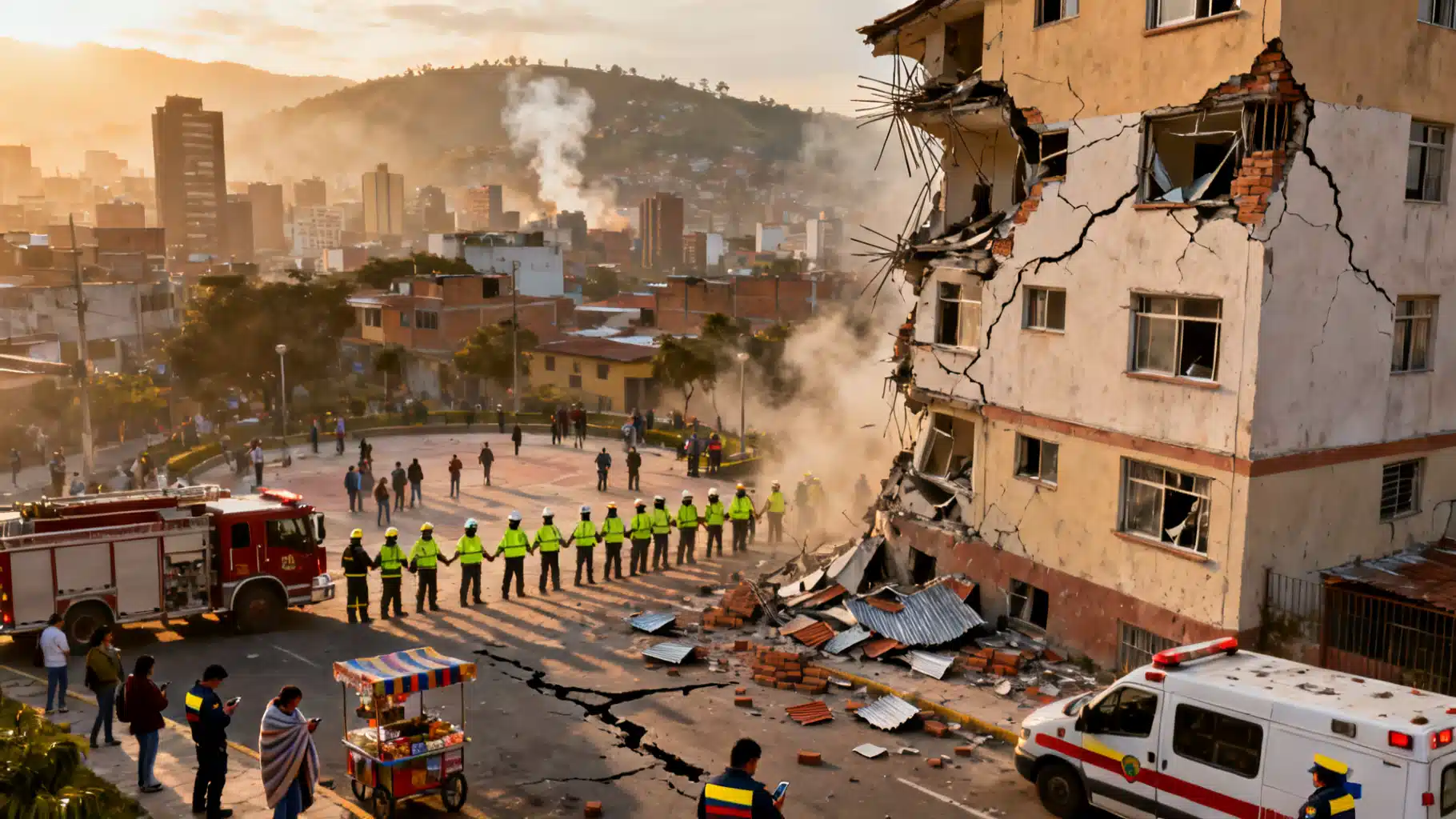
Image used for representation purposes only.
What happened
A powerful magnitude 7.4 earthquake struck western Colombia on Monday, August 10, 2026, with the epicenter near San José del Palmar in the department of Chocó. Authorities say at least 111 people were killed, at least 87 injured, and roughly 1,600 buildings were damaged, including at least 61 that collapsed. Shaking was felt widely in cities such as Cali and Pereira and as far as Bogotá, prompting evacuations. These figures are preliminary and may change as search-and-rescue operations continue. (apnews.com )
Key points officials have confirmed so far:
- Magnitude 7.4; epicenter near San José del Palmar, Chocó. (apnews.com )
- At least 111 fatalities, 87 injuries, and around 1,600 buildings damaged; at least 61 collapsed. (apnews.com )
- Strong shaking reported in Cali, Pereira, and Bogotá; mass evacuations captured in early images. (apnews.com )
Colombia’s president, Abelardo de la Espriella, reported the initial death toll and said condolences and support offers have arrived from leaders across the Americas as emergency coordination scaled up. (apnews.com )
Where it hit and why this region is vulnerable
The epicentral area—Colombia’s Pacific slope—sits along the seismically active Pacific “Ring of Fire,” where the Nazca Plate subducts beneath South America. That tectonic context explains why significant intermediate-depth earthquakes can rattle western and central Colombia. (apnews.com )
Colombia’s national geological service (Servicio Geológico Colombiano, SGC) has repeatedly highlighted the country’s high seismic hazard, underpinned by a national seismic hazard model developed with international partners. Events above magnitude 6 are less frequent than smaller “temblores,” but the risk of damaging earthquakes persists across several populated corridors. (www2.sgc.gov.co )
The impact on cities
- Cali (Valle del Cauca) and Pereira (Risaralda) reported widespread damage assessments and building collapses; images from the aftermath show dust plumes, cracked facades, toppled masonry and residents crowding into open spaces. (apnews.com )
- Bogotá felt prolonged shaking despite the epicenter being in the country’s west, underscoring how intermediate-depth quakes can transmit energy across large distances. (apnews.com )
While first responders continue urban search-and-rescue operations, structural engineers will begin rapid assessments to determine red-, yellow-, or green-tag status for affected buildings. Authorities have urged residents to keep clear of visibly compromised structures until they are inspected.
Government response
President Abelardo de la Espriella said the government is mobilizing emergency resources and coordinating with local authorities. International messages of support have begun arriving, with offers of technical and humanitarian assistance. (apnews.com )
Colombia’s disaster risk management system (the UNGRD and associated agencies) typically coordinates logistics, shelter, and critical infrastructure restoration during large emergencies; officials have recently emphasized strengthening national preparedness capacities, which are now being tested by this quake. (presidencia.gov.co )
Recent seismic context in Colombia
Though today’s quake is the strongest to hit Colombia in years, the country has experienced notable recent events. On June 8, 2025, an M6.4 earthquake between Medina and Paratebueno (Cundinamarca) affected about 1,590 families and caused ground failures such as liquefaction and fissuring—reminders that damaging shaking is not confined to the Pacific slope. (www2.sgc.gov.co )
What to expect next
Aftershocks are typical following a large mainshock; even if they are smaller, they can further damage weakened buildings and trigger secondary hazards. Response agencies and scientists stress the importance of preparing for continuing shaking. (redcross.org )
Residents are advised to:
- Avoid reentering visibly damaged buildings until cleared by authorities.
- Stay alert for aftershocks; “Drop, Cover, and Hold On” if shaking starts.
- Keep roads clear for emergency vehicles; use text/data messaging to check on loved ones to ease network congestion.
- Follow official guidance from local authorities and the national risk management system.
How to help, responsibly
Humanitarian organizations such as the Colombian Red Cross and their international partners typically support shelter, health, and family-linking services in the immediate aftermath of major earthquakes. If you plan to donate, prioritize cash contributions to reputable organizations and monitor official channels for appeals tailored to needs on the ground. (cruzrojacolombiana.org )
The road ahead
In the coming days, engineers will complete more detailed evaluations of public buildings, hospitals, schools, bridges, and lifeline utilities across the affected departments. Urban cores like Cali and Pereira will likely see cordoned-off zones while debris removal and structural shoring proceed. Communities closer to the epicenter in rural Chocó may need targeted support where access is constrained and telecommunications are less robust—logistics that Colombia’s disaster system will have to solve quickly as the humanitarian picture comes into sharper focus. (apnews.com )
This is a developing story. Authorities are expected to release updated casualty figures and damage assessments as rescue teams gain access to more neighborhoods and outlying communities. We will update as new official information becomes available. (apnews.com )