
Elon Musk’s November 2026 power play: wireless ambitions, Starship’s next shot, xAI cost squeeze—and record midterm spending
As of Nov. 4, 2026: Musk eyes Boost Mobile, Starship targets November, xAI throttles Grok over costs, X fights the EU—and his midterm spending shatters records.
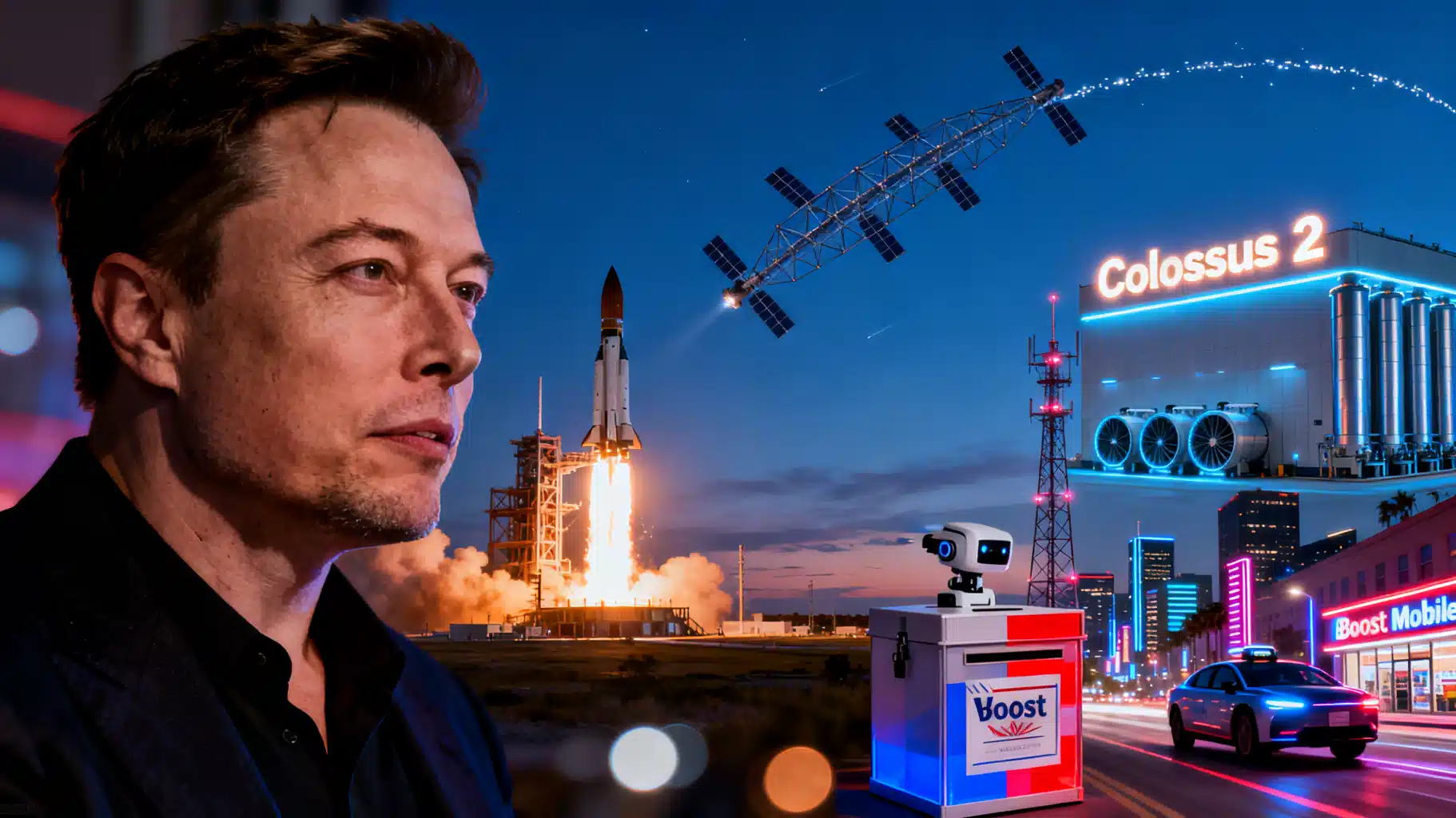
Image used for representation purposes only.
The state of Elon Musk in November 2026: wireless gambits, a looming Starship flight, xAI growing pains, and record political spending
Elon Musk’s empire is touching nearly every front of U.S. business and politics this week. As of November 4, 2026, SpaceX is exploring a shock move into terrestrial wireless, Starship is lining up for Flight 15, xAI is reining in usage of its Grok Bot over costs, X (formerly Twitter) is fighting EU regulators, and Musk’s unprecedented midterm outlays have become a storyline of their own. (washingtonpost.com )
SpaceX’s new frontier: becoming a U.S. wireless carrier
SpaceX has been in talks with EchoStar about acquiring Boost Mobile—or leveraging its network arrangements—to accelerate a hybrid terrestrial-satellite service that could vault Musk into the nation’s $200+ billion mobile market. Reporting this week detailed discussions that could provide a back door into established spectrum and tower access, even as the feasibility and contract restrictions are debated. (washingtonpost.com )
Industry specialists caution that an acquisition alone may not cleanly transfer MVNO rights. Analysts note “change-of-control” clauses could obstruct any automatic Boost-based shortcut, while top carriers have publicly signaled little appetite to help SpaceX become a full-fledged rival. On October 28–30, T-Mobile executives said there’s “no room” for an MVNO deal with SpaceX and characterized satellite-only offerings as technologically inferior to nationwide 5G without extensive ground infrastructure. (lightreading.com )
SpaceX, for its part, has stressed that Starlink Direct to Cell is already texting from unmodified phones via satellites launched in 2024, and that next-gen service will layer satellite capacity with spectrum and terrestrial build-out. The company’s own updates and filings outline a roadmap that began with text messaging and aims toward voice, data, and IoT in the mid‑2020s. (new.spacex.com )
Starship: Flight 15 is nearing, with eyes on November
After a string of incremental test successes and hardware upgrades through 2025–2026, SpaceX appears on track for Starship Flight 15 this month from Starbase, Texas. Recent static fires of the booster and Ship 42 and independent launch-trackers point to a November window, pending federal licensing. SpaceX’s own mission logs confirm the Flight 14 campaign wrapped September 28, 2026. (space.com )
NASA’s inspector general this year underlined the program’s risks and mixed performance across versions, citing underperforming tests and a 2025 ground anomaly as SpaceX moves toward Artemis lunar-lander milestones. The watchdog’s report underscores why each iterative Starship flight remains material to NASA timelines. (oig.nasa.gov )
Starlink’s influence—and controversy—in geopolitics
Starlink continues to be central to battlefield connectivity in Ukraine, drawing scrutiny over resiliency and control. On October 28, the Associated Press reported the Pentagon’s inspector general declined a congressional request to investigate recent slowdowns, a flashpoint given Starlink’s outsized role in defense communications and Musk’s prior restrictions during sensitive operations. (apnews.com )
xAI: growth meets the cost wall
Musk’s AI venture xAI—flush from a $20 billion Series E announced January 6, 2026 and an infrastructure-heavy push behind the Grok model family—has hit a very public speed bump. Over the weekend, Musk acknowledged on X that the “cost of serving Grok Bot was unsustainably high relative to revenue,” after users complained of hitting caps. Coverage from TechCrunch and others confirmed the statement and the throttling. (x.ai )
xAI’s rapid data-center buildout has also drawn legal challenges. A federal suit brought in April alleges the gas turbines powering xAI’s “Colossus 2” facility in the Greater Memphis area operated without required permits; a judge recently declined to dismiss, allowing claims to proceed. The litigation highlights the environmental and regulatory friction accompanying gigawatt‑scale AI infrastructure. (naacp.org )
X vs. Brussels—with Washington unusually weighing in
X was fined €120 million in late 2025 under the EU’s Digital Services Act for transparency failings, one of the first major DSA penalties against a U.S.-based platform. In September 2026, the U.S. Department of Justice took the unusual step of seeking to intervene—supporting X/Musk’s court bid to annul the European Commission’s decision on jurisdictional and comity grounds. The clash could shape how DSA enforcement lands on American tech companies operating in Europe. (digital-strategy.ec.europa.eu )
Tesla: robotaxis, FSD “Supervised,” and the Optimus bet
Tesla says it began limited driverless robotaxi rides in Austin in December 2025, removing in‑vehicle safety monitors for some customer trips in January 2026 and signaling Dallas as a first‑half 2026 expansion. Local coverage and civic planning memos point to Dallas-area coordination with first responders. In late October, Axios noted Tesla’s service footprint in Houston had expanded. (ir.tesla.com )
Full Self-Driving (Supervised) remains driver‑responsible advanced assistance—marketed by Tesla as capable of handling most routes “under your supervision”—and continues to be rolled out via software updates; the company ended an FSD transfer program on March 31, 2026. European type‑approval scrutiny has also persisted, with the Netherlands’ RDW detailing its process this June. (tesla.com )
On the robotics front, Musk reiterated through 2026 that Optimus is central to Tesla’s long-term value. Trade and tech media have reported early production activities in California and ambitions to scale dramatically by late 2027, though skeptics note the technical and generalization hurdles that still exist. Tesla’s October and year‑to‑date investor materials emphasize factory pilots and future capacity targets while delineating risks and ongoing regulatory inquiries. (techcrunch.com )
The midterms: nearly half a billion dollars—and a political test
Musk’s political spending across the January 1, 2025–October 14, 2026 cycle has shattered modern records. The Washington Post and New York Times–based tallies report hundreds of millions directed to Republican committees and super PACs, with figures widely cited between roughly $276 million (since July alone) and $474 million overall through late October, with additional “dark‑money” contributions possible. Public Citizen’s synthesis last week placed Musk’s super PAC contributions at about $445 million for the cycle. (washingtonpost.com )
As initial returns and analyses of the November 3, 2026 midterms rolled in, Axios reported that GOP candidates backed by Musk were hit by a “drubbing,” and noted his post‑election quips on X. Separate Axios coverage framed the cycle as an early test of AI’s salience as a political wedge and of whether alignment with marquee tech moguls helps—or hurts—candidates heading toward 2028. (axios.com )
What to watch next
- Wireless dealmaking: Whether SpaceX advances beyond talks into a concrete Boost Mobile transaction—or an alternative path to terrestrial build‑out—and how MVNO contract clauses and spectrum hurdles shape the outcome. (washingtonpost.com )
- Starship licensing: FAA sign‑off for Flight 15 and the flight’s performance against NASA’s HLS schedule pressures. (thelaunchwindow.com )
- xAI unit economics: If throttling Grok Bot brings costs in line—or forces pricing, product, or infra changes—while environmental litigation over Colossus 2 proceeds. (techcrunch.com )
- X’s DSA fight: The court’s response to the DOJ intervention and broader precedent for EU‑U.S. regulatory friction over platform governance. (justice.gov )
- Tesla autonomy and robots: Verification of sustained driverless service beyond Texas pilots, regulatory posture in more states, and credible production disclosures for Optimus as 2027 targets draw nearer. (ir.tesla.com )
Bottom line
Musk enters November 2026 with outsized bets across telecom, space, AI, media regulation, and national politics—each with immediate catalysts. The next few weeks could determine whether SpaceX’s push into wireless is more than talk, whether Starship can notch another step toward lunar ambitions, whether xAI can square growth with costs, how far X can push back on EU oversight—and whether nearly half a billion dollars in campaign spending moved the political needle at all. (washingtonpost.com )
Related Posts

SpaceX’s spring surge: Starship V3 eyes May flight, Falcon hits 600 landings, Starlink scales — and a blockbuster IPO looms
As of April 23, 2026: Starship V3 nears a May test, Falcon hits 600 landings, Starlink tops 10M users, and SpaceX quietly files for a record IPO.
Is Grok Down Right Now? Checking Today’s Status and What’s Behind the Glitches
Is Grok down? As of March 27, 2026, xAI reports no incidents. Why some users still can’t connect, and how to check what’s really happening.
Space in 2026: Artemis II’s countdown, Starship V3’s leap, Ariane 64’s debut and New Glenn’s rise
Artemis II eyes April 1, Starship V3 readies, Ariane 64 debuts with Amazon Leo satellites, and New Glenn advances—spaceflight hits a 2026 stride.