
API Mocking Tools Compared: How to Choose the Right Mock for Your Stack
A practical comparison of leading API mocking tools, with use-case mapping, recipes, and a decision guide to pick the right fit for your team.
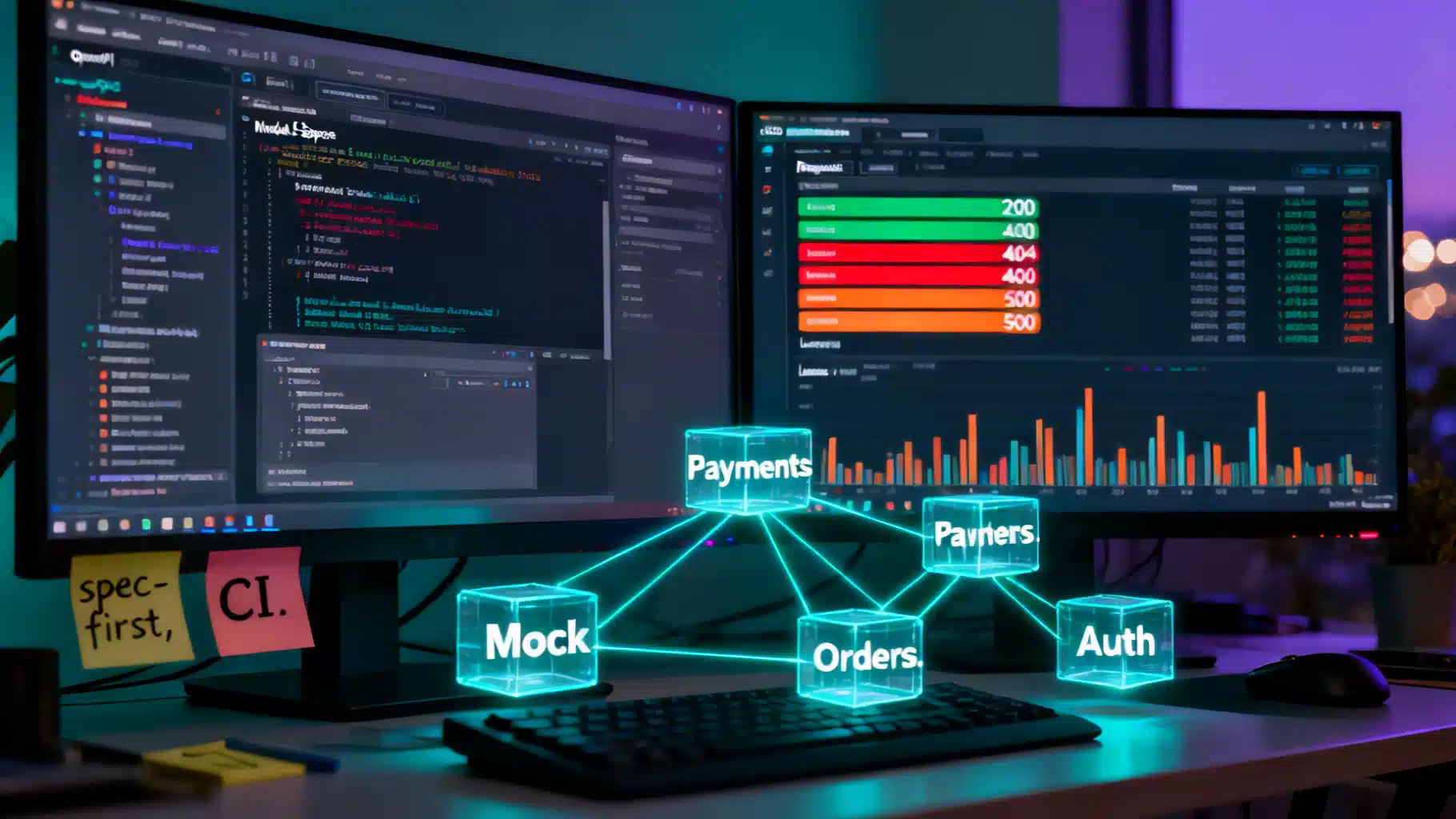
Image used for representation purposes only.
Why API Mocking Matters in 2026
Modern systems depend on dozens of internal and third‑party APIs. Waiting for every dependency to be stable before you can build or test slows teams down. API mocking removes that bottleneck by simulating services with realistic behavior, data, latency, and failures—so you can design, develop, and test earlier, faster, and safer.
This guide compares leading API mocking tools, explains when each shines, and offers practical recipes for getting started.
Evaluation Criteria
Before picking a tool, align on what “good” means for your scenario:
- Protocols and transports: HTTP/HTTPS only, or also gRPC, TCP, WebSocket, SMTP.
- Spec-first support: OpenAPI/Swagger, GraphQL SDL, gRPC proto; validation of requests/responses; example and schema-based data generation.
- Fidelity: static examples vs dynamic templating; stateful flows; data seeding; correlation across calls; record-and-replay.
- Fault modeling: latency, rate limiting, timeouts, resets, malformed payloads.
- Developer experience: CLI, code library, GUI/desktop, or managed cloud; hot reload; watch mode; templating languages.
- Automation: Docker/Kubernetes, CI pipelines, ephemeral environments, GitOps.
- Collaboration and governance: version control of mocks, review workflows, visibility, RBAC.
- Observability: request logs, metrics, tracing context passthrough.
- Performance: concurrency, throughput, memory footprint for large test suites.
- Licensing and cost: OSS vs commercial; SaaS vs self-hosted.
Tool-by-Tool Comparison
WireMock
- What it is: A mature Java-based HTTP mock and service virtualization tool with a rich stubbing DSL; also available as a standalone JAR, Docker image, libraries for JUnit, and a managed cloud offering.
- Strengths: Powerful request matching; transformers for dynamic responses; scenario/state handling; record-and-replay; robust fault injection; strong ecosystem and CI/Docker support.
- Limitations: Primarily HTTP(S); Java heritage may feel heavy for minimal setups (though the standalone/Docker modes are simple).
- Best for: Microservices integration tests, backend contract tests, and realistic negative-path testing with latency/faults.
MockServer
- What it is: Java-based mock/proxy with an expressive JSON/Java expectation DSL and TLS support.
- Strengths: TDD-friendly expectations; verification of call patterns; proxying and recording; fine-grained matching.
- Limitations: Configuration can be verbose; focused on HTTP(S).
- Best for: Teams that want a programmable mock + verification layer for backend services.
mountebank
- What it is: Node.js service virtualization for HTTP(S), TCP, and SMTP using “imposters.”
- Strengths: Multi-protocol; JSON configuration; JavaScript injection for dynamic behaviors; good for polyglot stacks.
- Limitations: JS injection increases flexibility but can complicate security/governance; not as spec-driven out of the box.
- Best for: Broad protocol coverage and teams comfortable with JavaScript-based customization.
Stoplight Prism
- What it is: OpenAPI-first mock and validator (CLI) that generates responses from your API spec and examples.
- Strengths: Instant mocks from design; request/response validation; dynamic or example-based payloads; great for design-first workflows.
- Limitations: Primarily spec-driven HTTP mocking; less suited for complex stateful flows.
- Best for: Design reviews, early frontend development against OpenAPI contracts, and governance via validation.
MSW (Mock Service Worker)
- What it is: Intercepts network calls at the browser/Node boundary, mocking fetch/XHR and GraphQL operations.
- Strengths: Exceptional developer experience for frontend and component testing; works with Storybook, Jest/Vitest, Cypress/Playwright; GraphQL support.
- Limitations: Not a standalone network server; intended for UI/unit/integration tests rather than shared external mocks.
- Best for: Frontend teams, DX-first mocking close to the UI.
Postman Mock Server
- What it is: Managed cloud mocks integrated with Postman Collections and API definitions.
- Strengths: Zero-infrastructure; quick sharing with partners and QA; environment and example-driven behavior.
- Limitations: Throughput and complexity bound by SaaS limits; advanced stateful simulations are harder.
- Best for: Public/partner sandboxes, demos, and lightweight team mocks without running servers.
Mockoon
- What it is: Desktop app and CLI for creating local HTTP mocks with templating, environment variables, and latency.
- Strengths: Fast to start; GUI-friendly; exportable to JSON; good CLI for CI and Docker.
- Limitations: Focused on HTTP(S); complex state machines require manual setup.
- Best for: Individual developers and small teams who want quick, local mocks with an approachable UI.
Hoverfly
- What it is: Lightweight Go-based service virtualization offering capture/replay and simulation files.
- Strengths: Efficient footprint; capture mode for recording live traffic; middleware for transformation.
- Limitations: Focused on HTTP(S); advanced spec-first features are limited.
- Best for: High-throughput capture/replay scenarios and performance-sensitive CI jobs.
Pact (for contrast)
- What it is: Consumer-Driven Contract testing framework that can spin up stub servers from Pact files.
- Strengths: Prevents integration drift by verifying contracts across teams; auto-generated stubs reflect real consumer expectations.
- Limitations: Not a general-purpose freeform mock—its primary goal is contract verification.
- Best for: Microservice ecosystems enforcing strict consumer/producer contracts.
Mapping Tools to Common Use Cases
-
Frontend-first development:
- MSW for UI and component tests.
- Prism (OpenAPI) to provide realistic server responses while the backend is still a sketch.
- Mockoon for quick local endpoints and manual tweaking.
-
Backend and microservices integration:
- WireMock or MockServer for precise matching, state, and faults.
- Hoverfly or mountebank for capture/replay, multi-protocol, and transformation.
-
Contract governance:
- Prism to validate implementations against OpenAPI.
- Pact to prevent consumer/producer drift and to generate stub servers from verified pacts.
-
Public/partner sandboxes and demos:
- Postman Mock Server or a managed WireMock instance for easy external access and sharing.
-
Failure testing and latency modeling:
- WireMock/mountebank to inject realistic failures (timeouts, resets, jitter, chaos scenarios).
Quick Decision Guide
- Need mocks immediately from an OpenAPI file? Choose Prism.
- Building UI with fast local iteration? Choose MSW; add Prism if you also want spec validation.
- Complex backend flows with state and negative tests? Choose WireMock or MockServer.
- Recording live traffic to replay in CI? Choose Hoverfly or WireMock’s recording.
- Non-HTTP protocols? Choose mountebank.
- External sharing without infrastructure? Choose Postman Mock Server.
Practical Recipes
1) Spin up a spec-driven mock with Prism
# Assuming openapi.yaml exists
npx @stoplight/prism-cli mock ./openapi.yaml --port 4010 --dynamic --cors
- Use –dynamic for schema-based data; remove it to serve explicit examples.
- Add –errors to validate and surface request/response contract issues.
2) Stateful scenarios and fault injection with WireMock (Docker)
# Run WireMock standalone with files mounted
docker run --rm -p 8080:8080 \
  -v "$PWD/mappings":/home/wiremock/mappings \
  -v "$PWD/__files":/home/wiremock/__files \
  wiremock/wiremock:latest

# Example stub (mappings/get-order.json)
{
  "request": {"method": "GET", "urlPathPattern": "/orders/([0-9]+)"},
  "response": {
    "status": 200,
    "headers": {"Content-Type": "application/json"},
    "bodyFileName": "order.json",
    "fixedDelayMilliseconds": 300
  }
}
- Add scenarios to evolve state across calls (e.g., created → paid → shipped).
- Simulate faults with “fault”: “RANDOM_DATA_THEN_CLOSE” or timeouts via “chunkedDribbleDelay”.
3) Frontend-first mocking with MSW
// src/mocks/handlers.ts
import { http, HttpResponse } from 'msw'

export const handlers = [
  http.get('/api/orders/:id', ({ params }) => {
    return HttpResponse.json({ id: params.id, status: 'shipped' })
  }),
]
- Works in browser and Node test environments; keeps tests close to user flows.
- Combine with Storybook to showcase states without real backends.
4) Capture and replay with Hoverfly
# Capture
hoverfly -capture -listen-on :8500 -destination http://real.service
# Point your app’s HTTP proxy to localhost:8500, exercise flows, then export:
hoverctl export simulation.json

# Replay
hoverfly -simulate -import simulation.json -listen-on :8500
- Useful when reproducing tricky production sequences in a safe, deterministic way.
Pitfalls and How to Avoid Them
- Drift from reality: If mocks become the source of truth, they quickly diverge. Tie mocks to specs (OpenAPI/GraphQL) or verified contracts (Pact), and regenerate often.
- Over-simplified data: Thin examples hide edge cases. Use schema-driven data generation and seed realistic datasets.
- Ignoring negative paths: Always model timeouts, 4xx/5xx, pagination quirks, and retries; surface them in CI.
- One-size-fits-all tool: Frontend UI tests and backend integration tests have different needs. It’s normal to use more than one tool.
- Unversioned mocks: Store mocks in Git and gate changes via PRs; tag versions alongside API definitions.
- Security blind spots: Never leak secrets in fixtures; scrub recorded traffic; restrict who can reach public mock endpoints.
Implementation Checklist
- Choose a source of truth (OpenAPI, GraphQL SDL, Pact contracts) and automate mock generation from it.
- Define required behaviors: happy path, validation errors, auth failures, rate limits, and chaos scenarios.
- Pick tools per layer: MSW (UI), Prism (design), WireMock/MockServer (integration), Hoverfly/mountebank (record/replay or protocols), Postman (sharing).
- Containerize and run mocks in CI; publish simulation artifacts as build outputs.
- Add smoke tests that verify mocks themselves (schemas, examples, determinism).
- Monitor usage: logs, request counters, and slow endpoints to catch unrealistic patterns.
Final Thoughts
API mocking is not just a developer convenience; it is a strategic enabler for parallel work, higher-quality releases, and safer change. Start with your workflow constraints—design-first, UI-first, or integration-first—and select a focused tool for each layer. Keep mocks aligned with contracts, embrace negative testing, and automate everything. Do that, and mocks become a competitive advantage rather than a maintenance burden.
Related Posts
API Documentation Auto‑Generation Tools: A Practical Guide
Practical guide to auto‑generating API docs: tools, workflows, examples, CI/CD, and best practices for OpenAPI, GraphQL, and gRPC.
React Testing Library Unit Testing Guide: From Setup to Confident UI Tests
A practical guide to unit testing React with Testing Library—setup, queries, user events, async, MSW, providers, and best practices.