
API Microservices Communication Patterns: A Practical Guide for Scale and Resilience
A practical guide to synchronous and asynchronous microservice communication patterns, trade-offs, and implementation tips for resilient APIs.
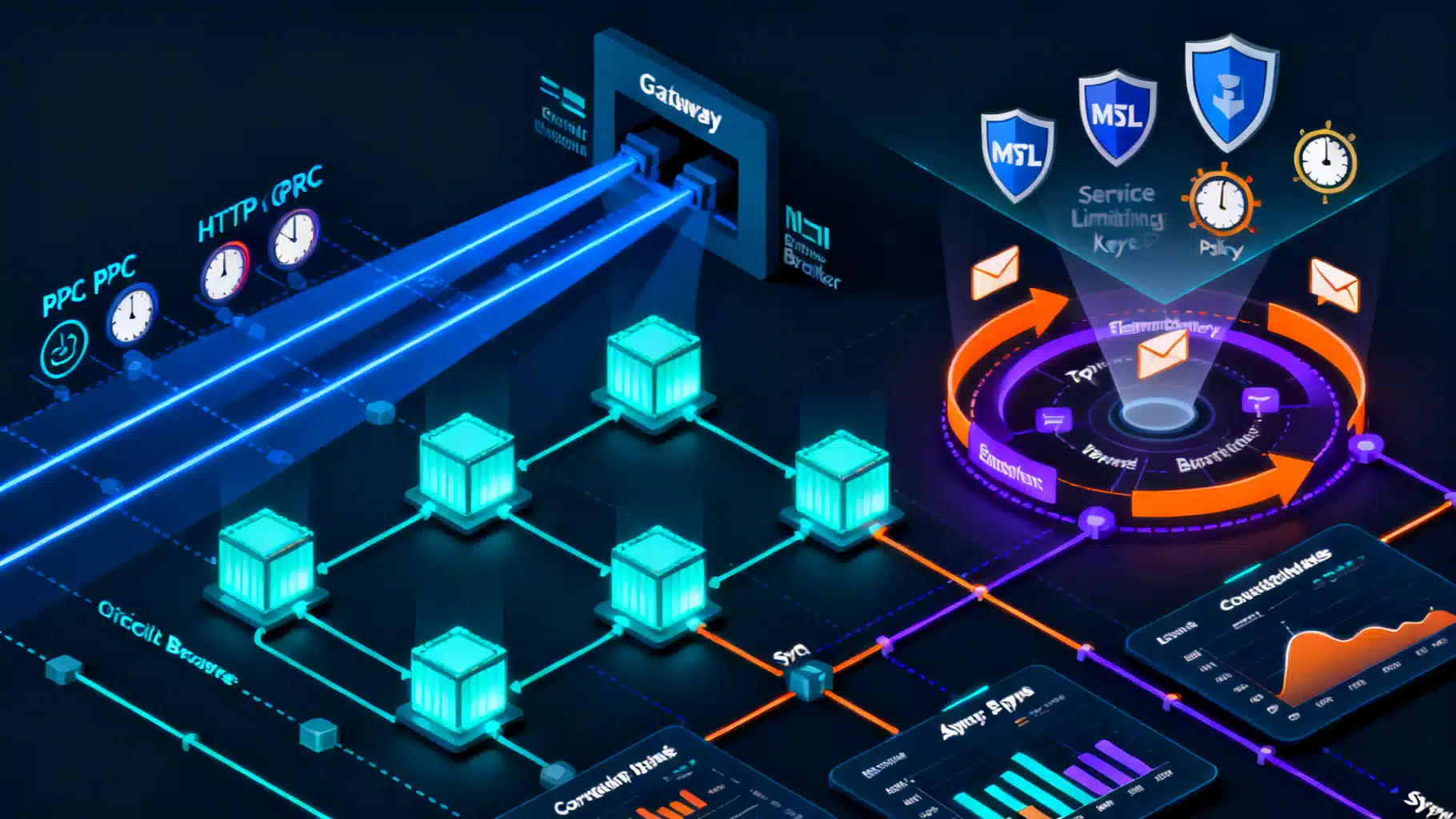
Image used for representation purposes only.
Why communication patterns matter in microservices
Microservices live and die by how they talk to each other. The right communication strategy reduces latency, isolates failures, and keeps teams decoupled. The wrong one creates chatty, fragile systems that are hard to evolve. This guide surveys the major patterns for microservice-to-microservice and client-to-service communication, explains when to use each, and highlights the cross‑cutting practices that keep APIs reliable at scale.
A mental model: four axes of choice
When choosing a pattern, weigh these axes:
- Coupling: How tightly do producers and consumers depend on each other’s schemas and availability?
- Latency: Is near-real-time interaction required, or can work be deferred?
- Throughput: Do you need to smooth traffic spikes and protect dependencies?
- Consistency: Is eventual consistency acceptable, or must state change appear atomic to users?
No single pattern wins across all four; you mix patterns per workflow.
Synchronous request/response patterns
Synchronous calls are the simplest mental model: one service asks, another immediately answers.
REST over HTTP
- Strengths: ubiquitous tooling, simple caching, human-readable payloads, easy to expose externally via an API gateway.
- Trade-offs: verbose payloads, weaker type contracts, and tight coupling to availability. If Service B is down, Service A blocks unless you add timeouts and fallbacks.
Best for: CRUD-style interactions, resource-oriented APIs, and external developer ecosystems.
gRPC (HTTP/2, Protobuf)
- Strengths: compact binary payloads, strong contracts, bi‑directional streaming, and first-class code generation.
- Trade-offs: steeper learning curve for non‑polyglot teams; browser support requires a proxy.
Best for: high‑throughput, low‑latency internal RPC between services.
GraphQL via Gateway or BFF
- Strengths: clients fetch exactly what they need, schema evolves via fields not endpoints, good for mobile/web frontends.
- Trade-offs: complex server performance tuning, risk of N+1 backend calls if not planned, less ideal for service‑to‑service unless you adopt federation carefully.
Best for: client-to-edge aggregation. Internally, prefer RPC or messaging and expose a GraphQL facade for clients.
Reliability guardrails for sync calls
- Timeouts and retries with exponential backoff and jitter (never infinite retries).
- Circuit breakers to shed load from failing dependencies.
- Idempotency keys for safe retries on operations that create or mutate state.
- Bulkheads and connection pools to isolate resource exhaustion.
Example: safe retry of a payment authorization using an idempotency key.
curl -X POST https://api.example.com/payments \
  -H 'Content-Type: application/json' \
  -H 'Idempotency-Key: 4e1a5d0a-8e2f-4c8b-b1f1-7a2f4b9a9aa2' \
  -d '{ "amount": 4200, "currency": "USD", "source": "tok_abc" }'
Example backoff pseudocode:
attempt = 0
while attempt < max_attempts:
  try request()
  if success: break
  sleep( base * 2^attempt + random_jitter )
  attempt += 1
Asynchronous messaging patterns
Async decouples producers and consumers in time. Producers publish events or commands to a broker; consumers process independently. This absorbs bursts, increases resilience, and enables eventual consistency.
Publish/Subscribe (event-driven)
- Producers emit facts: OrderCreated, PaymentCaptured, InventoryReserved.
- Multiple consumers react independently (notification, analytics, billing).
- Schema: prefer versioned, backward‑compatible contracts; binary formats like Avro or Protobuf paired with a schema registry help evolution.
Trade-offs: harder to trace end‑to‑end effects; eventual consistency by default; requires strong observability and data governance.
Queues (commands and work distribution)
- Point‑to‑point delivery; a message represents a command or unit of work.
- Competing consumers scale horizontally; queues apply backpressure naturally.
Best for: CPU or IO heavy tasks, retries without blocking callers, smoothing traffic spikes.
Request/Reply over messaging
- When you need a response but can’t couple to synchronous availability, include a reply‑to topic and correlation ID. The caller waits on a message or a timeout.
Delivery semantics and idempotency
- At-most-once: simplest, may drop messages; rarely acceptable for critical flows.
- At-least-once: common default; handle duplicates with idempotent consumers and de‑duplication keys.
- Exactly-once: a myth at system scale; you emulate via idempotency and transactional outbox.
Consumer idempotency checklist:
- Use natural idempotency keys (e.g., payment_id) and store processed keys.
- Make handlers side‑effect free or compensate on duplicates.
- Prefer upserts to inserts; design APIs as PUT/PATCH where applicable.
Sagas for distributed transactions
Two coordination styles ensure multi‑service workflows complete or compensate.
- Choreography: services emit events and react to each other. Simple to start, but the flow becomes implicit.
- Orchestration: a central coordinator sends commands and listens for outcomes. Clear flow, easier to reason about retries and timeouts.
Example saga (orchestration) for Order Placement:
- Orchestrator sends ReserveInventory(order_id).
- On success, sends AuthorizePayment(order_id).
- On failure at any step, sends compensations like ReleaseInventory.
Transactional Outbox and Change Data Capture (CDC)
Avoid dual writes (DB and message broker) by writing an event to an outbox table in the same transaction as your state change. A relay publishes from the outbox to the broker. Alternatively, use CDC to stream DB changes to events.
-- within the same DB transaction
update orders set status = 'CREATED' where id = :order_id;
insert into outbox(id, type, payload)
values(:uuid, 'OrderCreated', :json_payload);
Streaming interactions
Some workloads are long‑lived or continuous.
- Server-Sent Events (SSE): unidirectional events from server to client; easy over HTTP.
- WebSockets: bi‑directional, useful for UI updates and collaborative apps.
- gRPC streaming: client, server, or bi‑directional streams with flow control; great for internal high‑throughput pipelines.
- Log/stream platforms (e.g., Kafka, Pulsar): partitioned, ordered event logs for analytics and stateful stream processing.
Use streaming when you have steady flows of small messages, need low latency updates, or benefit from consumer replay.
Structural building blocks
API Gateway and BFF (Backend for Frontend)
- Gateway centralizes auth, rate limiting, request shaping, and routing.
- BFF tailors APIs per client (web, mobile) to avoid over/under‑fetching and simplify the frontend.
Service Discovery and Service Mesh
- Discovery: dynamic registration and health‑based routing.
- Mesh (e.g., sidecars): uniform mTLS, retries, circuit breaking, and telemetry without changing app code.
- Beware: a mesh is not a silver bullet; still define sane timeouts and idempotency in your app logic.
Schema management and versioning
- Prefer additive, backward‑compatible changes; deprecate before removal.
- Use schema registries for typed formats; document event and RPC contracts clearly.
- Introduce new fields as optional; never repurpose existing semantics.
Security for service-to-service communication
- Mutual TLS (mTLS) for identity and encryption in transit; automate certificate rotation.
- Authorization: use workload identities and fine‑grained policies. For user‑delegated calls, propagate user context via JWT or tokens with least privilege.
- External APIs: OAuth 2.0 flows; never pass long‑lived secrets between services.
- Zero Trust posture: authenticate and authorize every call, even inside the cluster.
Observability and governance
- Distributed tracing with correlation IDs across sync and async hops; standardize on OpenTelemetry.
- Metrics: golden signals (latency, traffic, errors, saturation) per dependency.
- Logs: structured and contextual; include request_id and user_id when appropriate.
- Trace async: carry trace context in message headers; ensure consumers continue spans.
- SLOs and error budgets: choose patterns that meet your latency and availability goals.
Choosing the right pattern: practical scenarios
- User checkout: orchestrated saga. Begin with synchronous reservation and payment authorization for fast feedback; finalize fulfillment asynchronously.
- Media processing: enqueue commands to a work queue; notify clients via events or WebSockets when done.
- Analytics pipelines: publish domain events; consumers aggregate and project; expose read models via CQRS.
- Internal low‑latency calls: gRPC with deadlines; fall back to cached data on timeouts.
- Mobile APIs: BFF or GraphQL at the edge; microservices remain RPC or event‑driven behind the gateway.
Putting it together: reference flow
- Web app calls BFF; BFF issues a gRPC call to Orders.
- Orders writes to its DB and outbox in one transaction.
- Outbox relay publishes OrderCreated to the broker.
- Inventory and Billing consume; Inventory replies with InventoryReserved, Billing with PaymentAuthorized.
- Orchestrator listens to both; on success, marks OrderConfirmed and emits OrderConfirmed.
- Notifications service sends user updates; Analytics updates projections.
- If Billing fails, Orchestrator emits ReleaseInventory and OrderFailed; UI shows an actionable error.
Common pitfalls and how to avoid them
- Distributed monolith: too many synchronous hops for a single user request. Limit fan‑out, cache, and use aggregation patterns.
- Dual writes: adopt outbox or CDC to keep messages and DB state in lockstep.
- Chatty APIs: design coarse‑grained operations; prefer batch endpoints or streaming for bursty updates.
- Hidden coupling via shared DBs: keep data ownership per service; share via events or well‑defined APIs, not tables.
- Infinite retries: cap attempts, add jittered backoff, and surface dead letters for operator action.
- Schema breakage: automate contract checks in CI; roll out additive changes first.
Migration and evolution tips
- Start synchronous for clarity; introduce async where latency tolerance and throughput gains justify it.
- Carve out one flow to pilot eventing and sagas; invest early in tracing and schema governance.
- Treat your broker as critical infrastructure: quotas, partitions, and retention policies must be designed, not defaulted.
Readiness checklist
- Clear contracts (RPC or event schemas) with versioning rules.
- Timeouts, retries, and circuit breakers defined per dependency.
- Idempotency strategy for producers and consumers.
- Observability: tracing, metrics, and logs stitched with correlation IDs.
- Security: mTLS between services, scoped tokens, and least privilege policies.
- Runbooks for dead letters, partial failures, and compensation steps.
Conclusion
Successful microservice communication is a portfolio of patterns, not a single choice. Use synchronous RPC for immediacy and clarity at the edges of a request, and asynchronous messaging to decouple teams, smooth traffic, and scale reliably. Invest in contracts, observability, and failure management from the start; these cross‑cutting disciplines make any pattern robust. With those foundations, you can evolve architecture confidently as your product and teams grow.
Related Posts
The definitive guide to API resource naming conventions
Clear rules for naming API resources, fields, and events across REST, GraphQL, and gRPC—with examples, pitfalls, and a practical checklist.
Implementing an AI Content Moderation API: Architecture, Policy, and Code
Design and implement a reliable AI content moderation API: taxonomy, architecture, code, policy config, thresholds, privacy, and evaluation best practices.
Consumer-Driven Contract Testing: A Practical Guide to Safer, Faster API Delivery
A practical guide to consumer-driven contract testing: how it works, why it matters, and how to implement it with CI/CD to ship APIs faster without breaks.