
The Complete Guide to API Endpoint Deprecation Communication
A practical, end-to-end playbook for API endpoint deprecation communication: timelines, headers, templates, and runbooks that prevent breaking changes.
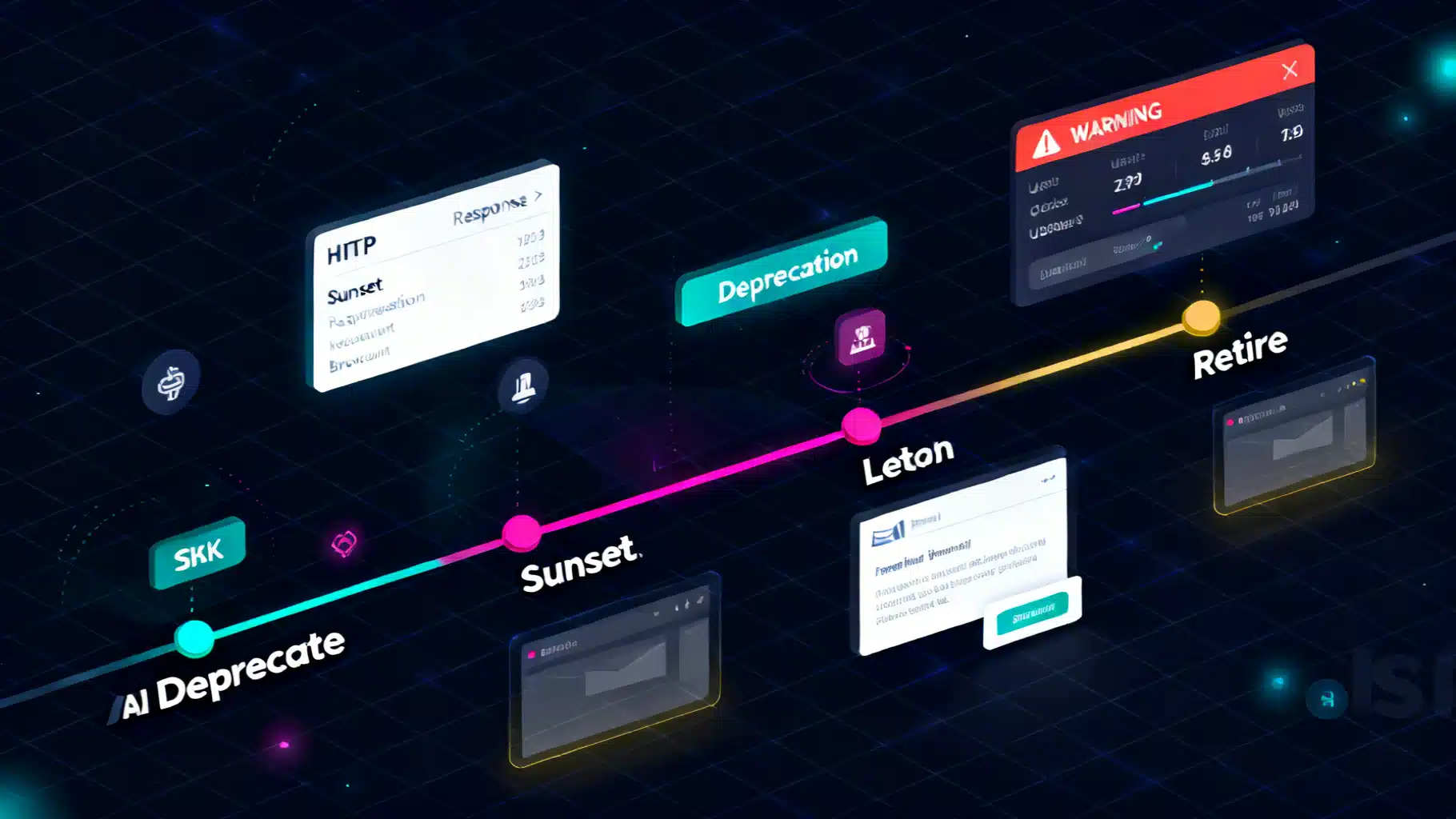
Image used for representation purposes only.
Why API endpoint deprecation communication matters
Poorly handled deprecations erode developer trust, trigger incident fire drills, and stall product velocity. Clear, early, and repeated communication turns a breaking change into a predictable upgrade. Your goal is simple: no customer should learn about a deprecation from a production outage.
This article outlines a pragmatic, end-to-end playbook you can adopt tomorrow: terminology, timelines, channels, headers, artifacts, runbooks, templates, and metrics.
Define the lifecycle: deprecate → sunset → retire
- Deprecate: You announce that an endpoint or behavior will be removed or changed after a defined period. The endpoint still works.
- Sunset: You set a concrete date/time when the endpoint will stop working. Communicate this date everywhere.
- Retire: You remove the endpoint. Clients should receive clear errors (typically 410 Gone) with guidance.
Tip: Commit to minimum stability windows (e.g., “No breaking removals sooner than 180 days from announcement”) and publish them in your public API policy.
Core principles
- Predictable timelines over speed: give most clients 6–12 months. Shorter windows (30–90 days) suit beta or sandbox-only features.
- Multi-channel, multi-touch: assume messages will be missed unless repeated across diverse surfaces.
- Targeted outreach beats blast emails: contact the owners of affected apps using usage telemetry, not just newsletter lists.
- Evidence-driven: instrument every deprecation notice, click-through, and migration event. Let data guide escalations.
- Grace with guardrails: offer compatibility shims, brownouts, and safe rollback levers.
A blueprint timeline you can adapt
Use this “90/180/365” model, adjusting for risk and customer commitments.
-
T0 (Announcement):
- Publish changelog, docs, and a migration guide.
- Add response headers (Deprecation, Sunset), and in-product banners.
- Send targeted emails to active integrators and account owners.
- Ship SDK and OpenAPI markers (
deprecated: true).
-
T0 + 30 days (First nudge):
- Re-email non-migrated apps.
- Add dashboard warnings that show real request counts to the deprecated endpoint.
-
T0 + 60 days (Brownout 1):
- 30-minute planned outage in non-peak windows; return 299-like advisory logs or 2xx with warning fields in staging; 503 with Retry-After in prod for brownout window.
- Provide live migration office hours.
-
T0 + 90 days (Escalation for 90-day path) or Status Check (for 180/365):
- If on the 90-day path, sunset now; otherwise, publish progress metrics and upcoming brownout dates.
-
T0 + 120–150 days (Brownout 2 for 180/365):
- 2–4 hour brownout with verbose error body and migration link.
-
T0 + 180 days (Sunset for standard path):
- Enforce retirement: return 410 Gone with remediation link.
-
T0 + 365 days (Extended support path):
- For strategic or regulated customers who opted into an extension, retire here with contractual notice.
Channels and the sequence that works
- Changelog: single source of truth with permanent URL.
- Docs: banner on the affected endpoint page and on the migration target page.
- Console/UI: account-level and app-level banners showing live usage impact (“Your app called GET /v1/reports 12,438 times last week”).
- API responses: headers and machine-readable fields.
- Email: targeted to verified technical contacts, account admins, and billing owners.
- Status page: schedule brownouts/retirements as maintenance.
- SDKs/CLIs: deprecation warnings at build or run time.
- Webhooks: optional “deprecation.advisory” event for integrators.
Make it machine-readable in responses
Adopt standardized headers so tooling can catch issues early.
- Sunset header (RFC-standardized):
HTTP/1.1 200 OK
Sunset: Tue, 14 Oct 2025 10:00:00 GMT
Link: <https://developer.example.com/migrate/reports-v2>; rel="sunset"
- Deprecation signal (widely used as a response header; include an explanation URL):
HTTP/1.1 200 OK
Deprecation: true
Link: <https://developer.example.com/changelog#reports-v1-deprecation>; rel="deprecation"
- Error after retirement:
HTTP/1.1 410 Gone
Content-Type: application/json
Sunset: Tue, 14 Oct 2025 10:00:00 GMT

{
  "error": {
    "code": "endpoint_retired",
    "message": "GET /v1/reports was retired on 2025-10-14. Migrate to GET /v2/reports.",
    "docs": "https://developer.example.com/migrate/reports-v2"
  }
}
Signal it in your contract: OpenAPI and SDKs
- OpenAPI example:
openapi: 3.0.3
paths:
  /v1/reports:
    get:
      summary: Retrieve reports (Deprecated)
      deprecated: true
      description: |
        Deprecated. Use /v2/reports. Sunset on 2025-10-14.
      responses:
        '200':
          description: OK
          headers:
            Sunset:
              schema:
                type: string
              description: RFC-compliant Sunset date.
- SDK deprecation warnings (build-time and run-time):
// TypeScript client
export function getReportsV1(...) {
  console.warn(
    "[DEPRECATION] getReportsV1 will be removed on 2025-10-14. See https://developer.example.com/migrate/reports-v2"
  );
  // ...
}
Migration aids that reduce customer effort
- Pin-compatible replacement endpoints with better defaults.
- Compatibility shim: accept old payloads but transform to the new schema at the edge.
- Bulk migration scripts: example CLIs, Terraform modules, Postman collections.
- Diffed examples: before/after request and response bodies side-by-side.
- Assisted testing: provide a header or query param to preview new behavior on production data, e.g.,
?preview=v2orX-API-Preview: reports-v2. - Data backfills and dual-write to populate new resources ahead of cutover.
Brownouts done right
- Announce dates at T0 with calendars (UTC and customer-local time shown).
- Choose low-traffic windows but rotate times to be fair across regions.
- Return explicit, parseable bodies with migration links.
- Log correlation IDs and include them in error responses so support can quickly investigate.
- Provide a bypass token for emergency business-critical traffic, time-boxed and auditable.
Templates you can copy
- Changelog entry
Title: Deprecating GET /v1/reports; replacement is GET /v2/reports
Date: 2025-04-14
Summary: We are deprecating GET /v1/reports. The endpoint will be retired on 2025-10-14. Use GET /v2/reports.
Migration guide: https://developer.example.com/migrate/reports-v2
Key changes:
- Pagination moves from offset to cursor
- Field `status_text` replaced by `status` (enum)
- Max page size increased to 1,000
Brownouts: 2025-08-20 02:00–04:00 UTC; 2025-09-24 10:00–12:00 UTC
- Targeted email to affected users
Subject: Action required: /v1/reports will retire on Oct 14, 2025

Hi {{first_name}},

Your application {{app_name}} called GET /v1/reports {{calls_last_7d}} times in the past week. This endpoint will retire on October 14, 2025.

What to do
1) Migrate to GET /v2/reports (guide below)
2) Test with header X-API-Preview: reports-v2
3) Confirm completion in your dashboard

Resources
- Migration guide: {{guide_url}}
- SDK update: {{sdk_url}}
- Office hours: {{cal_link}}

We will run brief brownouts on Aug 20 and Sep 24 (see details in the guide). If you need an extension, reply to this email before Sep 30.

Thank you,
{{signature}}
- Console banner (app-level)
{
  "type": "deprecation-banner",
  "severity": "warning",
  "title": "/v1/reports retires Oct 14, 2025",
  "body": "Your app made 12,438 calls last week. Update to /v2/reports.",
  "actions": [
    {"label": "View guide", "href": "https://developer.example.com/migrate/reports-v2"},
    {"label": "Email owner", "href": "mailto:owner@example.com"}
  ]
}
Governance, owners, and the deprecation runbook
Create a cross-functional working group with clear RACI:
- Product: owns the rationale, the guide, and the final timelines.
- Engineering: ships headers, shims, metrics, and removal PRs.
- Developer Relations: drafts comms, samples, and office hours.
- Support/Success: manages escalations and extensions.
- Legal/Privacy: reviews obligations and retention impacts.
Runbook steps
- Inventory usage: top apps, orgs, regions, and error budgets.
- Risk score: regulatory exposure, partner commitments, and critical-path workflows.
- Choose timeline (90/180/365) and brownout cadence.
- Prepare artifacts: docs, guides, SDK changes, OpenAPI, dashboards.
- Announce (T0) and instrument all surfaces for read/ack events.
- Biweekly review: adoption curve, top blockers, targeted outreach.
- Sunset: enforce 410, keep logs and dashboards for 90 days.
- Postmortem: what reduced risk, what slowed migration, what to automate.
The dashboards that keep you honest
Track these in a single deprecation view:
- Unique apps still calling the endpoint, by week.
- Call volume and percent of total traffic, by endpoint version.
- Top N orgs by remaining volume and migration status.
- SDK version adoption curve.
- Brownout impact: error counts during windows and follow-on migrations.
- Support tickets by category (docs confusion, feature gaps, auth issues).
Handling exceptions and extensions
- Extensions are explicit, time-boxed, and logged with a new Sunset date attached to the organization/account.
- Provide a “compat mode” key or allowlist header only after executive approval.
- Communicate to internal teams so sales and support don’t promise indefinite extensions.
Common pitfalls to avoid
- Announcing without a migration path or samples.
- Vague dates (“Q4”) instead of precise timestamps with time zones.
- One-and-done emails with no telemetry or follow-up.
- Retiring before SDKs and client libraries ship warnings.
- Hiding breaking changes inside “minor” releases.
A concise checklist
- Changelog entry with T0, brownouts, and Sunset date
- Docs banner on old and new endpoints
- Migration guide with diffs and code samples
- Response headers: Deprecation and Sunset + Link rels
- OpenAPI
deprecated: true; SDK warnings shipped - Targeted email + console banner + status page post
- Brownouts scheduled and announced at T0
- Dashboards for adoption and outreach
- Exception policy and extension workflow
- Post-sunset 410 with actionable error body
Final word
Deprecation is a product capability, not a last-mile announcement. When you systematize timelines, headers, tooling, and human outreach, you turn a high-risk moment into a routine upgrade your developers can plan around—and trust you more for the next one.
Related Posts

Consumer-Driven Contract Testing: A Practical Guide to Safer, Faster API Delivery
A practical guide to consumer-driven contract testing: how it works, why it matters, and how to implement it with CI/CD to ship APIs faster without breaks.

Building a Production-Ready AI Image Recognition API for Mobile Apps
Design and ship a production-grade AI image recognition API for mobile apps: architecture, models, privacy, performance, and code snippets for iOS/Android.
API Microservices Communication Patterns: A Practical Guide for Scale and Resilience
A practical guide to synchronous and asynchronous microservice communication patterns, trade-offs, and implementation tips for resilient APIs.