
Designing resilient REST API webhook retry mechanisms
Design reliable webhook retries: backoff with jitter, idempotency, Retry-After, DLQs, security, and ops patterns for resilient REST API webhooks.
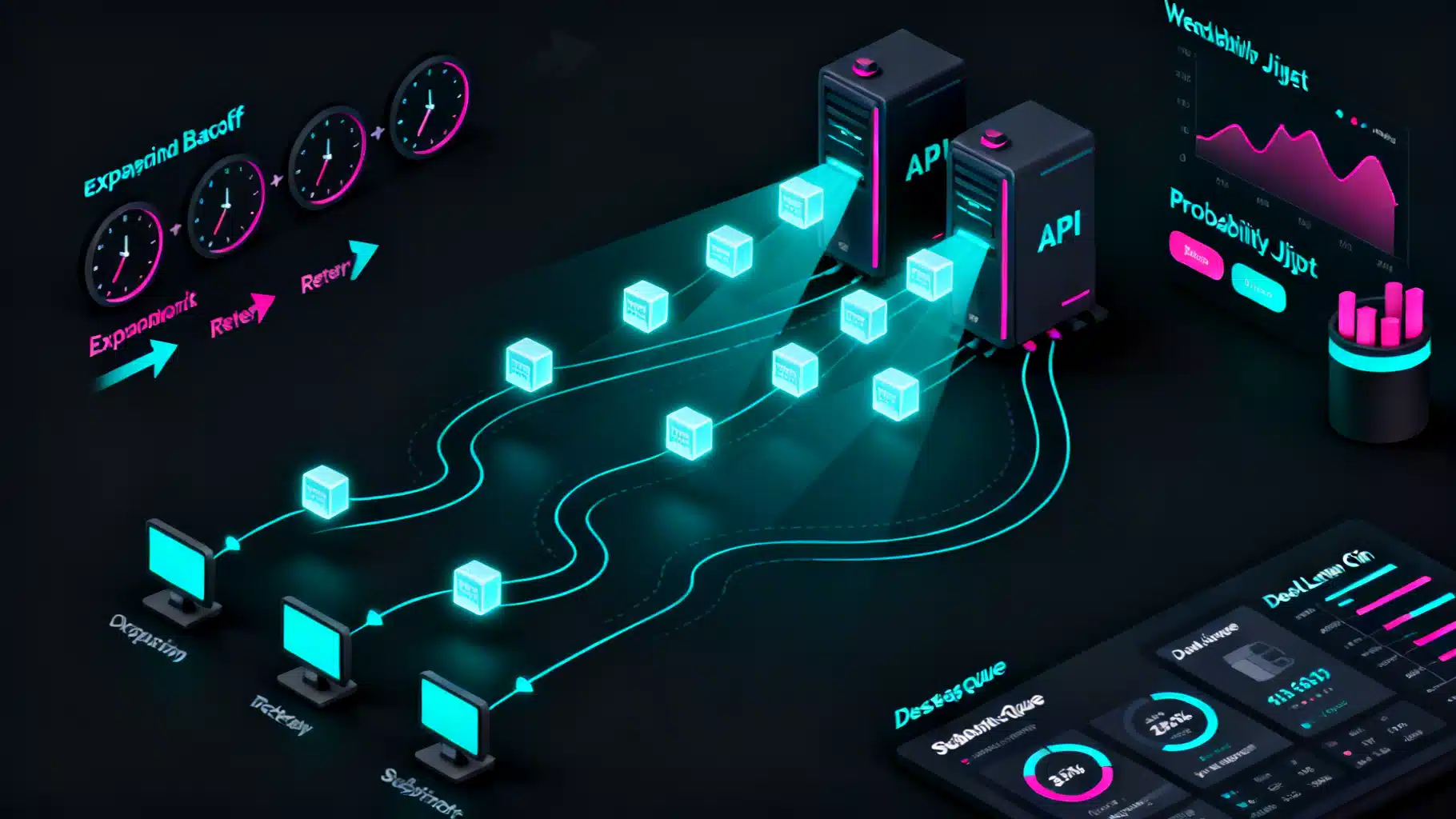
Image used for representation purposes only.
Overview
Webhooks turn your REST API into an event-driven platform by pushing notifications to subscriber endpoints. But the open internet is lossy: endpoints go down, networks split, DNS fails, TLS handshakes time out, and servers rate-limit. Reliable delivery therefore depends on robust retry mechanisms. This article explains how to design, implement, and operate production-grade webhook retries—from backoff and jitter to idempotency, dead-letter queues, and observability—so your events arrive once, only-once in effect, and fast.
Delivery semantics: what you can (and can’t) guarantee
- At-most-once: never retries; events may be lost. Not acceptable for critical events.
- At-least-once: retries until acknowledged; duplicates can occur. This is the pragmatic default for webhooks.
- Exactly-once: not realistically achievable over HTTP without cooperation from receivers. Emulate it with idempotency keys and deduplication.
Design your system around at-least-once delivery with strong idempotency on the receiver side.
Defining success and failure
A retry engine needs crisp rules:
- Success: any 2xx response (200–299). Avoid parsing bodies for success. The receiver should return 2xx after safely queuing the work.
- Temporary failure (retryable): network errors, timeouts, TCP resets; HTTP 408, 409, 425, 429, 500–599. Respect Retry-After when present.
- Permanent failure (non-retryable): malformed request or unsupported condition—commonly 400, 401, 403, 404, 410, 415, 501. Permit per-integration overrides because some receivers misuse codes.
- Timeouts: treat as retryable. Keep request timeouts short (e.g., 5–10 seconds) so you can fail fast and retry.
Tip: keep a small allowlist/denylist to adapt to idiosyncratic partners. For example, some integrations use 404 for temporary maintenance—your operator can flip a switch to treat 404 as retryable for them.
Backoff strategies that don’t melt your fleet
Synchronous, aggressive retries amplify outages. Use backoff.
- Fixed backoff: constant delay (e.g., 30s). Simple but can cause thundering herds.
- Exponential backoff: delay grows as base × 2^attempt. Faster recovery, lower load.
- Exponential backoff with jitter: add randomness to spread retries across time. Prefer full jitter or decorrelated jitter.
Formulas (T is next delay, attempt starts at 1):
- Exponential: T = min(max_delay, base × 2^(attempt-1))
- Full jitter: T = random(0, min(max_delay, base × 2^(attempt-1)))
- Decorrelated jitter: T = min(max_delay, random(base, prev_delay × 3))
Choose bounds. Example defaults:
- base = 1–5 seconds
- max_delay = 1–10 minutes (per tenant/endpoint)
- delivery_ttl = 72 hours (stop after this window)
Provide a deterministic schedule for debugging. Example (illustrative): 1m, 2m, 4m, 8m, 15m, 30m, 1h, 2h, 4h, 8h, 16h, 24h, then daily until TTL.
Respecting server backpressure
If the receiver sends 429 or 503 with a Retry-After header:
- If Retry-After is a number, wait that many seconds.
- If it is a HTTP-date, wait until that time.
- Cap with your max_delay to protect your backlog.
When missing, fall back to your backoff strategy.
Idempotency: the antidote to duplicates
Because at-least-once delivery yields duplicates, every webhook must include a stable, unique identifier per event and (ideally) a delivery attempt counter.
Recommended fields:
- event_id: UUID or ULID, unique system-wide.
- event_type and resource identifiers: to scope semantics.
- produced_at: timestamp for observability and ordering.
- signature and timestamp: for authenticity and replay protection.
Receiver best practice:
- Verify the signature before any side effects.
- Check a dedup store (e.g., Redis, Postgres unique index) for event_id. If seen, return 200 and do nothing.
- If new, persist event_id with a TTL (e.g., 7–30 days, aligned with your replay window), enqueue work, and return 2xx quickly.
This pattern yields exactly-once effects even with duplicate deliveries.
Ordering and concurrency
Global ordering of webhooks is fragile. Prefer per-resource ordering:
- Include sequence numbers or version in the payload per aggregate (e.g., user_version).
- Process events per resource key serially, or detect out-of-order arrivals and wait until missing sequence numbers arrive (with a timeout).
- Document that ordering is best-effort across aggregates.
Handling permanent failures and poison events
- Dead-letter queue (DLQ): when delivery_ttl expires or a non-retryable status is returned, move the event to a DLQ with rich metadata (last status, body hash, headers, attempt count).
- Quarantine: isolate repeated 4xx from the same endpoint to protect your system.
- Replay tooling: allow operators (and customers) to fix endpoints and trigger replays from DLQ or from an event archive, optionally filtered by event_type and date.
Security considerations for retries
- TLS everywhere; pin minimum TLS version.
- HMAC signatures: compute over the signed timestamp and raw payload; compare in constant time. Example header: X-Signature: scheme=v1,ts=…,sig=…
- Timestamp tolerance: reject messages older than a small window (e.g., 5 minutes) to limit replay risk. Retries should refresh the signature timestamp.
- Secret rotation: support multiple active signing secrets.
- IP allow lists and mTLS (for high-trust, private integrations).
Never log full payloads that contain secrets; use hashing/redaction.
Timeouts, size limits, and payload hygiene
- Sender: short connect+read timeouts (e.g., 5–10s). Avoid retry storms by not waiting 60s per attempt.
- Receiver: respond fast (under 1s) after enqueueing. If heavy processing is required, do it asynchronously.
- Limit payload size. For larger events, deliver a reference (event_id) and require the receiver to fetch details via an authenticated API.
Observability and SLOs
Track, alert, and visualize at least:
- Delivery success rate (per endpoint, per tenant, per event_type)
- Time-to-first-success (TTFS) and time-to-deliver (TTD)
- Attempt distribution and backlog size
- Top failure codes and endpoints
- DLQ rate and age of oldest message
Set SLOs, e.g., “99.9% of webhooks are delivered within 10 minutes.” Backpressure policies and retry knobs should be visible in dashboards.
Example: sender-side retry engine (pseudocode)
import random, time, requests

class RetryPolicy:
    def __init__(self, base=2, max_delay=300, ttl_seconds=72*3600, max_attempts=100):
        self.base = base
        self.max_delay = max_delay
        self.ttl_seconds = ttl_seconds
        self.max_attempts = max_attempts

    def next_delay(self, attempt, prev_delay=None):
        # exponential backoff with full jitter
        exp = min(self.max_delay, self.base * (2 ** (attempt - 1)))
        return random.uniform(0, exp)

class WebhookDispatcher:
    def __init__(self, policy=RetryPolicy(), http_timeout=8):
        self.policy = policy
        self.http_timeout = http_timeout

    def deliver(self, endpoint, payload, headers, produced_at):
        attempt, start = 1, time.time()
        prev_delay = None
        while attempt <= self.policy.max_attempts and (time.time() - start) < self.policy.ttl_seconds:
            try:
                resp = requests.post(endpoint, json=payload, headers=headers, timeout=self.http_timeout)
                if 200 <= resp.status_code < 300:
                    return { 'status': 'ok', 'attempt': attempt }
                if resp.status_code in (429, 503) and 'Retry-After' in resp.headers:
                    delay = parse_retry_after(resp.headers['Retry-After'])
                elif resp.status_code >= 500 or resp.status_code in (408, 409, 425):
                    delay = self.policy.next_delay(attempt, prev_delay)
                else:
                    break  # non-retryable
            except requests.RequestException:
                delay = self.policy.next_delay(attempt, prev_delay)

            time.sleep(delay)
            prev_delay = delay
            attempt += 1

        # Move to DLQ with metadata
        return { 'status': 'failed', 'attempt': attempt-1, 'dlq': True }
Notes:
- The loop respects max_attempts and a delivery TTL.
- Retry-After, if present, takes precedence.
- Non-retryable responses exit early to avoid useless retries.
Example: receiver-side idempotent handler with signature verification
const crypto = require('crypto');
const express = require('express');
const Redis = require('ioredis');
const app = express();
const redis = new Redis(process.env.REDIS_URL);

app.post('/webhooks', express.raw({ type: '*/*' }), async (req, res) => {
  const signatureHeader = req.header('X-Signature');
  const timestamp = req.header('X-Signature-Timestamp');
  const body = req.body; // raw Buffer

  if (!verifySignature(body, timestamp, signatureHeader, process.env.SIGNING_SECRET)) {
    return res.status(400).send('invalid signature');
  }

  const event = JSON.parse(body.toString('utf8'));
  const key = `evt:${event.id}`; // event.id provided by sender

  // Set a short NX key to achieve idempotency; extend or persist as needed
  const wasNew = await redis.set(key, '1', 'NX', 'EX', 60 * 60 * 24 * 14); // 14 days
  if (!wasNew) {
    return res.status(200).send('duplicate');
  }

  // Offload heavy work to a queue; ack quickly
  await enqueueForProcessing(event);
  return res.status(202).send('accepted');
});

function verifySignature(body, ts, header, secret) {
  if (!ts || !header) return false;
  const now = Math.floor(Date.now() / 1000);
  if (Math.abs(now - parseInt(ts, 10)) > 300) return false; // 5-minute tolerance
  const payload = `${ts}.${body.toString('utf8')}`;
  const hmac = crypto.createHmac('sha256', secret).update(payload).digest('hex');
  // header format example: "scheme=v1,ts=...,sig=..." -> parse sig
  const sig = header.split('sig=')[1];
  return crypto.timingSafeEqual(Buffer.from(hmac), Buffer.from(sig));
}
Key points:
- Use express.raw to avoid body mutation before signature verification.
- Perform a constant-time comparison.
- Return 2xx immediately after enqueueing; do the real work asynchronously.
Rate limiting, fairness, and isolation
- Per-endpoint concurrency caps: avoid overwhelming slow receivers.
- Token buckets per tenant: ensure fairness during spikes.
- Circuit breakers: temporarily pause an endpoint after repeated failures; retry with longer intervals.
- Isolation: shard queues by tenant or endpoint to prevent a single bad actor from clogging the global pipeline.
Payload evolution and schema safety
Retries may cross deployment boundaries. To avoid breaking receivers:
- Maintain backward compatibility; add fields, don’t remove or repurpose.
- Include a schema_version; keep old versions for the TTL period.
- Offer a self-serve replay to backfill receivers after they upgrade.
Operational playbook
- Failure injection: regularly simulate 500s, timeouts, and 429s to validate backoff and jitter.
- Blackhole tests: drop all responses and ensure DLQ + alerts kick in.
- Chaos on schedules: randomize cron-driven batch sends to avoid synchronized surges.
- Runbooks: document how to promote DLQ items back to the live queue and how to toggle per-endpoint retry overrides.
Checklist for production readiness
Sender side:
- Exponential backoff with jitter and max_delay
- Respect Retry-After and cap it
- Short HTTP timeouts with connection reuse
- Per-endpoint concurrency and circuit breaker
- Delivery TTL and DLQ with replay tools
- Structured logs with event_id and attempt
- Metrics: success rate, TTD, backlog, DLQ
Receiver side:
- Signature verification with timestamp tolerance
- Idempotent processing via event_id store
- Fast 2xx after enqueue; async processing
- Clear 4xx vs 5xx responses
- Rate-limit and backpressure (429 + Retry-After)
- Observability: dedup hits, processing lag
Conclusion
Reliable webhook delivery is a systems problem: you must treat the internet as unreliable, plan for duplicates, and design for backpressure. A sound retry strategy—exponential backoff with jitter, respect for Retry-After, tight timeouts—paired with idempotent receivers, DLQs, and strong observability turns best-effort HTTP into dependable event delivery. Start with at-least-once semantics, make effects idempotent, and your webhooks will remain resilient even when everything else is failing.
Related Posts

Implementing a Robust Webhook API: A Practical Guide
Design, secure, and operate reliable webhook APIs with signatures, retries, idempotency, observability, and great developer experience.
Designing Idempotent APIs: A Practical Guide
A practical guide to API idempotency: keys, retries, storage design, error handling, and patterns for exactly-once effects in distributed systems.

The Enterprise Blueprint for API Governance Standards
A practical blueprint for enterprise API governance: standards, security, lifecycle, observability, and a 90‑day rollout plan to scale APIs safely.