
Ethical Use of AI Medical Diagnosis APIs: A Practical Blueprint
A practical guide to ethical AI medical diagnosis APIs: privacy, consent, validation, fairness, security, oversight, and monitoring for trustworthy use.

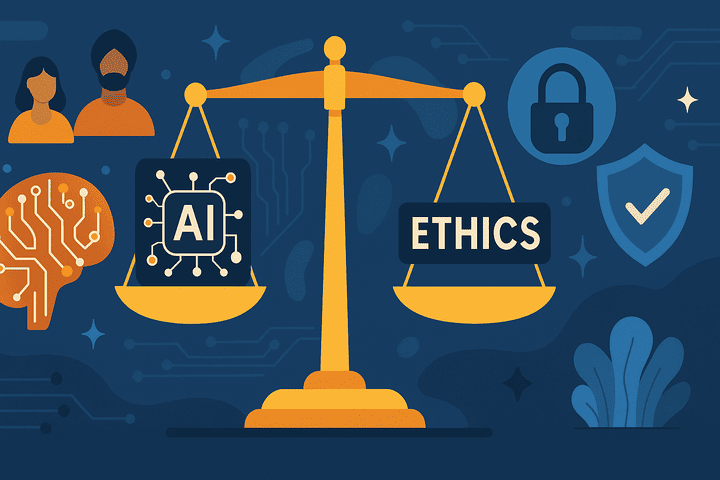
Image used for representation purposes only.
Why ethics must lead AI diagnosis APIs
AI that flags conditions, triages symptoms, or supports clinical decisions can expand access and improve outcomes—but only if it is designed and used ethically. An API turns powerful models into programmable building blocks that many teams can integrate quickly. That scale amplifies both benefits and risks. This article distills practical principles, patterns, and safeguards for ethically building, integrating, and operating medical diagnosis APIs.
What counts as a “medical diagnosis API”
In practice, these APIs do one or more of the following:
- Risk stratification: estimate probability (e.g., “pneumonia likelihood = 0.62”).
- Decision support: suggest next steps (e.g., “recommend chest X‑ray”).
- Triage/routing: prioritize cases or direct to services.
- Eligibility screening: check whether a clinical pathway applies.
The ethical posture changes with capability. A probability that aids a clinician is different from an autonomous diagnosis delivered to a patient. Higher autonomy demands stronger evidence, oversight, and controls.
Ethical pillars adapted to healthcare APIs
- Respect for persons: obtain informed consent; communicate limitations; respect the right to refuse.
- Beneficence and non‑maleficence: maximize clinical benefit; minimize harm via validation, monitoring, and safe defaults.
- Justice: ensure equitable performance across populations; avoid exclusionary design.
- Accountability: assign clear responsibility for decisions, maintenance, and incidents.
- Transparency: document intended use, performance, failure modes, and updates in accessible language.
Data governance and privacy by design
- Data minimization: collect only what the use case requires; prefer structured features over raw text/images when possible.
- PHI handling: encrypt in transit and at rest; segregate keys; enforce least‑privilege access; log all access to PHI.
- De‑identification and pseudonymization: keep linkage files separate; rotate tokens; avoid unnecessary re‑identification.
- Consent management: honor explicit, informed consent for data use; provide easy withdrawal paths; record provenance and time stamps.
- Retention and purpose limitation: set default retention to the minimum necessary; block secondary use unless explicitly consented and approved by governance.
- Vendor contracts and assurances: for hosted APIs, require security attestations (e.g., SOC 2/ISO 27001), business associate agreements where applicable, data processing addenda, and clear sub‑processor lists.
Example: consent-aware API request flow
# Pseudocode for a backend that calls a diagnosis API only with valid consent

def handle_inference(patient_id, features):
    consent = consent_store.get(patient_id)
    if not consent or not consent.active or 'ai_diagnosis' not in consent.scopes:
        return {"status": "blocked", "reason": "no_valid_consent"}

    payload = minimize(features, required_fields=[
        'age','sex','symptom_onset_days','vitals','lab_summary'
    ])

    response = diag_api.infer(payload)
    audit_log.write({
        'patient_id_hash': hash_id(patient_id),
        'model_version': response['model_version'],
        'timestamp': now(),
        'purpose': 'clinical_support',
        'request_fields': list(payload.keys())
    })
    return safe_response(response)
Model development and validation: evidence before scale
- Intended use: state the clinical context, indications, contraindications, and user type (clinician vs. patient). Avoid “general diagnostic” claims.
- Dataset curation: document sources, labeling quality, and representativeness; include under‑represented groups; track prevalence shifts.
- Performance metrics: report AUROC/PR, sensitivity/specificity, PPV/NPV at clinically meaningful thresholds, calibration error, and decision‑relevant utility metrics.
- Fairness: evaluate performance stratified by age, sex, race/ethnicity, language, socioeconomic status, and site; include intersectional slices where feasible.
- External and prospective validation: test on data from different sites and time periods; when possible, run silent trials before clinical use.
- Uncertainty estimation: communicate confidence intervals or prediction intervals; avoid single‑number certainty.
- Documentation: publish a model card detailing training data, limitations, failure modes, and monitoring plans.
Human oversight and workflow integration
- Human‑in‑the‑loop: design for clinician verification; ensure the UI shows raw inputs, rationale/explanations where available, and easy override pathways.
- Thresholds and routing: set conservative cut‑offs that err toward safety; send ambiguous or high‑risk cases to expert review.
- Role clarity: specify who is responsible for acting on model outputs (ordering tests, notifying patients, documenting decisions).
- Time‑sensitive cases: implement escalation protocols and on‑call ownership for urgent alerts.
Example: thresholding with safe fallbacks
risk = response['risk_score']  # 0..1

if risk >= 0.8:
    action = 'urgent_escalation'   # notify on-call clinician immediately
elif 0.4 <= risk < 0.8:
    action = 'clinician_review'    # add to review queue with SLA
else:
    action = 'no_action_but_log'   # log and continue routine care

# Never auto-diagnose; always present uncertainty and rationale
ui.render({
    'risk': risk,
    'confidence': response['confidence'],
    'top_features': response.get('top_features', []),
    'action': action,
    'disclaimer': 'AI is a support tool, not a diagnosis.'
})
Security and abuse prevention
- Threat modeling: consider model inversion, membership inference, and data poisoning risks in pipelines.
- API security: enforce mutual TLS, OAuth2 with short‑lived tokens, IP allow‑lists, HSTS, and strict rate limits to deter scraping and enumeration.
- Secrets management: store keys in an HSM or managed secrets vault; rotate regularly; block logging of secrets.
- Data egress controls: restrict export functions; watermark datasets; monitor anomalous downloads.
- Adversarial inputs: validate schemas, constrain input sizes, and sanitize free‑text to reduce injection or prompt‑based manipulation.
Monitoring and post‑deployment surveillance
- Continuous evaluation: track calibration, alert volume, and clinical utility over time; compare to pre‑deployment baselines.
- Drift detection: watch feature distributions and outcome prevalence; retrain or recalibrate before performance erodes.
- Safety signals: maintain an incident registry; define what counts as an adverse event; share learnings with stakeholders.
- Kill switch: be able to roll back model versions instantly; default to safest known configuration.
- Feedback loops: collect structured clinician feedback and case‑level annotations; close the loop with product updates.
Minimal observability schema
- Inference metadata: timestamp, model version, input schema version, site, user role, consent scope.
- Performance labels: ground truth when available, latency, confidence.
- Safety flags: overrides, escalations, adverse events, post‑hoc corrections.
Transparent communication and explainability
- Audience‑appropriate explanations: clinicians may want feature attributions and counterfactuals; patients need plain language about what the tool can and cannot do.
- Uncertainty display: show ranges, not just point estimates; avoid anthropomorphic language.
- Limitations: state excluded populations, known failure modes, and “do not use for” contexts in‑product, not only in documentation.
- Change logs: surface model updates, rationale, and expected impact with versioned notes.
Governance and accountability
- Multidisciplinary review: include clinicians, data scientists, security, legal, and patient representatives in an ethics board.
- Risk assessments: conduct data protection impact assessments (DPIA) or similar algorithmic impact reviews before launch and on major updates.
- Decision records: keep a lightweight but auditable trail of model choices, threshold settings, and exception approvals.
- Training and competency: ensure end users complete training; track attestations before granting access.
Fair access and health equity
- Inclusive design: support multiple languages and accessible interfaces; avoid requiring high digital literacy for patient‑facing tools.
- Site parity: prevent “tiered” safety where resource‑rich sites get better models; plan for rollout equity and support.
- Pricing ethics: avoid usage‑based pricing that penalizes high‑need populations; consider capped plans for safety‑critical integrations.
Practical implementation blueprint
- Define the clinical problem and intended use; write the non‑goals.
- Map stakeholders and context: patients, clinicians, administrators, IT, compliance.
- Draft a model card and a data sheet for datasets before training.
- Build privacy and security baselines: access controls, encryption, consent flows, logging.
- Train and validate; run blinded external validation; publish metrics and limitations.
- Design UI and workflow with safety defaults; implement thresholding and escalation.
- Conduct a DPIA/ethics review; finalize contracts and regulatory strategy.
- Run a silent pilot; measure drift and operational load; tune thresholds.
- Launch with kill switch, alerting, and clear ownership; train users.
- Monitor continuously; update with transparent change logs; re‑validate after major shifts.
Documentation essentials for an ethical API
- Intended use statement and contraindications
- Performance summary with stratified metrics and calibration plots
- Data governance: sources, consent, retention, and sharing policy
- Security architecture: authentication, authorization, encryption, and key management
- Model lifecycle: training data vintages, versioning, and rollback plan
- Monitoring plan: KPIs, alert thresholds, incident response
- Validation reports: external/prospective studies and limitations
- User guidance: when to trust, when to override, and how to report issues
Common pitfalls and how to avoid them
- Silent scope creep: lock purpose and data use; require governance approval for new scopes.
- Over‑automation: maintain human checkpoints for high‑risk actions.
- Aggregated success hiding subgroup harm: always examine stratified metrics before claiming improvement.
- Opaque updates: treat model updates like medication changes—communicate, re‑train users, re‑validate.
- Data hoarding: delete or archive to cold storage per policy; reevaluate necessity regularly.
Quick pre‑launch checklist
- Consent flows tested; opt‑out honored end‑to‑end
- External validation complete; fairness review passed with mitigations
- Security controls audited; secrets rotated; least privilege enforced
- Thresholds calibrated; escalation pathways staffed and tested
- Monitoring dashboards live; kill switch verified in staging and production
- Clear disclaimers in UI; user training documented; responsibilities assigned
- Contracts and regulatory posture confirmed; incident plan rehearsed
Conclusion: build for trust, not just accuracy
Ethically deploying a medical diagnosis API is less about a single brilliant model and more about engineering a trustworthy system. That system respects people, protects privacy, earns validation in the setting of use, acknowledges uncertainty, and stays accountable over time. When ethics lead design—as requirements, not afterthoughts—AI becomes a reliable partner in care, rather than a risky shortcut.
Disclaimer: This article is for informational purposes only and does not constitute legal or regulatory advice. Teams should consult qualified counsel and clinical governance bodies for their specific context.
Related Posts

AI Image Generation API Integration: Architecture, Code Examples, and Best Practices
A practical guide to integrating AI image generation APIs with production-ready code, architecture patterns, safety, and cost optimization.
The Ethical Angle of Generative AI: Balancing Innovation and Responsibility
An expansive exploration of ethical considerations in generative AI, including bias, privacy, accountability, and emerging governance frameworks.
GraphQL File Uploads: A Practical Guide with Node.js, Apollo, and S3
A practical, production-grade guide to implementing GraphQL file uploads with Node.js, Apollo, streaming, S3, validation, and security.