
Blue‑Green Deployment for APIs: Strategies, Playbooks, and Pitfalls
A practical guide to blue‑green deployment for APIs: traffic switching, database changes, observability, rollback, and Kubernetes/gateway examples.
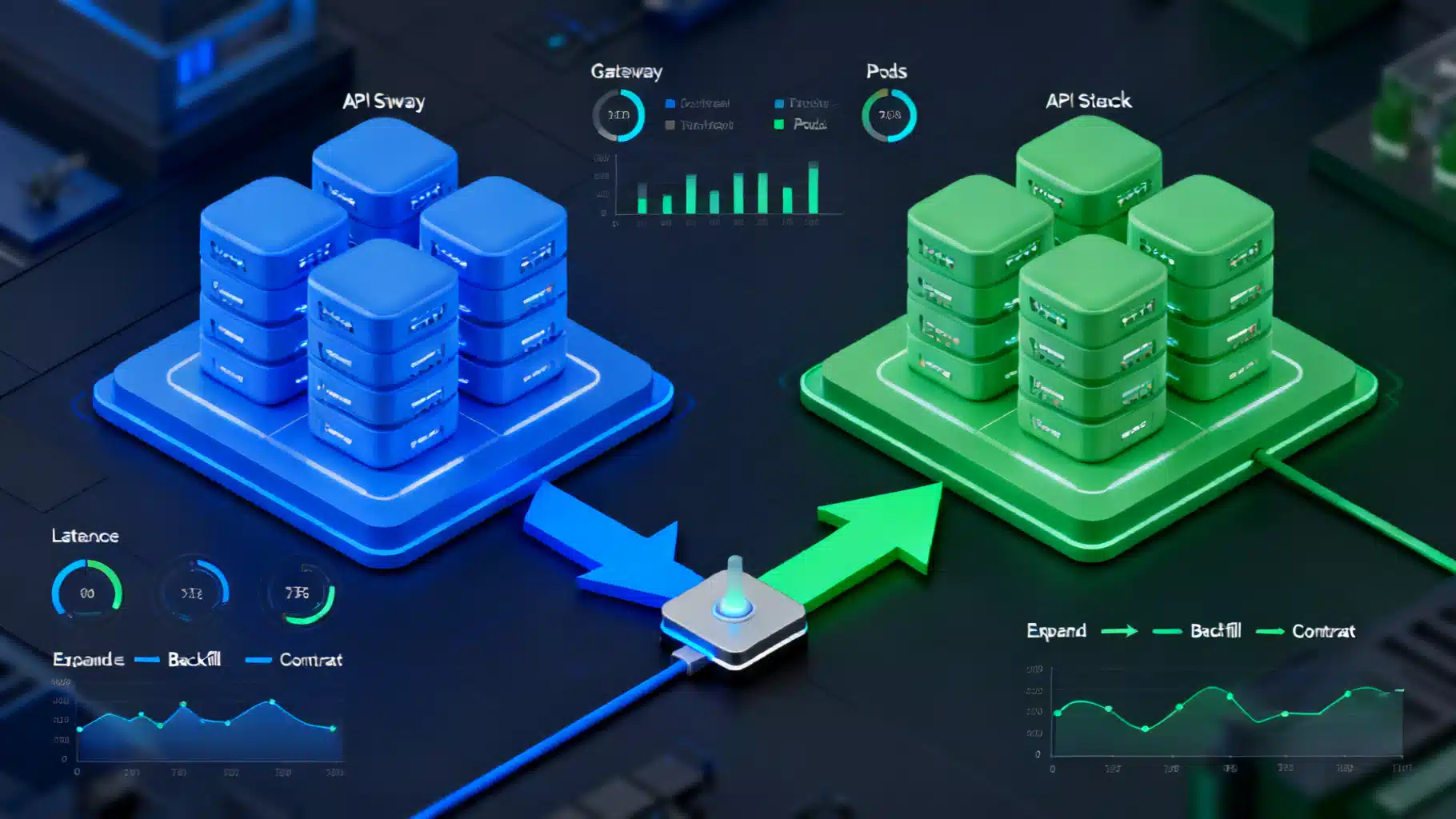
Image used for representation purposes only.
Overview
Blue‑green deployment is a zero‑downtime release technique where you run two production‑like environments side by side: Blue (current) and Green (new). Only one receives live traffic at any time. You validate Green, then shift traffic in a single, reversible move. For APIs—where consumers are tightly coupled through contracts, tokens, caches, and database schemas—blue‑green shines by offering fast rollback and predictable behavior when executed with discipline.
This guide focuses on API‑specific concerns, practical traffic‑switching methods, database strategies, and concrete playbooks for Kubernetes, service meshes, and gateways.
Why blue‑green for APIs?
- Zero‑downtime cutovers: no rolling restarts that can cause partial outages.
- Fast, binary rollback: redirect traffic back to Blue in seconds.
- Predictable state: entire Green stack (app + config + infra) is validated as a unit.
- Clean separation for smoke tests, contract tests, and synthetic traffic before go‑live.
When your API must meet strict SLOs, handle bursty traffic, or coordinate schema changes, blue‑green reduces uncertainty compared to piecemeal rollouts.
Core workflow at a glance
- Provision Green alongside Blue using the same IaC, secrets model, and policies.
- Run automated tests, contract tests, and synthetic load on Green.
- Warm Green caches and dependencies; verify health and golden signals.
- Switch traffic from Blue → Green using DNS, a load balancer, gateway, or mesh routing.
- Observe, hold steady, and—if needed—roll back instantly by restoring Blue.
- Decommission Blue after a safe window, or keep it as the next staging base.
Traffic switching options
Choosing how you switch traffic determines cutover speed, observability, and blast radius.
-
DNS cutover
- Pros: simple, tool‑agnostic.
- Cons: TTLs, client caching, and propagation delays complicate instant rollback.
- Use when: you lack control of edge/load balancer or need broad simplicity.
-
Load balancer target groups
- Pros: near‑instant shifts, granular health checks, atomic flip.
- Cons: platform‑specific configuration.
- Use when: you run ALB/NLB, GCLB, or similar and can manage target groups.
-
API gateway stages (weighted routes)
- Pros: controlled routing, header‑based overrides, fast rollback.
- Cons: feature sets vary by vendor.
- Use when: you already terminate and authorize at a gateway layer.
-
Service mesh (Istio/Linkerd/Consul) with VirtualService/TrafficSplit
- Pros: fine‑grained routing (weights, headers), mTLS, circuit breaking, telemetry.
- Cons: added complexity and operational overhead.
- Use when: you need precise control and rich observability.
-
Edge proxies (NGINX/Envoy)
- Pros: portable, expressive routing rules, header‑based pinning.
- Cons: you must operate the proxy fleet.
- Use when: you manage your edge and want full control without a mesh.
API‑specific readiness checklist
Before switching traffic, ensure Green meets these API criteria:
- Backward compatibility: Green accepts all requests and payload shapes supported by Blue.
- Versioning: endpoints are versioned (e.g., /v1, header‑version, or media type) with a defined compatibility window.
- Idempotency: retries won’t duplicate side effects; use idempotency keys for POST where applicable.
- Authentication and authorization: token validation, JWKS rotation, scopes, and rate limits behave identically.
- Caching: Vary headers, Cache‑Control, and ETags are correct; warm critical caches to avoid a cold‑start thundering herd.
- Sticky sessions: either avoid stickiness or ensure stickiness follows the new environment during cutover.
- Long‑lived connections: WebSockets/HTTP/2 streams are gracefully drained or pinned to Blue until completion.
- Observability: standardized correlation IDs, structured logs, and metrics parity with Blue.
Database strategies (expand/contract)
Blue‑green only guarantees transport‑level safety; the hard part is data. Use an expand/contract pattern to make schema changes safe.
-
Expand (backward‑compatible):
- Add new columns/tables as nullable or with safe defaults.
- Deploy Green that writes to both old and new fields (dual‑write) or reads from both until backfill completes.
- Backfill data in batches; verify row counts and checksums.
-
Switch reads/writes:
- Toggle Green to read from the new fields.
- Monitor write/read error rates and latency; verify data parity.
-
Contract (remove old):
- After a deprecation window where Blue is fully retired, remove old fields.
Example migration flow:
-- Expand: add new nullable column
ALTER TABLE orders ADD COLUMN external_id TEXT NULL;

-- Backfill in batches (pseudo‑SQL)
UPDATE orders SET external_id = concat('ext_', id)
WHERE external_id IS NULL
AND id BETWEEN :start AND :end;

-- After Green is live and stable: contract (later)
ALTER TABLE orders DROP COLUMN legacy_ref;  -- Only after removing all consumers
Principles:
- Never perform breaking schema changes in the same release as the traffic switch.
- Keep data migrations idempotent and resumable.
- Maintain a reversible switch: Green can operate in compatibility mode if rollback is required.
Validating Green before the flip
- Smoke tests: run basic CRUD and auth flows through the same gateways clients use.
- Contract tests: validate request/response schemas (e.g., OpenAPI/AsyncAPI) for all consumers.
- Shadow traffic: mirror a slice of production requests to Green (responses are dropped) to expose hotspots without risk.
- Synthetic load: replay production traces to warm caches and JIT compilers.
- Health checks: separate shallow (port/alive) from deep checks (DB query, cache, third‑party calls) with timeouts.
Observability and SLO‑driven cutover
Define your go/no‑go guardrails around user‑visible health, not just instance readiness.
- Golden signals per SLO: latency (p50/p95), error rate, saturation (CPU/memory), and traffic volume.
- API layer metrics: auth failures, rate‑limit evictions, upstream dependency latency.
- Logs: correlate by request ID; verify parity with Blue for key flows.
- Traces: compare hop counts and spans between Blue and Green to catch unexpected calls.
- Alarms: pre‑wire rollback automations that trigger if SLOs breach for N minutes.
Rollback plan (practice it!)
- Keep Blue healthy and ready until Green passes a soak period.
- Rollback is a routing change, not a redeploy.
- Data: ensure compatibility modes so Green writes do not break Blue. If a write path changed shape, continue supporting old shape on rollback.
- Post‑rollback verification: confirm consumer errors and latency recover before re‑attempting.
Playbooks
Kubernetes Service flip (selector switch)
Run two Deployments (api‑blue, api‑green). Switch the Service selector atomically.
# Service
apiVersion: v1
kind: Service
metadata:
  name: orders-api
spec:
  selector:
    app: orders-api
    color: blue   # flip to green during cutover
  ports:
    - port: 80
      targetPort: http
---
# Blue Deployment
apiVersion: apps/v1
kind: Deployment
metadata:
  name: orders-api-blue
spec:
  selector:
    matchLabels: {app: orders-api, color: blue}
  template:
    metadata:
      labels: {app: orders-api, color: blue}
    spec:
      containers:
        - name: api
          image: registry/orders-api:1.12.3
          ports: [{name: http, containerPort: 8080}]
---
# Green Deployment
apiVersion: apps/v1
kind: Deployment
metadata:
  name: orders-api-green
spec:
  selector:
    matchLabels: {app: orders-api, color: green}
  template:
    metadata:
      labels: {app: orders-api, color: green}
    spec:
      containers:
        - name: api
          image: registry/orders-api:1.13.0
          ports: [{name: http, containerPort: 8080}]
Flip command:
kubectl patch svc orders-api -p '{"spec": {"selector": {"app": "orders-api", "color": "green"}}}'
Notes:
- Verify Green endpoints readiness gates include dependencies (DB, cache).
- Use PodDisruptionBudgets and connection draining to gracefully retire Blue.
Istio weighted routes (instant rollback)
apiVersion: networking.istio.io/v1beta1
kind: DestinationRule
metadata:
  name: orders-api
spec:
  host: orders-api
  subsets:
    - name: blue
      labels: {color: blue}
    - name: green
      labels: {color: green}
---
apiVersion: networking.istio.io/v1beta1
kind: VirtualService
metadata:
  name: orders-api
spec:
  hosts: ["orders.example.internal"]
  http:
    - match:
        - headers:
            X-Env:
              exact: green   # manual pinning for test clients
      route:
        - destination: {host: orders-api, subset: green, port: {number: 80}}
          weight: 100
    - route:
        - destination: {host: orders-api, subset: blue, port: {number: 80}}
          weight: 100       # flip to 0 for blue, 100 for green at cutover
        - destination: {host: orders-api, subset: green, port: {number: 80}}
          weight: 0
This allows header‑based validation of Green before globally flipping weights.
NGINX edge switch with header‑based pinning
map $http_x_env $backend {
    default     http://blue_upstream;
    green       http://green_upstream;  # testers send X-Env: green
}

upstream blue_upstream  { server 10.0.1.10:8080 max_fails=3 fail_timeout=10s; }
upstream green_upstream { server 10.0.2.20:8080 max_fails=3 fail_timeout=10s; }

server {
    listen 80;
    location / {
        proxy_set_header X-Request-ID $request_id;
        proxy_pass $backend;  # flip default to green_upstream at cutover
    }
}
This pattern supports gradual validation via headers and an atomic default switch.
API gateway stage split (conceptual)
- Create two stages: prod‑blue and prod‑green referencing separate backends.
- Route 100% to prod‑blue; send a small percentage or header‑pinned traffic to prod‑green for tests.
- At cutover, set prod route to prod‑green; keep prod‑blue for instant rollback.
CI/CD automation
Automate the workflow to reduce human error:
- Pipeline stages:
- Build & sign image → 2) Infra apply (Green) → 3) DB expand migration → 4) Deploy Green → 5) Tests (unit/integration/contract) → 6) Shadow/synthetic load → 7) Manual or automated approval → 8) Traffic switch → 9) Soak and monitor → 10) Decommission Blue → 11) DB contract migration.
- Policy checks: SAST/DAST, dependency scans, SBOM attestation, admission controls.
- Change windows: choose low‑risk periods; announce to consumers.
Handling state, sessions, and caches
- Sessions: prefer stateless JWTs or external session stores; avoid node‑local state.
- Caches: pre‑warm Green (popular keys) to avoid latency spikes.
- Idempotency and exactly‑once: use idempotency keys and deduplication for side‑effecting requests.
- Message queues: ensure consumer groups and offsets are isolated or safely shared during the switch.
Testing consumers and contracts
- Publish OpenAPI/AsyncAPI artifacts for each environment.
- Run CDC (consumer‑driven contract) tests against Green.
- Provide a sandbox or header pin for partners to validate before the flip.
- Use deprecation headers and sunset policies for any breaking changes scheduled later.
Security considerations
- Ensure both environments receive updated secrets and keys (rotate on cutover when practical).
- Validate mTLS, OAuth/JWT verifiers, and WAF rules in Green.
- Confirm rate‑limit and quota policies are identical to prevent accidental throttling changes.
Common pitfalls
- Breaking DB changes paired with the cutover.
- Hidden dependencies (cron jobs, async workers) left pointing to Blue.
- Incomplete cache warm‑up causing latency spikes.
- Client DNS caching sabotaging rollbacks.
- Unobserved error domains (e.g., 499/Client Closed, upstream timeouts) masking issues.
When to choose canary or rolling instead
- You need gradual exposure to uncover performance cliffs with real user traffic.
- You operate at massive scale and want to limit blast radius to a few percent before 100% shift.
- Your migrations are fully backward‑compatible and you value continuous change over environment duplication.
A hybrid approach works well: use a service mesh or gateway to canary within the Green environment before the final blue‑green flip.
A concise blue‑green runbook
- Pre‑flight: DB expand migration complete, Green healthy, caches warm, dashboards green.
- Pin test clients to Green and validate end‑to‑end.
- Announce freeze window, pause auto‑scalers that might churn instances.
- Flip traffic atomically (LB weights, Service selector, or gateway stage).
- Watch SLOs for 15–30 minutes; if breached, rollback immediately.
- If stable, keep Blue for a defined soak period; then decommission and proceed to DB contract.
Conclusion
Blue‑green deployment brings operational discipline and a safety net to API releases. By combining environment duplication with careful data strategies, precise routing control, and SLO‑based verification, you can achieve predictable, reversible, zero‑downtime upgrades. Start with a simple load balancer flip, evolve to gateway or mesh routing for finer control, and automate the runbook so every release follows the same reliable path.
Related Posts
API Observability with Distributed Tracing: Patterns, Pitfalls, and Production Tactics
A practical guide to API observability with distributed tracing—OpenTelemetry, W3C Trace Context, sampling, correlation, and cost control you can operate.

Copy Fail (CVE-2026-31431): 732 Bytes to Root Threatens Linux and Cloud Workloads
Copy Fail (CVE-2026-31431) gives local root on most Linux since 2017. CISA flags active exploitation. Patches and mitigations: what teams must do now.
API SDK Client Library Generation: A Practical Guide to Fast, Idiomatic, Multi‑Language Clients
How to generate maintainable, idiomatic API SDKs from OpenAPI, gRPC, and GraphQL—patterns, tooling, CI, versioning, and release automation.