
A Practical API Semantic Versioning Strategy: From Contracts to Deprecation
Practical API semantic versioning: rules for MAJOR.MINOR.PATCH, rollout, negotiation, deprecation, and tooling for REST, GraphQL, and gRPC.
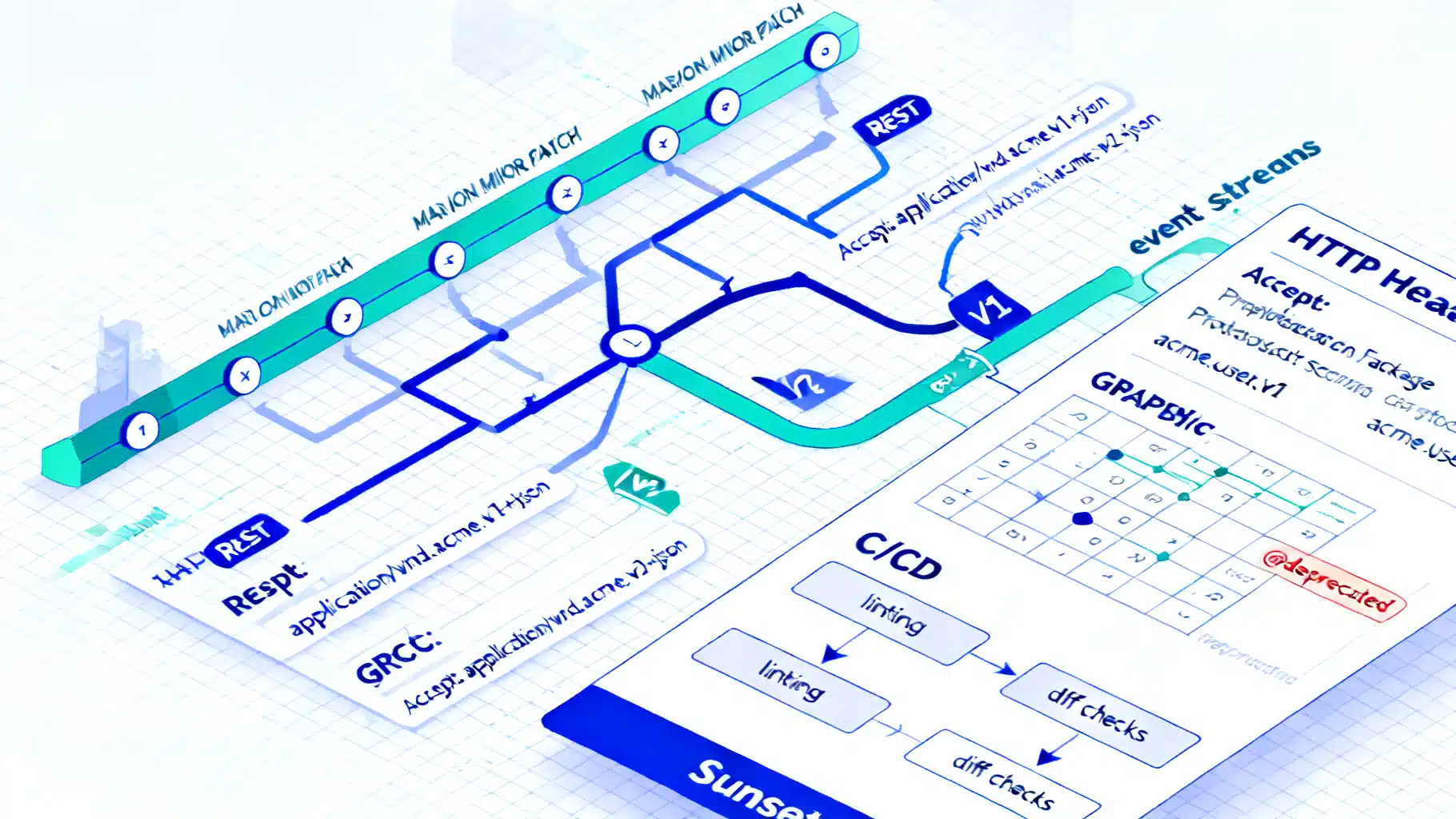
Image used for representation purposes only.
Overview
Semantic versioning gives your API a durable contract with clients while allowing you to ship improvements at speed. The promise is simple: encode the scope of change in a version number—MAJOR.MINOR.PATCH—and use that to plan releases, communicate risk, and automate integrations. The practice is trickier: not all changes are equal, different API styles have different ergonomics, and “compatible” means more than compiling code. This guide turns semver theory into a practical strategy you can adopt across REST, GraphQL, gRPC, and event-driven APIs.
What semantic versioning means for APIs
At a glance:
- MAJOR: Incompatible change to the public API contract.
- MINOR: Backward-compatible addition or behavior expansion.
- PATCH: Backward-compatible bug fix or internal change that doesn’t alter the contract.
For APIs, “public contract” includes:
- Resource models and field shapes (types, nullability, allowed ranges)
- Protocol and surface (endpoints, methods, headers, status codes, streaming shapes)
- Semantics (business rules, default values, rate limits, idempotency)
- Operational SLOs that clients rely upon (pagination guarantees, sorting defaults)
If any of these break existing clients without action on their side, you’ve made a MAJOR change.
Mapping semver to real changes
Use these rules of thumb to decide the bump:
-
Patch
- Fixes to documentation that clarify but don’t change meaning
- Tightening validation only when previous responses already documented the constraint and servers never accepted violating inputs
- Performance or scaling improvements with unchanged behavior
- Security patches that do not alter request/response shapes
-
Minor
- Adding optional request fields or response properties
- Introducing new endpoints or methods that are not required
- Expanding enum values if clients are specified to ignore unknown values
- Adding new error codes in a non-breaking error model (e.g., typed errors with an “unknown” fallback)
- Soft-deprecating fields while keeping them functional
-
Major
- Removing or renaming fields, endpoints, or gRPC RPCs
- Changing types or nullability (string → integer, optional → required)
- Altering default behavior (e.g., default sort changes) or pagination semantics
- Modifying authentication flows or token formats clients must send
- Tightening validation in ways that reject formerly valid requests
Tip: If you need to debate for more than a minute whether it’s breaking, it’s probably breaking for at least one client; treat it as MAJOR or provide a feature-flagged transition.
Where to put the version
There’s no single right answer; choose based on your ecosystem, CDN, and governance model. Common patterns:
-
REST
- Path prefix:
/v1/...(simple routing, easy to cache, coarse-grained) - Header negotiation:
Accept: application/vnd.acme.user+json;version=1.2(fine-grained, lets you evolve resources independent of path) - Query parameter:
?version=1.2(easy to test; be wary of caches ignoring query strings)
- Path prefix:
-
GraphQL
- Prefer a single stable schema; use field-level deprecation and additive evolution. Introduce a new MAJOR via a new endpoint (e.g.,
/graphql/v2) only if the old contract cannot be preserved.
- Prefer a single stable schema; use field-level deprecation and additive evolution. Introduce a new MAJOR via a new endpoint (e.g.,
-
gRPC/Protobuf
- Encode version in the package and import path:
package acme.user.v1; - Use field numbers carefully; never reuse removed field numbers.
- Non-breaking changes are additive: new fields with new tags, reserve old tags for removals.
- Encode version in the package and import path:
-
Event-driven (Kafka, SNS/SQS, Pub/Sub)
- Version the schema and topic/subject name:
user.created.v1 - Store schemas in a registry; enforce compatibility modes per stream (backward/forward/full).
- Version the schema and topic/subject name:
Examples:
GET /users/123 HTTP/1.1
Host: api.acme.com
Accept: application/vnd.acme.user+json;version=1.4
syntax = "proto3";
package acme.user.v1; // MAJOR in package name

message User {
  int64 id = 1;
  string email = 2;  // new optional field is backward-compatible
  // reserve 3;       // if you remove a field, reserve its tag
}
type User {
  id: ID!
  email: String @deprecated(reason: "Use primaryEmail")
  primaryEmail: String
}
Pre-releases and feature flags
Pre-release identifiers (1.3.0-beta.1) are ideal for early adopters. Pair them with:
- Opt-in headers or feature flags for specific fields or operations
- Canary environments or sandboxes
- Clear rollback plans and expiration dates
Guideline: Do not ship a pre-release that silently alters behavior for stable clients. Pre-releases should be explicitly requested and isolated.
Compatibility contracts you should write down
Document rules that keep changes safe:
- Unknown-field tolerance: Clients must ignore unrecognized fields; servers must ignore unrecognized query params unless they conflict.
- Enum forward-compatibility: Clients must handle unknown enum values without crashing; provide a fallback.
- Pagination and sorting guarantees: Token stability, default order, and maximum page size are part of the contract.
- Idempotency: Define idempotency keys and when retries are safe.
- Error model: Use a structured error envelope with a stable code space and human-readable message as non-contractual.
A short policy snippet you can adapt:
apiVersionPolicy:
  versioning: semver
  placement:
    rest: header-media-type
    grpc: package-suffixed
    events: topic-suffixed + schema-registry
  compatibility:
    clientsIgnoreUnknownFields: true
    enumsAllowUnknown: true
    pagination:
      tokenStableAcross24h: true
      defaultSort: created_at_desc
    errorModel:
      code: stable-string
      message: best-effort
  deprecation:
    announcementWindowDays: 30
    supportWindowDays: 180
    signal: ["Sunset header", "changelog", "email to registered apps"]
Deprecation and end-of-life signals
Communicating change is as important as shipping it. Adopt a predictable lifecycle:
- Announce: Publish a changelog entry and a migration guide. Include a target removal date.
- Warn in-band: Use standardized response headers to communicate timelines (e.g., a Sunset header with a retirement date) and link to documentation. Provide per-request warnings in test/sandbox environments.
- Support window: Keep the old behavior running long enough for most clients to migrate (commonly 90–365 days, depending on criticality and client update cycles).
- Enforce: Remove the old path/field after the window closes; return a clear error with guidance if feasible.
Also consider:
- Per-consumer extensions of the window for enterprise agreements
- Usage dashboards so consumers can see their reliance on deprecated features
- Automatic tickets or emails to app owners when deprecated paths are called
Strategy by API style
-
REST
- Default to header/media-type versioning for fine-grained evolution; use path versioning for rare MAJORs.
- Keep response shapes additive. Never change meanings of existing fields.
- Use composition: add subresources instead of overloading one endpoint.
-
GraphQL
- Strongly prefer additive changes: new fields, new types, new arguments with defaults.
- Use
@deprecatedon fields/enum values with clear reasons and replacement pointers. - Publish schema diff reports; avoid whole-API major bumps unless the schema is irreparably inconsistent.
-
gRPC
- Treat field tag reuse as a hard “no.”
- Add new RPCs for new operations; avoid changing request/response messages in place in breaking ways.
- Automate breaking-change checks with linters and Buf-like tools.
-
Events/Streaming
- Choose a compatibility mode per stream: backward for consumers that read new events; forward for reprocessing old events with new code.
- Use schema evolution with defaults; avoid in-place renames—add a new field and deprecate the old.
- Version in-topic only for MAJORs; prefer schema evolution for MINOR/PATCH.
Tooling and automation
-
Design-time
- OpenAPI/AsyncAPI and protobuf schemas as the source of truth
- Lint rules that enforce compatibility guidelines
- Automated schema diff in CI to block breaking changes unless the version bump is MAJOR
-
Test-time
- Consumer-driven contract tests (e.g., Pact-like) to validate real clients
- Golden files/snapshots for responses
- Backward-compatibility suites that replay production requests in staging
-
Release-time
- Conventional Commits or commit scopes to trigger the right semver bump
- Automated changelog generation grouped by breaking/minor/patch
- Canary deploys and traffic shadowing for safety
Example OpenAPI excerpt:
openapi: 3.1.0
info:
  title: Acme User API
  version: 1.6.0
paths:
  /users/{id}:
    get:
      parameters:
        - name: Accept
          in: header
          required: false
          schema:
            type: string
          example: application/vnd.acme.user+json;version=1.6
Managing SDKs and client compatibility
- Keep SDK major versions aligned with API major versions when feasible.
- Allow SDKs to target multiple API minors via negotiation headers or server-driven capability discovery.
- Pin dependencies: Servers should be tolerant; clients can be strict. For example, specify
^1.6.0to get patches and minors automatically if your contract allows it. - Provide typed feature gates in SDKs so apps can opt into preview features without upgrading the entire SDK.
Common pitfalls to avoid
- Silent behavior changes labeled as PATCH (e.g., adjusting default time zones, rounding rules)
- Enum contraction (removing values) or changing case-sensitivity
- Changing pagination tokens or cursors format without a capability flag
- Reusing protobuf field tags or GraphQL field names for different meanings
- Rate limit policy changes without notice
Governance and documentation
Publish a short, actionable policy your teams and consumers can trust:
- Decision tree for bump types with concrete examples
- Required artifacts for each release (changelog, migration guide, deprecation notices)
- SLAs for support windows and security backports on old majors
- Ownership model: who approves MAJORs, who can deprecate, who communicates
A minimal migration playbook
- Propose the change with an impact analysis and recommended bump.
- If breaking, create a vNext surface behind a feature flag or
/v2path. - Ship dual-write/dual-read where relevant (events, storage schema). Validate parity.
- Announce, set deprecation headers, and provide an example diff.
- Monitor adoption; nudge stragglers with direct outreach.
- Remove legacy, archive the docs, and tag the final release.
Quick checklist
- Did we objectively classify the change as PATCH/MINOR/MAJOR?
- Is the version discoverable by clients (docs, headers, SDKs)?
- Are unknown fields and enum values safely handled by clients?
- Do we have automated breaking-change detection in CI?
- Are deprecation timelines documented and signaled in-band?
- Is there a migration guide with examples and roll-back steps?
Conclusion
A great API versioning strategy is more than a number; it’s a promise backed by process, tooling, and communication. Adopt semver rigor, design for additive evolution, and automate detection of breaking changes. With clear deprecation signals and predictable windows, you can move quickly without stranding clients—and your API will earn the most valuable version of all: trust.
Related Posts
The definitive guide to API resource naming conventions
Clear rules for naming API resources, fields, and events across REST, GraphQL, and gRPC—with examples, pitfalls, and a practical checklist.
API Microservices Communication Patterns: A Practical Guide for Scale and Resilience
A practical guide to synchronous and asynchronous microservice communication patterns, trade-offs, and implementation tips for resilient APIs.
API Backward Compatibility Strategies: Designing Change Without Breaking Clients
Practical strategies to keep APIs backward compatible—versioning, additive changes, deprecation, rollout, and testing for REST, GraphQL, and gRPC.