
Building Reliable API Mock Servers for Development and Testing
A practical, contract-first guide to building reliable API mock servers for faster development and testing across REST, GraphQL, and gRPC.
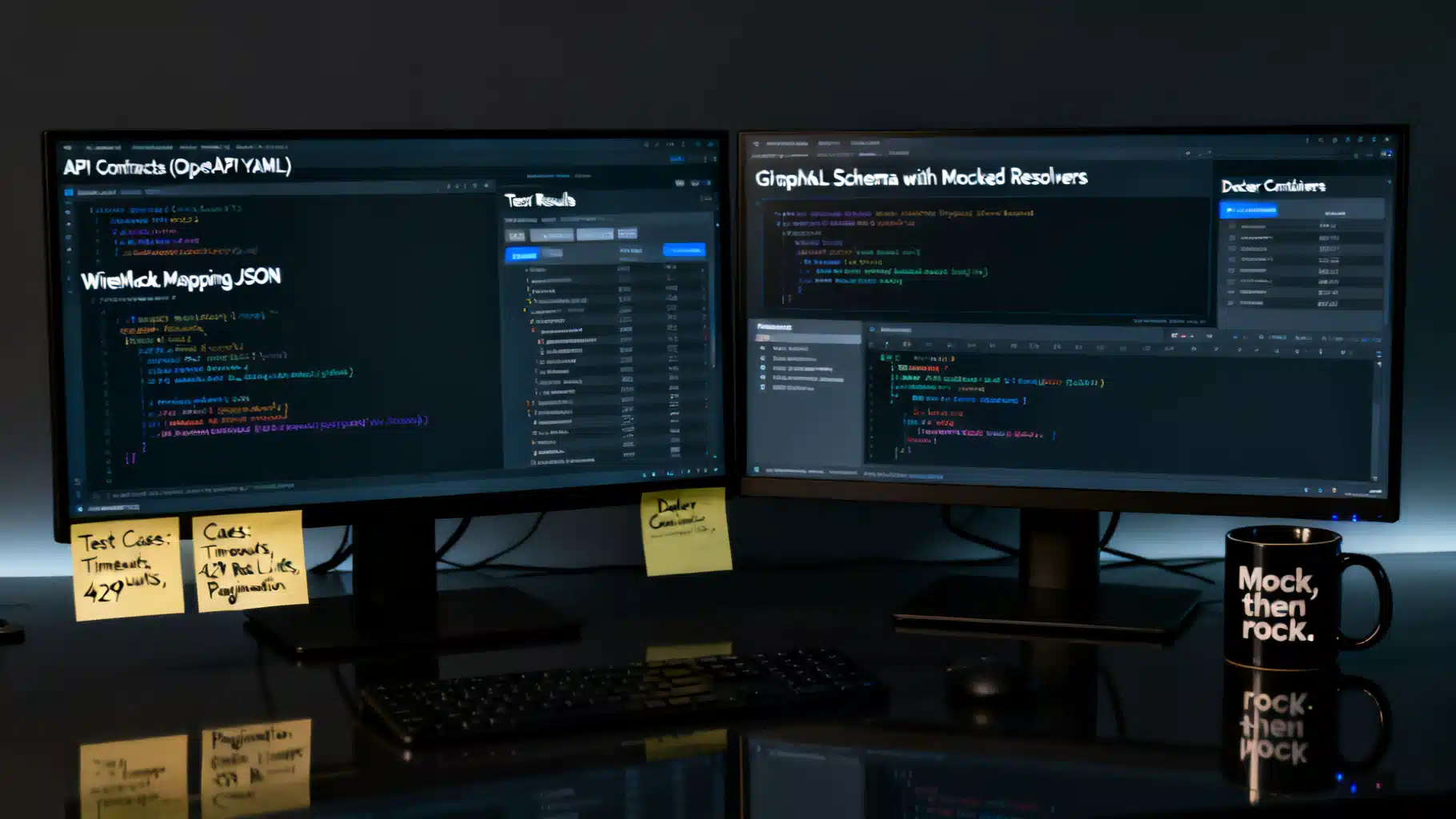
Image used for representation purposes only.
Overview
Modern systems depend on dozens of internal and third‑party APIs. Waiting for every dependency to be ready—or paying to hit real services while you iterate—is wasteful and risky. An API mock server lets teams simulate endpoints with predictable behavior, so you can design, develop, and test in parallel. This article explains when and how to use mock servers effectively, covers essential capabilities, compares popular tools and patterns across REST, GraphQL, gRPC, and WebSockets, and offers practical code and configuration examples.
What is an API mock server?
An API mock server is a stand‑in service that returns predefined or dynamically generated responses to API requests. It behaves like the real API (paths, schemas, headers, status codes), but it is:
- Isolated: runs locally, in CI, or in ephemeral environments.
- Deterministic: returns consistent responses for repeatable tests.
- Controllable: can simulate edge cases, faults, and specific states on demand.
Mock servers complement, not replace, integration and end‑to‑end testing. Their purpose is to increase speed and confidence early and often.
Stubs vs. Mocks vs. Service Virtualization
- Stubs: Minimal, fixed responses to support a narrow test scenario. Great for unit tests.
- Mocks: Verify interactions (e.g., a request with certain headers/body occurred) and often assert contract conformance.
- Service virtualization: Rich, stateful simulations of complex or unavailable systems (e.g., mainframes, third‑party rate limits, unpredictable latency).
In practice, many teams say “mock server” for anything beyond simple stubs. Be explicit in your docs about which capabilities your setup provides.
Core capabilities your mock server should offer
- Contract awareness: Understand OpenAPI/Swagger, JSON Schema, GraphQL SDL, or protobuf. Optionally validate requests and auto‑generate responses.
- Data modeling: Static fixtures, factories, and templating for realistic payloads.
- Stateful scenarios: Session, resource state (create/read/update/delete), and scenario transitions.
- Fault injection: Latency, timeouts, dropped connections, malformed payloads, HTTP 4xx/5xx, rate limiting, and retry cues.
- Parametrization: Route behavior varies by path/query/header/body/auth.
- Record‑replay/proxy: Capture real traffic to seed mocks or replay production journeys safely.
- Observability: Request/response logs, metrics, traces, and verification APIs.
- DevEx: Hot‑reload, Docker images, CLI/GUI, and CI‑friendly startup/health checks.
Contract‑first mocking
Start with a machine‑readable contract. That unlocks auto‑mocking, validation, and documentation.
- REST: OpenAPI with JSON Schema
- GraphQL: SDL schema + operation mocks/resolvers
- gRPC: .proto files + canned responses
Example OpenAPI excerpt:
openapi: 3.0.3
info:
  title: Orders API
  version: 1.2.0
paths:
  /orders/{id}:
    get:
      parameters:
        - in: path
          name: id
          required: true
          schema: { type: string }
      responses:
        '200':
          description: Order
          content:
            application/json:
              schema:
                $ref: '#/components/schemas/Order'
components:
  schemas:
    Order:
      type: object
      required: [id, status, total]
      properties:
        id: { type: string }
        status: { type: string, enum: [new, paid, shipped, cancelled] }
        total: { type: number, format: float }
With this, a mock server can validate request shapes and synthesize consistent responses.
Designing test data that tells the truth
- Start small and explicit: A few realistic, hand‑crafted fixtures beat a thousand random objects.
- Encode scenarios in IDs: e.g., order ‘A1’ => ’new’, ‘B2’ => ‘paid’. Document them.
- Control timestamps and clocks: Freeze time to make assertions deterministic.
- Reflect pagination/range semantics: Verify cursors, next links, and boundary behavior.
- Include PII safeguards: Use synthetic data; never copy production PII into mocks.
Tooling landscape at a glance
- REST/HTTP: WireMock, Mountebank, Prism, Hoverfly, JSON Server, Mockoon, Postman Mock Server.
- GraphQL: Apollo Server + mocking, GraphQL Tools, MSW (browser/node) for network‑level mocks.
- gRPC: grpcmock, Traffic Parrot, WireMock for gRPC (extensions), bespoke interceptors.
- WebSockets/Event streams: Socket.io test servers, NATS/Kafka test harnesses, custom simulators.
Choose based on protocol fit, contract support, fault modeling, and CI ergonomics.
A tiny Express mock server (good for prototypes)
// mock-server.js
const express = require('express');
const app = express();
app.use(express.json());

// Latency toggle via query (?delay=200)
app.use((req, res, next) => setTimeout(next, Number(req.query.delay || 0)));

// Simple auth gate
app.use((req, res, next) => {
  if (req.headers['authorization'] === 'Bearer test-token') return next();
  res.status(401).json({ error: 'unauthorized' });
});

// Deterministic fixtures
const orders = {
  A1: { id: 'A1', status: 'new', total: 19.99 },
  B2: { id: 'B2', status: 'paid', total: 49.0 }
};

app.get('/orders/:id', (req, res) => {
  const o = orders[req.params.id];
  if (!o) return res.status(404).json({ error: 'not_found' });
  res.json(o);
});

app.post('/orders', (req, res) => {
  const id = 'X' + Date.now();
  const order = { id, status: 'new', total: req.body.total || 0 };
  orders[id] = order; // naive statefulness for tests
  res.status(201).json(order);
});

app.listen(8080, () => console.log('Mock server on :8080'));
Pros: trivial to start; flexible. Cons: no contract validation, easy to drift from reality. Use for early spikes, then graduate to contract‑driven mocks.
WireMock via Docker: stateful mocks and fault injection
# docker-compose.yml
version: '3.8'
services:
  wiremock:
    image: wiremock/wiremock:3.6.0
    ports: ['8081:8080']
    volumes:
      - ./mappings:/home/wiremock/mappings
      - ./__files:/home/wiremock/__files
    command: [
      '--verbose',
      '--global-response-templating'
    ]
A test mapping (mappings/get-order.json):
{
  "request": {"method": "GET", "urlPathPattern": "/orders/([A-Z0-9]+)"},
  "response": {
    "status": 200,
    "headers": {"Content-Type": "application/json"},
    "jsonBody": {
      "id": "{{request.pathSegments.[1]}}",
      "status": "paid",
      "total": 49.0
    }
  }
}
Inject faults or latency:
{
  "request": {"method": "GET", "url": "/gateway/unstable"},
  "response": {"fault": "RANDOM_DATA_THEN_CLOSE"}
}
WireMock supports scenarios, recording, and verification APIs, making it solid for CI and contract evolution.
GraphQL mocking: schema‑driven resolvers
Use Apollo Server with mocks enabled or GraphQL Tools to attach resolvers that return deterministic data while honoring types.
import { ApolloServer } from '@apollo/server';
import { makeExecutableSchema } from '@graphql-tools/schema';
import { addMocksToSchema } from '@graphql-tools/mock';

const typeDefs = `
  type Order { id: ID!, status: String!, total: Float! }
  type Query { order(id: ID!): Order }
`;
const schema = addMocksToSchema({
  schema: makeExecutableSchema({ typeDefs }),
  mocks: {
    Order: () => ({ id: 'A1', status: 'new', total: 19.99 })
  },
  preserveResolvers: false
});

const server = new ApolloServer({ schema });
This yields contract‑faithful responses quickly, ideal for front‑end development.
gRPC mocking: protobuf‑aware responses
gRPC adds binary protocols and streaming, so favor tools that understand .proto contracts. Options include grpcmock or embedding interceptors in a test server that respond to known method names with canned messages. Record‑replay is valuable to bootstrap realistic fixtures from a staging environment (scrub data before storage).
Record‑replay and proxy mode
When a real dependency exists but is flaky, expensive, or rate limited:
- Route traffic through a proxying mock in “record” mode.
- Capture requests/responses into fixtures.
- Switch to “replay” for deterministic tests.
This is excellent for complex pagination, auth handshakes (with synthetic tokens), and multi‑step flows. Always sanitize secrets and PII before saving cassettes.
Authentication, CORS, and headers
- CORS: Enable for front‑end dev, but mirror production origins/methods in CI to catch misconfigurations.
- API keys/OAuth: Provide fake but realistic flows. For OAuth, simulate token endpoint, expiry, and scopes; do not embed real secrets in tests.
- Idempotency keys: Verify server behavior on retries; ensure duplicate suppression logic is modeled.
Fault injection scenarios you should cover
- Slow responses and timeouts (e.g., p95=3s).
- Intermittent 5xx followed by success (retry testing).
- 429 rate limits with proper ‘Retry-After’.
- Malformed JSON or wrong content‑type.
- Partial failures in batch endpoints.
- WebSocket disconnects and re‑subscribe flows.
Integrating with local dev
- Ship a ‘make dev’ or ’npm run mocks’ target that starts mocks and exports endpoints via .env.
- Provide seed scripts to reset state: ‘POST /_reset’.
- Use unique ports per service and a simple service catalog in README.
- For browser apps, consider MSW to intercept fetch/XHR for component tests while keeping server‑side mocks for integration tests.
CI/CD and ephemeral environments
- Spin up mocks in Docker alongside your app under test.
- Gate test jobs on mock server health checks.
- Parameterize behavior via environment variables or admin endpoints to run negative suites.
- For pull requests, provision short‑lived preview envs with mocks wired behind a stable URL to unblock reviewers.
Example CI step:
- name: Start mocks
  run: |
    docker compose up -d wiremock
    ./scripts/wait-on http://localhost:8081/__admin
- name: Run integration tests
  run: npm test -- --group=integration
Observability and verification
- Structured logs: capture method, path, headers (sans secrets), correlation IDs.
- Metrics: request counts by route/status; latency histograms.
- Tracing: propagate trace IDs to ensure mocks integrate into distributed traces for end‑to‑end visibility.
- Verification APIs: Assert that expected calls occurred with precise bodies/headers.
Performance and scalability in tests
- Parallelize: Ensure mocks are stateless by default or isolate state per test (namespacing, containers, or randomized IDs).
- Deterministic data: Avoid time‑based IDs unless frozen.
- Warm caches: If simulating caches, pre‑seed to avoid flakiness.
- Resource limits: Cap max concurrent connections to expose back‑pressure handling logic.
Security and compliance
- Never store or replay production PII. Use generators/fakers.
- Audit fixtures into version control; treat them like code.
- Redact secrets in logs and cassettes; enforce secret scanning.
- Mirror auth scopes and permissions to catch authorization bugs early.
Managing drift between mocks and reality
- Contract tests: Use consumer‑driven contracts (e.g., Pact) or provider contract tests to validate the real service against the shared contract.
- CI gate: Fail builds if the provider deviates from the contract or if mocks don’t conform.
- Versioning: Tag mock definitions with API version; support multiple versions during migrations.
Minimal Pact interaction example (conceptual):
{
  "consumer": "CheckoutUI",
  "provider": "OrdersAPI",
  "interactions": [
    {
      "description": "get order A1",
      "request": {"method": "GET", "path": "/orders/A1"},
      "response": {"status": 200, "body": {"id": "A1", "status": "new", "total": 19.99}}
    }
  ]
}
Migration strategy: from mocked to real
- Feature flags: Toggle endpoints between mock and live per environment.
- Gateway routing: Path or host‑based routing to swap providers without code changes.
- Shadow traffic: Send read‑only copies to the real service and compare responses off‑path.
- Staging parity checks: Periodically replay critical journeys against staging to detect contract drift.
Common pitfalls and how to avoid them
- Over‑permissive mocks: Accept any request and always return 200. Fix by enabling schema validation and negative tests.
- Unrealistic happy‑paths only: Add fault injection and edge cases to the default suite.
- Test interdependence: Reset state between tests; provide an admin ‘_reset’ endpoint or container re‑creation.
- Hidden coupling: Keep mocks close to the contract, not implementation details.
- Ignoring pagination/sorting: Validate query semantics and return consistent ’next’ tokens.
A practical checklist
- Contract exists and is versioned (OpenAPI/SDL/proto).
- Mock server spins up via one command and has health checks.
- Fixtures are documented, deterministic, and scrubbed of PII.
- Negative and fault scenarios are first‑class.
- Verification of calls is part of tests.
- CI integrates mocks and fails fast on drift.
- Migration path to real services is feature‑flagged and observable.
Conclusion
API mock servers are a force multiplier for delivery speed and software quality. Start with a contract, pick tools that honor it, invest in realistic data and fault models, and wire mocks into your local dev and CI flows. With disciplined verification and versioning, you’ll reduce flakiness, catch integration bugs early, and keep teams unblocked—even when real dependencies are not.
Related Posts

GraphQL Input Validation and Sanitization: A Practical, Defense‑in‑Depth Guide
A practical guide to GraphQL input validation and sanitization with schema design, scalars, directives, resolver checks, and query cost controls.
Consumer-Driven Contract Testing: A Practical Guide to Safer, Faster API Delivery
A practical guide to consumer-driven contract testing: how it works, why it matters, and how to implement it with CI/CD to ship APIs faster without breaks.