
API Chaos Engineering: A Practical Playbook for Resilient Services
A practical guide to API chaos engineering for resilient APIs: principles, experiments, tooling, metrics, and CI/CD automation with examples.
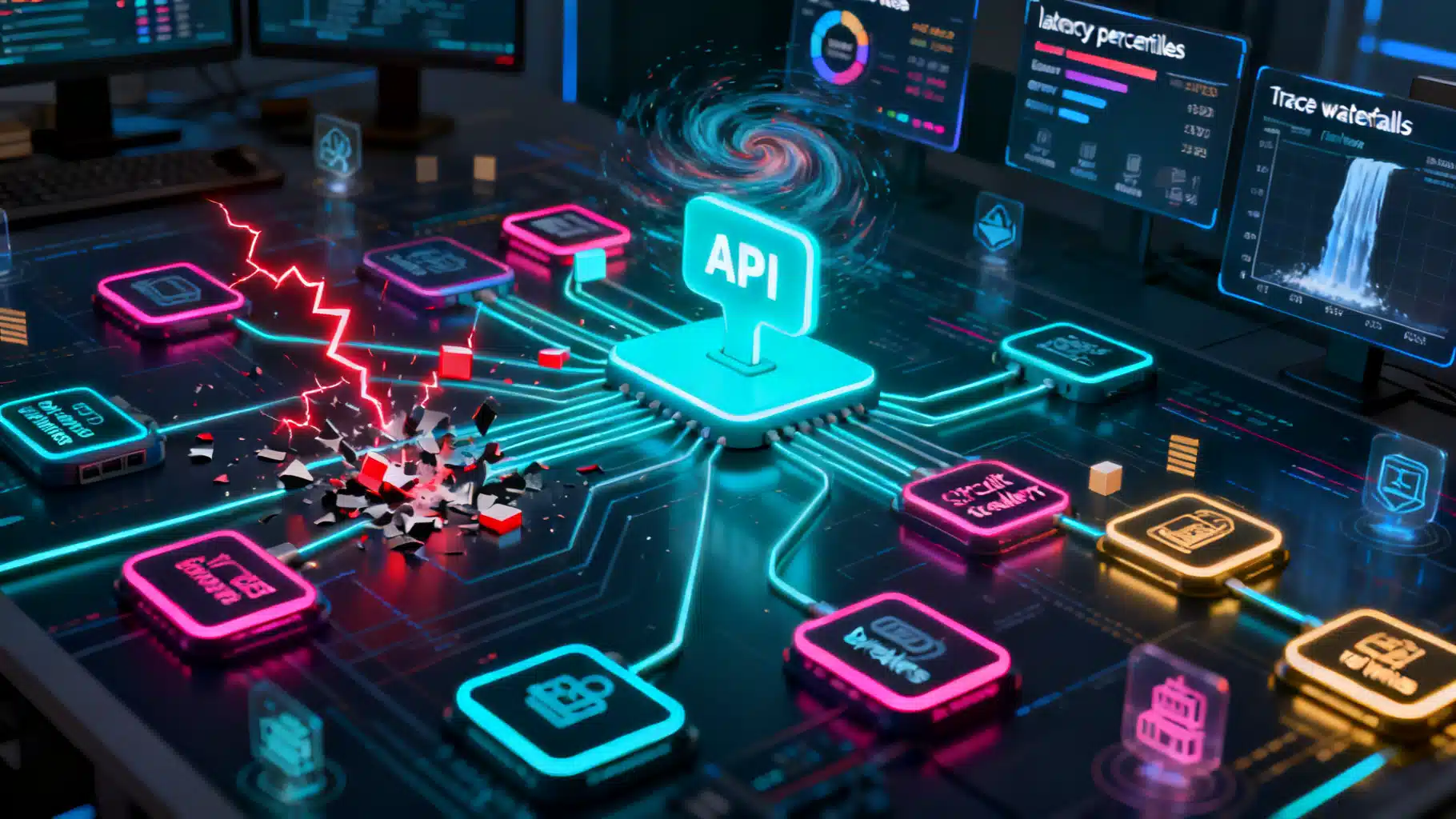
Image used for representation purposes only.
Overview
APIs are the connective tissue of modern systems. When they fail—whether from latency spikes, dependency timeouts, bad deployments, or third‑party outages—entire customer journeys break. Chaos engineering for APIs is the deliberate practice of injecting controlled failures into API paths to verify that resilience mechanisms really work. This article provides a practical, end‑to‑end approach to API chaos engineering, from experiment design and tooling to metrics, automation, and governance.
What Makes APIs Fragile
Common API failure modes include:
- Latency amplification: one slow dependency cascades into client timeouts.
- Retry storms: naive retries exacerbate load during partial outages.
- Thundering herds: simultaneous cache expirations or cold starts.
- Contract drift: backward‑incompatible schema or semantic changes.
- Rate/Quota exhaustion: hitting provider limits or gateway throttles.
- Network path issues: DNS, TLS handshakes, connection pool starvation.
- Data anomalies: duplicate or out‑of‑order events, idempotency gaps.
- Security edges: token expiration, JWKS endpoint failures, clock skew.
Resilience Principles for APIs
- Timeouts everywhere: set per‑hop timeouts with sane defaults and budgets.
- Bounded retries: use capped, exponential backoff with jitter; avoid retrying non‑idempotent operations.
- Circuit breakers: open on consecutive failures and half‑open to probe recovery.
- Bulkheads: isolate resources (threads, pools) per dependency.
- Backpressure: shed load gracefully (queues, 429s) to protect the core.
- Idempotency keys: ensure safe retries for write operations.
- Caching and fallbacks: return stale‑while‑revalidate or degraded responses.
- Contract governance: versioning, consumer‑driven contracts, compatibility tests.
Chaos Experiment Design
- Hypothesis: “If downstream service X adds 300 ms latency, our API still meets a 99th percentile ≤ 800 ms and <1% error rate.”
- Blast radius: start in staging or with a narrow traffic segment (e.g., 2% canary).
- Steady state: define current SLOs and key indicators (p99, error rate, saturation).
- Fault injection: choose the mechanism (latency, aborts, packet loss, CPU pressure).
- Observability: confirm you can see cause→effect: trace spans, logs, metrics, events.
- Abort conditions: auto‑rollback rules to halt the experiment if thresholds breach.
- Learning: document results and update runbooks, configs, and code.
Tooling Options
- Network fault injectors: Toxiproxy, tc netem, traffic control at the sidecar.
- Service mesh/gateway faults: Envoy/Istio/NGINX/Traefik fault filters, aborts, delays.
- Cloud chaos platforms: fault injection simulators for network, compute, and DNS.
- Contract testing: Pact, OpenAPI validators for backward compatibility.
- Load and synthetic traffic: k6, Locust, Vegeta, or production shadow traffic.
Pick low‑friction tools that match your stack. For API paths, mesh/gateway fault filters are often the fastest to adopt because they need no application code change.
Observability and Success Metrics
- Golden signals: latency (p50/p95/p99), error rate, throughput, saturation.
- Trace‑level insight: end‑to‑end traces with span attributes (status codes, retry count, circuit state).
- Quality of fallback: response shape/fields preserved? cache hit ratios? served‑from‑fallback labels.
- SLO alignment: budget burn rate during and after the experiment.
- Client experience: page/API step completion, time‑to‑first‑byte, abandonment.
High‑Value Experiment Recipes
- Latency and Jitter Injection
- Fault: +300–1500 ms random delay on a specific upstream.
- Expect: client‑side timeouts tuned, retries bounded, p99 within SLO, no retry storms.
- Validate: circuit breaker opens appropriately, backoff with jitter, user path degrades gracefully.
- Partial Outage (5xx Burst)
- Fault: 30–60% HTTP 503s for a dependency.
- Expect: fallbacks or cached responses; error budgets minimally impacted.
- Validate: breaker trips; health checks and autoscaling don’t flap.
- DNS/TLS Failure
- Fault: NXDOMAIN or TLS handshake errors to a hostname/JWKS URL.
- Expect: token verification caches; graceful degradation with clear error semantics.
- Validate: no global outage from a single cert rotation or DNS glitch.
- Rate Limit/Quota Exhaustion
- Fault: Force 429s or quota exhausted responses from gateway/provider.
- Expect: clients back off; requests shed rather than cascade; priority traffic preserved.
- Validate: differentiated QoS lanes (user‑critical vs. background jobs).
- Schema/Contract Drift
- Fault: remove/rename a non‑required field or change an enum value in a shadow.
- Expect: consumers tolerate unknown fields; strict validation only where needed.
- Validate: consumer‑driven contract tests fail safely in CI before prod.
- Idempotency Under Retries
- Fault: inject connection resets after processing on the server.
- Expect: client resubmits with idempotency key; server deduplicates.
- Validate: no duplicate side effects (charges, emails, writes).
- Slow Upstream + Hot Spot
- Fault: add 500 ms latency while forcing cache misses.
- Expect: request collapsing, caching, and bulkheads cap resource use.
- Validate: no thread/connection pool exhaustion.
- Dependency Kill and Recovery
- Fault: terminate pods/instances for a single dependency.
- Expect: breaker opens; half‑open probes restore traffic on recovery.
- Validate: warm‑up strategies prevent cold‑start stampedes.
Fault Injection Examples
1) Istio HTTP Fault (Delay + Abort)
apiVersion: networking.istio.io/v1alpha3
kind: VirtualService
metadata:
  name: payments-faults
spec:
  hosts: ["payments.svc.cluster.local"]
  http:
  - route:
    - destination:
        host: payments.svc.cluster.local
    fault:
      delay:
        fixedDelay: 500ms
        percentage: { value: 40 }
      abort:
        httpStatus: 503
        percentage: { value: 20 }
2) Toxiproxy Latency and Timeout
# Add 800ms latency to upstream on port 9000
toxiproxy-cli create payments --listen 0.0.0.0:9000 --upstream payments:80
toxiproxy-cli toxic add payments -t latency -a latency=800 -a jitter=200 -w 60
# Simulate timeouts
toxiproxy-cli toxic add payments -t timeout -a timeout=2000 -w 60
3) Linux tc netem (Local Dev/Staging)
# Add 20% packet loss and 400ms delay to traffic destined for 10.1.2.0/24
sudo tc qdisc add dev eth0 root netem delay 400ms loss 20%
# Clean up
sudo tc qdisc del dev eth0 root
4) Defensive Client Retries (Exponential Backoff with Jitter)
import random, time, requests

MAX_RETRIES = 4
BASE = 0.2  # seconds

for attempt in range(MAX_RETRIES):
    try:
        r = requests.post("https://api.example.com/pay", timeout=1.5)
        r.raise_for_status()
        break
    except requests.RequestException as e:
        if attempt == MAX_RETRIES - 1:
            raise
        sleep = (BASE * (2 ** attempt)) + random.uniform(0, BASE)
        time.sleep(sleep)
CI/CD and Automation
- CI gate: run contract tests and minimal chaos checks (fault‑tolerant unit/integration) on every PR.
- Staging soak: scheduled fault campaigns during off‑peak hours with synthetic load.
- Production guardrails: progressive delivery (canary/blue‑green) with automated rollback on SLO breach.
- GameDays: cross‑functional exercises to practice incident response and test runbooks.
Working with Third‑Party APIs
- Shadow traffic: mirror a small percentage of production requests to a sandbox.
- Budgeting: track per‑provider quotas; implement adaptive client throttles.
- Contract buffers: accept unknown fields; tolerate enum growth; version conservatively.
- Caching strategy: cache static provider metadata (JWKS, catalogs) with safe TTLs and prefetch.
Security and Privacy Considerations
- Never chaos‑test using real PII in non‑prod; use masked or synthetic data.
- Isolate credentials and rotate secrets used in test environments.
- Test auth failure modes deliberately: expired tokens, invalid scopes, unavailable identity providers.
Common Pitfalls and How to Avoid Them
- Unbounded retries: cap attempts and add jitter; label retries in traces.
- Over‑broad blast radius: always start small and time‑box experiments.
- Ignoring client behavior: validate mobile/web SDKs and third‑party consumers, not just servers.
- Observability blind spots: instrument before you inject faults.
- One‑and‑done tests: schedule recurring experiments; resilience decays over time.
Maturity Roadmap
- Foundation: timeouts, retries with jitter, baseline dashboards and tracing.
- Staging chaos: inject delays/aborts in pre‑prod with synthetic load.
- Controlled prod chaos: narrow canaries, strict aborts, regular GameDays.
- Continuous verification: automated chaos in CI/CD and post‑deploy.
- Adaptive resilience: autoscaling, dynamic backpressure, SLO‑driven controls.
Measurement: SLOs and Error Budgets
- Availability SLO: e.g., 99.9% success for write endpoints over 30 days.
- Latency SLO: e.g., p99 ≤ 800 ms for read, ≤ 1200 ms for write.
- Budget policy: halt risky releases when budget burn > 2x normal; require remediation.
- Experiment KPIs: reduction in incident MTTR, fewer customer‑visible errors under injected faults, improved fallback hit rate.
API Gateway and Edge Tests
- Faults at the edge: inject 429s/503s, header mangling, and malformed payloads.
- CORS and auth: simulate preflight failures and expired tokens.
- Cache behavior: validate stale‑while‑revalidate and cache‑busting strategies.
Runbook Snippet (Before You Inject)
- Confirm dashboards and traces for the exact endpoints.
- Define steady state and abort conditions.
- Limit scope (service, version, route, percent of traffic, duration).
- Align on pager ownership and comms channel.
- Announce window and record change in your change‑management system.
Minimal Checklist
- Timeouts per hop, per operation.
- Exponential backoff with jitter; max attempts set.
- Circuit breakers and bulkheads enabled and monitored.
- Idempotency keys for writes; dedup on server.
- SLOs with error budgets; burn alerts configured.
- Trace each call; label retries, fallbacks, and cache hits.
- Chaos experiments automated and scheduled; learnings fed into design.
Conclusion
API chaos engineering turns unknowns into verified behaviors. By starting with clear hypotheses, tight blast radii, strong observability, and a bias for automation, teams can harden their APIs against the messy realities of networks, dependencies, and human change. The payoff is measurable: steadier SLOs, faster recovery, and a better customer experience under real‑world stress.
Related Posts

API‑First Development: An End‑to‑End Workflow Guide
A practical, end-to-end API-first workflow: design, mock, test, secure, observe, and release with contracts as the single source of truth.
gRPC Microservices Tutorial: Build, Secure, and Observe a Production-Ready API in Go
Step-by-step gRPC microservices tutorial: Protobuf design, Go services, TLS/mTLS, deadlines, retries, streaming, observability, Docker, and Kubernetes.

Consumer‑Driven Contract Testing for APIs: A Practical Guide
Learn how consumer‑driven contract testing works, why it matters, and how to implement it for REST, GraphQL, and event-stream APIs with CI/CD integration.