
Consumer‑Driven Contract Testing for APIs: A Practical Guide
Learn how consumer‑driven contract testing works, why it matters, and how to implement it for REST, GraphQL, and event-stream APIs with CI/CD integration.

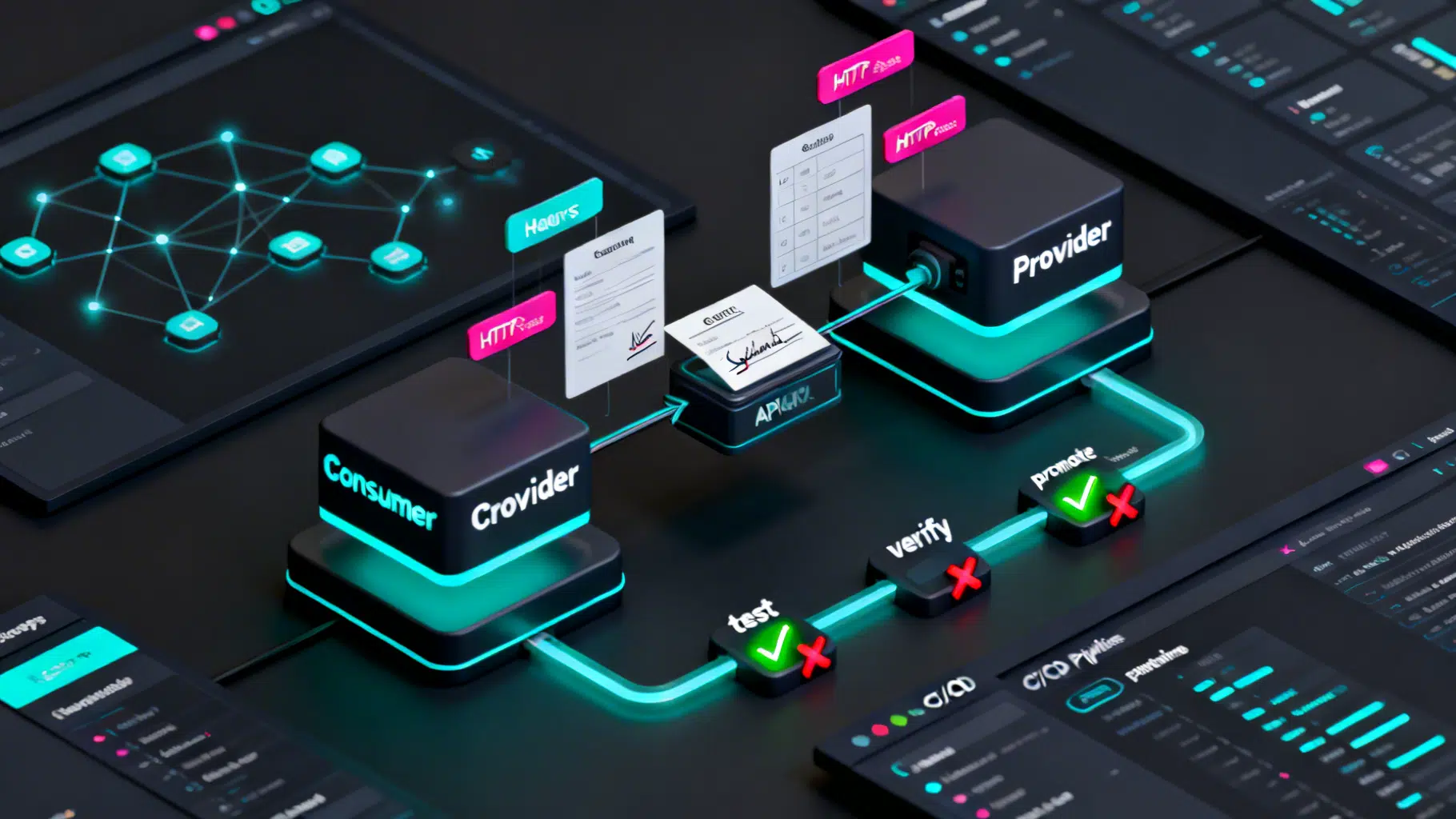
Image used for representation purposes only.
What is consumer‑driven contract testing?
Consumer‑driven contract (CDC) testing is a collaboration technique for APIs and event streams where downstream applications (consumers) define their expectations of an upstream service (provider) as executable “contracts.” Providers then verify they meet those expectations before releasing. Instead of testing broad provider behavior in isolation, CDC focuses on the exact request/response shapes consumers rely on—reducing integration risk, speeding delivery, and enabling autonomous deployments in distributed systems.
CDC testing complements, not replaces, unit, integration, and end‑to‑end tests. It narrows the surface area to critical integration points, making failures highly actionable and closer to where they will manifest in production.
Why it matters
Modern systems—microservices, serverless functions, and event‑driven platforms—change frequently and independently. Without tight feedback loops, small schema changes can break customers far away in the graph.
Consumer‑driven contract testing helps you:
- Detect breaking changes early, before integration or production.
- Align teams on what “compatible” means through executable specifications.
- Reduce reliance on large, flaky end‑to‑end environments.
- Unblock independent deployments with high confidence.
- Document actual usage, not just what an API reference claims.
Key concepts and roles
- Consumer: The application that calls the API or subscribes to events. It publishes a contract describing the requests it will make and the responses it can handle.
- Provider: The service that fulfills those contracts. It verifies the contracts against its implementation.
- Broker/Registry: A central store for contracts and verification results, enabling discovery, versioning, and cross‑team visibility.
- Verification: Automated execution of each contract against a running provider (or its test double) in CI/CD.
How CDC testing works end‑to‑end
- Capture expectations on the consumer side
- Write tests that define the requests the consumer will send and the minimal valid responses it requires.
- Generate a contract artifact from those tests.
- Publish contracts to a broker
- Contracts are versioned and tagged (e.g., “dev”, “prod”, “branch-xyz”).
- Verify on the provider side
- Providers pull relevant contracts and execute them against a deployed instance or a controlled test harness.
- Results are pushed back to the broker for traceability.
- Enforce compatibility in CI/CD
- Gate provider releases if any dependent consumer contract fails verification.
- Optionally gate consumer releases on provider compatibility (e.g., can‑i‑deploy checks).
Example: a simple HTTP contract
Below is an illustrative pact‑style contract for a consumer that reads a product by ID. The contract describes the request, the expected response, and matching rules so providers can return any value of the correct type without being forced to mirror example literals exactly.
{
  "consumer": { "name": "catalog-web" },
  "provider": { "name": "product-service" },
  "interactions": [
    {
      "description": "get product by id",
      "request": {
        "method": "GET",
        "path": "/products/42",
        "headers": { "Accept": "application/json" }
      },
      "response": {
        "status": 200,
        "headers": { "Content-Type": "application/json" },
        "body": {
          "id": 42,
          "name": "Wireless Mouse",
          "price": 29.99,
          "inStock": true
        },
        "matchingRules": {
          "$.body.id": { "matchers": [{ "match": "number" }] },
          "$.body.price": { "matchers": [{ "match": "number" }] },
          "$.body.name": { "matchers": [{ "match": "type" }] }
        }
      }
    }
  ],
  "metadata": { "pactSpecification": { "version": "3.0.0" } }
}
Consumer‑side tests: generating the contract
At the consumer, write a test that uses a mock provider implementing the contract. When the test passes, it produces the contract artifact for publication.
// Pseudocode using a pact-style library
import { PactV3, MatchersV3 } from '@pact-foundation/pact';

const provider = new PactV3({ consumer: 'catalog-web', provider: 'product-service' });

provider
  .given('product 42 exists')
  .uponReceiving('get product by id')
  .withRequest({ method: 'GET', path: '/products/42', headers: { Accept: 'application/json' } })
  .willRespondWith({
    status: 200,
    headers: { 'Content-Type': 'application/json' },
    body: {
      id: MatchersV3.integer(42),
      name: MatchersV3.string('Wireless Mouse'),
      price: MatchersV3.decimal(29.99),
      inStock: true
    }
  });

it('renders product detail page', async () => {
  await provider.executeTest(async mockBaseUrl => {
    const product = await fetch(`${mockBaseUrl}/products/42`).then(r => r.json());
    // Assert the consumer correctly handles the response
    expect(product.name).toContain('Mouse');
  });
});
This pattern ensures the consumer only relies on fields it truly needs. Anything not asserted is safe for the provider to change.
Provider‑side verification: preventing regressions
On the provider CI pipeline, run verification for all relevant consumer contracts before merging or releasing. Typical flow:
- Spin up the provider (locally or in a container) with test data loaded.
- Fetch the latest contracts for your provider and tag/environment.
- Execute verification; fail the build if any contract breaks.
- Publish verification results back to the broker.
Example (pseudocode shell):
# Fetch contracts and verify against a running provider on :8080
pact-provider-verifier \
  --provider-base-url=http://localhost:8080 \
  --broker-base-url=$PACT_BROKER_URL \
  --broker-username=$PACT_BROKER_USERNAME \
  --broker-password=$PACT_BROKER_PASSWORD \
  --provider product-service \
  --publish-verification-results \
  --provider-app-version=$GIT_SHA \
  --enable-pending
The “enable‑pending” pattern allows new contracts to be visible without immediately failing builds until the provider explicitly verifies them, enabling smoother onboarding.
Beyond REST: GraphQL, gRPC, and event streams
- GraphQL: While schemas are strongly typed, CDC tests help pin down actual queries and selections used by consumers, including error scenarios and directive behavior.
- gRPC/Protobuf: Schemas and backward‑compatible field evolution are essential; CDC tests verify RPC surface expectations and message semantics observed by real consumers.
- Event‑driven (Kafka, SNS/SQS, Pub/Sub): Contracts describe message shapes and topics/keys. Providers verify they publish events that existing consumers can parse; consumers verify they can process events sent by providers.
Event contract example (illustrative):
{
  "consumer": { "name": "inventory-worker" },
  "provider": { "name": "order-service" },
  "event": {
    "name": "OrderCreated",
    "contentType": "application/json",
    "body": {
      "orderId": "123e4567-e89b-12d3-a456-426614174000",
      "items": [ { "sku": "SKU-1", "qty": 2 } ],
      "createdAt": "2026-05-24T10:15:00Z"
    },
    "matchingRules": {
      "$.body.orderId": { "matchers": [{ "match": "uuid" }] },
      "$.body.items[*].qty": { "matchers": [{ "match": "number" }] }
    }
  }
}
Integrating CDC into CI/CD
A pragmatic pipeline for both sides:
-
Consumer pipeline
- Run unit tests and contract tests to generate contracts.
- Publish contracts to the broker with the commit SHA and branch tag.
- Optionally run a “can‑i‑deploy” check to ensure an existing provider version satisfies the new contract before merging.
-
Provider pipeline
- Start the service with realistic test data.
- Pull the latest contracts for relevant tags (e.g., “main”, “prod‑tested”).
- Verify and publish results.
- Gate release on all required consumer contracts being green.
-
Pre‑prod/prod promotion
- Use environment tags to ensure the exact artifacts verified in lower environments are those promoted. Immutable versions plus recorded verifications create a trustworthy release ledger.
Best practices
- Keep contracts minimal: Assert only what the consumer truly needs. Avoid brittle fields like timestamps unless necessary.
- Include negative and edge cases: 404s, validation errors, pagination boundaries, auth failures, and rate‑limit headers.
- Use flexible matching rules: Prefer type/format matchers over fixed values.
- Control test data: Seed deterministic records or use provider states (“given”) to decouple from live databases.
- Automate everything: Contract generation, publication, verification, and deployment gates should run in CI, not locally.
- Version and tag consistently: Tag by branch, environment, and release to control blast radius.
- Treat the broker as a source of truth: It should answer “what versions are safe to deploy together?”
- Align with API style guides: CDC tests enforce compatibility; style guides keep APIs coherent and evolvable.
Common pitfalls and how to avoid them
-
Over‑specifying payloads
- Symptom: Tiny provider changes break many contracts.
- Fix: Use matchers; assert on required fields only.
-
Conflating contract tests with end‑to‑end tests
- Symptom: Long, flaky tests needing many dependencies.
- Fix: Run provider in isolation with controlled data; avoid cross‑service orchestration.
-
Ignoring error paths
- Symptom: Consumers crash on realistic provider errors.
- Fix: Add negative interactions to contracts and handle them in code.
-
Storing secrets or PII in contracts
- Symptom: Compliance risk.
- Fix: Use synthetic data; scrub payloads.
-
No ownership of verification failures
- Symptom: Broken windows, finger‑pointing.
- Fix: Define runbooks: who fixes consumer overreach vs. provider breaking change.
Scaling CDC across an organization
-
Establish a contract lifecycle policy
- Define deprecation windows and communication rules.
- Require backward compatibility for at least one deprecation cycle.
-
Introduce compatibility gates
- A merge to main or a release candidate must pass can‑i‑deploy checks against the broker for targeted environments.
-
Build templates and libraries
- Provide starter kits for common stacks (Node, Java, .NET, Python) so teams adopt consistent patterns.
-
Observability integration
- Correlate contract versions with runtime errors and consumer usage metrics to prune dead fields and interactions.
Measuring impact
Track measurable outcomes to prove value:
- Lead time for changes across service boundaries.
- Number of integration incidents and their mean time to recovery (MTTR).
- Percentage of provider releases blocked by contract failures (should drop over time).
- Ratio of end‑to‑end tests to contract tests (aim for more CDC, fewer brittle E2E).
When CDC may not be the right tool
- One‑off or internal scripts where strict compatibility isn’t required.
- Monoliths with shared types and single deployment units.
- Purely synchronous database integrations (though consider API‑fronting those boundaries).
In these cases, simpler integration tests or schema checks may suffice.
Getting started checklist
- Pick a pilot integration with frequent changes and pain points.
- Choose tooling aligned with your stack (e.g., Pact ecosystem, Spring Cloud Contract, or equivalent).
- Add consumer tests that generate a minimal contract for one critical interaction.
- Stand up a broker/registry and wire publication into CI.
- Add provider verification and block releases on failures.
- Expand coverage to error cases and additional interactions.
- Socialize results and roll out to more teams.
Final thoughts
Consumer‑driven contract testing makes integration behavior explicit and verifiable, enabling teams to move fast without breaking their neighbors. By codifying expectations in executable contracts, you replace tribal knowledge and fragile, environment‑heavy tests with fast, deterministic feedback. Start small, automate relentlessly, and let verified contracts become the backbone of safe, independent releases in your API and event ecosystems.
Related Posts

API Testing Automation with Postman: A Complete Guide
Automate API testing in Postman and Newman: write reliable tests, use data-driven runs, and wire everything into CI/CD with best practices.
Consumer-Driven Contract Testing: A Practical Guide to Safer, Faster API Delivery
A practical guide to consumer-driven contract testing: how it works, why it matters, and how to implement it with CI/CD to ship APIs faster without breaks.

API‑First Development: An End‑to‑End Workflow Guide
A practical, end-to-end API-first workflow: design, mock, test, secure, observe, and release with contracts as the single source of truth.