
Fine-Tuning vs. Prompting: A Practical Comparison Guide for LLM Teams
A practical, data-driven guide comparing prompting vs. fine-tuning for LLM apps, with decision checklists, trade-offs, and implementation tips.
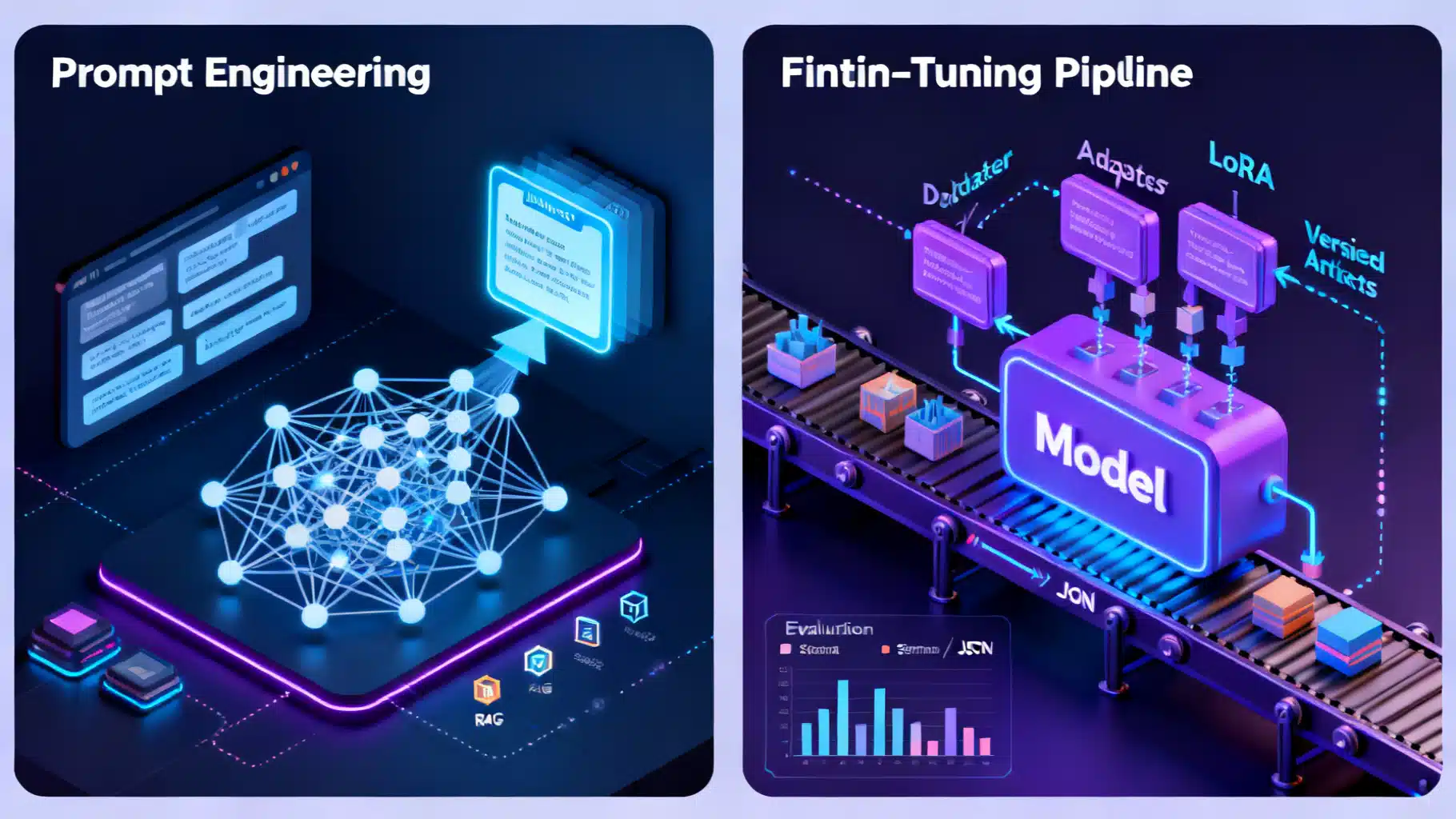
Image used for representation purposes only.
TL;DR
- Start with prompt engineering and retrieval-augmented generation (RAG). It’s fastest to ship and cheapest to iterate.
- Move to fine-tuning when you need consistent style, domain-specific jargon, structured outputs, or lower per-request tokens at scale.
- Most robust systems blend both: strong prompts + RAG for facts, light fine-tuning for tone/format, guardrails for safety, and rigorous evaluation.
What We Mean by “Prompting” and “Fine‑Tuning”
- Prompting: Crafting instructions, examples, and constraints at inference time. Variants include zero-shot, few-shot, chain-of-thought (hidden), role prompting, and tool calls. No model parameters change.
- Fine-tuning: Updating some or all model weights on curated examples to nudge behavior. Modern approaches favor parameter-efficient fine-tuning (PEFT) like LoRA/adapters to reduce cost and risk.
Think of prompting as steering the car with the wheel; fine-tuning is aligning the wheels for your typical road.
Strengths of Prompting
- Speed to value: No training pipeline; you can ship in hours.
- Flexibility: Change behavior by editing text or adding tools.
- Lower operational burden: No model versioning, checkpoints, or retraining loops.
- Great with RAG: Retrieve up-to-date or private documents at query time; no need to bake them into weights.
Use prompting when:
- The task varies widely user-to-user.
- Correctness hinges on fresh or private data (docs, databases, APIs) you can retrieve.
- You’re still exploring requirements or the problem shifts frequently.
Strengths of Fine‑Tuning
- Consistency and style control: Marketing voice, legal register, or strict persona that must not drift.
- Format fidelity: JSON schemas, database-ready outputs, code style, or DSLs where minor deviations break downstream systems.
- Domain compression: Reduce long, costly prompts by teaching the model your ontology, abbreviations, or workflows.
- Latency and cost at scale: Shorter prompts and smaller target models can reduce tail latencies and per-call cost once volume is high.
Use fine-tuning when:
- You have stable, recurring tasks and well-defined success criteria.
- You can assemble hundreds to tens of thousands of high-quality labeled examples.
- Guardrails via prompts alone aren’t sticky enough.
Cost, Latency, and Scale
- Prompting costs grow with prompt length and model size. Long few-shot prompts scale linearly with tokens.
- Fine-tuning shifts some cost to a fixed training step. Inference can be cheaper if:
- You shorten prompts significantly, and/or
- You can move to a smaller model with tuned performance.
- Latency: Fine-tuned smaller models often respond faster than large general models with huge prompts.
A simple rule of thumb:
- Low volume or volatile requirements → prompting/RAG wins.
- High volume, stable spec, and long prompts → consider fine-tuning to reduce ongoing costs.
Data and Governance Considerations
- Prompting:
- Data lives outside the model; easier to revoke or update.
- Great for handling sensitive data via retrieval with access controls.
- Fine-tuning:
- You must audit training data: licensing, PII, consent, and bias.
- Updating or forgetting specific facts requires retraining or techniques like selective unlearning.
Governance tips:
- Keep a manifest of all data sources used in fine-tuning.
- Automate PII scanning and redaction in both prompts and training sets.
- Version datasets and model artifacts; tie them to evaluation reports and risk reviews.
Quality and Control
- Prompting gives rapid iteration but can be brittle under distribution shifts.
- Fine-tuning improves repeatability and reduces the need for heavy prompt scaffolding.
- For structured output, combine:
- Fine-tuning on schema-conforming examples.
- A constrained decoder or output validator that enforces JSON schemas.
Engineering Complexity and MLOps
- Prompting stack:
- Prompt templates and guards
- RAG (vector store + retrieval + re-ranking)
- Observability (traces, token usage, latency, user feedback)
- Fine-tuning stack adds:
- Data pipelines (labeling, QA, dedupe, decontamination)
- Training jobs (PEFT, checkpoints, hyperparameters)
- Model registry and rollout (A/B, canary, fallback)
- Continuous training triggers (drift, new style guide)
If your team lacks ML ops maturity, start with prompting + RAG and add lightweight fine-tuning once requirements stabilize.
Evaluation: Decide With Data
Design an evaluation harness before changing anything:
- Define success metrics: exactness (precision/recall), structure validity, toxicity, style adherence, latency, and cost.
- Build a static test set that mirrors production queries, plus adversarial edge cases.
- Use both automatic and human ratings:
- Automatic: regex/schema checks, BLEU/ROUGE for summaries, task-specific scores.
- Human: pairwise preference, rubric-based scoring (1–5 for clarity, accuracy, tone).
- Run head-to-head: baseline prompt vs. prompt+RAG vs. fine-tuned.
- Freeze only what wins statistically with practical significance.
Hybrid Strategies That Win in Practice
- RAG first: Keep facts in a retriever, not in weights. Index documents, use query rewriting and re-ranking, and cite sources.
- Light fine-tuning for style/format: Train on 1–5k curated examples to lock output structure and voice.
- Tools and function calling: Offload math, database queries, or code execution to tools; teach the model when to call them.
- System prompts as policy, fine-tuning as habit: Prompts declare rules; fine-tuning reinforces them.
Quick Decision Checklist
Choose prompting (with RAG) if most answers depend on:
- Current or private data
- Rapidly changing instructions
- Low to medium volume
- Limited labeled data
Choose fine-tuning if you need:
- Strong consistency and brand voice
- Schema-perfect outputs for integration
- Lower latency and cost at scale
- Stable tasks and ample labeled examples
Often, do both: RAG for facts, fine-tuning for behavior.
Implementation Quick-Start
1) Establish a strong prompting baseline
- Create a system prompt that states goals, constraints, and style.
- Add few-shot examples showing good and bad outputs.
- Use a schema-enforcing wrapper with retries.
Example prompt template:
System: You are a precise technical assistant. Always return JSON matching this schema:
{"title": string, "risk": "low|medium|high", "rationale": string}

User: Evaluate the following change request:
<request>{{text}}</request>
Constraints:
- No outside assumptions.
- Short sentences. Active voice.
- If uncertain, set risk="medium" and explain.
2) Add Retrieval-Augmented Generation (RAG)
- Chunk domain docs (500–1,000 tokens), embed, and store in a vector DB.
- Query-flow:
- Rewrite the user query for retrieval.
- Retrieve top-k passages; re-rank if possible.
- Build a prompt with the most relevant passages.
- Ask for citations or passage IDs in the output.
Pseudocode sketch:
query = rewrite(user_input)
passages = rerank(retrieve(query, k=8))[:4]
prompt = build_prompt(system, few_shots, passages, user_input)
result = llm(prompt)
validated = json_validate(result)
3) Graduate to parameter-efficient fine-tuning (PEFT)
- Start with LoRA/adapters rather than full fine-tuning to cut compute and risk.
- Curate data: 1–20k high-quality instruction–response pairs. Remove duplicates, redact PII, and label style/format fields explicitly.
- Evaluate on held-out tasks before rollout.
Minimal PEFT training sketch (conceptual):
base_model = load_model("your-base-llm")
lora_cfg = LoraConfig(r=8, alpha=16, dropout=0.05, target_modules=["q_proj","v_proj"])
model = attach_lora(base_model, lora_cfg)
train(model, dataset, lr=2e-4, batch_size=64, epochs=3, max_tokens=2048)
merge_and_export(model)
Data Curation Tips for Fine‑Tuning
- Represent real production distribution (common, edge, and adversarial cases).
- Annotate failure modes: hallucinations, formatting errors, tone violations.
- Prefer few excellent examples over many noisy ones; measure inter-annotator agreement.
- Include counter-examples and corrections so the model learns boundaries.
Common Pitfalls and How to Avoid Them
- Overfitting to prompts: If you must use 30-shot prompts to succeed, you’re masking a need for fine-tuning or better retrieval.
- Baking facts into weights: Facts change; store them in a retriever.
- Training on model outputs without QA: Self-generated data compounds errors. Always human-review a critical subset.
- Ignoring eval drift: Re-run evaluations regularly; track latency and cost alongside quality.
- Skipping constrained decoding: For structured outputs, use JSON schema validation and repair loops.
Real-World Scenarios
- Customer support summaries: Prompting + RAG from tickets/knowledge base; light fine-tuning for brand tone and summary length.
- Contract clause extraction: Fine-tune for schema fidelity; combine with RAG for referencing the exact clauses.
- Code migration notes: Prompting with tool calls to analyzers; fine-tune for consistent checklists and risk scoring.
- Marketing copy at scale: Fine-tune for voice; prompt for campaign-specific context and goals.
Measuring ROI
- Token cost: Track average tokens per request before/after fine-tuning.
- Latency: Measure p50/p95; smaller tuned models should reduce p95.
- Quality uplift: Human preference win-rate and schema validity rate.
- Ops burden: Time-to-change for new requirements (prompt edit vs. new training run).
Final Guidance
- Start with a strong prompt + RAG baseline and an evaluation harness.
- If prompts grow long or outputs remain inconsistent, pilot PEFT fine-tuning with a small, clean dataset.
- Compare end-to-end: quality, cost, and latency. Ship only when the data says it’s better.
- Keep facts in retrieval, behavior in fine-tuning, and policy in prompts. That separation of concerns makes systems easier to evolve.
Related Posts

RAG vs. Fine‑Tuning: How to Choose the Right Approach
A practical guide to choosing RAG vs fine-tuning, with a clear decision framework, patterns, code sketches, and pitfalls.
Practical Techniques to Reduce AI Hallucinations
A practical, end-to-end guide to reducing AI hallucinations with data, training, retrieval, decoding, and verification techniques.

From Prototype to Production: Deploying Autonomous AI Agents Safely and at Scale
A practical blueprint for deploying autonomous AI agents to production—architecture, safety, reliability, evals, cost control, and ops patterns.