
Automating Backward Compatibility Testing for APIs: A Practical Guide
Learn strategies, tools, and CI patterns to automate API backward compatibility testing across REST, gRPC, and GraphQL, with examples and checklists.

Image used for representation purposes only.
Overview
Backward compatibility is the quiet contract that keeps distributed systems moving. When an API evolves without breaking existing clients, product teams ship faster, incidents shrink, and upgrade costs plummet. This article explains what “backward compatible” really means for different API styles (REST, gRPC, GraphQL), then shows how to automate checks in CI/CD so regressions are caught before they reach users.
What backward compatibility actually means
Think of compatibility across four layers:
- Wire compatibility: Clients can still connect and parse messages (content types, encodings, gRPC method names, GraphQL fields).
- Schema compatibility: Request/response shapes are additive and defaults are preserved; required fields and enums are not tightened.
- Behavioral/semantic compatibility: The same inputs yield equivalent meaning—status codes, pagination order, idempotency, and error shapes remain stable.
- Operational compatibility: Non-functionals such as latency budgets, rate limits, and auth scopes don’t suddenly change.
A change is backward compatible if every client that worked yesterday continues to work tomorrow without code changes.
Common breaking changes to guard against
- Removing or renaming fields, endpoints, RPC methods, or GraphQL types/fields.
- Making optional fields required, or narrowing validation (e.g., min length increases).
- Changing types (int → string), precision, or units without clear migration.
- Altering default values or enum membership in a breaking way (removing or reusing values).
- Modifying error contracts (status codes, error codes, problem+json details) or pagination cursors.
- Tightening auth requirements or scopes; changing rate limit semantics.
Automation strategies at a glance
A reliable automation program layers static and dynamic checks:
- Spec/schema diffs
- REST/HTTP: Compare OpenAPI specs between main and PR branches; fail builds on breaking changes.
- gRPC/Protobuf: Enforce backward compatibility with descriptor-based breaking checks.
- GraphQL: Detect breaking vs safe changes in the schema diff (e.g., removing a field is breaking, adding is safe).
- Evented APIs: Use AsyncAPI or protobuf-avro schema registries with compatibility rules.
- Contract tests
- Consumer‑driven contracts (CDC): Each consumer publishes expectations; the provider verifies them before release.
- Provider contract tests: Ensure the implemented service still matches the canonical spec.
- Property- and fuzz-based tests
- Validate invariants on responses, pagination, and error shapes.
- Use schema-based fuzzers to probe edge cases without hand-written cases.
- Runtime verification
- Shadow traffic replay and response diffing in staging.
- Canary releases with synthetic probes covering critical flows.
Designing a compatibility test pyramid
- Base: Linting and spec validation (fast feedback, pre-merge).
- Middle: Schema diffs and contract tests (per-PR in CI, also nightly).
- Top: End-to-end and shadow/canary checks (post-deploy gates, SLO-aligned monitors).
This pyramid keeps most failures caught before integration while still validating real-world behavior after deployment.
Versioning and deprecation that work with automation
- Prefer additive changes: Add new optional fields or endpoints; do not change semantics of existing ones.
- Adopt an explicit deprecation lifecycle: Announce, warn in headers or responses, monitor usage, then remove after a documented window.
- Use feature/version negotiation (e.g., custom media types, gRPC package versions, GraphQL field deprecation) to stage changes.
- Treat “soft breaks” (e.g., default value shifts) as breaks unless guarded by explicit versioning.
Automation should enforce: “No removals without an approved deprecation ticket and expiry date,” and “No tightening of required/validation rules.”
Tooling patterns (language- and stack-agnostic)
Below are concise examples you can adapt. The specific tools are interchangeable—focus on the workflows and gates.
1) Spec diffs in CI
Use a spec diff to fail on breaking REST changes:
# Compare main vs current branch and fail on breaking changes
openapi-diff --fail-on-breaking main:openapi.yaml openapi.yaml
For gRPC/Protobuf with a descriptor-based check:
# Fail if current branch introduces breaking protobuf changes vs main
buf breaking --against '.git#branch=main' --config buf.yaml
GraphQL schema diff:
# Show breaking changes; exit non-zero on any
npx graphql-inspector diff main:schema.graphql schema.graphql --exit-on-breaking
2) Consumer‑driven contract test (example in JavaScript)
import { Pact } from '@pact-foundation/pact';
import fetch from 'node-fetch';

const provider = new Pact({ consumer: 'web-app', provider: 'orders-api' });

describe('orders-api contract', () => {
  beforeAll(() => provider.setup());
  afterAll(() => provider.finalize());

  it('retrieves an order by id', async () => {
    await provider.addInteraction({
      state: 'order 123 exists',
      uponReceiving: 'a request for order 123',
      withRequest: { method: 'GET', path: '/orders/123' },
      willRespondWith: {
        status: 200,
        headers: { 'Content-Type': 'application/json' },
        body: { id: '123', status: 'SHIPPED' }
      }
    });

    const res = await fetch(provider.mockService.baseUrl + '/orders/123');
    const json = await res.json();
    expect(json.id).toBe('123');
  });
});
Publish contracts from consumers; providers verify them in CI before merging or releasing.
3) Property-based API tests
# Pseudocode using hypothesis-style checks
@given(valid_order_ids())
def test_order_is_monotonic(created_at):
    res = api.list_orders(sort='created_at', order='asc')
    assert is_non_decreasing([o.created_at for o in res.items])
4) GitHub Actions gate example
name: api-compat
on: [pull_request]
jobs:
  compat:
    runs-on: ubuntu-latest
    steps:
      - uses: actions/checkout@v4
      - uses: actions/setup-node@v4
        with: { node-version: '20' }
      - run: npm ci
      - name: Lint and validate spec
        run: |
          npm run lint:openapi
          npm run validate:openapi
      - name: REST breaking-change check
        run: openapi-diff --fail-on-breaking main:openapi.yaml openapi.yaml
      - name: GraphQL breaking-change check
        run: npx graphql-inspector diff main:schema.graphql schema.graphql --exit-on-breaking
      - name: Protobuf breaking-change check
        run: buf breaking --against '.git#branch=main' --config buf.yaml
      - name: Verify consumer contracts
        run: npm run pact:verify
Classifying and handling changes
Automation should do more than pass/fail; it should classify and explain:
- Breaking: Removal/rename; required → optional is safe, optional → required is breaking; enum removals; narrower formats.
- Potentially risky: New defaults; new validation on optional fields; new pagination order.
- Safe: Additive fields/endpoints with sensible defaults; new optional enum values.
Introduce an allowlist mechanism with:
- Scope: the exact rule to suppress (e.g., remove-field: orders.v1.Order.status) and why.
- Expiration: a date after which the exception fails the build.
- Owner: a team/contact to revisit the decision.
This turns exceptions into time‑boxed, auditable decisions instead of permanent holes.
Data and determinism: making tests trustworthy
- Use seeded data builders and fixtures to avoid flaky tests.
- Keep golden snapshots of representative responses; diff them with semantic comparators (order‑insensitive for maps, tolerant of additional fields).
- For time, IDs, and randomness, inject clocks and generators so tests control them.
- Record/replay for 3rd‑party dependencies to stabilize provider tests.
Runtime safeguards that catch the unknowns
- Shadow traffic: Mirror a slice of production requests to the candidate build; compare responses after normalizing non-deterministic fields. Alert only on semantic diffs.
- Canary analysis: Release to a small percentage and run synthetic probes that assert contracts and SLOs.
- SLO‑aware alarms: Treat spikes in 4xx/5xx for known operations as potential compatibility regressions.
Governance and developer experience
- API style guides and linters (naming, pagination, error format) prevent many breaks upstream.
- An ADR/RFC process documents intended breaking changes with migration paths and timelines.
- Automated changelog generation from spec diffs improves communication to consumers.
- Provide a local pre-commit hook so engineers see failures before pushing.
Special considerations by API style
- REST/HTTP: Embrace additive design. Never repurpose enum values; prefer new ones. Keep error formats stable (problem+json or equivalent).
- gRPC/Protobuf: Only add new field numbers; never reuse. Reserve removed numbers/names. Keep wire compatibility by avoiding required fields in proto3.
- GraphQL: Removing fields/types is breaking. Prefer field deprecation with descriptions. Adding non-null args to existing fields is breaking; add new fields instead.
- Event streams: Use schema registries with “backward” or “full” compatibility modes. Ensure consumers ignore unknown fields.
Anti-patterns to avoid
- Treating documentation as the contract while the code drifts.
- Relying on end‑to‑end tests alone; they are too slow and sparse to catch all breaks.
- Wide, silent allowlists that never expire.
- Overusing major version bumps as an escape hatch; each bump fractures your ecosystem.
- Assuming “added a field” is always safe—some consumers break on strict decoders or unexpected properties.
A practical rollout plan (90 days)
- Weeks 1–2: Inventory APIs and schemas; adopt or generate OpenAPI/GraphQL/proto specs. Set style guide and lint rules.
- Weeks 3–4: Add spec validation and diff checks to PRs; make results visible but non-blocking.
- Weeks 5–6: Onboard top consumers to CDC; start provider verification in CI; enable breaking checks as required for new endpoints.
- Weeks 7–8: Introduce fuzz/property tests and golden snapshots for critical operations.
- Weeks 9–10: Add shadow traffic in staging; wire canary probes and SLO alarms.
- Weeks 11–12: Flip CI gates to blocking; add allowlist with expirations and ownership.
Checklist
- Do we maintain a machine‑readable spec per API and version?
- Are PRs blocked on breaking-change detection for REST, gRPC, and GraphQL?
- Do providers verify the latest consumer contracts before release?
- Are deprecations time‑boxed, announced, and monitored?
- Do we have shadow/canary probes and SLO alerts for compatibility regressions?
- Can engineers reproduce failures locally with fixtures and seeded data?
- Is there an allowlist with owners and expiry dates, audited regularly?
Conclusion
Automating API backward compatibility is less about a single tool and more about layered, fast feedback: spec diffs for structure, contracts for semantics, property tests for invariants, and runtime checks for the unknown. With a clear deprecation policy and CI gates that fail loudly—and explain why—you’ll turn breaking changes from production incidents into small, fixable pull requests.
Related Posts
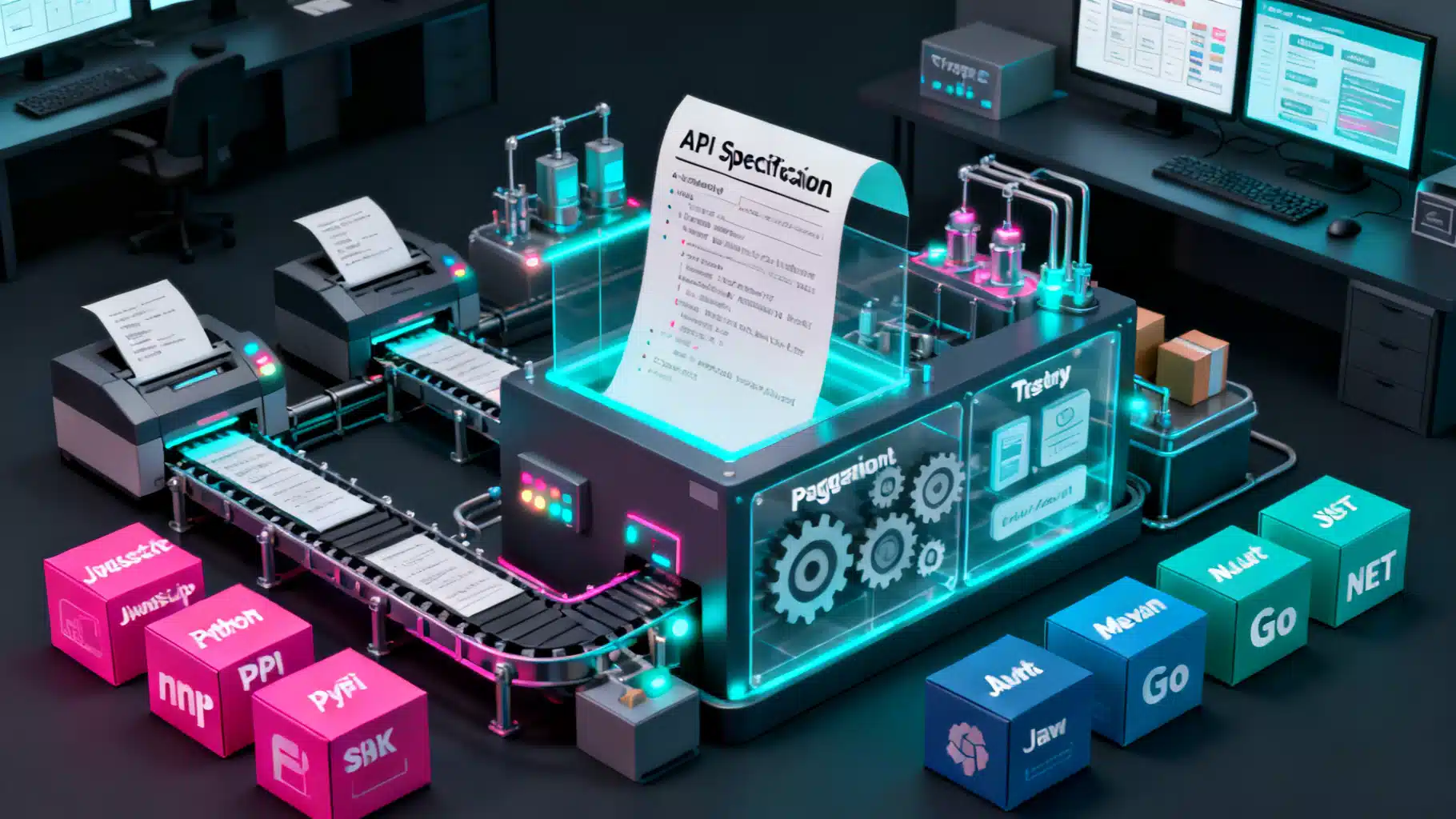
API SDK Client Library Generation: A Practical Guide to Fast, Idiomatic, Multi‑Language Clients
How to generate maintainable, idiomatic API SDKs from OpenAPI, gRPC, and GraphQL—patterns, tooling, CI, versioning, and release automation.
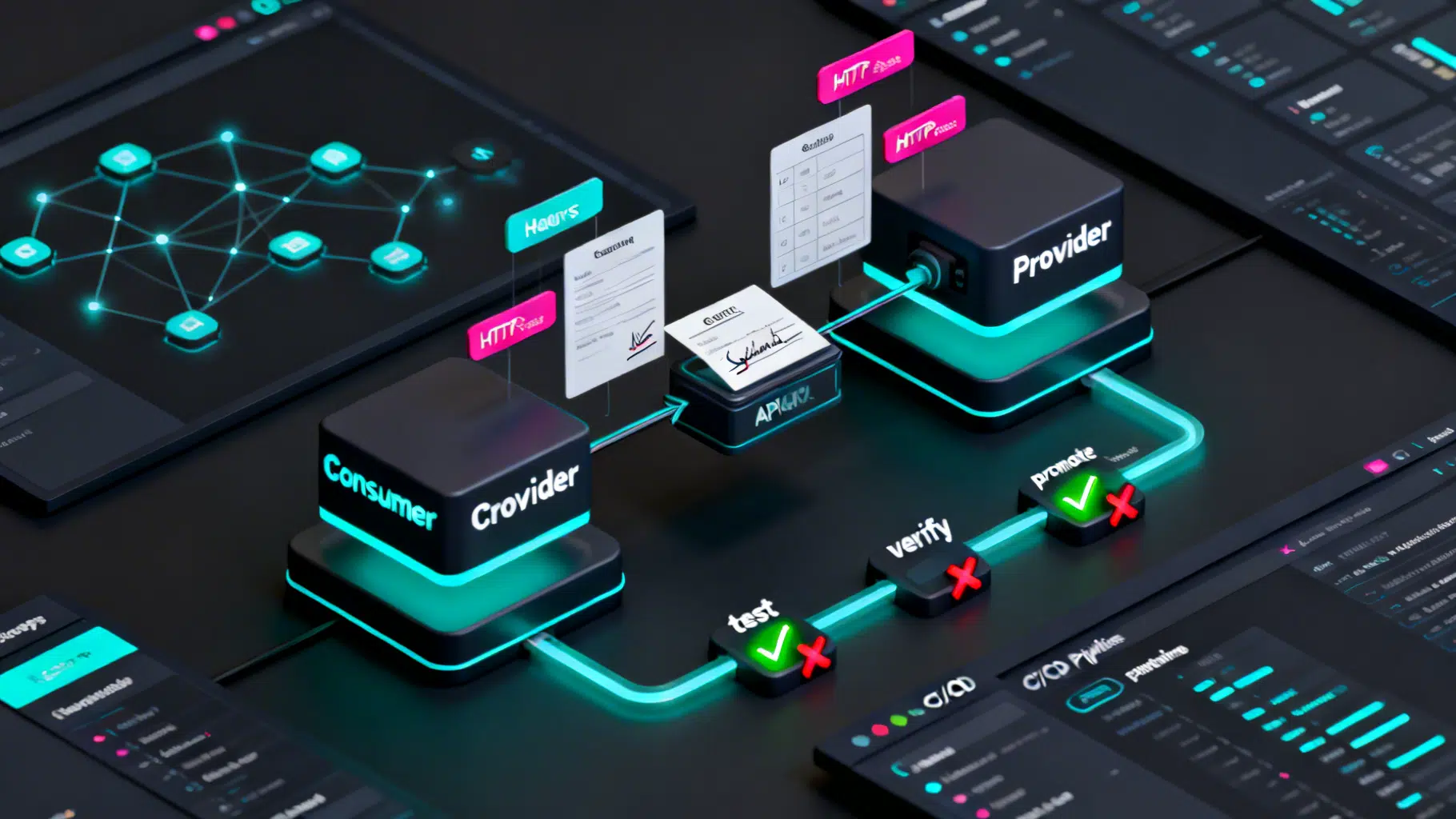
Consumer-Driven Contract Testing: A Practical Guide to Safer, Faster API Delivery
A practical guide to consumer-driven contract testing: how it works, why it matters, and how to implement it with CI/CD to ship APIs faster without breaks.

API‑First Development: An End‑to‑End Workflow Guide
A practical, end-to-end API-first workflow: design, mock, test, secure, observe, and release with contracts as the single source of truth.