
Llama vs. Mistral in 2026: How to Choose the Right Open‑Weight Model
An up-to-date, practical comparison of Llama vs. Mistral open‑weight models: architecture, licenses, context windows, modality, and deployment tips.
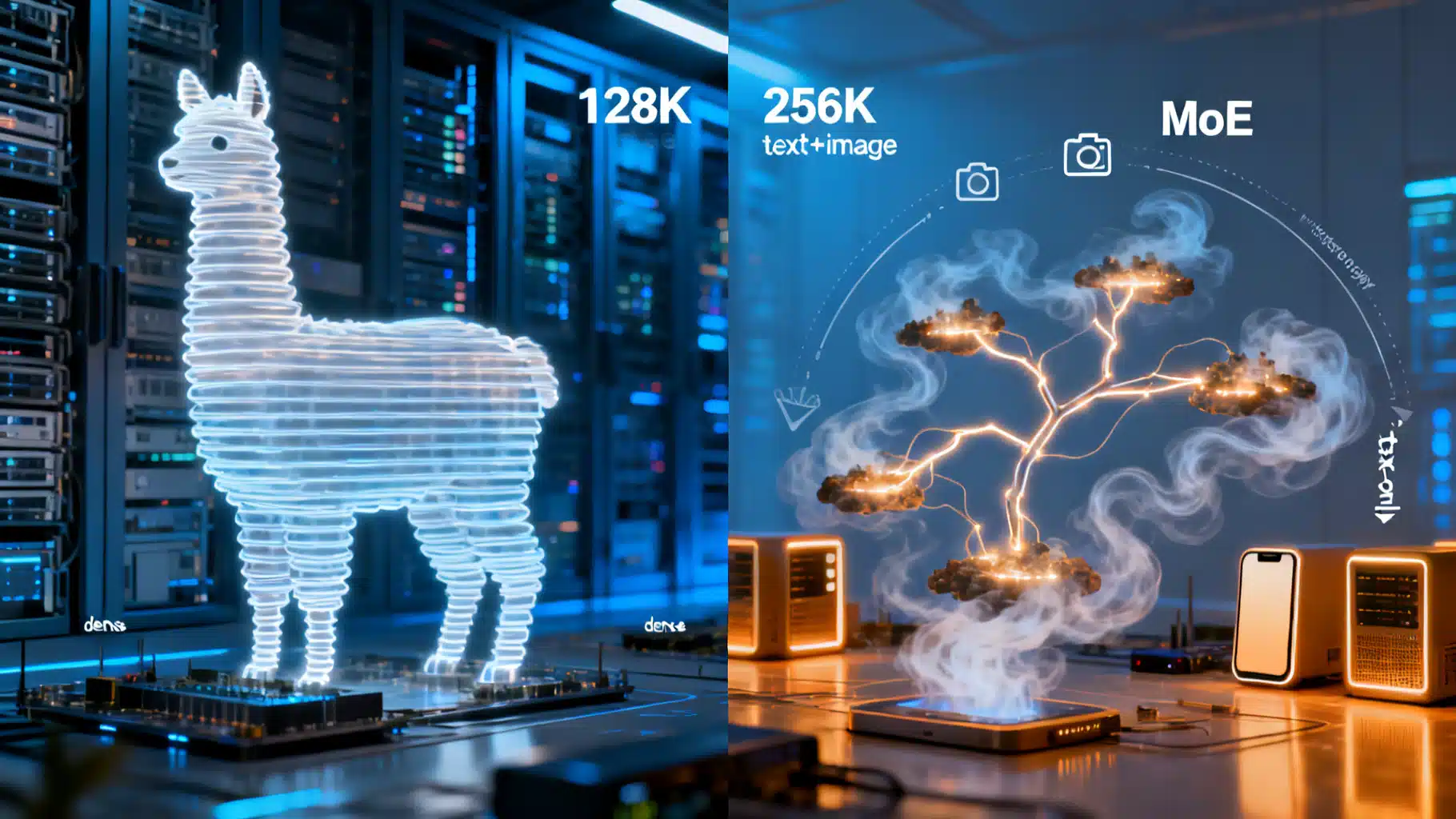
Image used for representation purposes only.
Overview
Open‑weight large language models have matured fast. As of August 29, 2026, two families dominate most self‑hosted and hybrid stacks: Meta’s Llama and Mistral’s model line. Both are capable, broadly adopted, and actively evolving—but they differ in architecture, licensing, modality, and deployment ergonomics. This article distills what changed, what’s stable, and how to pick the right base model for your use case.
Model lineups at a glance
-
Llama
- Llama 3.1 (July 23, 2024): 8B, 70B, and a 405B dense flagship with 128K context; Meta emphasizes broad partner support and claims competitive performance with top closed models. (ai.meta.com )
- Llama 3.2 (September 2024): adds 1B/3B lightweight text models and new multimodal “Vision” models (11B and 90B), along with Llama Guard 3 Vision for safer image understanding. (ai.meta.com )
- Llama 3.3 (late 2024/2025): a 70B multilingual model; Meta’s developer channels highlight parity with 3.1‑405B on many text tasks. (github.com )
-
Mistral
- Mistral 7B and Mixtral 8×7B (Dec 2023): efficient 7B dense and the widely‑used sparse MoE open‑weights baseline. (mistral.ai )
- Mixtral 8×22B (Apr 2024): larger open MoE (64K context) later retired on March 30, 2025; still instructive for MoE memory/latency trade‑offs. (docs.mistral.ai )
- Mistral Large 3 (Dec 2, 2025): open‑weight, Apache‑2.0, multimodal frontier‑class MoE with 41B active/675B total parameters and 256K context. (docs.mistral.ai )
- Ministral 3 (3B/8B/14B): compact Apache‑2.0 open‑weights for edge/latency‑sensitive scenarios. (docs.mistral.ai )
- Mistral NeMo 12B: open‑weight collab with NVIDIA, often used as a strong mid‑size base. (mistral.ai )
Architecture and scaling strategies
- Llama favors dense decoder‑only transformers at every scale. Even for 3.1‑405B, Meta stayed dense (not MoE) to maximize training stability and predictable behavior, then leaned on post‑training to raise instruction quality. (ai.meta.com )
- Mistral’s signature is sparse Mixture‑of‑Experts: Mixtral layers route each token to a subset of experts, delivering larger “total capacity” without always paying full dense FLOPs. Mistral Large 3 extends this idea with a granular MoE at frontier scale. (docs.mistral.ai )
What it means for you:
- Dense models (Llama) tend to be simpler to reason about and tune; throughput scales linearly with size.
- MoE models (Mistral) can deliver higher quality/price at similar latency—if your serving stack is MoE‑aware and well‑tuned.
Modality and context windows
- Llama 3.2 introduced official multimodal “Vision” variants (11B, 90B) and a companion safety model (Llama Guard 3 Vision), while keeping text‑only 1B/3B models for on‑device and edge. (ai.meta.com )
- Llama 3.1 expanded text context to 128K on 8B/70B/405B. (ai.meta.com )
- Mistral Large 3 is multimodal with a 256K context window, which materially changes retrieval and long‑document use cases. (docs.mistral.ai )
- Mixtral 8×22B shipped with 64K context and remains a useful reference for MoE memory footprints. (docs.mistral.ai )
Licenses and what “open‑weight” really allows
- Llama models are released under Meta’s Llama Community License (per‑generation variants). It permits commercial use, redistribution, and modification but adds conditions beyond OSI open source: an Acceptable Use Policy, attribution rules, and a 700‑million MAU threshold that triggers a separate license requirement. These terms are spelled out in the Llama 3.x license files. (github.com )
- Llama 3.3’s policy for multimodal models further withholds certain rights from EU‑domiciled individuals/companies, so check region‑specific terms before distribution. (github.com )
- By contrast, Mistral’s current open‑weight lineup (e.g., Mistral Large 3 and the Ministral 3 family) is Apache‑2.0—OSI‑approved and familiar to legal/compliance teams. Always confirm per‑model cards, but the catalog explicitly marks Apache‑2.0 for these releases. (docs.mistral.ai )
Practical takeaway: If you need OSI‑approved terms and minimal usage caveats for redistribution, Mistral’s Apache‑2.0 open‑weights simplify due diligence. If you’re fine with a custom community license and want dense‑model ergonomics or specific Llama ecosystem tools, Llama can be a great fit—just account for the license triggers and required attributions. (github.com )
Serving and systems: throughput, memory, and quantization
- Llama 3.1 405B is supported in mainstream inference stacks (e.g., vLLM) with FP8 quantization to make single‑node serving feasible; this was available near launch and has continued to mature. (vllm-project.github.io )
- Mixtral 8×22B’s model card shows why MoE can be hardware‑friendly for its quality level: ~39B active parameters at inference and documented RAM estimates across BF16→FP4. This is representative of MoE’s capacity/latency trade‑off. (docs.mistral.ai )
- Mistral Large 3’s 256K context pushes retrieval and multi‑doc QA at scale; ensure your vector store, chunking, and caching strategy are designed for high token throughput. (docs.mistral.ai )
General guidance:
- Choose quantization (FP8/BF16→INT8/FP4) based on target hardware and latency SLOs; validate accuracy on your own evaluation sets before promoting to prod.
- For MoE, profile router load balance and KV‑cache residency. For dense models, watch batch size, paged KV‑cache, and speculative decoding for latency control.
Ecosystem and integrations
- Llama 3.1 launched with day‑one integrations across major clouds, GPUs, and inference frameworks—handy if you prefer managed endpoints or hybrid self‑hosting. (ai.meta.com )
- Mistral’s catalog spans generalist, code, OCR, audio, and safety models with consistent APIs and model‑card transparency, making it straightforward to compose pipelines around open weights. (docs.mistral.ai )
Which should you choose?
Pick Llama if:
- You want dense‑model simplicity with strong instruction following, broad community recipes, and you’re comfortable with the Llama Community License obligations.
- You need small text‑only models for phones/edge (Llama 3.2 1B/3B) or official multimodal Vision models integrated with Llama Guard 3 Vision. (ai.meta.com )
Pick Mistral if:
- You need Apache‑2.0 open‑weights with minimal caveats for redistribution or embedding into your own products. (docs.mistral.ai )
- Your workloads benefit from MoE efficiency (quality/latency) and very long context (256K) for retrieval‑heavy tasks—Mistral Large 3 is compelling here. (docs.mistral.ai )
- You’re building for edge/serverless with compact Apache‑2.0 models (Ministral 3 family). (docs.mistral.ai )
Quick start: self‑hosting both families
Below are minimal, illustrative commands. Adapt model IDs, quantization, and engine flags to your stack and GPU memory.
# Serve Llama 3.1 8B Instruct with vLLM (OpenAI-compatible API)
pip install vllm
python -m vllm.entrypoints.openai.api_server \
  --model meta-llama/Llama-3.1-8B-Instruct \
  --max-model-len 131072 \
  --quantization awq  # or fp8/fp16 depending on GPUs

# Serve Mixtral 8x7B Instruct (MoE) with TGI
docker run --gpus all -p 8080:80 ghcr.io/huggingface/text-generation-inference:latest \
  --model mistralai/Mixtral-8x7B-Instruct-v0.1 \
  --max-input-length 32768 --max-total-tokens 40960

# Test the endpoints
curl http://localhost:8000/v1/chat/completions \
  -H 'Content-Type: application/json' \
  -d '{"model":"llama-3.1-8b","messages":[{"role":"user","content":"Summarize our policy."}]}'
Tips:
- For Llama 3.2 Vision/LLama Guard 3 Vision, ensure your engine supports image inputs and multimodal safety hooks. (ai.meta.com )
- For MoE, start with conservative batch sizes; scale after verifying router/bandwidth headroom.
Evaluation checklist before committing
- License fit: Will Llama’s MAU or jurisdiction clauses affect launch? Is Apache‑2.0 preferable? (github.com )
- Context needs: Are 128K tokens enough, or do you need 256K? (ai.meta.com )
- Modality: Text‑only or image‑understanding out of the box? (ai.meta.com )
- Serving stack: Dense vs MoE readiness (quantization, KV cache, router balance). (vllm-project.github.io )
- Vendor ecosystem: Are managed endpoints, on‑prem GPU partners, or compliance docs required? (ai.meta.com )
Bottom line
- If you want maximal licensing simplicity and state‑of‑the‑art long‑context multimodality under Apache‑2.0, Mistral Large 3 and the Ministral 3 family are excellent defaults. (docs.mistral.ai )
- If you prefer dense models with deep community support, strong text quality from 8B→405B, and official Vision variants, Llama remains a powerhouse—just align on license obligations early. (ai.meta.com )
With either path, you’re building on open‑weight models that are production‑ready today. The best choice is the one that fits your license constraints, context budget, and MLOps maturity—not the biggest parameter count.
Related Posts

The Practical Guide to Model Compression with Quantization (INT8, INT4, FP8)
A practical, modern guide to model compression via quantization—PTQ, QAT, calibration, mixed precision, and LLM-focused methods—with code and checklists.

Building a Reliable AI Legal Document Review API: Architecture, Playbooks, and Safeguards
Designing an AI legal document review API: architecture, security, playbooks, evaluation, and examples for reliable, auditable contract analysis.
Build an AI Recipe Generation API: End-to-End Tutorial with JSON Schema, Validation, and Caching
Build a production-ready AI recipe generation API with JSON schema, prompting, validation, caching, and code in Node.js and Python.