
Automating AI Data Labeling with APIs: A Practical Blueprint for Scale
Design, build, and scale an API-driven data labeling pipeline with quality gates, active learning, and strong governance.
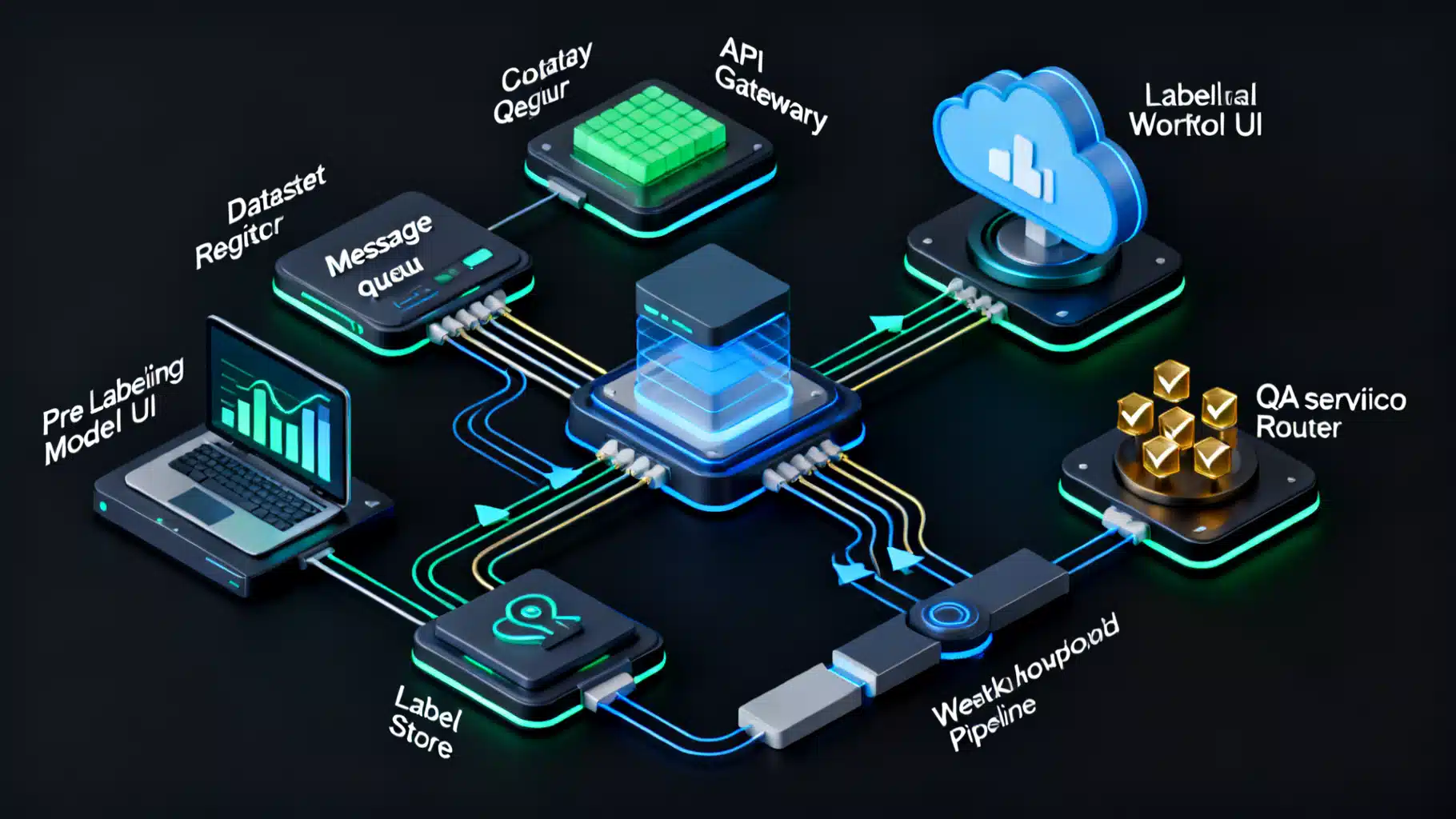
Image used for representation purposes only.
Why automate data labeling with APIs
High-quality labeled data is the most brittle dependency in modern AI systems. Manual coordination by spreadsheets and ad‑hoc uploads cannot keep pace with iterative model training, shifting taxonomies, and compliance controls. API-driven automation turns labeling into an observable, testable, and scalable subsystem of your ML platform.
Benefits include:
- Repeatability: infrastructure-as-code for datasets, instructions, and quality gates.
- Speed: parallelized task creation, pre-labeling, and auto-approval loops.
- Quality: programmatic checks, gold standards, and consensus.
- Cost control: dynamic sampling and active learning target only the most informative items.
- Governance: audit trails, PII enforcement, and versioned ontologies.
Reference architecture
A minimal production design separates orchestration from execution while keeping strong observability.
+----------------+      +----------------+      +------------------+
|  Data Sources  | ---> |  Ingestion/ETL | ---> | Dataset Registry |
+----------------+      +----------------+      +------------------+
         |                         |                        |
         v                         v                        v
+----------------+      +----------------+      +------------------+
|  Pre-labeler   | ---> | Task Generator | ---> |  Task Broker MQ  |
|  (model(s))    |      |  & Serializer  |      |  (queues/topics) |
+----------------+      +----------------+      +------------------+
                                                  |         |
                                                  v         v
                                        +----------------+  +----------------+
                                        | Labeling API   |  | Webhook Router |
                                        | provider(s)    |  | & DLQ          |
                                        +----------------+  +----------------+
                                                |                    |
                                                v                    v
                                         +------------+       +-------------+
                                         | Workforce  |       | QA Service  |
                                         | UI / Tools |       | (auto+human)|
                                         +------------+       +-------------+
                                                |                    |
                                                v                    v
                                         +--------------------------------+
                                         |  Label Store & Versioned Gold  |
                                         +--------------------------------+
                                                |
                                                v
                                      +--------------------+
                                      | Training Pipeline  |
                                      | & Model Registry   |
                                      +--------------------+
Key components:
- Dataset registry: immutable data references, content hashes, and split metadata.
- Task generator: transforms items into provider-specific payloads using a versioned ontology.
- Message broker: buffers and controls backpressure; supports retries and dead-letter queues (DLQs).
- Webhook router: validates signatures, ensures idempotency, and persists events atomically.
- QA service: consensus, gold checks, and rule-based validators.
API design patterns and contracts
Design your internal labeling interface so you can swap external vendors or tools without rewrites.
Principles:
- Versioned REST (e.g., /v1/…), with explicit resources: datasets, tasks, batches, labels, quality-reports.
- Idempotency keys on mutations to survive retries safely.
- Strong typing and JSON Schema validation at boundaries.
- Webhook-first for completion, with exponential backoff and signed HMAC.
- Field masks and pagination for efficient reads.
Example endpoints:
POST   /v1/batches               # create a logical batch with ontology + QA policy
POST   /v1/tasks:bulkCreate      # enqueue tasks; requires idempotency-key header
GET    /v1/tasks?status=pending&batch_id=...
POST   /v1/webhooks:register     # subscribe to label.created, label.updated, qa.failed
POST   /v1/labels/{id}:review    # auto/human review actions
GET    /v1/quality-reports/{batch_id}
Sample task payload:
{
  "task_id": "img_000123",
  "data_uri": "s3://bucket/images/000123.jpg",
  "ontology_version": "vehicles@3.2.0",
  "instructions_uri": "s3://docs/vehicles_guidelines_v7.pdf",
  "prelabel": {"boxes": [{"cls":"car","x":12,"y":45,"w":200,"h":120,"score":0.78}]},
  "metadata": {"split":"train","region":"us-east-1"}
}
Security controls to adopt:
- OAuth2 client credentials for service-to-service calls.
- VPC peering or private links where possible; otherwise presigned URLs for data.
- Webhook signing with shared secrets; rotate keys; reject clock-skewed timestamps.
- PII minimization: ship references, not raw content, and redact by default.
End-to-end automated workflow
- Ingest and register data with content hashes and lineage.
- Pre-label items using your current model to accelerate human work.
- Generate tasks from the registry; attach ontology and instruction versions.
- Push tasks via API in bounded-size batches; record idempotency keys.
- Receive webhook events upon label completion; verify signature; ack.
- Run programmatic QA (rules, golds, consensus); auto-accept or route to review.
- Write accepted labels to the label store; update golds if promoted.
- Trigger training jobs on newly accepted data; log to experiment tracker.
- Evaluate drift and gap coverage; feed selection back to the task generator.
Programmatic quality assurance (PQA)
Combine several automated checks before any human review:
- Schema validation: all required fields present; ontologies match versions.
- Heuristic rules: e.g., bounding boxes cannot exceed image bounds; text spans must be UTF‑8.
- Gold checks: seed tasks with known answers; enforce minimum accuracy before acceptance.
- Consensus: require agreement across k annotators for uncertain items.
- Statistical sampling: audit a configurable percentage of accepted tasks.
Inter‑annotator agreement example (Cohen’s kappa for binary classification):
kappa = (p_o - p_e) / (1 - p_e)
where p_o = observed agreement, p_e = chance agreement from marginal probabilities
Set guardrails like: kappa ≥ 0.75 per annotator per class per week; auto-pause if violated.
Quality report shape:
{
  "batch_id": "veh-aug-2026",
  "kappa": 0.81,
  "gold_accuracy": 0.93,
  "review_rate": 0.18,
  "blocker_ratio": 0.02,
  "top_errors": ["car vs. van", "occluded wheels"],
  "actions": ["refresh examples in section 4", "increase consensus on low-light items"]
}
Active learning loop design
Prioritize what to label, not just how much.
- Uncertainty sampling: entropy or margin for probabilistic models.
- Diversity sampling: clustering or core-set selection to avoid redundancy.
- Error-focused sampling: misclassified items and drift detections from production logs.
- Stratified quotas: per class/region/time to maintain balanced coverage.
Policy example:
- 50% high-entropy; 30% underrepresented classes; 20% recent production drift windows.
- Raise human consensus to k=3 for items with entropy > 1.2 or low-light metadata.
Reliability engineering patterns
- Idempotency: include x-idempotency-key; server must upsert and return the original response.
- Retries: exponential backoff with jitter; respect Retry-After header.
- DLQs: any event failing N times gets quarantined; add replay tooling.
- At-least-once webhooks: ensure handler is idempotent and transactional.
- SLOs: e.g., P95 task start latency < 10 min; P99 webhook processing < 1 min; weekly QA accuracy ≥ 92%.
Webhook handler skeleton:
from flask import Flask, request, abort
import hmac, hashlib, json

app = Flask(__name__)
SECRET = b"whsec_..."

@app.post("/webhooks/labels")
def labels():
    sig = request.headers.get("X-Signature")
    body = request.data
    if not verify(sig, body):
        abort(401)
    event = json.loads(body)
    # idempotency: upsert by event["id"] in DB transaction
    upsert_event(event)
    if event["type"] == "label.created":
        run_pqa_and_persist(event["data"])  # may enqueue review
    return {"ok": True}

def verify(sig, body):
    digest = hmac.new(SECRET, body, hashlib.sha256).hexdigest()
    return hmac.compare_digest(sig, digest)
Cost, throughput, and SLA modeling
Throughput model:
items_per_day = annotators * task_rate_per_hour * hours_per_day * availability * efficiency
Efficiency improves with:
- Pre-label acceptance rate (A): manual time ≈ base_time * (1 - A).
- Auto-accept ratio via PQA and golds.
Cost per accepted label:
cost = (labor_cost + platform_fees + infra_cost) / accepted_items
Use simulation to choose consensus k and sampling rates that minimize cost subject to target QA.
Security, privacy, and governance
- Data minimization: share only what’s required; prefer URIs plus short-lived credentials.
- PII controls: automated redaction (images: blur faces/plates; text: regex/ML); maintain allow/deny lists.
- Data residency: pin labeling regions; log cross-border access.
- Access control: least privilege IAM; rotate keys; periodic secret scanning.
- Audit: immutable logs for who labeled what, with timestamps, ontology versions, and diffs.
- Differential privacy or k-anonymity techniques where aggregate sharing is needed.
Testing and monitoring
- Contract tests: validate provider payloads against JSON Schemas.
- Replay tests: record+replay real webhook sequences in staging.
- Canary batches: small, high-gold mixes to verify quality before scaling.
- Observability: emit metrics—task age, start latency, completion rate, QA pass rate, consensus cost, and blocker ratio.
Example JSON Schema guard:
{
  "$schema": "https://json-schema.org/draft/2020-12/schema",
  "$id": "https://example.com/schemas/task.json",
  "type": "object",
  "required": ["task_id", "data_uri", "ontology_version"],
  "properties": {
    "task_id": {"type": "string"},
    "data_uri": {"type": "string", "pattern": "^(s3|gs|az)://"},
    "ontology_version": {"type": "string"}
  }
}
Provider abstraction and portability
Avoid lock-in by isolating provider specifics behind an adapter pattern:
- Define a canonical Task and Label model.
- Implement adapters that translate to each provider’s API and normalize webhook events.
- Keep instruction documents and ontologies in your registry; pass by reference.
- Maintain a capabilities matrix (e.g., video frame interpolation, polygon editing, model-assisted mode) to select the best fit per batch.
End-to-end example: create, track, and accept labels
Create a batch and enqueue tasks:
curl -X POST https://labeler.example.com/v1/batches \
  -H 'Authorization: Bearer $TOKEN' \
  -H 'Content-Type: application/json' \
  -d '{
        "name": "veh-aug-2026",
        "ontology_version": "vehicles@3.2.0",
        "qa_policy": {"consensus": 2, "gold_fraction": 0.05}
      }'

curl -X POST https://labeler.example.com/v1/tasks:bulkCreate \
  -H 'Authorization: Bearer $TOKEN' \
  -H 'Content-Type: application/json' \
  -H 'x-idempotency-key: 0e02-veh-aug-2026' \
  -d '{"batch_id":"veh-aug-2026","tasks": [...]}'
Consume webhook and persist labels (pseudo-flow):
if event.type == 'label.created':
  if run_pqa(event.data) == 'pass':
     write_label_store(event.data)
  else:
     enqueue_review(event.data)
Common pitfalls and anti-patterns
- Single-bucket thinking: mixing raw data, instructions, and labels without versioning.
- No idempotency: duplicate tasks or double-charged items after retries.
- Ignoring ontology drift: silent class renames break longitudinal analytics.
- Overusing consensus: paying triple for clear tasks; use dynamic consensus based on uncertainty.
- Webhooks without verification: easy path to spoofed or replayed events.
- Lack of golds: no anchor to detect systemic regressions in annotator quality.
Implementation checklist
- Versioned ontology and instructions with changelogs and examples.
- Dataset registry with content hashes and URIs; zero-trust sharing.
- Canonical API with idempotency, pagination, and webhook signing.
- Pre-labeler integration and dynamic consensus policy.
- PQA: schema, heuristics, golds, consensus, and sampling.
- QA dashboards with kappa, gold accuracy, and blocker ratio.
- SLOs, alerts, DLQs, and replay tooling.
- Privacy controls: redaction, residency, and audit trails.
- Provider adapters and capabilities matrix.
- Staging with replay tests and canary batches.
Conclusion
API automation transforms labeling from a manual bottleneck into a governed, testable service that evolves with your models. By standardizing contracts, enforcing quality programmatically, and coupling selection policies with active learning, you can deliver more useful labels at lower cost and higher velocity—while keeping strict privacy and reliability guarantees. Start with a canonical schema, instrument everything, and let your automation learn where human attention adds the most value.
Related Posts

Deploying Small Language Models at the Edge: Architecture, Optimization, and Operations
A practical guide to selecting, optimizing, and operating small language models for edge deployment—latency, memory, tooling, and MLOps.

Building an AI‑Powered Competitor Analysis API: From Ingestion to Automated Insights
Build an AI-powered competitor analysis API with RAG, embeddings, orchestration, and guardrails—architecture, code patterns, KPIs, and governance.
Implementing an AI Content Moderation API: Architecture, Policy, and Code
Design and implement a reliable AI content moderation API: taxonomy, architecture, code, policy config, thresholds, privacy, and evaluation best practices.