Event Sourcing for API Microservices: A Practical Guide
A practical, end-to-end guide to using event sourcing in API-based microservices, with design tips, code snippets, and operational best practices.
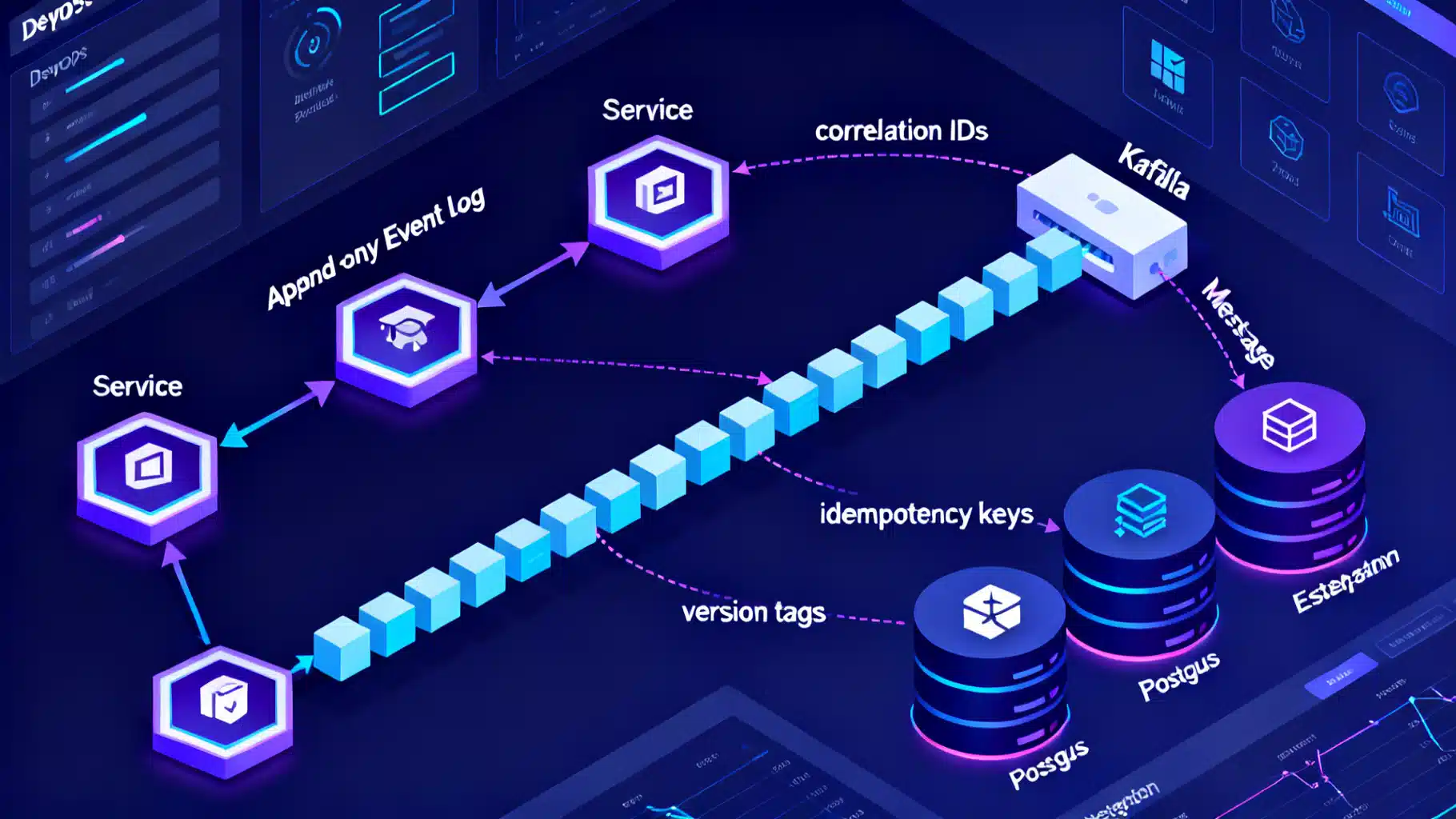
Image used for representation purposes only.
Why Event Sourcing for API Microservices?
Event sourcing reshapes how microservices persist and communicate state. Instead of storing only the latest object snapshot, an event‑sourced service records every state change as an immutable event. This creates a complete, auditable history, enables time‑travel debugging, and naturally supports asynchronous integration between services via event streams.
For API teams, event sourcing can improve reliability and scalability by decoupling writes (commands) from reads (projections), reducing contention on hot aggregates, and enabling near‑real‑time data products. However, the pattern introduces operational and design complexity that must be managed deliberately.
Core Concepts
- Events: Facts describing something that happened in the domain (e.g., OrderPlaced). Immutable and append‑only.
- Aggregate: Consistency boundary that validates commands and emits events (e.g., Order). Follows single‑writer per aggregate instance.
- Command: Intent to change state (e.g., PlaceOrder). Commands do not mutate; aggregates do by emitting events.
- Event Store: Durable, append‑only log of events, ordered by aggregate and time.
- Projection/Read Model: A materialized view built by replaying events to serve queries efficiently.
- CQRS: Separates write (commands) and read (queries) paths. Often—but not always—paired with event sourcing.
How It Fits With APIs
Event‑sourced microservices still expose synchronous APIs but treat them as command submission or query endpoints:
- Write APIs accept commands and return acknowledgement with aggregate version and correlation IDs.
- Read APIs query projections optimized for client use cases.
- Integration events are published for other services, enabling loose coupling and eventual consistency.
Key effects on API design:
- Idempotency: Clients may retry; servers must deduplicate using idempotency keys or command IDs.
- Concurrency: Use optimistic versioning (e.g., If‑Match:
) to guard against lost updates. - Observability: Include traceparent/correlation IDs in responses and emitted events.
Event and Schema Design
Good event modeling is the backbone of the pattern:
- Name events in past tense, domain‑centric language (OrderPlaced, PaymentCaptured).
- Include stable identifiers (aggregateId, eventId, causationId/correlationId) and an eventVersion.
- Prefer explicit, additive evolution. Never change historical semantics.
- Keep PII to a minimum; reference IDs over embedding sensitive attributes.
- Partitioning: Choose keys that promote locality (often aggregateId) for ordered processing.
Example minimal JSON/Avro‑style schema:
{
  "type": "record",
  "name": "OrderPlaced",
  "namespace": "com.acme.orders.events",
  "fields": [
    {"name": "eventId", "type": "string"},
    {"name": "eventVersion", "type": "int"},
    {"name": "occurredAt", "type": "string"},
    {"name": "aggregateId", "type": "string"},
    {"name": "customerId", "type": "string"},
    {"name": "items", "type": {"type": "array", "items": "string"}},
    {"name": "total", "type": "double"}
  ]
}
Versioning strategies:
- Additive fields with sensible defaults (backward compatible).
- Upcasters to transform old events when read.
- Topic/subject versioning for breaking changes.
Storage and Infrastructure Options
- Log + projections: Kafka/Pulsar/Kinesis as the event log; read models in Postgres/Elasticsearch/DynamoDB.
- Database event store: Purpose‑built (e.g., EventStore‑style) or relational/NoSQL tables modeling an append‑only stream with snapshots.
- Snapshots: Periodically persist aggregate state to accelerate rehydration; keep events for audit/replay.
Selection tips:
- Favor strong ordering per aggregate and at‑least‑once delivery guarantees.
- Consider CDC (Change Data Capture) with transactional outbox to bridge database and broker safely.
Command Handling and Aggregates (Example)
// TypeScript-like pseudocode
interface Command { id: string; aggregateId: string; }
interface Event { eventId: string; aggregateId: string; version: number; type: string; payload: any; }

class OrderAggregate {
  private state = { status: 'NEW', items: [], total: 0 };
  private version = 0;

  // Rehydrate from history
  load(history: Event[]) { history.forEach(e => this.apply(e)); }

  // Decide: validate and produce new events
  placeOrder(cmd: Command, items: string[], total: number): Event[] {
    if (this.state.status !== 'NEW') throw new Error('Already placed');
    return [{
      eventId: uuid(), aggregateId: cmd.aggregateId, version: this.version + 1,
      type: 'OrderPlaced', payload: { items, total }
    }];
  }

  // Evolve: update state from an event
  private apply(e: Event) {
    this.version = e.version;
    if (e.type === 'OrderPlaced') {
      this.state.items = e.payload.items;
      this.state.total = e.payload.total;
      this.state.status = 'PLACED';
    }
  }
}
Transactional Outbox for Exactly‑Once Publishing (Semantics)
To avoid dual‑write bugs when storing events and publishing to a broker, use the outbox pattern:
- In a single DB transaction, append event to event_store and to outbox table.
- A background relay (or CDC) reads outbox rows and publishes to the broker.
- Upon successful publish, mark outbox row as sent.
BEGIN;
  INSERT INTO event_store(stream_id, version, type, payload)
  VALUES (:aggregateId, :nextVersion, :type, :json);

  INSERT INTO outbox(id, stream_id, type, payload)
  VALUES (:eventId, :aggregateId, :type, :json);
COMMIT;
CDC tools (e.g., Debezium‑style) can stream outbox rows to Kafka with strong ordering guarantees per aggregate.
Projections and Read Models
Projections transform event streams into queryable state optimized for API reads:
- Materialize common views (OrderSummary, CustomerLedger).
- Ensure idempotency by tracking last processed offset/version.
- Use bulk rebuilds by replaying from the beginning or from snapshots.
// Go-like pseudocode
func ProjectOrderSummary(e Event, store Store) error {
  // dedupe using eventId or aggregate version
  if store.Seen(e.EventID) { return nil }
  s := store.Get(e.AggregateID)
  switch e.Type {
  case "OrderPlaced":
    s.Status = "PLACED"; s.Total = e.Payload.Total
  case "PaymentCaptured":
    s.Status = "PAID"
  }
  store.Put(e.AggregateID, s)
  store.MarkSeen(e.EventID)
  return nil
}
Sagas: Cross‑Service Consistency
Complex workflows span multiple aggregates and services. Coordinate them with sagas:
- Orchestration: A centralized saga service issues commands and awaits events (explicit control, easier monitoring).
- Choreography: Services react to each other’s events (loose coupling, fewer dependencies, risk of implicit cycles).
- Compensation: Model undo steps for failure paths (e.g., refund payment if shipment fails).
Guidance:
- Prefer small, well‑bounded sagas.
- Make timeouts and retries explicit; use backoff and DLQs.
- Store saga state as events to enable recovery and replay.
API Design Patterns for Event‑Sourced Services
- Idempotency keys: Accept Idempotency-Key headers for unsafe methods (POST/PUT) and cache results keyed by (key, route).
- Concurrency control: ETag or custom Version headers; reject If‑Match mismatches with 412 Precondition Failed.
- Contracts: Publish event schemas with clear compatibility rules; use consumer‑driven contracts for both APIs and events.
- Error design: Return 202 Accepted for async flows; provide status endpoints to poll. Include problem+json for errors.
- Correlation: Propagate traceparent/correlation‑id across command handling and emitted events for end‑to‑end tracing.
Observability, Operations, and Governance
- Tracing: Span for command handling; child spans for storage, outbox, broker publish, and projection handlers.
- Metrics: Count events by type, lag of projections, outbox queue depth, saga age, and DLQ rates.
- Logging: Include aggregateId, eventId, version, and correlationId. Avoid logging PII.
- Replays: Build tooling to reset and rebuild projections deterministically. Protect production topics with ACLs.
- Retention: Define event retention per domain; for long‑lived facts, plan for archival tiers.
- Security & privacy: Encrypt sensitive fields client‑side or use envelope encryption; support key‑erasure to honor data deletion requests.
Testing Strategies
- Aggregate tests (Given‑When‑Then):
- Given historical events
- When command
- Then expected events
- Contract tests: Validate event payloads against schemas; verify de/serialization during version bumps.
- Projection tests: Idempotency and ordering; replay subsets and full streams.
- Saga simulations: Inject failures to validate compensations.
- Chaos testing: Broker partitions, consumer restarts, and slow handlers.
Migration: From CRUD to Event Sourcing
- Strangler approach: Wrap legacy service with a façade; new features emit events while old endpoints remain.
- Change capture: Backfill initial events from current state; mark them as Synthetic for audit clarity.
- Dual‑run: Maintain read models alongside legacy DB until parity is proven.
- Cutover: Route reads to projections; lock down legacy tables to append‑only patterns.
- Decommission: Remove legacy write paths; keep a replayable archive.
Pitfalls and How to Avoid Them
- Over‑modeling events: Keep events business‑meaningful; avoid mirroring internal state leaks.
- Unbounded projections: Guard with backpressure and batch sizes; monitor lag.
- Global transactions: Don’t reintroduce distributed 2PC; rely on sagas and compensation.
- Ordering assumptions: Design for at‑least‑once delivery and potential reordering; use sequence numbers per aggregate.
- Runaway growth: Apply compaction/snapshots; partition high‑volume streams carefully.
Reference Architecture (Text Walkthrough)
- Client calls POST /orders with Idempotency-Key.
- API gateway forwards to Orders Service command endpoint.
- Orders Aggregate validates and emits OrderPlaced event.
- Event appended to event_store and outbox within the same DB transaction.
- Outbox relay/CDC publishes OrderPlaced to the broker.
- Payment Service consumes OrderPlaced, authorizes payment, emits PaymentCaptured.
- Orders Projection updates OrderSummary read model; API GET /orders/{id} reflects latest state.
- Saga (orchestrator) awaits both PaymentCaptured and InventoryReserved; on success emits OrderReadyToShip; on failure emits OrderCancelled with compensation.
- Observability pipeline correlates spans using traceparent.
Readiness Checklist
- Clear aggregate boundaries and single‑writer policy
- Event schemas versioned and governed
- Transactional outbox or equivalent CDC in place
- Projections with replay and idempotency
- Saga design for cross‑service workflows
- Idempotency, concurrency, and traceability in APIs
- Monitoring: lag, DLQ, outbox depth, replay tools
- Data retention, security, and PII strategies
When to Use (and Not)
Use it when:
- You need a full audit trail and time‑travel debugging.
- Many downstream consumers need near‑real‑time changes.
- High write contention on aggregates benefits from append‑only logs and CQRS.
Avoid or defer when:
- Domain is simple CRUD, low change frequency, and no audit/history needs.
- Team lacks bandwidth to operate brokers, CDC, and replay tooling.
- Hard real‑time consistency across many aggregates is a requirement.
Conclusion
Event sourcing can be transformative for API‑driven microservices. By embracing immutable events, careful schema evolution, and robust operational patterns—outbox, projections, and sagas—you gain auditability, scalability, and integration agility. Success hinges less on tooling and more on disciplined modeling, strong contracts, and production‑grade observability. Start small, treat events as your product, and evolve deliberately.
Related Posts
API Dependency Management in Microservices: Contracts, Resilience, and Governance
A practical guide to API dependency management in microservices: contracts, versioning, resilience, testing, observability, and governance.
API Microservices Communication Patterns: A Practical Guide for Scale and Resilience
A practical guide to synchronous and asynchronous microservice communication patterns, trade-offs, and implementation tips for resilient APIs.
Designing Idempotent APIs: A Practical Guide
A practical guide to API idempotency: keys, retries, storage design, error handling, and patterns for exactly-once effects in distributed systems.