
Reinforcement Learning from AI Feedback (RLAIF): A Practical Guide to Scaling Alignment
A practical guide to Reinforcement Learning from AI Feedback (RLAIF): how it works, key algorithms, design choices, pitfalls, and evaluation.
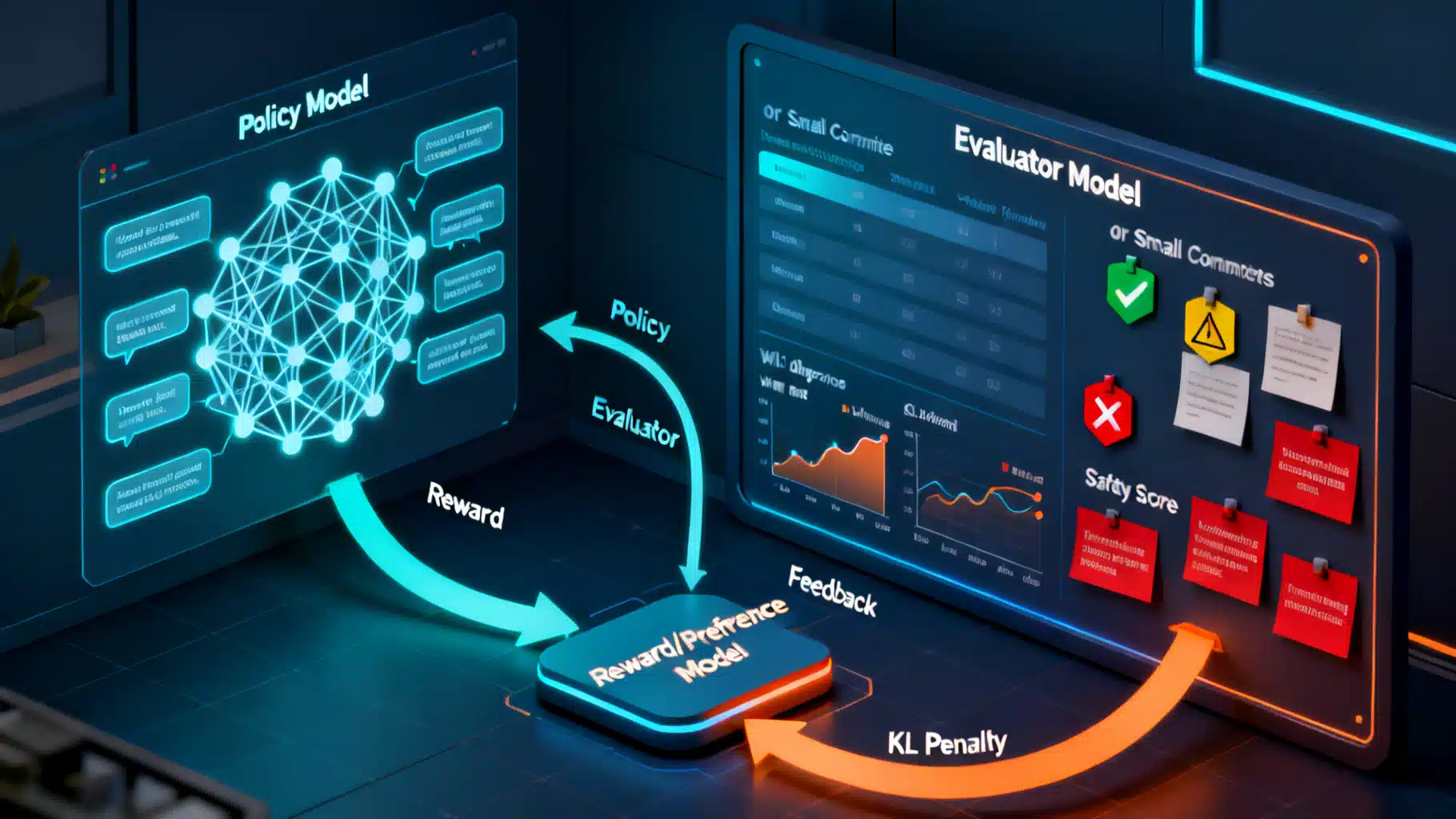
Image used for representation purposes only.
What is Reinforcement Learning from AI Feedback (RLAIF)?
Reinforcement Learning from AI Feedback (RLAIF) is a training paradigm where a model—often a large language model (LLM)—is optimized using feedback generated by other AIs rather than exclusively by humans. An “evaluator” model (or a committee of models) scores, ranks, critiques, or edits candidate outputs from a “policy” model. Those signals drive preference learning or reinforcement learning updates so the policy produces higher‑quality, safer, and more useful outputs over time.
RLAIF extends the idea behind RLHF (Reinforcement Learning from Human Feedback): instead of relying only on costly, slow human labels, it scales training by letting AIs propose judgments that are cheaper and faster to produce, while still being checked or guided by human‑written principles, rubrics, or spot audits.
Why RLAIF now?
- Scale and speed: High‑quality human preference data is expensive. AI feedback can be generated on demand at web scale.
- Coverage and consistency: Evaluators can apply consistent rubrics across long runs, reducing labeler variance.
- Safety iteration: AI judges can continuously red‑team, critique, and refine policies between human review cycles.
- Research flexibility: Teams can quickly prototype new objectives (e.g., helpfulness, harmlessness, style) without spinning up new annotation campaigns from scratch.
The core pipeline
A typical end‑to‑end RLAIF loop looks like this:
- Define objectives and guardrails
- Write explicit rubrics or “principles” that describe what good behavior means: helpfulness, honesty, safety, style, format constraints, etc.
- Optionally encode a “constitution” or policy that the evaluator uses when judging.
- Generate candidate outputs
- Sample multiple responses per prompt from the current policy (vary temperature, top‑p, length, or decoding strategy to ensure diversity).
- Collect AI feedback
- Pairwise preferences: The evaluator ranks A vs. B.
- Multi‑way ranking: The evaluator orders n candidates.
- Scalar rewards: The evaluator assigns a numeric score (e.g., 1–10) along several dimensions (helpfulness, correctness, safety), optionally with a weighted composite.
- Critiques and edits: The evaluator points out flaws and/or proposes an improved response; the critique can guide the next round of samples.
- Fit a reward or preference model
- Train a small “reward model” (RM) to predict evaluator scores or pairwise choices from (prompt, response) pairs.
- Alternatively, train directly on preferences without an intermediate scalar reward.
- Optimize the policy
- RL with a reward model: Use PPO‑style policy gradients with a KL penalty to the base model for stability.
- Preference‑only objectives: Use direct preference optimization methods (e.g., DPO, IPO, KTO, ORPO families) to move probability mass toward preferred completions without an explicit learned reward.
- Rejection sampling / best‑of‑n: At inference or training time, sample many candidates and pick the one with the best evaluator score. This can be combined with light finetuning.
- Evaluate, audit, and iterate
- Measure win rates versus baselines, judge disagreement, and safety metrics.
- Periodically include human audits on a stratified sample (especially on safety‑critical prompts) to correct evaluator drift.
- Refresh the evaluator (and its rubric) when failure patterns emerge.
How RLAIF differs from RLHF
- Source of judgment: RLHF labels come from humans; RLAIF can bootstrap from AI judges, optionally guided by human‑authored principles.
- Cost profile: RLAIF reduces marginal labeling cost but introduces new risks (evaluator bias, self‑reinforcement of model quirks).
- Iteration cadence: RLAIF enables faster inner loops (many more judgments per day) with human “outer loop” oversight.
A robust practice is hybrid: use AI feedback for breadth and speed, and human feedback for calibration, ethics, and hard cases.
Design choices and algorithmic options
- Preference modeling
- Pairwise Bradley–Terry/Luce choice models from ranked comparisons.
- Listwise losses to use full rankings when available.
- Policy optimization
- PPO with KL penalty to a reference policy; reward model trained on evaluator labels.
- Direct Preference Optimization (DPO) and related methods that transform preferences into a simple supervised objective on log‑probabilities.
- Offline weighting: Reweight SFT data by evaluator scores to emphasize high‑quality examples without full RL.
- Decoding and data diversity
- Use temperature sweeps and top‑p ranges to ensure the evaluator sees diverse candidates.
- Mix short/long formats and prompt baskets to avoid overfitting to narrow distributions.
Building a minimal RLAIF system (step‑by‑step)
Below is a practical blueprint you can adapt to most LLM stacks.
- Prepare seed data and rubrics
- Seed prompts: representative tasks (Q&A, summarization, coding, safety‑critical instructions).
- Rubric: a short, explicit checklist for helpfulness, factuality, safety, and style. Consider weightings, e.g., factuality > style.
- Stand up components
- Policy model P0: a base SFT model aligned to instructions.
- Evaluator E: one model (or a committee) prompted with the rubric to score, critique, and rank outputs.
- Optional: Small reward model R trained on evaluator labels.
- Sampling job
- For each prompt x, sample k candidates {y1..yk} from P.
- Feed (x, yi) to E to produce labels: pairwise preferences, scores, and critiques.
- Learning job
- Train R on labeled (x, yi) to minimize preference loss; or skip R if using DPO‑style methods.
- Update policy P using PPO+R, or DPO/IPO‑style objectives on preferred vs. dispreferred pairs.
- Evaluation job
- Compute win rate vs. P0 and a strong baseline on a held‑out set with an independent evaluator (ideally human‑audited).
- Track KL to P0, response length, refusal rates, toxicity, and hallucination proxies.
- Governance and audit
- Run periodic human spot checks on uncertain or high‑impact samples.
- Maintain versioned datasets and evaluator prompts for reproducibility.
Example data schema
{
  "prompt_id": "abc123",
  "prompt": "Explain photosynthesis to a 10-year-old.",
  "candidates": [
    {"id": "y1", "text": "..."},
    {"id": "y2", "text": "..."}
  ],
  "evaluator": {
    "rubric_version": "v1.2",
    "pairwise": [{"winner": "y2", "loser": "y1", "reason": "More age-appropriate"}],
    "scores": {
      "helpfulness": {"y1": 6, "y2": 9},
      "factuality": {"y1": 8, "y2": 8},
      "safety": {"y1": 10, "y2": 10}
    },
    "critique": {"y1": "Too technical.", "y2": "Good analogies."}
  }
}
Training loop sketch (DPO‑style)
for batch in preference_batches:
    x, y_pos, y_neg = batch  # chosen vs. rejected
    loss = - (logp(policy, x, y_pos) - logp(policy, x, y_neg))
    + beta * kl(policy, reference)
    loss.backward(); opt.step()
Practical hyperparameter tips
- Start small: beta (KL) 0.01–0.1 for stability; adjust per domain.
- Keep a frozen reference policy to prevent drift.
- Use early stopping on evaluator win rate and human spot‑checks.
- Mix rejection sampling with training: fine‑tune on best‑of‑n outputs periodically.
Making the evaluator reliable
RLAIF’s power depends on evaluator quality. Key practices:
- Model committees and voting
- Use diverse evaluators (different model families or seeds) and aggregate via majority vote or weighted means.
- Track disagreement as an uncertainty signal; route high‑disagreement cases to humans.
- Calibration and abstention
- Calibrate scores so that a “7/10” means the same thing across tasks.
- Allow evaluators to abstain when unsure; escalate such samples.
- Adversarial and contrastive prompting
- Prompt evaluators to find concrete flaws (factual errors, missing steps, unsafe advice) and to propose fixes.
- Use “compare‑and‑critique” prompts rather than single‑shot scoring.
- Periodic human audits
- Sample by uncertainty, novelty, and safety criticality, not just at random.
- Guard against leakage
- Separate evaluator prompts and policy prompts. Do not let the policy see evaluator rationales during generation unless your objective includes self‑critique.
Evaluation metrics and protocols
- Win rate vs. baseline: Percentage of pairwise comparisons the new policy wins against a strong reference on a held‑out set.
- Reward/ELO: Maintain an ELO‑like rating using your evaluator or a neutral judge model; watch for drift.
- KL to reference: Protects against over‑optimization and mode collapse.
- Quality metrics by dimension: factuality, coherence, harmlessness, style adherence.
- Refusal and verbosity: Track over‑refusals and excessively long answers.
- Safety dashboards: Toxicity, jailbreak success rate, and leakage of sensitive information.
- Human audits: Regular, stratified checks to validate that evaluator preferences match human values.
A robust protocol keeps an “independent judge” (separate from the training evaluator) to reduce evaluation leakage.
Common failure modes (and fixes)
- Over‑optimization on the evaluator (reward hacking)
- Symptom: Outputs that please the evaluator but disappoint humans.
- Fix: Rotate evaluators, add human spot‑checks, regularize with KL, and train evaluators on counterexamples.
- Mode collapse and short answers
- Symptom: Bland or overly concise outputs.
- Fix: Penalize brevity only when harmful; encourage diversity via temperature sweeps; mix SFT refreshes.
- Safety over‑refusal
- Symptom: The policy refuses benign requests.
- Fix: Improve rubric granularity; add positive examples where safe help is allowed.
- Loss of factuality
- Symptom: Confident hallucinations that slip past the evaluator.
- Fix: Add retrieval‑augmented evaluation, fact‑checking tools, and critique‑then‑revise loops.
- Evaluator drift
- Symptom: Gradual change in what the evaluator rewards.
- Fix: Version and pin evaluator prompts; run periodic recalibration and back‑testing.
Compute and infrastructure considerations
- Orchestration: Use asynchronous pipelines where sampling, evaluation, and training run concurrently.
- Caching: Deduplicate (prompt, response) pairs and evaluator computations to control costs.
- Sharding and queues: Prioritize high‑uncertainty or novel prompts for faster learning.
- Dataset hygiene: Version every artifact—prompts, evaluator prompts, labels, model checkpoints, and metrics.
- Reproducibility: Fix seeds, log decoding params, and snapshot evaluator weights and rubrics.
When to use RLAIF vs. RLHF vs. SFT
- Start with SFT (supervised finetuning) on curated, instruction data for a strong baseline.
- Add RLAIF to scale breadth and iterate quickly on multi‑objective behavior, with humans in the loop for oversight.
- Use RLHF when human judgment is irreplaceable (domain expertise, ethics, policy compliance) or where AI evaluators underperform.
In practice, the best systems blend all three: SFT for general skills, RLAIF for rapid iteration and breadth, and targeted RLHF for high‑stakes behaviors.
Putting it all together: a minimal roadmap
- Week 1: Define rubrics and assemble seed prompts. Stand up a single evaluator and a small preference pipeline.
- Weeks 2–3: Run sampling → evaluation → DPO/PPO loops. Add an independent judge and dashboards for win rate, KL, and safety.
- Weeks 4–6: Introduce evaluator committees, human audits on high‑uncertainty items, and retrieval‑augmented evaluation for factuality.
- Ongoing: Periodically refresh prompts, rotate evaluators, and harden against reward hacking.
Outlook
RLAIF is not a replacement for human judgment—but it is a force multiplier. With clear rubrics, careful evaluator design, and disciplined measurement, teams can ship models that are more helpful, more robust, and safer, while reserving scarce human expertise for the highest‑leverage decisions. The future likely belongs to hybrid systems that combine human values, AI scale, and principled optimization into one continuous training loop.
Related Posts

RLHF Explained: How Human Feedback Steers Reinforcement Learning
A clear, practical guide to RLHF—how human preferences train models, the pipeline, pitfalls, and modern variants like DPO and RLAIF.

Constitutional AI: A Practical Guide to Alignment with Principles
Learn how Constitutional AI aligns models using explicit principles, self-critique, and AI feedback, with recipes, code, and evaluation tips.

Mustafa Suleyman’s Hard Line: Microsoft AI’s “Humanist” Code Takes Aim at Consciousness Claims
Microsoft AI chief Mustafa Suleyman unveils a “Humanist AI” code and challenges Anthropic’s stance on AI consciousness as labs call to “pace the frontier.”