
Prompt Chaining: Designing Reliable Multi‑Step AI Workflows
A practical guide to building robust multi-step AI pipelines with prompt chaining, orchestration patterns, state, testing, guardrails, and cost control.
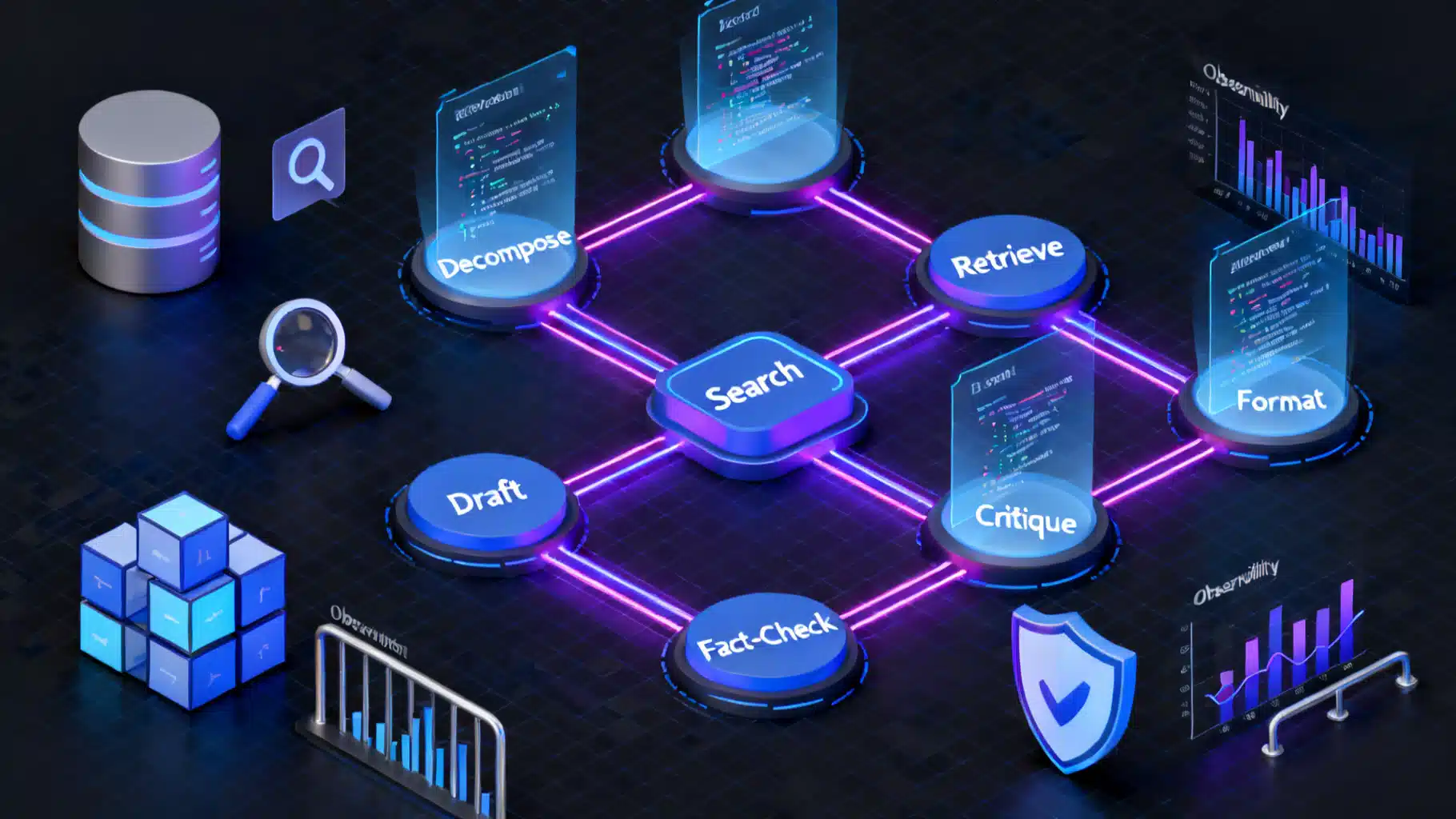
Image used for representation purposes only.
Overview
Prompt chaining is the practice of decomposing a complex task into a sequence (or graph) of smaller LLM prompts, each with clear inputs and outputs. Instead of asking a model to “do everything,” you build a multi-step workflow that promotes reliability, traceability, and control. This article explains when to use prompt chaining, common orchestration patterns, how to design robust steps, and how to ship production-grade multi-step AI systems.
Why prompt chaining?
Single-shot prompts work for simple tasks, but they struggle when you need:
- Structured outputs with strict formats or schema compliance.
- Deterministic behavior across varied inputs.
- Tool use (search, databases, code execution) with checks and balances.
- Auditability and partial retries when a subtask fails.
Chaining reduces cognitive load on the model, lets you validate incremental outputs, and makes failures localized and recoverable.
Core concepts
- Units of work: Each step is a narrowly scoped prompt with a contract: input schema, output schema, side effects (if any), and success/failure conditions.
- State: A shared store (JSON object, document graph, or key–value cache) that carries artifacts—queries, snippets, drafts, citations—between steps.
- Orchestrator: The engine coordinating execution order, concurrency, retries, and human-in-the-loop checkpoints.
- Guardrails: Constraints and validators (schema checks, regex, Pydantic/JSON Schema, content filters) applied at step boundaries.
- Observability: Logs, traces, token/cost metrics, wall-clock latency, and step-level quality signals.
When chaining beats agents—and when it doesn’t
- Prefer chaining when the path is known: e.g., “ingest → retrieve → draft → fact-check → format.” You gain predictability and easy debugging.
- Prefer agent-style loops when the path is unknown and requires iterative tool selection. Even then, constrain the loop with a policy and time/tool budgets.
- Hybrid: Use a DAG with one or two agentic nodes for exploration while keeping the rest deterministic.
Common workflow patterns
- Linear pipeline: S1 → S2 → S3. Simple and fast to reason about.
- Branching: A classifier step routes inputs to distinct subflows (e.g., sentiment → reply vs. escalate).
- Map–reduce: Fan out a prompt across a set (documents, URLs), then consolidate.
- Iterative refinement: Draft → critique → revise loops with a capped number of cycles.
- Human-in-the-loop: Gate steps that carry risk (compliance, tone, large purchases) for approval.
- Tool-augmented nodes: Steps that call search APIs, databases, vector stores, or code execution sandboxes.
Designing a step contract
Each step should specify:
- Purpose: What sub-problem it solves.
- Inputs: Required fields and types.
- Prompt template: With placeholders and explicit instructions.
- Output schema: JSON fields, enums, number ranges; include examples.
- Validation: Schema checks, semantic assertions (e.g., “citations must be present for each claim”).
- Failure policy: Retry, backoff, alternate model, or escalate to human.
Example JSON schema (simplified):
{
  "type": "object",
  "properties": {
    "thesis": {"type": "string", "minLength": 5},
    "outline": {"type": "array", "items": {"type": "string"}},
    "sources": {"type": "array", "items": {"type": "string", "pattern": "^https?://"}}
  },
  "required": ["thesis", "outline"],
  "additionalProperties": false
}
Example: A research-and-write pipeline (end-to-end)
We’ll outline a multi-step workflow that turns a topic into a fact-checked article with citations.
- Decompose the task
- Input: user_topic
- Output: refined_topic, subquestions[]
- Notes: This tightens scope and identifies answerable pieces.
- Search and gather
- Input: subquestions[]
- Output: sources[] with URLs, snippets, and confidence
- Tool: web search API or enterprise search
- Retrieve and chunk
- Input: sources[]
- Output: chunks[] (embeddings, metadata)
- Tool: vector database; chunking rules
- Draft synthesis
- Input: chunks[], subquestions[]
- Output: draft sections mapped to subquestions
- Critique and gap analysis
- Input: draft, subquestions[]
- Output: issues[], missing_citations[]; optionally proposed revisions
- Fact-check and cite
- Input: draft, chunks[]
- Output: corrected_draft with inline citations
- Guardrails: require source mapping for each factual claim
- Final formatting
- Input: corrected_draft
- Output: markdown_article with title, headings, references
Code-first orchestration (Python-like pseudocode)
from typing import Dict, List
from pydantic import BaseModel, ValidationError

class DecomposeOut(BaseModel):
    refined_topic: str
    subquestions: List[str]

class Source(BaseModel):
    url: str
    snippet: str
    confidence: float

class DraftOut(BaseModel):
    sections: Dict[str, str]  # subquestion -> text

state = {}

@retry(times=2, backoff=2)
def step_decompose(topic: str) -> DecomposeOut:
    prompt = f"""
    Task: Break the topic into 3-6 research subquestions.
    Topic: {topic}
    Return JSON with refined_topic and subquestions.
    """
    raw = llm(prompt)
    return DecomposeOut.model_validate_json(raw)

@retry(times=2)
def step_search(subqs: List[str]) -> List[Source]:
    results = []
    for q in subqs:
        hits = web_search_api(q)
        results.extend([Source(url=h.url, snippet=h.snippet, confidence=h.score) for h in hits])
    return dedupe_and_rank(results)

@retry(times=2)
def step_draft(chunks: List[str], subqs: List[str]) -> DraftOut:
    sys = "You are a precise researcher. Cite only provided material."
    prompt = template("draft_synthesis.txt", chunks=chunks, subqs=subqs)
    raw = llm(sys, prompt)
    return DraftOut.model_validate_json(raw)

# ... critique, factcheck, format steps ...

try:
    d = step_decompose(user_topic)
    state.update(d.model_dump())
    sources = step_search(d.subquestions)
    chunks = build_chunks_and_embeddings(sources)
    draft = step_draft(chunks, d.subquestions)
    issues = step_critique(draft, d.subquestions)
    fixed = step_factcheck(draft, chunks, issues)
    article = step_format(fixed)
except ValidationError as e:
    log_failure(e.json())
    raise
Declarative DAG (YAML-like)
steps:
  decompose:
    uses: llm
    input: {topic: ${inputs.topic}}
    output_schema: DecomposeOut
  search:
    uses: web.search
    needs: [decompose]
    input: {queries: ${decompose.subquestions}}
  retrieve:
    uses: vector.retrieve
    needs: [search]
    input: {sources: ${search.results}}
  draft:
    uses: llm
    needs: [retrieve, decompose]
    input: {chunks: ${retrieve.chunks}, subqs: ${decompose.subquestions}}
    output_schema: DraftOut
  critique:
    uses: llm
    needs: [draft, decompose]
  factcheck:
    uses: llm+rules
    needs: [draft, critique, retrieve]
  format:
    uses: templating
    needs: [factcheck]
Prompt design per step
- Minimal context: Only pass the inputs the step needs. Extraneous context increases cost and error surface.
- Role and constraints: “You are a precise researcher. Use only provided chunks. If missing data, say ‘INSUFFICIENT EVIDENCE.’”
- Output-first: Define the JSON schema and include 1–2 valid examples. Instruct the model to “respond with JSON only, no prose.”
- Self-checks: Ask the model to validate its own output against the schema or enumerate uncertainties before emitting the final JSON.
- Determinism levers: Lower temperature for classification/extraction; use higher temperature for creative drafting nodes.
State, memory, and data contracts
- Immutable artifacts: Treat outputs as versioned blobs in object storage with content hashes. This enables reproducibility and caching.
- Minimal mutable state: Keep a small run-state (pointers, IDs, step statuses). Avoid cross-step hidden dependencies.
- Provenance: Attach source/document IDs and offsets to claims. Store them beside the text to recover traceability.
Guardrails and validation
- Structural: JSON Schema/Pydantic validation; reject unparseable or schema-violating outputs.
- Semantic: Domain rules (e.g., “all currency amounts in USD,” “no PII in summaries”).
- Content safety: Block unsafe or disallowed outputs at step boundaries.
- Policy prompts: Encode style guides, compliance standards, and allowed citations.
- Adversarial inputs: Normalize encodings, filter prompt injections, and clip context to trusted chunks only.
Testing and evaluation
- Unit tests: Golden input–output pairs for each step; assert JSON schema and semantic invariants.
- Pipeline tests: End-to-end runs with fixed seeds and mocked tools for determinism.
- Regression suite: Lock in improvements; catch drift when models or prompts change.
- Metrics:
- Structural validity rate (% of outputs that pass schema).
- Hallucination rate (claims without sources).
- Task success rate (human-graded or rule-based).
- Cost and latency per step and end-to-end.
- Evaluation harness: Maintain sampled datasets and use rubric-based LLM grading plus spot human review.
Performance and cost control
- Caching: Memoize step outputs keyed by input hash, prompt, and model version.
- Partial retries: Only rerun the failed node and its dependents.
- Context economy: Aggressive chunk selection and rankers before passing to LLMs.
- Streaming: Start rendering UI from early nodes while later nodes compute.
- Model selection: Small/fast models for routing/extraction; larger models reserved for synthesis.
- Batch fan-out: For map steps, batch requests and use concurrency with rate limiting.
Observability and operations
- Tracing: Correlate every token back to a step ID and prompt version.
- Prompt/version registry: Track prompt templates, model versions, and parameter settings.
- Cost dashboards: Tokens, dollars, cache hit rates, and retry counts.
- Incident tooling: Capture failed artifacts, inputs, and validation errors for swift triage.
Security, privacy, and compliance
- Data classification: Route sensitive inputs to isolated models or on-prem endpoints.
- Redaction: Remove PII before logging or sending to third parties.
- Secrets: Store API keys in a vault; never inline secrets into prompts.
- Least privilege: Scope tool tokens narrowly (read vs. write operations).
- Audit: Immutable logs of prompts, outputs, and approvals for regulated domains.
Deployment and versioning
- CI/CD: Lint prompts, run schema checks, and execute the eval harness on every change.
- Canary releases: Roll out to a small cohort, monitor metrics, then ramp.
- Rollbacks: Keep immutable prompt+model bundles; revert quickly if metrics regress.
- AB testing: Compare alternative chains, prompts, or model choices with guardrail-equivalent policies.
Anti-patterns to avoid
- Monolithic prompts doing too much—hard to debug and expensive.
- Passing entire documents when you only need a handful of snippets.
- No schema or weak schema—leads to brittle downstream parsing.
- Silent failures—lack of validation means garbage propagates.
- Infinite agent loops—always cap tool calls, depth, and time.
A practical checklist
- Define the user outcome and acceptance criteria.
- Draft the DAG with clear inputs/outputs for each node.
- Write output-first prompts with examples and JSON schemas.
- Add validators and failure policies per node.
- Implement caching and partial retries.
- Instrument tracing, cost metrics, and quality signals.
- Build a regression-friendly eval set and run it in CI.
- Plan for safe deployment: canary, AB test, rollback.
Closing thoughts
Prompt chaining is about engineering discipline more than model magic. By carving a big problem into verifiable steps, encoding expectations in schemas, and operating with strong observability, you can turn LLM capabilities into predictable, maintainable products. Start small, add guardrails early, measure relentlessly, and iterate on the places where your users feel the most friction.
Related Posts
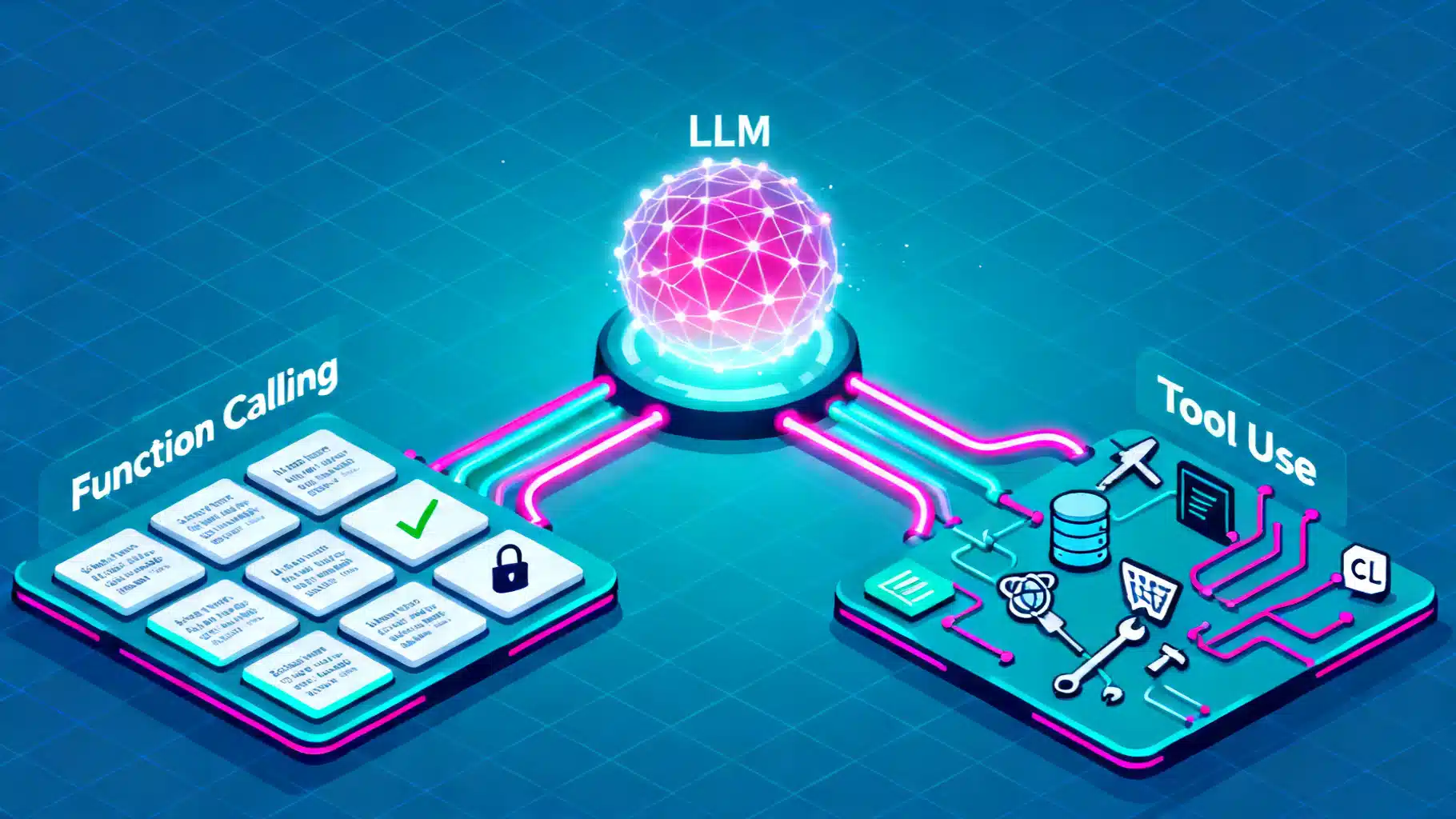
Function Calling vs. Tool Use in LLMs: Architecture, Trade-offs, and Patterns
A practical guide to function calling vs. tool use in LLMs: architectures, trade-offs, design patterns, reliability, security, and evaluation.

AI Agent Debugging: A Practical Guide to Observability Tools
Build end-to-end observability for AI agents: traces, metrics, logs, and evals to debug, govern privacy, and scale quality, reliability, and cost.

AI Text Summarization API Comparison: A Practical Buyer’s Guide for 2026
A practical, vendor-agnostic guide to evaluating, implementing, and scaling AI text summarization APIs in 2026.