
Designing a REST–GraphQL Hybrid Architecture: Patterns, Trade‑offs, and Playbook
Design a pragmatic REST–GraphQL hybrid: patterns, trade‑offs, caching, security, federation, and migration steps to ship faster without breaking what works.
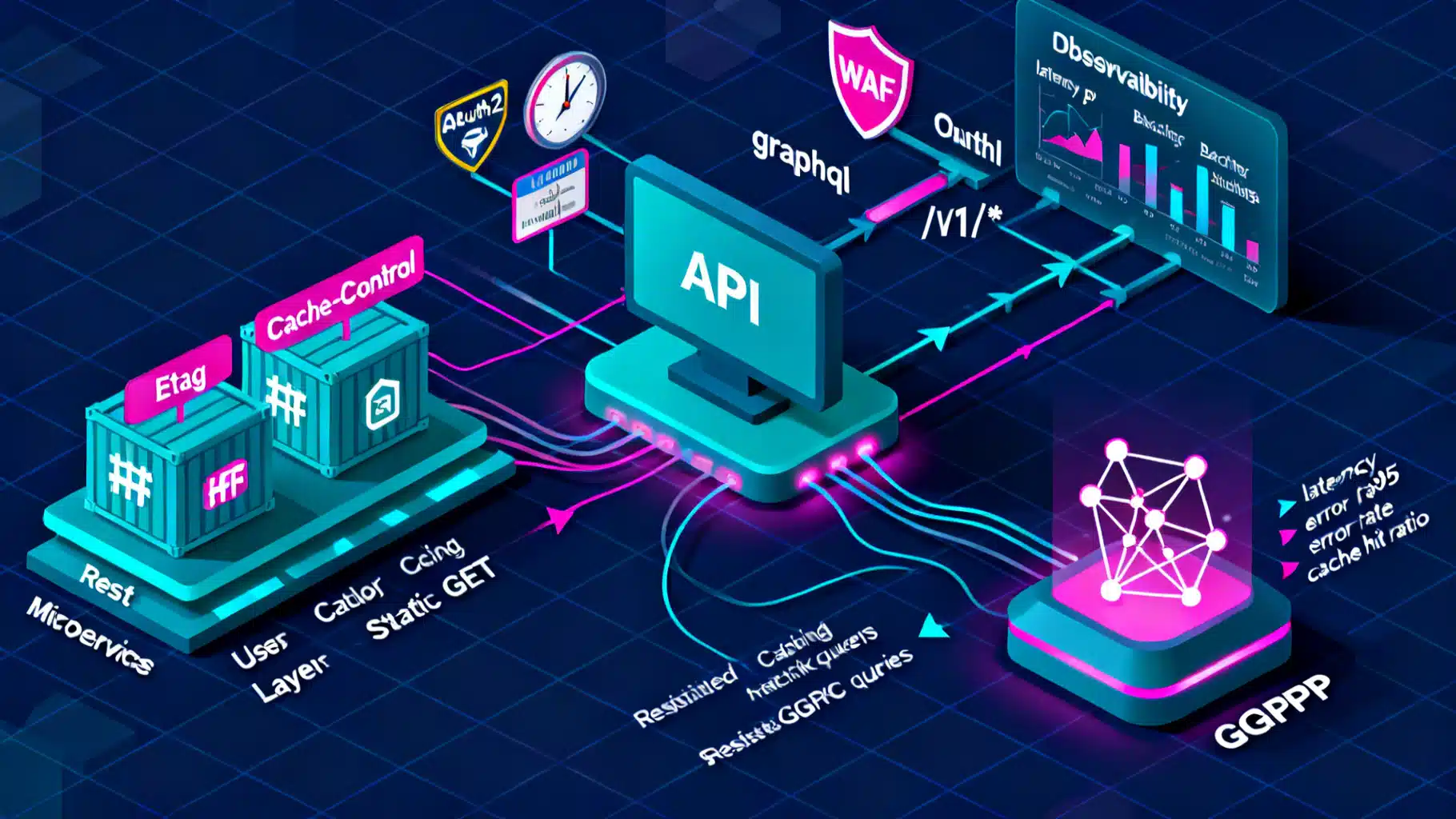
Image used for representation purposes only.
Overview
Hybrid REST–GraphQL architectures combine the predictability and caching strengths of REST with the flexibility and client‑driven queries of GraphQL. In practice, most organizations don’t replace all REST services with GraphQL at once; they layer GraphQL where it delivers the most value (aggregation, schema cohesion, product iteration speed) while keeping stable REST endpoints for high‑throughput, cache‑friendly operations. This article explains the main patterns, design trade‑offs, and implementation details to help you design a robust hybrid.
When a Hybrid Architecture Makes Sense
- You already have mature REST services and SLAs you don’t want to jeopardize.
- Mobile or multi‑surface clients need tailored payloads to reduce chatty calls and over/under‑fetching.
- You need a single, typed graph across domains (users, orders, inventory) without a big‑bang migration.
- CDN caching for certain resources (e.g., product details, images) is critical and works better with REST and HTTP semantics.
- Teams want strong contracts and evolution without breaking existing consumers.
Core Patterns
- GraphQL as an Aggregation Layer over REST
- A GraphQL server (“BFF for frontends”) resolves fields by calling existing REST services.
- Pros: Fast to adopt; keeps domain microservices intact. Cons: Potential N+1 calls unless batched.
- Mixed Gateway with Smart Routing
- API gateway exposes a single entry point, routing some paths to REST (e.g., /v1/products) and others to /graphql.
- Pros: Clean coexistence; centralized auth, rate limits. Cons: Requires careful traffic management and documentation.
- Domain Graphs with Federation + REST Backends
- Teams own subgraphs that still call their domain’s REST microservices under the hood.
- Pros: Scales with teams; contracts by schema. Cons: Requires federation ops, composition checks, and observability.
- GraphQL for Read, REST for Write (or Vice Versa)
- Use GraphQL queries for flexible reads; keep idempotent writes or bulk operations in REST for stronger HTTP semantics.
- Pros: Leverages HTTP verbs, ETags, and caching on writes/reads where appropriate. Cons: Two mental models for clients.
High‑Level Reference Architecture
- Clients: Web, mobile, partner integrations.
- Edge: CDN, WAF, bot protection.
- API Gateway: AuthN/Z, routing, quotas, global headers.
- GraphQL Layer: Schema, resolvers, batching, persisted queries, DataLoader.
- REST Services: Domain microservices (users, catalog, orders), often with OpenAPI specs.
- Data: SQL/NoSQL stores, caches, search indexes.
- Observability: Tracing, metrics, logs, error analytics.
# Example: Gateway routes
routes:
  - match:
      - path: /graphql
    upstream: graphql-service:4000
  - match:
      - path_prefix: /v1/
    upstream: rest-aggregate:8080
policies:
  auth: oauth2
  rate_limits:
    - key: user_id
      limit: 1000/min
  cors:
    origins: ["https://app.example.com"]
GraphQL Over REST: Resolver Example
// TypeScript (Node.js) using DataLoader for batching REST calls
import DataLoader from 'dataloader';
import fetch from 'node-fetch';

const productLoader = new DataLoader(async (ids: readonly string[]) => {
  const resp = await fetch(`https://api.example.com/v1/products?ids=${ids.join(',')}`);
  const products = await resp.json();
  const map = new Map(products.map((p: any) => [p.id, p]));
  return ids.map(id => map.get(id));
});

export const resolvers = {
  Query: {
    product: (_: any, { id }: { id: string }) => productLoader.load(id),
    products: (_: any, { ids }: { ids: string[] }) => productLoader.loadMany(ids)
  },
  Product: {
    reviews: async (p: any) => {
      const r = await fetch(`https://reviews.example.com/v1/reviews?productId=${p.id}`);
      return r.json();
    }
  }
};
# SDL snippet
 type Query {
   product(id: ID!): Product
   products(ids: [ID!]!): [Product!]!
 }
 type Product {
   id: ID!
   title: String!
   price: Money!
   reviews: [Review!]!
 }
 type Money { amount: Float!, currency: String! }
 type Review { id: ID!, rating: Int!, comment: String }
Choosing Where REST Shines vs. Where GraphQL Wins
- REST best for: Public CDN‑cached GETs, asset delivery, webhooks, bulk exports, long‑lived stable integrations.
- GraphQL best for: Aggregated domain graphs, dynamic UI queries, joining across services, rapid product iteration, type‑safe contracts.
Contract Management and Documentation
- REST: Maintain OpenAPI specs, ensure semantic versioning (MAJOR.MINOR.PATCH), document headers and error codes.
- GraphQL: Publish a versioned schema registry; enforce composition checks in CI; generate typed SDKs for clients.
// OpenAPI extract for a stable REST endpoint
{
  "openapi": "3.0.3",
  "paths": {
    "/v1/products/{id}": {
      "get": {
        "responses": {
          "200": { "description": "OK" },
          "404": { "description": "Not Found" }
        }
      }
    }
  }
}
Security Model
- Authentication: OAuth 2.0 / OIDC at the gateway; mTLS between gateway and services.
- Authorization: Central policy engine (e.g., OPA) or schema directives for field‑level rules in GraphQL.
- Threat controls: Query cost/complexity limits, depth limits, persisted queries, rate limiting, and input validation.
- Data protection: Enforce least privilege for resolvers; never leak internal errors in GraphQL’s errors array; PII masking in logs.
Caching and Performance
- REST: Leverage ETag/If‑None‑Match, Cache‑Control, and CDN surrogate keys for hot GETs.
- GraphQL: Use persisted queries and CDN caching keyed by SHA256 of the operation + variables; cache resolvers with TTL where safe.
- Batching: DataLoader or gateway‑level request collapsing to avoid N+1 calls.
- Partial results: Leverage @defer/@stream where supported to improve TTFB for large lists.
GET /v1/products/123 HTTP/1.1
If-None-Match: "W/\"6c1a-...\""
Pagination Strategy
- For REST endpoints, keep offset/limit for simple, cacheable lists; support cursor pagination for large/real‑time datasets.
- For GraphQL, prefer cursor connections (edges/nodes, pageInfo) to support stable pagination and relay‑style tooling.
type ProductConnection {
  edges: [ProductEdge!]!
  pageInfo: PageInfo!
}

type PageInfo { hasNextPage: Boolean!, endCursor: String }
Error Handling and Status Codes
- REST: Use canonical HTTP codes; provide machine‑readable error bodies with codes and docs pointers.
- GraphQL: Return 200 with partial data and an errors array for resolver failures; elevate to 4xx/5xx when the whole operation is invalid or unauthorized.
{
  "errors": [
    {
      "message": "Unauthorized",
      "extensions": { "code": "UNAUTHENTICATED" },
      "path": ["product", "price"]
    }
  ],
  "data": { "product": { "title": "…", "price": null } }
}
Observability and SLOs
- Tracing: Propagate trace IDs from gateway to resolvers and REST calls (W3C Trace Context). Visualize in your APM.
- Metrics: p50/p95 latency per field and operation name; REST endpoint RPS and cache hit ratio; GraphQL error rate by resolver.
- Logging: Structured logs with request IDs, user identity (if allowed), and input sizes; redact secrets.
- SLOs: Distinct SLOs for REST and GraphQL; e.g., 99.9% for core REST catalog GETs, 99.5% for GraphQL aggregation queries.
Tooling and Governance
- Schema registry: Track changes, diff schemas, alert on breaking changes.
- OpenAPI + GraphQL codegen: Generate client SDKs, types, and docs portals.
- Contract tests: Validate that GraphQL resolvers conform to REST contracts and that REST responses match OpenAPI.
- Linting: Enforce naming conventions, nullability, and deprecation annotations in GraphQL.
Migration Playbook
- Inventory and classify REST endpoints by traffic, cacheability, and business criticality.
- Introduce a GraphQL BFF for one high‑value surface (e.g., product detail page) that aggregates 3–5 REST calls.
- Add DataLoader, persisted queries, and error mapping. Measure latency and error budgets.
- Expand graph coverage domain by domain; publish a public schema; start schema‑first development.
- For large orgs, adopt federation and ownership boundaries (e.g., catalog subgraph, accounts subgraph).
- Optimize: enforce query cost limits, field‑level auth, and CDN caching for persisted queries.
Common Anti‑Patterns
- Massive “God schema” with no ownership: adopt subgraphs and clear boundaries.
- Hiding slow REST under GraphQL without fixing root causes: instrument, batch, and cache.
- Overusing GraphQL for bulk exports or large binary payloads: keep those in REST.
- Versioned GraphQL schemas via URLs (/v2/graphql): prefer iterative, non‑breaking evolution and deprecations.
Mini Case Study: Acme Commerce
- Situation: REST microservices for catalog, pricing, and reviews. Mobile team faces over‑fetching and multiple round‑trips.
- Approach: Add a GraphQL BFF that stitches catalog + reviews, leaves pricing as a CDN‑cached REST endpoint for hot GETs.
- Results: Product detail payload reduced from 3.2 MB to 900 KB; TTFB p95 from 920 ms to 420 ms after batching and persisted queries; cache hit ratio for REST product images at 94%.
- Next Steps: Move to federated subgraphs owned by teams; enforce query cost limits; add field‑level authorization directives.
Read vs. Write Tactics
- Writes: Keep REST for idempotent PUT/PATCH with ETags and concurrency control; expose transactional invariants clearly.
- Reads: Use GraphQL for composite views (e.g., cart with personalized promotions). Consider @defer for incremental hydration.
Example AuthZ via Directives
# Schema directive for role-based access (example only)
directive @requiresRole(role: String!) on FIELD_DEFINITION

type Query {
  me: User @requiresRole(role: "user")
}

type User { id: ID!, email: String! }
Deliverables for Production Readiness
- REST: OpenAPI docs, golden tests, synthetic canaries, CDN config.
- GraphQL: Persisted queries, cost limits, schema registry, field‑level metrics, resolvers with timeouts and circuit breakers.
- Gateway: Global auth, rate limits, WAF rules, error mapping, traffic splitting.
Checklist
- Define ownership per domain (service, subgraph, on‑call).
- Establish non‑breaking change policy and deprecation windows.
- Instrument end‑to‑end tracing and per‑field metrics.
- Implement batching and caching to eliminate N+1 issues.
- Publish unified docs portal for REST (OpenAPI) and GraphQL (SDL + Playground, but lock to prod tokens).
- Test failure modes: REST 500 under GraphQL; gateway timeouts; partial data strategies.
Conclusion
A REST–GraphQL hybrid lets you keep what already works—HTTP semantics, CDN caching, stable contracts—while layering a flexible, typed graph where you need it most. Start with a thin GraphQL aggregation layer, instrument thoroughly, and evolve toward federation and strong governance. The winning architectures are pragmatic: they optimize for product velocity and reliability, not dogma.
Related Posts

GraphQL to REST Migration: A Practical, Low‑Risk Guide
Step-by-step guide to migrate APIs from GraphQL to REST: design mapping, caching, auth, rollout, and pitfalls to avoid.
Designing REST APIs with Partial Response Field Selection (fields, select, $select)
Design and implement REST API partial responses for speed and safety—syntax options, caching, security, and implementation patterns with examples.

GraphQL Schema Design Best Practices: A Practical Guide
Practical best practices for GraphQL schema design: naming, types, pagination, nullability, errors, auth, evolution, and performance.