
Television in 2026: Streaming’s new normal, sports’ big reshuffle, and the return of ads
TV in 2026: Streaming leads, sports rights reset distribution, and ad‑supported viewing dominates as platforms rebundle and events still drive spikes.
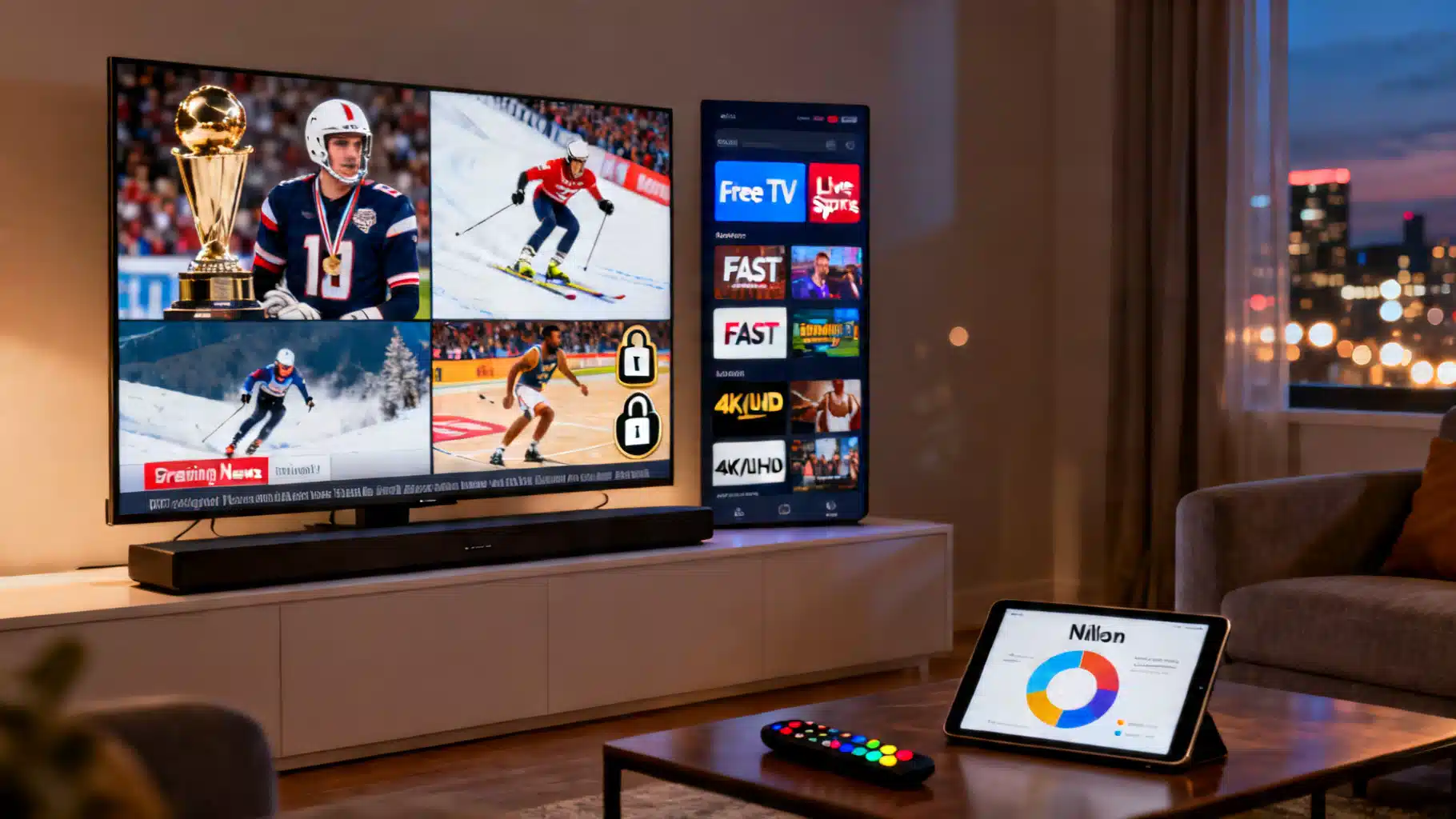
Image used for representation purposes only.
The State of Television in 2026: Streaming ascendant, sports reshape the grid, and ads roar back
A decade-long shift has reached a new equilibrium. Streaming now defines how Americans watch TV, while live sports and event programming concentrate cultural moments across a growing mix of broadcast, cable, and apps. As the 2026 upfronts approach, fresh data and new rights deals show an industry reorganizing around reach, real-time viewing, and ad-supported economics.
The viewing pie: streaming leads, events still spike
- In May 2025, streaming’s share of total TV usage surpassed the combined share of broadcast and cable for the first time, a watershed captured by Nielsen’s The Gauge. (nielsen.com )
- January 2026 set a 12‑month high for TV usage as football and winter weather lifted viewing, with cable climbing to 21.2% of total TV; “Stranger Things” led streaming programs by minutes viewed. (nielsen.com )
- February 2026 illustrated how tentpole events still move mountains: Super Bowl LX and the Milan–Cortina Winter Olympics propelled NBCU–Versant to the top among media companies and pushed Peacock to its best share yet at 3.0% of total TV in The Gauge. (nielsen.com )
Sports rights redraw the channel guide
- NBA: An 11‑year suite of deals begins with the 2025–26 season, keeping ABC/ESPN in place while bringing NBC/Peacock back and adding Amazon’s Prime Video. The agreements run through 2035–36 and re-balance distribution across broadcast, cable, and streaming. (pr.nba.com )
- WNBA: Starting with the 2026 season, the league’s landmark 11‑year agreements distribute games across Disney (ABC/ESPN and a DTC service), NBCU/Versant (NBC, USA Network, Peacock) and Prime Video globally; USA Network will televise at least 50 games annually under a separate long‑term pact. (wnba.com )
- NASCAR: From 2025–31, Prime Video and TNT Sports split a midseason package, joining FOX and NBC. Early Prime Video races delivered a younger audience and new on‑screen analytics like the “Burn Bar,” previewing how tech will augment live viewing. (nascar.com )
- MLB: For 2026–28, baseball added short‑cycle national packages with ESPN and NBCU and introduced Netflix into the mix for select events such as Opening Night and Home Run Derby, signaling streamers’ growing appetite for live sports. (forbes.com )
- WWE: Netflix became the exclusive home of Monday Night Raw in the U.S. and several regions in January 2025, with the premiere drawing 2.6 million U.S. households and 4.9 million global views—another proof point that weekly live franchises travel to streaming. (about.netflix.com )
Local sports: the RSN reset accelerates
- With regional sports in flux, teams and leagues are experimenting. The Atlanta Braves will bring more than 140 games to a new in‑house channel, BravesVision, beginning in the 2026 season. MLB is also widening direct distribution of select clubs through its own platforms this year as it stabilizes local rights. (apnews.com )
Monetization pivots: ad-supported rules again
- Ad‑supported TV (across broadcast, cable, and streaming) represented 74.2% of overall viewing in Q4 2025, underscoring that “free” and “with ads” now anchor the mainstream experience. (nielsen.com )
- FAST leaders continue to climb inside The Gauge: in January 2026, Nielsen reported gains for both The Roku Channel and Tubi as free, ad‑supported options deepen their hold on incremental reach. (nielsen.com )
- Amazon tightened its model: on April 10, 2026, the ad‑free add‑on became Prime Video Ultra at $4.99/month and locked 4K/UHD behind the paid tier, while expanding concurrent streams and downloads—a signal that platform economics will keep evolving. (aboutamazon.com )
Bundling 2.0: live TV streamers and new packs
- YouTube TV will roll out à‑la‑carte, genre‑based “Plans” in early 2026, a modular spin on the cable bundle designed to soften price sensitivity and improve choice. (blog.youtube )
- ESPN’s flagship direct‑to‑consumer service launched in the U.S. on August 21, 2025, with bundle options alongside Disney+ and Hulu. In April 2026, ESPN expanded on Disney+ in Europe and parts of APAC, reflecting Disney’s strategy to weave sports deeper into a global super‑app. (espnpressroom.com )
Corporate map: NBCU’s cable spinoff becomes Versant
Comcast completed the spin‑off of most NBCUniversal cable networks and related digital assets into Versant (Nasdaq: VSNT) on January 2, 2026. The move separates brands like USA Network, CNBC, E!, SYFY, Golf Channel and the newly rebranded MS NOW from NBC’s remaining operations, while ad sales coordination with NBCU continues. February’s Gauge reports referenced the combined “NBCU–Versant” footprint during the Olympics/Super Bowl surge. (cmcsa.gcs-web.com )
What it means at the upfronts
- Audience: Streaming leads total usage, but live events keep broadcast and cable culturally central during peak moments. Marketers will need cross‑platform frequency controls and unified measurement to capture both. (nielsen.com )
- Inventory: Ad‑supported viewing dominates, with FAST and AVOD growth expanding incremental reach among light‑TV and cord‑cutting homes. (nielsen.com )
- Investment: The IAB and independent trackers point to double‑digit U.S. CTV ad‑spend growth in 2026, as buyers reallocate from linear into addressable, sports, and shoppable formats. Nielsen’s 2026 Upfront Planning Guide highlights that 18–49‑year‑olds now spend two‑thirds of ad‑supported TV time with streaming. (iab.com )
Dates and developments to watch
- April 10, 2026: Prime Video Ultra goes live in the U.S., with 4K/UHD exclusive to the tier. (aboutamazon.com )
- May–June 2026: Spring sports overlap intensifies on linear and apps; WNBA’s first season under its new media framework begins. (wnba.com )
- 2025–26 seasons: NBA’s new media era ramps with Disney, NBC/Peacock, and Prime Video; streamers push deeper into premium live rights. (pr.nba.com )
- Throughout 2026: RSN alternatives expand (team‑owned channels, league DTC), testing price, reach, and blackout rules market‑by‑market. (apnews.com )
Bottom line
Television in 2026 is a study in convergence: streaming sets the pace, but appointment viewing—especially live sports—still drives the biggest spikes. The winners this year will be those who buy and sell across boundaries: mixing broadcast mass with streaming precision, leaning into FAST for incremental reach, and exploiting sports’ gravitational pull while the rights map keeps shifting.
Related Posts
The Roku Channel in 2026: FAST leader adds channels, expands on Fire TV, and doubles down on originals
The Roku Channel’s 2026 surge: new free channels, Fire TV integration, and Originals fuel a FAST leader’s momentum.
The State of the TV App in 2026: Sports, Ads, FAST, and the Return of Bundles
In 2026, the TV app is the battleground: sports drive redesigns, ads go default, bundles return, and FAST channels hit 100M+ users.
Amazon sued over ‘bricked’ Fire TV Sticks: What the April 2026 class action means for consumers
New class action alleges Amazon ‘bricked’ older Fire TV Sticks by ending software support. What the April 2026 case claims and what owners should know.