
App Store adds 12‑month commitment subscriptions: annual prices, paid monthly — U.S. excluded at launch
Apple adds monthly billing with a 12‑month commitment for App Store subscriptions, rolling out in May 2026 — not initially in the U.S. or Singapore.
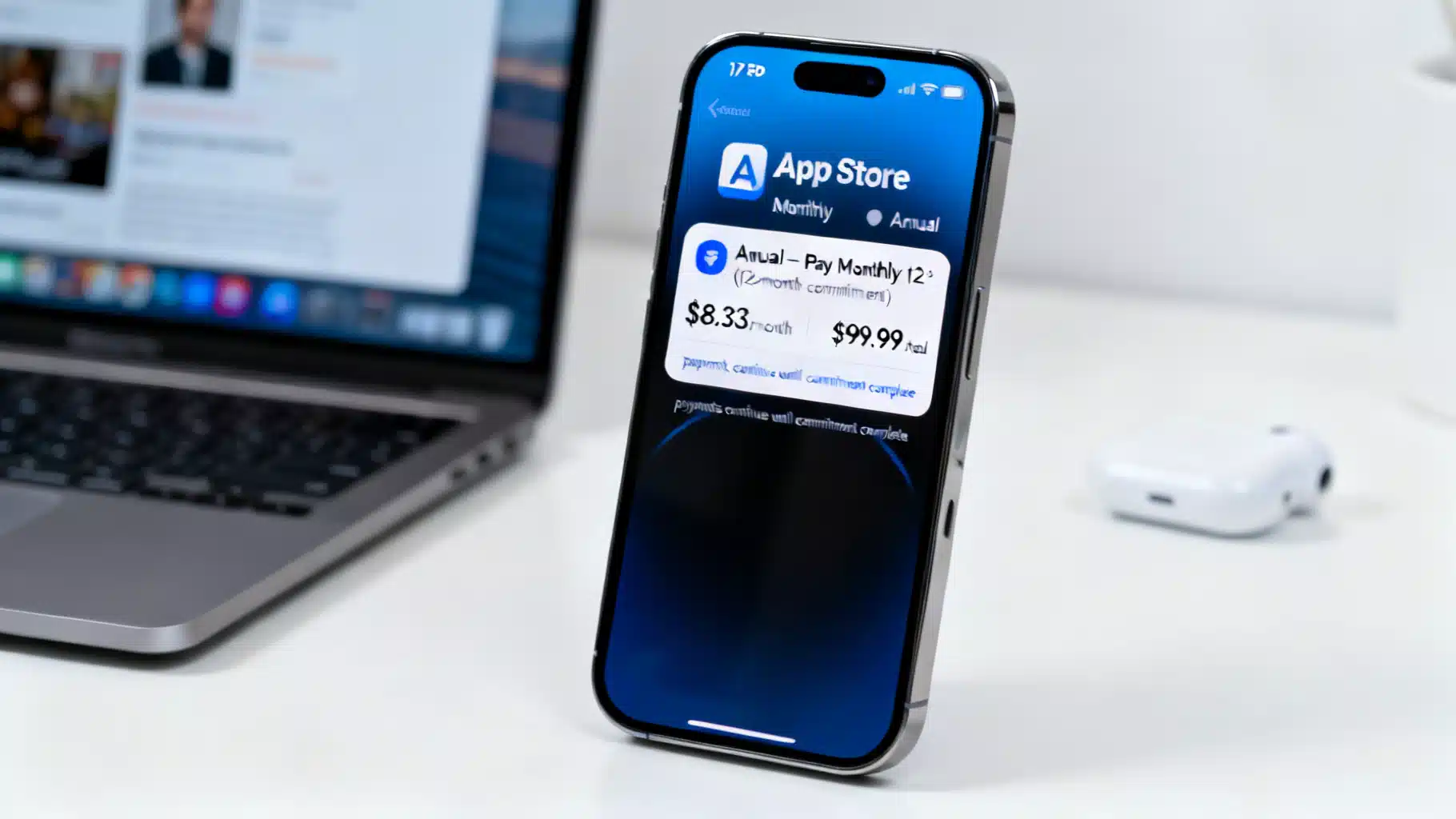
Image used for representation purposes only.
Apple brings 12‑month commitment subscriptions to the App Store — annual pricing, paid monthly
Apple has introduced a new way to pay for in‑app subscriptions: monthly billing with a 12‑month commitment. Announced on April 27, 2026, the option gives users access to the lower “annual” price while spreading payments over 12 installments — but they remain on the hook for the full year once they commit. The feature is rolling out in May alongside OS updates, with one big caveat for U.S. readers. (developer.apple.com )
How the new plan works
- What you’re buying: an annual, auto‑renewable subscription that bills monthly for 12 months at the app’s annual‑equivalent rate.
- Cancellation: you can cancel at any time to prevent renewal after the current 12‑month term, but monthly charges continue until the commitment is fulfilled.
- Transparency: Apple will show how many payments you’ve completed and how many remain in your Apple Account, and will send email and optional push reminders before renewal. (developer.apple.com )
Media coverage underscores the key nuance: cancellation stops the next year from starting, not the remaining payments in the current commitment. (appleinsider.com )
Where and when it’s launching
Developers can configure the option now in App Store Connect and test it in Xcode. For customers, Apple says availability begins in May 2026 with iOS/iPadOS 26.5, macOS Tahoe 26.5, tvOS 26.5, and visionOS 26.5 — but not in the United States or Singapore at launch. Devices need to be on version 26.4 or later to see the option when it goes live. (developer.apple.com )
What this means for users
- Pros: access the lower annual price without a large upfront payment; clearer visibility into remaining payments; renewal reminders.
- Cons: you’re committing to 12 monthly payments; if you stop using the app mid‑term, charges continue until the commitment ends. Apple hasn’t detailed edge‑case consequences for failed payments, and third‑party reporting likens the setup to an interest‑free payment plan. (appleinsider.com )
If you prefer flexibility over savings, standard month‑to‑month plans still avoid long commitments — but typically cost more over a year.
What developers should know
Apple is modeling this as multiple billing plan types under one annual subscription. In App Store Connect, developers choose between “1 Year Upfront” and “Monthly With 12‑Month Commitment,” then present the right option on their paywall (including both the monthly installment and the total commitment). Analysts recommend treating this as a pricing experiment, watching for conversion lift versus any cannibalization of paid‑upfront annuals, along with payment failure rates and support volume. (revenuecat.com )
Practical setup and retention mechanics (including cross‑grades and how commitments interact) are documented in Apple’s subscription guidance. (developer.apple.com )
How it compares to Google Play
Google Play already supports “installments” base plans: users commit to a fixed number of monthly payments (for example, 12 of $8.33 instead of $99.99 upfront) to obtain entitlement for the period. Availability is limited to select countries, and developers configure it as one of multiple base plans per subscription. Apple’s new plan is functionally similar in concept. (support.google.com )
Industry observers note that Google’s installment option hasn’t become a universal default — a hint that Apple’s version is best used selectively where upfront annual pricing is a barrier. (revenuecat.com )
Early reaction and concerns
Coverage and commentary have split between applauding greater affordability and warning about potential pressure to push users into longer commitments. Some reports suggest developers might position the “monthly, no‑commitment” tier at a premium while offering the annual‑paid‑monthly rate as the “good deal,” intensifying price steering. Whether that materializes will depend on app‑by‑app pricing choices once the feature ships. (techradar.com )
The bigger services backdrop
Apple is expanding monetization tools as Services engagement grows: the company reported more than 850 million average weekly App Store users in 2025 and cumulative developer earnings topping $550 billion since 2008 — context for why new subscription levers matter. (apple.com )
What to watch next
- May rollout: Look for the option to appear with iOS/iPadOS 26.5 and other OS updates.
- U.S. timing: Apple has not announced when the plan will reach the United States or Singapore.
- Adoption patterns: Watch whether fitness, productivity, and education apps — categories with strong annual retention — pilot the plan first.
- Paywall clarity: Expect clearer disclosures of total commitment, monthly price, and renewal timing as developers update flows.
Quick tip: clear paywall copy (example)
If you’re a developer, reduce confusion with text like this:
Annual plan — pay monthly: $8.33/month (12-month commitment; $99.99 total).
Cancel anytime to stop next year’s renewal. Payments continue through the end of your 12-month term.
That phrasing mirrors Apple’s guidance on commitments and renewal, with both per‑month and total amounts shown. (developer.apple.com )
Bottom line
Apple’s 12‑month commitment plan brings annual pricing to more people by removing the upfront lump sum — but it trades flexibility for savings. For consumers, read the fine print before you opt in. For developers, test it deliberately and localize where upfront pricing suppresses conversion.
Related Posts
The App World’s Great Reset: Lower Fees, More Ads, and AI Rule 2026
Apps are in flux: Google trims Play fees, Fortnite returns, Apple expands ads (even in Maps), and AI-led formats surge as new rules hit in 2026.

iPhone Ultra: The foldable iPhone is tracking for a 2026 debut — latest reports, specs, and what to watch
Apple’s foldable likely to launch as iPhone Ultra in September 2026 with a wide screen, near‑invisible crease tech, Samsung panels, and a $2,000+ price tag.

iOS 26.4.2: Apple’s urgent privacy fix closes a notification data gap
Apple’s iOS 26.4.2 fixes a notification data-retention bug tied to CVE‑2026‑28950. Update now for improved privacy; iOS 18.7.8 brings the same fix.