
Data Centers 2026: AI’s Power Crunch Meets Politics, Cooling, and Capex
AI has turned data centers into a power and policy battleground. Here’s what’s new in 2026: grid strain, local moratoriums, liquid cooling, and nuclear PPAs.
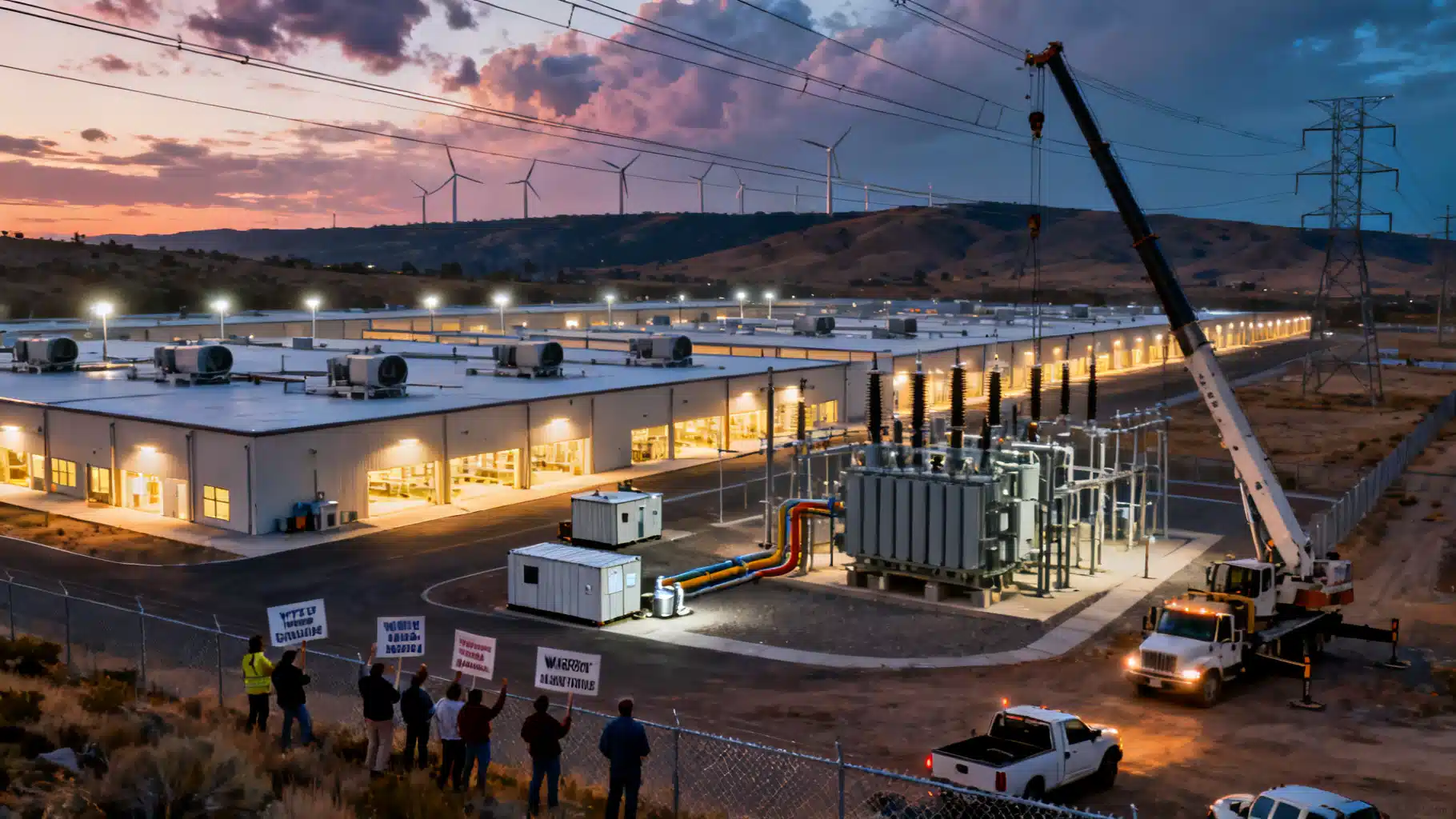
Image used for representation purposes only.
The AI supercycle runs into a power wall
AI has turned data centers from background infrastructure into front‑page news. In 2026, utilities, regulators, and communities are grappling with record electricity demand from “AI factories,” while developers face long lead times for critical grid equipment and growing local pushback. PJM, the largest U.S. grid operator, is pursuing an emergency plan to procure 15 GW of new supply, underscoring how fast demand is outpacing capacity. (bloomberg.com )
Power is now the market
- PJM’s recent long‑term forecast ties much of its multi‑decade load growth to data centers, even as near‑term projections were modestly trimmed following stricter vetting of projects. The structural trend remains higher. (modoenergy.com )
- A new industry analysis frames power availability as the defining constraint on AI campuses, pushing gigawatt‑scale designs, on‑site generation, and a shift toward emerging markets with faster interconnections. (datacenterfrontier.com )
- Reporting points to widespread delays: a Sightline Climate report summarized by Semafor warned that 30–50% of 2026 data‑center projects could slip due to power constraints and grid‑equipment shortages; developers are increasingly exploring their own power solutions. (semafor.com )
- PJM leadership has been blunt about the stakes, with public commentary describing today’s situation as “not tenable” if planning and policy don’t adapt to the new, continuous load shape of AI. (techcrunch.com )
The supply squeeze: Transformers, switchgear, and time
The buildout is colliding with a procurement crunch. Analysts and trade outlets report multiyear lead times for high‑power transformers and extended waits for medium‑voltage switchgear, delaying energization even when shells are complete. BloombergNEF and industry trackers note that transformer lead times have more than doubled since 2019, with U.S. prices sharply higher. (pv-magazine-usa.com )
Community pushback and policy flashpoints
- Statehouse spotlight: Maine’s legislature passed what would have been the country’s first statewide moratorium on large new data centers in mid‑April 2026—but Governor Janet Mills vetoed the bill on April 24, and the veto was later sustained. (washingtonpost.com )
- Local pauses proliferate: Durham, North Carolina, enacted a two‑year moratorium on data‑center approvals on May 4, 2026; Charlotte is debating a freeze as Duke Energy tracks 7.6 GW of data‑center load in its pipeline. (cityordinances.durhamnc.gov )
- Water as a veto point: The Ypsilanti Community Utilities Authority in Michigan approved a 12‑month moratorium on providing water and sewer services to data centers on April 22, 2026, citing capacity and environmental reviews. (wemu.org )
Heat, water, and the sustainability pivot
- Europe is codifying transparency: Under the EU Energy Efficiency Directive and a 2024 delegated regulation, data centers ≥500 kW must report energy and water metrics into an EU database, with the first submissions beginning in 2024 and annual updates each spring. (eur-lex.europa.eu )
- Heat reuse at scale: In Finland, energy utility Fortum has started up large heat‑pump plants tied to Microsoft’s new Helsinki‑region data centers. Once fully implemented, recovered waste heat is expected to cover roughly 40% of local district‑heating demand for ~250,000 users. (datacenterdynamics.com )
- Southwestern water stress: Cities in Arizona—one of the nation’s hottest data‑center markets—are seeing rising community resistance and even water service restrictions to proposed sites amid Colorado River shortages. (axios.com )
Density, thermals, and the liquid‑cooling turn
NVIDIA’s rack‑scale GB200/GB300 NVL72 systems, already in cloud production, crystallize the new thermal reality: tightly coupled 72‑GPU domains designed from the ground up for liquid cooling. Operators are re‑architecting facilities around high‑density blocks and new scheduling models to keep these racks fully utilized. (blogs.nvidia.com )
Industry surveys show average rack densities rising rapidly, with GPU‑dense AI racks commonly surpassing 25–30 kW and reference architectures targeting 100 kW‑class liquid‑cooled racks. Even so, the Uptime Institute cautions that direct‑to‑chip liquid cooling will remain concentrated in high‑density niches rather than overtaking all workloads. (datacenterfrontier.com )
Nuclear and “behind‑the‑meter” power re‑enter the chat
Facing interconnection queues and public backlash over grid costs, developers are testing alternative power paths:
- Google, TVA, and Kairos Power announced an advanced‑nuclear PPA tying a 50 MW Hermes 2 reactor to Google’s data centers in Tennessee and Alabama, with first power targeted around the end of the decade. (datacenterdynamics.com )
- Meta signed a 20‑year agreement with Constellation for 1,121 MW of nuclear generation from the Clinton plant in Illinois, part of a broader push by hyperscalers to secure firm, carbon‑free baseload. (investors.constellationenergy.com )
- Within PJM, proposals are moving to clarify how very large “behind‑the‑meter” resources at data‑center campuses should be planned and accounted for—evidence that on‑site or adjacent generation is entering mainstream conversation. (datacenterfrontier.com )
Follow the money: Capex breaks records
Hyperscalers are spending at unprecedented levels to secure land, power, chips, and cooling. Meta raised its 2026 capital‑expenditure guidance to $125–$145 billion on April 29, citing higher component pricing and additional data‑center costs. Amazon, Alphabet, and Microsoft also signaled heavy AI‑infrastructure investment alongside strong cloud demand, with AWS disclosing a >$15 billion AI revenue run rate. (fortune.com )
What to watch next
- Transmission and interconnection reform: PJM’s emergency procurement and evolving rules for flexible, non‑firm connections could shape how fast capacity becomes available—and who pays. (bloomberg.com )
- Equipment bottlenecks: Whether transformer and switchgear lead times shorten will determine if “time‑to‑power” remains the gating factor more than land or capital. (pv-magazine-usa.com )
- Cooling standardization: Expect more liquid‑cooling deployments around defined rack blocks (for example, NVL72‑scale domains) and hybrid liquid/air halls, with operators selectively applying immersion where densities justify the operational complexity. (docs.nvidia.com )
- Policy ripple effects: EU data‑center reporting rules will inform city and state debates in the U.S., where local moratoriums and water‑use scrutiny are already steering site selection. (eur-lex.europa.eu )
Bottom line: In 2026, speed‑to‑power—not just speed‑to‑compute—decides winners. The developers that can secure firm, low‑carbon megawatts; digest liquid‑cooling at 100 kW‑plus per rack; and navigate a fast‑shifting policy map will define the AI era’s physical footprint. (datacenterfrontier.com )
Related Posts
Meta’s 2026 playbook: AI megadeal with AMD, a mobile‑first metaverse, and a race for power
Meta’s 2026 pivot: a $60B+ AMD chip pact, mobile-first Horizon Worlds, nuclear power deals, record AI capex, and Threads’ surge past X on mobile.
NBIS Alert: Nebius Snags $2B From NVIDIA and Wins Approval for a 1.2 GW AI Factory in Missouri
NVIDIA invests $2B in Nebius (NBIS) as Independence, Missouri approves a 1.2 GW “AI factory,” signaling a rapid buildout of hyperscale AI compute.
Corning (GLW) soars after Nvidia deal: Inside the AI fiber supercycle and what comes next
Corning (GLW) jumps on a new Nvidia partnership and strong Q1. Here’s what drove the move, the numbers, risks, and what to watch next.