
Googlebook debuts: Google’s AI-first laptop platform lands this fall
Google unveils Googlebook, an AI-first laptop platform built around Gemini with Magic Pointer, phone app casting, and a glowbar, launching fall 2026.
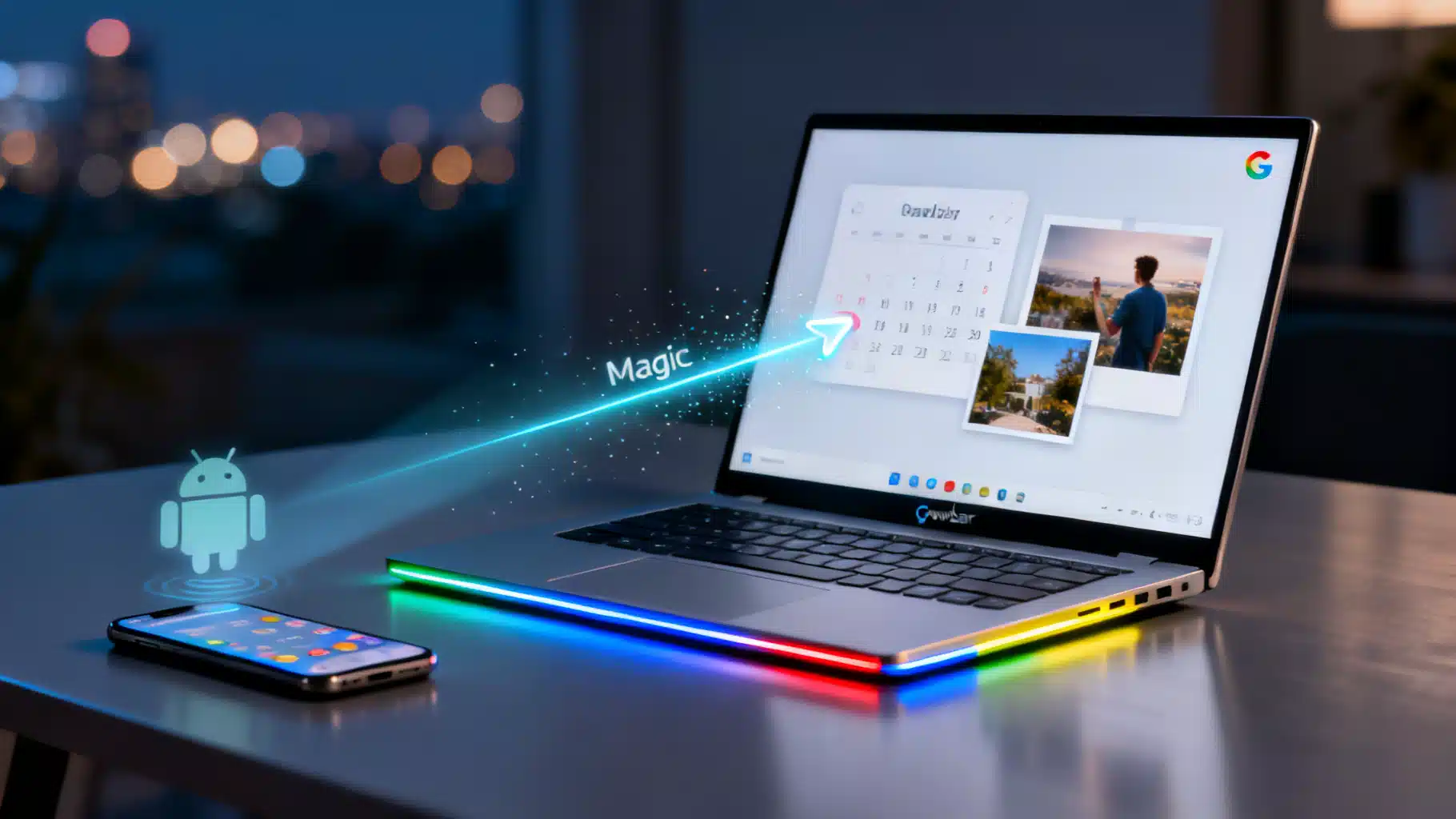
Image used for representation purposes only.
Googlebook arrives: Google’s AI-first laptop platform, unveiled May 12, 2026
Google has taken the wraps off Googlebook, a new premium laptop platform designed “for Gemini Intelligence” and tightly integrated with Android. Announced at The Android Show on May 12, 2026, Googlebook marks Google’s most significant rethink of the laptop since the debut of Chromebooks—this time centering the experience on on-device and cloud Gemini features. The first models are slated to ship in fall 2026. (techcrunch.com )
What is Googlebook?
Googlebook is a category of laptops built around Gemini, Google’s family of AI models, with the goal of delivering personal, proactive assistance throughout the system. Rather than layering AI onto an existing desktop, Googlebook’s core interactions—searching, selecting, composing—are designed to flow through Gemini. In Google’s words, it’s a move “from an operating system to an intelligence system.” (blog.google )
Key features highlighted at launch include:
- Magic Pointer: a context-aware cursor that “comes alive” when you wiggle it, surfacing actions based on what’s on screen. Point at a date to schedule; select two images to visualize them together; or ask, compare, and create directly from what you’ve highlighted. Built in collaboration with Google DeepMind. (blog.google )
- Create My Widget: generate custom, live desktop widgets by prompting Gemini—such as a travel tracker that pulls flight, lodging, and reservation details from the web and Google apps like Gmail and Calendar. (blog.google )
- Deep phone integration: open apps from your Android phone on the laptop without installing them, and browse or insert your phone’s files via Quick Access in the Googlebook file browser. Google labels the app handoff “Cast my apps.” (googlebook.google )
Hardware, design, and who’s building them
At launch, Google is partnering with Acer, ASUS, Dell, HP, and Lenovo to produce Googlebooks across multiple form factors. Every device will feature premium materials and a distinctive “glowbar” accent—both an aesthetic signature and a functional status element—making the machines visually identifiable as Googlebooks. (blog.google )
Google has not yet disclosed full hardware specifications, but the company told WIRED the platform supports both ARM and x86 architectures, signaling a wide range of potential chip choices depending on OEMs and price tiers. Expect slim, “featherweight” designs and a dedicated Google/Gemini key in some layouts, with more details to follow later in the year. (wired.com )
Built on Android tech, borrowing Chrome’s strengths
Under the hood, Googlebook is built on the Android tech stack while bringing over key elements from ChromeOS—most notably the Chrome browser and a desktop-optimized shell—so new features developed for Android and Gemini can land on laptops faster. Google emphasized that Googlebook is a distinct platform, not simply Android’s desktop mode. Developers are being encouraged to deliver adaptive, desktop-grade Android apps for larger screens, with Google positioning these as first-class citizens of the system. (blog.google )
Multiple outlets report the OS effort has used “Aluminium/Aluminum OS” as an internal codename, though Google has not officially named the operating system and describes Googlebook primarily as a laptop platform built on Android technologies. This is consistent with Google’s “intelligence system” framing. (wired.com )
Phone apps and files on your laptop, instantly
Two integrations stand out for day‑to‑day use:
- Cast my apps lets you run your Android phone’s apps on your Googlebook’s display without installing desktop versions—useful for tasks like finishing a Duolingo lesson or ordering food without breaking focus. (9to5google.com )
- Quick Access exposes your phone’s files directly inside the Googlebook Files app so you can view, search, and insert as if they were local. On Google’s official site, these capabilities are framed as “Perfect partner to your Android phone,” with footnotes indicating setup is required and phone casting requires Android 17 or later. (googlebook.google )
Where this leaves Chromebooks
Google is not sunsetting Chromebooks. The company says existing Chromebooks will continue to receive software support according to each device’s update commitment—up to 10 years for some newer models—and that many Chromebooks may be eligible to transition to the new Googlebook experience, with specifics coming before launch. Still, the tenor of the announcement positions Googlebook as the forward‑looking successor for consumer laptops in Google’s ecosystem. (techcrunch.com )
Competitive context: the AI PC race heats up
Googlebook arrives amid a new wave of “AI PCs,” as Microsoft and partners have pushed Copilot+ PCs since 2024 and Apple has leaned into on‑device AI across the Mac and iPhone. Coverage notes the timing and messaging as a direct answer to Microsoft’s strategy, while some speculate Googlebooks will compete with Apple’s lower‑cost MacBook Neo on design, performance per watt, and price—though Google has not shared pricing. (techcrunch.com )
What we still don’t know
- Pricing and exact configurations. Google has called the line “premium,” but has shared no price bands yet. (blog.google )
- The full capabilities of the glowbar. Google calls it functional, but details remain scarce. (9to5google.com )
- Offline behavior and network edge cases for phone‑app casting and file access. Demonstrations focused on seamless handoff, but not on offline scenarios. This remains to be clarified. (pcworld.com )
- Which Chromebooks, if any, can transition to Googlebook and how that migration will work. Google says “many” may be eligible and promises more information before availability. (9to5google.com )
Why this matters
For users embedded in Google’s ecosystem, Googlebook could close long‑standing gaps between phone and laptop workflows: you can cast mobile apps without awkward emulation, keep files in sync without manual transfers, and ask Gemini to act directly on what’s on screen via Magic Pointer. If developers embrace adaptive, desktop‑grade Android apps, Googlebook could also expand the software universe available on a lightweight, secure, and frequently updated platform—while giving Google a premium laptop foothold it never fully attained with Chromebooks. (blog.google )
Timeline and availability
- Announcement: May 12, 2026, at The Android Show (I/O Edition). (9to5google.com )
- First models ship: Fall 2026. Users can register for updates via Google’s official Googlebook microsite. OEMs at launch include Acer, ASUS, Dell, HP, and Lenovo. (googlebook.google )
Quick takeaways
- Googlebook is a premium, AI‑native laptop platform anchored by Gemini, debuting this fall. (blog.google )
- Magic Pointer, Create My Widget, Cast my apps, and Quick Access headline a new, context‑aware workflow that ties laptop and phone together. (blog.google )
- ChromeOS isn’t dead, but Googlebook signals Google’s consumer‑laptop future—and its answer to the AI PC push from Windows and Apple. (techcrunch.com )
As Google shares more ahead of fall 2026, we’ll update this story with hardware specifics, pricing, and first hands‑on impressions.
Related Posts
Google’s April 2026: Gemini alliances, tougher rules, a search reset, and I/O on deck
Google’s April 2026: Apple’s Gemini deal, U.S. antitrust remedies, EU DMA pressure, a fresh core update, Android 17 betas, Chrome DBSC, and a $20B bond tap.
Walmart’s new Onn 4K Streaming Stick surfaces ahead of launch: price, specs, and what to expect
Walmart’s Onn 4K Streaming Stick is surfacing in stores and online ahead of launch, with 4K Google TV, Gemini voice, and a likely sub-$30 price.
Sundar Pichai’s AI Bet: Apple’s Siri Tie‑Up, Record 2026 CapEx, and Gemini Everywhere
Sundar Pichai’s AI era: Apple’s Siri deal, record 2026 CapEx, and Gemini’s rapid expansion—plus the regulatory tests that could shape Google’s future.